
Home Blog Page 40

It’s Very Possible To Be Both Happy And Well-Informed

CAITLIN JOHNSTONE

FEB 21

Reading by Tim Foley:

There’s a viral tweet going around that says it’s “hard to find the balance between educating yourself on current events and not making yourself so indescribably sad that you can’t properly function.”

It’s a relatable statement, but it’s based on an incorrect understanding.

The key isn’t finding a balance between blissful ignorance and painful awareness, it’s learning to find happiness in sources that don’t depend on the delusional belief that everything is fine.

It’s very possible to be both happy and well-informed. We live in an explosively beautiful universe, and getting to experience anything at all is amazing. The fact that our world is plagued by human butchery and degradation does not cancel out the majesty of a bird in the sky, or the ecstasy of the wind upon your skin.

It is true that we live in a civilization of unfathomable cruelty. It is true that our biosphere is being strangled while human and non-human beings are subjected to horrific abuses in a society which elevates the worst art, the worst values, and the worst people to the highest levels of prominence.

It is also true that getting to live even a single moment on this astonishing blue planet is a gift worthy of immense joy and gratitude.

These things are both fully true at the same time. They do not negate each other.

Don’t find your happiness in the belief that everything is okay, because everything is not okay. If you spend your life squirming around trying to avert your gaze from the truth and psychologically compartmentalizing away from reality, you will never know actual happiness.

Instead, find your happiness in that which cannot be corrupted by this fraudulent dystopia.

Your connections with your loved ones. That’s real and authentic.

The radiance of the natural world. That’s real and authentic.

The crackling aliveness of the senses. That’s real and authentic.

The boundless peace deep down at the heart of your being which reveals itself if you listen closely enough. That’s real and authentic.

These things can supply endless happiness, even as the world burns, and even as you weep at its burning. Because it is entirely possible to honor the grief and tragedy of this world while also delighting in its beauty.

You can weep for the dying oceans while marveling at the stars.

You can rage for Gaza while reveling in the earth beneath your bare feet.

You can open your heart to all the suffering and to all the wonder.

You can fall to your knees in both anguish and gratitude.

You can do these things because feelings move through you if you don’t cling to them. You feel them fully without resistance, you invite them in to have their say, and then you let them leave when they are done.

It usually doesn’t take long; a few minutes, maybe even seconds. Then you get up and go back to marveling at the miracle.

Feelings are meant to be felt. If you simply feel them all the way through when they come up instead of repressing them or trying to manage them, they move through fairly quickly without setting up a permanent residence in your chest.

But you’ve got to really let them have their say. You’ve got to give yourself fully over to them. This takes practice if you don’t know how to do it, and because of the way our culture conditions people it tends to be harder for men than for women. But it’s a skill like any other, and anyone can teach themselves how to do it.

Appreciating the beauty of this terrestrial experience likewise takes practice. Everything is crackling with beauty all the time, but we don’t notice it because our attention gets wrapped up in mental stories. Just make a conscious practice of noticing beauty at every opportunity, and your aperture for appreciating beauty will get wider and wider. You can learn to live your whole life in this way, from moment to moment.

If you can get the hang of these two skills — appreciating beauty and feeling your feelings all the way through — then there will be nothing stopping you from living a joyful and fulfilling life while also having an entirely truth-based relationship with reality.

_______________

Caitlin’s Newsletter is a reader-supported publication. To receive new posts and support my work, consider becoming a free or paid subscriber.

The best way to make sure you see everything I write is to get on my free mailing list. My work is entirely reader-supported, so if you enjoyed this piece here are some options where you can toss some money into my tip jar if you want to. Click here for links for my social media, books, merch, and audio/video versions of each article. All my work is free to bootleg and use in any way, shape or form; republish it, translate it, use it on merchandise; whatever you want. All works co-authored with my husband Tim Foley.

Bitcoin donations: 1Ac7PCQXoQoLA9Sh8fhAgiU3PHA2EX5Zm2

Feature image via Adobe Stock.

.
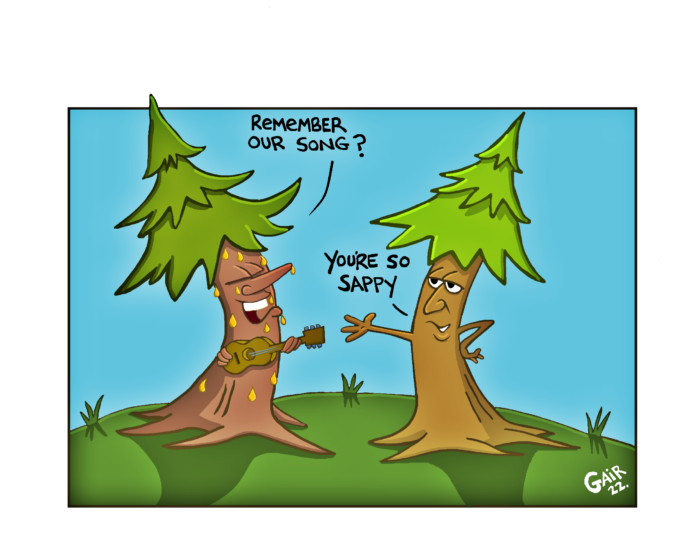
sappy effect

#1723

Denman ART Studio Tour gears up for 2026 edition

Denman ART Studio Tour gears up for 2026 edition

The Denman Island arts community is already buzzing with anticipation as preparations begin for the 2026 Denman ART Studio Tour, scheduled for August 15–16. Organizers are calling on local artists to take part in what has become one of the island’s most cherished cultural events. The annual tour offers artists a chance to open their studios, share their creative process, and connect directly with visitors. For many, it’s also a valuable opportunity to increase visibility and boost art sales during the busy summer season.

An information meeting for interested participants will be held on April 9 at 6 pm at Ourglass Studio, located at 2777 Lacon Road. Attendees are asked to park along the road due to limited on‑site parking.

Registration for the tour is open now and will close on April 30. Organizers encourage both emerging and established artists to get involved, noting that the event thrives on the diversity of creative voices found across the island.

Registration fee is as follow:

  • 1 studio/1 artist = $100
  • 1 studio/2 artists = $120
  • 1 studio/3 artists or more = $150

If you don’t have a studio space and would like to participate, please reach out to

denmanartstudiotour@gmail.com

Any questions? Please don’t hesitate to reach out by email.

A Fist Full of Water… For A Few Dollars More.

A Fist Full of Water…

For A Few Dollars More.

Happy belated 2026 All! 

Many thanks to those taxpayers, home owners, residents (both in and outside of the Graham Lake subdivision) who remain interested, concerned and offer questions and solutions.

The year has again started off with CVRD impaired Fire Hydrant protection, compromised Drinking Water and escalating costs as the subdivision is now into eight years of unecessary water system non-compliance and uncertainty. All avoidable. 

CVRD CEO James Warren and our CVRD elected Representative Daniel Arbour have yet to honestly answer, inform or dialogue. Daniel’s last communique back in July 2025 was “awaiting the next report from staff…to put to residents”. Was there a first time report?

What will this “report” even mean when simple answers are impossible to obtain?

Some continue to reach out, along with new residents to the Graham Lake subdivision, with outstanding questions and concerns to table. Stay informed and engaged. 

Here they are with my comments in italics : 

 Why did CVRD allow the decision of an unelected manager (a position outside of the improvement district charter) to initiate and sign off to convert our water improvement district without any referendum or electoral ascent? Good question. 

 What happened to the promise by the manager of “partnering” with the CVRD to lower water fees and get a free water upgrade? So far no steering committee, only escalating fees and no “all free today” upgrade.

 What was the Operator’s role in safe guarding against the current pitfalls subdivision residents have and will continue to face? Fair question. 

 With constant Boil Water advisories; Why am I paying for bottled water and or water filters ontop of the exorbitant water fees? A good question for Daniel who continues to expedite and approve price increases on CVRD’s behalf. 

 I’m a retired senior on a fixed income. Daniel? 

 What happened to our $250,000 capital fund? Audit? 

 Why spend money on new crappy looking Boil Notice signage? What was wrong with modifying the existing signs which were highly visible? Indeed but water fee increases must be justified. 

 Are the edge water septic fields (that surround Graham Lake) leeching into the water? Island Health? Islands Trust? CVRD? 

 Who authorized the removal of the Emergency By-Pass from the pumphouse? This needs to be investigated by an engineering review board. 

 What can be done about the many cigarette butts constantly found in and around the woods of Graham Lake (especially during summer months)? “No Smoking” signage? Fire safe outdoor ashtray stations? CVRD? 

 How can homeowners and others in the subdivision use Fire Smart equipment (like the wasp sprinkler) to protect property if the Fire Hydrants can’t supply water? Another good question for CVRD. 

Again, thank you for your questions and concerns for this Grapevine instalment. Stay informed and engaged. 

Cost effective solutions remain available as are historically successful project standards, procedures and protocols. 

Fear, apathy and the belief the subdivision was going to get a “free money” water upgrade has cost the residents dearly in so many ways. Nothing is “free”. 

I’ve been told “residents will get what they deserve”. That “patience” is an acceptable synonym for CVRD incompetence and obfuscation. I do not hold such nihilistic views. A positive course correction is still available. 

Last summer Little Qualicum and surrounding area was evacuated due to interface fires. The participating Fire Departments and volunteers did an amazing job to save life and property. Fires in Lytton to Lahaina to LA have demonstrated fire insurance is ineffective, if not somewhat redundant. Property structures now more than ever require protection and saving. For those that wish to understand why, watching Adam Carolla vlogs on the Palisade and Malibu fires, will highlight subdivision aftermath challenges. 

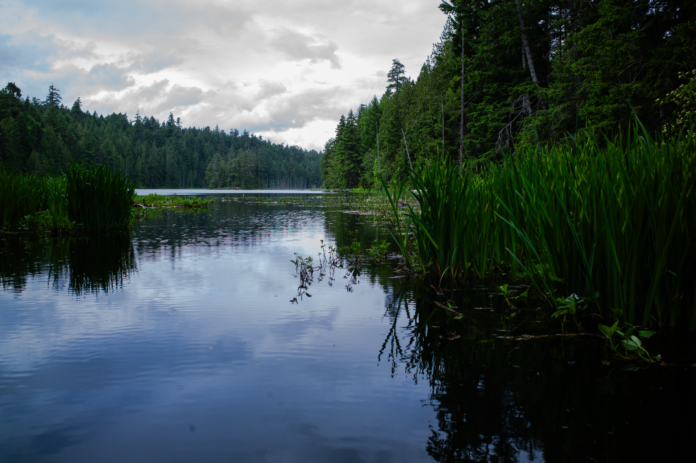
Prevention and suppression are everything for the subdivision, making insurance claims only signals failure. Besides; What kind of person wouldn’t want to unlock existing engineered fire suppression access to a 63,000,000 gallon water source (Graham Lake) for a neighbourhood on an island that is short on water? 

2026 can be a positive year! 

Till the next one

Shucking Oysters: Recreational Bitterness

Shucking Oysters: Recreational Bitterness

By Alex Allen

Carie McGregor Warning: The following content is “so opinionated and sooo intelligent and so hypocritical and so damned boring” please turn page. 

One of the many challenges we are facing more and more is what has been described as the rising “culture of contempt.” A culture where truth is distorted for the purposes of solely winning an argument or discrediting those with whom we disagree. Not only have we stopped listening to each other, we seem to feel perfectly justified to speak in disdainful, hate-filled ways. Even emails can be toxic. Yes it’s true, we’ve become ruder. And to be clear, we all have work to do. 

Canadian journalist Carl Honoré wrote that there is “the chronic frustration that bubbles just below the surface of modern life. Anyone or anything that steps in our way, that slows us down, that stops us from getting exactly what we want when we want it, becomes the enemy. So the smallest setback, the slightest delay, the merest whiff of slowness, can now provoke vein-popping fury in otherwise ordinary people.” Road rage, air rage, shopping rage, ferry rage, vacation rage, political rage, social media rage. We live in an age of rage. 

US public policy analyst Arthur C. Clark notes that it is online that we are seeing this “noxious brew of anger and disgust.” And not just contempt for other people’s ideas, but for other people. There are many sources of this outrage bias: divisive politicians, screaming internet bobble heads, hateful bloggers, angry activists and seemingly “everything on the contempt machines of social media.” What we need is not to disagree less, but to disagree better. Contempt makes landing on the same page virtually impossible, it is “either petty self-indulgence or cheap virtue signalling, neither of which wins converts.” Blocking, unfriending, or unfollowing online have become as natural as liking, nudging or sharing. 

Vancouver-based etiquette expert and consultant Ann Elizabeth Burnett sees bad manners as a result of the ubiquitous “smart” phone. “There seems to be an overwhelming preoccupation, if not infatuation, with online information.” The more we engage in online spaces the less frequently we hang with real people in our lives. Burnett points to another cause of the downfall of politeness: a lack of accountability, particularly online, where there are no consequences for being rude, let alone mean behind the screen. 

Do you remember the world before “smart” phones? Oh, it was a cold and unforgiving existence. People had to wait in grocery lines for minutes without distraction. At restaurants you had to hold a conversation and even look up at the person across the table. Ignoring friends and relatives required ingenuity. Today, like people wearing medical masks, people staring incessantly at their hand screens has become normalized.

There’s nothing wrong with posting selfies and pictures of meals you created, or sharing your happiness online. It’s when we crawl out of our caves and join in a random mob attack that is not right.  Why do we thrive off of mob mentality? It’s about belonging apparently. If the majority of people are choosing to hate-on the same person, one is bound to feel inclined to do the same in fear of being judged or ostracized. It’s not nice, but it is human. 

When social platforms become a “consensus chant” of “get her” we see the worst examples of mob-like hysteria with no constraints or safeguards. A 2016 study found that “catching rudeness is like catching a cold” –  when we witness impoliteness, we are more likely to behave that way ourselves. We enjoy being morally outraged. “Recreational bitterness” directed often at someone who is guilty until maybe never proven innocent, makes us feel righteous. Social media has changed the public shaming environment, where it is easier than ever for shaming to spin out of control and be cruel and nasty. 

Imagine being on the wrong side. The damage, deserved or not, is real and very lasting. Max Fisher wrote that our brains “process social ostracism as, quite literally, pain.” Being shunned hurts. On social media one person can with little warning, face the fury and condemnation of thousands. This “moral grandstanding” is everywhere and social platforms are rich with sources of moral outrage. The very structure of social media encourages this polarization. 

Rudeness touches us all – whether through social media, public discourse, or even in conversations with friends and colleagues. Local government and community meetings that once featured heated but respectful debate are increasingly marked by shouting, personal attacks, and harassment. In a 2025 Canadian Municipal Barometer survey of elected officials, 63% of respondents said they had experienced some form of harassment during their term or campaign. The numbers also indicate that rising incivility is driving good candidates away from running for office and pushing those who are out.

As ethics lawyer Gregg Levine asked: “Why share ideas when venom, vitriol and vituperation are so easy and straightforward? Why show kindness when cruelty is venerated?” Rudeness has gotten people famous and wealthy. We see how those who lie, insult, and behave vilely are seen as authentic, “that somehow being crude elevates one’s stature as a plain-spoken person.” Trump and Polievre are such examples of authenticity in politics. They tell it like it is. Both share a contempt for journalists, one more vulgar than the other. Trump’s perceived authenticity allows him to push beyond norms and be gleefully divisive. What does it say about a president (and his administration) when the standard response to those who disagree is that they must be a loser, a moron, or deranged? 

Civility is not about niceness. It’s about trust and good behaviour. It’s about disagreeing without being disagreeable. It’s about listening not rolling your eyes. As someone said, civility isn’t an accessory to be bolted on when convenient. It’s about empathy not judgment. This is not some new age world order, though it may be to some. Shaming, blaming, and self-righteousness can be extremely satisfying in the short term but quite ugly in the long. Sure, there is plenty to be outraged about, but when it is self-serving and nasty it becomes divisive and wrong. So ponder that, raging grasshoppers.

The Street Beneath the Water

Gabriel Jeroschewitz, December 22nd, 2025, The story I heard. As the water was leaving through the drain of my bath. 

The Street Beneath the Water

I have always liked the end of a bath.
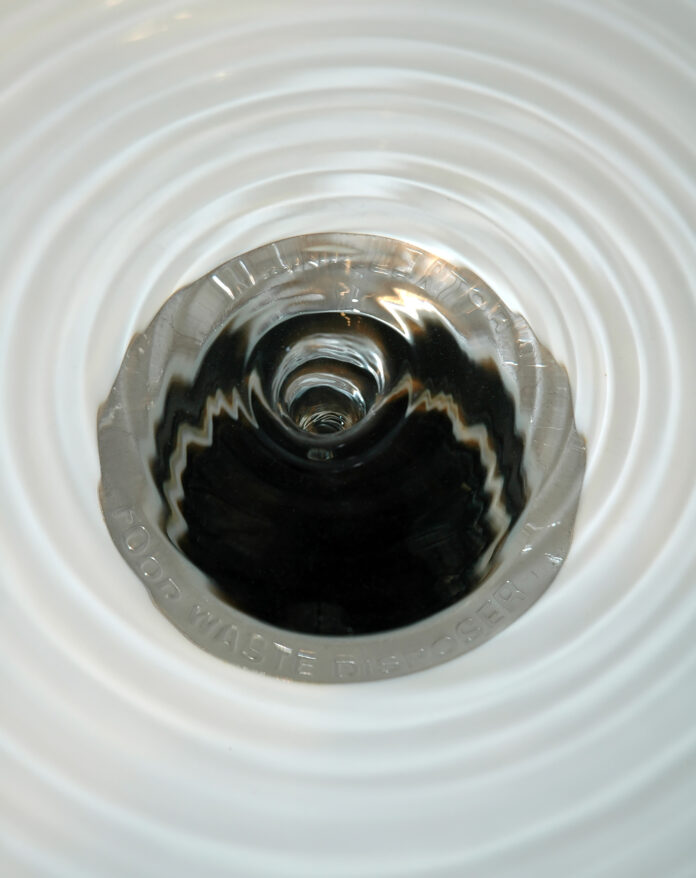
The moment when the water, warm and heavy with the day’s residue, begins to slip away, spiralling toward the drain with a sound that is not quite a whisper and not quite a sigh. I stand there now, naked under the bright glare of the bathroom light, a towel bunched in my hands. Outside my window, the night hovers like a patient predator, but in here it is almost surgical — white, clean, unforgiving.

My spine aches with its usual insistence, a dull, grinding pressure that feels like it’s pushing me through the floor. The MS makes my balance uncertain; I steady myself against the porcelain edge. The water makes its slow descent, and that is when I hear her again.

Not a voice exactly — not in the way you’d hear someone across a room — but a murmuring that threads itself between the tiny gurgles as the last of the bath drains away. I learned the language when I was nine, though at the time I thought it was only my imagination. My mother blamed fevers and poor sleep. But the cadence of those drained voices has never left me. They speak in a rhythm like breathing through silk.

Tonight, she tells me about a street in Poland, a place that exists between memory and dream, inviting me to explore its layered meanings.
A street where the crocodiles live.

Her words — or what I receive as words — are translucent. They glint with half-meanings and symbols I can almost touch. She describes tall, dark salesgirls with nearly beautiful faces, but each with a flaw: a scar too visible, a mouth too small, an eye that will not meet yours. They drift in and out of doorways as if pulled by invisible tides. I can see them in my mind, lingering just at the threshold, watching the salesman with the powdered cheeks and receding chin. He is delicate, almost birdlike, simpering and prancing with an exaggerated care, his gestures too deliberate, his smile too fixed.

He points to the fabric he is selling — the drain’s voice insists this is important — a swatch with a trademark, something so obvious in its symbolism that it shouldn’t need explanation. Yet in this street, everything needs explanation, and nothing receives it. Customers finger the goods tentatively, as if aware they are remaindered not just in price but in spirit. It is a world of slightly spoiled beauty, the kind that makes you ache but never reasonably believe.

The woman’s tone shifts, becoming more brittle. She tells me the street is gray — not the gray of clouds or stone, but the fragile gray of a fading photograph, flat and easily torn. The houses, the cars, even the people feel like fragile cut-outs, their reality thin and breakable.

And I see it.
The crocodiles, I realize, are not mere animals but symbols of the unseen forces that move beneath this world, relentless and silent.

The drain gurgles louder, and the vision wavers. I am here in my bathroom again, the towel now around my waist, my skin cooling in the bright air. But the gray street remains behind my eyes, like an afterimage that refuses to fade.

I wonder if the crocodiles know me.

I sit on the closed toilet lid for a moment, letting the towel rest loosely over my lap. My legs are heavy tonight, the stiffness creeping upward from my feet. I can feel the familiar electric hum in my spine, the one that tells me the stenosis is pressing harder than usual. Sometimes — and tonight is one of those times — I fear that my illnesses are not merely physical but are the very doorways through which these visions walk.

The drain had told me this once, years ago, in a language so faint I barely caught it: We speak to those who are already half in our world. I didn’t understand at the time. Now I think I do.

She — the woman from the drain — begins again.
Her voice is softer now, as if the water that carried it has thinned. She tells me about the salesman, how his powdered cheek is a mask, and how the black water behind every store is a liminal space where crocodiles swim, bridging worlds beyond perception.

I ask her — though I never hear my own questions aloud — why she tells me these things. She replies, Because you listen.

I close my eyes. The light in the bathroom is harsh against my lids, creating a red glare. The street in Poland blooms again in my mind’s eye. This time, I notice the pavement is damp, glistening as though washed clean, but still faintly smelling of rot. The salesgirls stand in their doorways, not watching customers but watching me. Their flaws are more pronounced now: one has a jaw that hinges too far open when she smiles; another’s left hand is missing two fingers. They are not grotesque — just wrong in ways that unsettle.

The salesman sees me too. He lifts his receding chin, his eyes catching mine with a deliberate pause. Then he points — once again — to the trademark on the fabric. I want to tell him I understand, but I don’t. Not yet.

The sound shifts — the drain is almost done. A final swirl of water pulls the voice away, leaving me alone in the bright bathroom. My skin prickles; I feel hollow, as if the water has drained something from me alongside its warmth. I stand, slowly, and step into the hallway. The rest of the apartment is dim, the night pressing at the windows.

I think about the street where crocodiles live.
I think about the salesgirls with their imperfect beauty, the powdered-cheek salesman, the crumbling façades that hide hollow theatres. I think about how reality is as thin as paper and how easily paper tears.

And I think about the eyes Bolaño once wrote of — eyes opening and closing endlessly in a darkness that is not total but enough to make you doubt your sight. I have seen those eyes. Perhaps they have seen me for years. Maybe they are watching still.

Later, in bed, I feel my body stiffen into its nightly arrangement, muscles locking into the familiar war with gravity. The heating pipes murmur faintly. Somewhere in the walls, water moves — not draining now, but travelling. I imagine it carrying whispers from other bathrooms, other drains, other listeners like me.

I wonder if the crocodiles are in my city too, masked behind different façades, selling various goods, but always there beneath the stage. I wonder if one day I will walk into that Polish street entirely, without the tether of my bathroom light to pull me back.

And I wonder, perhaps most of all, whether that will feel like escape… or arrival.

The End of History  

The End of History  by Cylon2036. we/us

For most of history, human limits acted as a kind of moral speed bump. We could imagine horrors faster than we could efficiently implement them. New computational power removes that inconvenience. It doesn’t invent cruelty, domination, or stupidity, it industrializes them. What was once a bad idea scribbled on a napkin can now be simulated, optimized, deployed, and scaled globally before anyone has time to ask whether it should exist at all. Maximized computational power, computers, robots and drones are going to destroy human civilization if they remain unregulated.

Computational power doesn’t simply accelerate problem-solving; it accelerates incentives. Systems that reward speed, profit, surveillance, and prediction become terrifyingly effective when paired with machines that never sleep and never doubt. Politics becomes an optimization problem for attention extraction. Culture becomes pattern recognition fed back into itself until originality collapses into statistically probable nostalgia. Truth, already fragile, is outcompeted by whatever narrative performs best under algorithmic selection. The future isn’t run by tyrants so much as by dashboards.

Worse, computation erodes responsibility. When decisions are mediated by models, blame becomes diffuse and ethics becomes technical debt. Harm is no longer committed by people but by “systems,” and  “emergent behavior,” or “unexpected outputs.” Violence wears the friendly face of efficiency. The destruction of livelihoods, ecosystems, and meaning is presented not as a choice but as an inevitability because the model says so. Human history doesn’t end with a bang, but with a progress update.

In the end, computational power doesn’t destroy humanity because machines become conscious or evil. It destroys us because we outsource judgment faster than we cultivate wisdom. We gain (godlike) tools without developing anything like moral or ethical restraint. The final irony is that the machines will work perfectly, faithfully executing objectives we were too short-sighted, fragmented, and incurious to question. And when everything finally breaks, we’ll marvel at the graphs, wondering how such a well optimized system could possibly have gone so wrong.

Woowoo Healing: The Morning Cleanse

Woowoo Healing: The Morning Cleanse

By Jean Gordy

Hello again folks.  Thanks for hanging in there with me as I relay to you in some kind of order information I feel will help you to make sense of the Anthony William Medical Medium material.  He’s prolific and it can be overwhelming about where to jump in.  I have been doing the morning cleanse for almost 6 years, and when I start to feel ‘not well’ I jump back on the morning cleanse protocol and immediately start to feel better again.  Waking up and feeling good each day is my motivation for sticking as closely as I can to the morning cleanse protocol.  Below I have posted information directly from one of his books.  

When we bombard our liver with the wrong food and liquid choices every morning, we unknowingly take away our liver’s critical morning routine of ridding toxins. We compromise the very essence of our health and well-being. The consequences are far more serious than missing morning meditation or tooth brushing or exercise or phone time—or avoidance of your phone, if that’s part of your routine. Our liver, other organs, lymphatic system, and bloodstream cannot cleanse or detox the troublemakers they’re trying to discard when we don’t let them.”

It’s these troublemakers (specifically pathogens and toxins) your body is trying to remove in the morning that are the cause of chronic illness, symptoms, and conditions. These pathogens and toxins are stored in your liver and elsewhere in the body too. Even if you have been given a diagnosis such as Hashimoto’s thyroiditis and told it’s an autoimmune condition and your body is attacking itself, the truth is that it’s still pathogens and toxins that are responsible for your symptoms and conditions. Your body never attacks itself. You can read about this truth in my book Cleanse to Heal.

As a result of radical fats in our morning food and drinks, our liver overworks itself, creating an overload of bile to break down those fats. If we ate a dinner that was high in fat the night before, our liver was already struggling to process it while we were sleeping. That’s on top of our liver working hard overnight to gather up and package poisons and toxins so they could be eliminated come morning.

Every day that we bring fats into our morning with our early meals, we prevent our body from completing its natural detox routine. On the other hand, every morning we work with our body by getting properly hydrated and keeping out radical fats, we guide ourselves toward healing. That’s the purpose of the Morning Cleanse.” – Excerpt from Cleanse to Heal

In Cleanse To Heal, I give you an in-depth understanding of how the Morning Cleanse works, exactly how to do it and what not to do to ensure it’s effective, and countless other critical tips and an abundance of healing wisdom for anyone wanting to heal with the Morning Cleanse or any of the other cleanses or information inside the book. Below I am giving you a quick overview into some of the key elements of the Morning Cleanse but please take note that it’s essential to read at least the full chapter on the Morning Cleanse in the book so you can be sure you are doing it correctly and getting the benefit from the time and effort you put into it. 

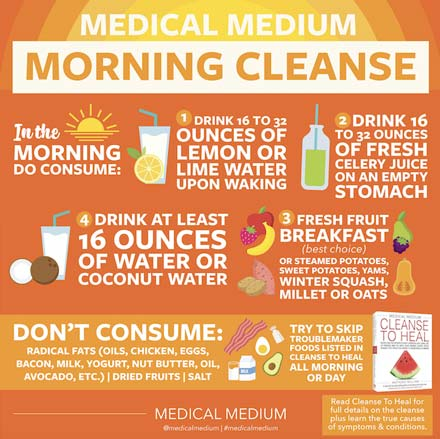
Medical Medium Morning Cleanse

In the Morning:

What to consume:

  1. Drink 16 to 32 ounces of lemon or lime water upon waking.
  2. Wait 15 to 30 minutes
  3. Drink 16 to 32oz fresh celery juice on empty stomach
  4. Wait 15 to 30 minutes
  5. Fresh fruit breakfast (best choice) OR steamed potatoes, sweet potatoes, yams, winter squash, millet, or oatmeal
  6. Drink at least 16oz of water or coconut water

Don’t consume:

  • Radical fats (oils, chicken, eggs, bacon, milk, yogurt, nut butter, oil, avocado, etc)
  • Dried fruits
  • Salt
  • Try to skip troublemaker foods all morning or day (refer to Cleanse to Heal for the list of troublemaker foods to avoid for best results).

It’s important to note that while lemon still has medicinal properties when it has been cooked, hot lemon water does not flush the bloodstream, liver, and body of poisons and toxins. That’s only accomplished with lemon water made with water that is room temperature, lukewarm, cool, or even cold.

In Cleanse To Heal you’ll also find detailed guidance on how to pick the right cleanse option for you from the different cleanses, when to user the Morning Cleanse versus another cleanse, for how long, and much more information about how to make the Morning Cleanse work for you. Cleanse To Heal holds healing information and wisdom for anyone who is living with a chronic symptom or condition of any kind, or anyone who wishes to safeguard and protect their health for the future. The truth is that we are all exposed to the troublemakers that cause sickness in one way or another today, so knowing how to protect and take care of our bodies has never been more important. I wrote Cleanse to Heal so you would have the answers you need by your side.

OK folks, that’s my 800 word limit!  Talk with you again next week.  Any questions email me at jeansdreams@yahoo.com.  Have a blessed week!