Gabriel Jeroschewitz, March 24th, 2026, from a dream I had the other night. Being stuck in a bookstore. and ending up in a forest. Abridged.
I woke up in the forest of words.
I woke in a forest, warm and tranquil among the trees. The air resonated with the syrupy peace of late morning. For a moment, I reasonably believed I had died and arrived in a writer’s heaven: part bookstore, part mossy library, every page faintly scented with coffee.
Then I noticed I was naked. Entirely naked. Bare, unprotected in my pale, middle-aged glory, standing among oaks and redwoods like a misplaced yard statue.
“Well,” I uttered, attempting dignity as a beetle inspected my ankle, “this is new.”
Uncertain whether to be embarrassed without clothing or impressed by nature’s dramatic reintroduction, I considered whether this was a metaphor. Writers love metaphors.
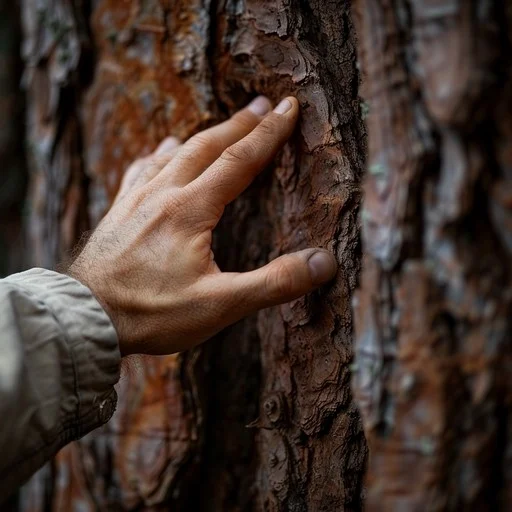
I laid my hand against the bark of a nearby oak. The roughness felt startlingly real. Each ridge pressed its indentation upon my fingertips. The grass underneath my feet prickled and whispered. The sunlight, warm and buttery, rested on me—an unfamiliar, gentle approval, as if from someone hopeful but unsure.
It was all too vivid to be a dream.
And yet—how else had I arrived here? The last detail I remembered was falling asleep at my desk, half a mug of cold tea nearby, my computer screen covered with the remains of a paragraph that had fought me to a stalemate. Then this.
A forest. A naked me. And a storm on the horizon.
I could smell the sharp metallic bite of lightning not yet born, the light sweetness of rain, and the fragrance of earth, trying to remember. But I could see no clouds, only blue sky and the restless leaves shifting in the wind.
“Well, if this is a metaphor,” I said to no one, “it’s doing an excellent job of foreshadowing.”
I checked myself for tools, survival gear, or any sign of civilization—a watch, a wallet, maybe a pocketknife. Nothing. Only skin, goose bumps, and slight existential confusion.
Then I observed something stranger: the air gleamed.
Not the sort of shimmer born of heat or light but one made of words.
The words floated between the trees, glowing quietly like slow fireflies within a classroom. A few came closer. One word, “Ephemeral,” popped against my nose like a soap bubble. Another, “Melancholy,” twirled toward my ear, as if wanting to be part of a sentence.
“Oh no,” I said in a whisper. “Not again.”
This happens more than I’d admit. Sometimes, words appear: falling from trees, trailing behind bumblebees, clinging to squirrels’ fur. Other times, they arrive at night, filling my dreams until my bedsheets turn into tangled paragraphs.
It’s both a blessing and a mess.
Once, I rose to find the word “serendipity” stuck to my tea mug for three days, refusing to let go until I used it correctly.
So this floating forest of words was familiar—except for the unwanted nudity.
I followed a narrow path through the trees, my bare feet rustling over leaves that murmured tiny adjectives while I stepped on them. Crinkly. Itchy. Disconte. The more deeply I went, the thicker the words grew. Fog made of vocabulary crowded me. Some drifted near my face, tickling my nose. Others fell upon my shoulders—weighty with Importance.
I tried to catch one. It wriggled and fluttered before sinking into my open palm. When it touched me, an idea bloomed—half story, half nonsense: a romance between a fern and a thundercloud.
“Noted,” I said aloud. “I’ll file that under ‘possibly genius, probably unpublishable.’”
I recognized other words—some I’d written, others I couldn’t recall inventing. “Wistful,” a favourite, floated by a puddle. “Taxidermy,” which I never liked, always appeared unexpectedly.
I walked naked through a world full of language.
It should have been terrifying, but it felt like home. The storm grew closer—thunder growling loudly through the sky. I looked for shelter. An old hollow tree accepted me with patience, as if it had seen many summers. I crouched inside, huddling against the moist wood, and watched through the gap as lightning turned the forest silver.
In the brief illuminations, I saw movement.
At first, I thought it was my imagination, but then a form appeared—a slender and glittering creature with the body of a dragonfly and the head of a librarian. It drifted above the ground, holding a pen made of lightning.
“Oh, you again,” I sighed.
The creature chirped in a high, papery voice. “You dropped your plot.”
“I do that often,” I said. “Where was it this time?”
“It rolled under a metaphor about three miles back.”
“Typical.”
The creature tutted, fluttering its wings impatiently. “You can’t finish the story without your plot.”
“Tell that to the modernists,” I spoke softly.
A second figure manifested—a short, plump being of punctuation: commas serving as arms, question marks for legs, a semicolon for a nose. It shuffled up, eyed my nakedness, and handed me a cloak formed from old drafts.
“Wear this,” it grumbled. “You’re making the adjectives nervous.”
I wrapped the cloak around me, grateful, though it had the scent of failed metaphors and unedited dialogue.
The storm burst overhead, drumming on the leaves. Raindrops began to pour—only they weren’t raindrops. They were letters, thousands of them, cascading down in a typographic deluge. Within minutes, the forest floor was coated in words. Puddles of sentences formed, rippling when touched.
“Marvellous,” I said. “A downpour of vocabulary.”
“Don’t let the verbs get in your eyes,” warned the punctuation creature.
Thought, and language— wind, clouds, and rain transforming the world—so after the rain, it felt as if words clung to every surface in the woods, from the branches and moss to my own skin. I pulled one off my arm: “Remember.” Another word held onto my foot: “home.”
Sadness overcame me. I briefly missed my disorganized desk, unfinished manuscripts, and the comfort of a kettle boiling while struggling with meaning.
“Is this a dream?” I asked the dragonfly librarian.
“Of course,” it said. “But that doesn’t make it untrue.”
“Words always say that,” I said under my breath.
“You could wake now, if you wished,” it continued. “Or you could stay, and help rebuild the dictionary. It was washed away last week by a flood of clichés.”
I laughed. “Tempting, but I think I’ve had enough naked existentialism for one morning.”
The dragonfly bowed. “Then catch one last word before you go.”
A single glowing word floated down, hovering between us. It was small, simple, and perfect: “Write.”
I put forth my hand and caught it. The forest melted away around me.
When I opened my eyes, I was seated back in my chair, clothed, my keyboard shining dimly. My screen was blank but for a flashing cursor.
Outside, thunder murmured in the distance, as though the storm had followed me home.
And then—it began again. Thousands of words seemed to appear on the screen all at once, as if they emerged without conscious effort, reminiscent of the dynamic, creative thought processes observed in participants as they generated metaphors. Sentences formed and collapsed. Characters introduced themselves with impeccable timing. I just sat there, barely more than a conduit, letting the forest flow across me.
I didn’t question where the mystery came from. I never really do.
After all, maybe every writer has their own forest—some wild, green place in the mind where words grow on trees and stories fall like rain, where you wake up naked sometimes because that’s what honesty looks like.
I happen to dream mine more literally.
When morning comes, I brush dried words from my sheets, gather a few good ones, and return to the page—barefoot, bewildered, and quietly delighted that the words still choose me.
Even if they occasionally make me lose my clothes.