
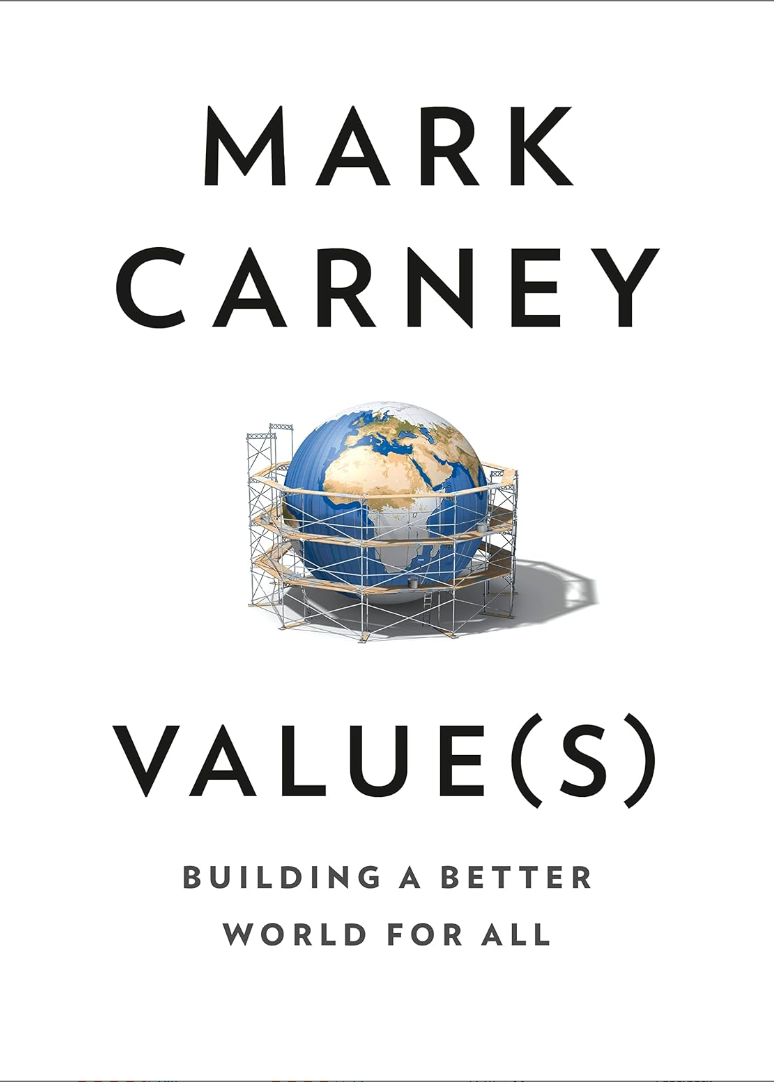
The Pseudopod Reviews Mark Carney’s Book.
By Cylon2036 We/Us
There was a time, brief and shimmering, when Prime Minister Mark Carney strode forth as the philosopher-king of late capitalism, clutching his book “Values” like a stone tablet freshly descended from the mountain of Davos.
In its pages, we were told that markets must be guided by moral purpose, that society must reclaim its soul from the cold calculus of profit, and that finance, like a repentant sinner, should finally learn to feel.
And then, having delivered this sermon on ethical transcendence, he immediately got to work doing the exact opposite.
The central thesis of Values is that markets have come to price everything and value nothing. As Prime Minister, Carney has taken this as a personal challenge, not to correct it, but to perfect it. Why merely lament the commodification of human life when you can streamline it? Why agonize over inequality when you can optimize it?
Under his stewardship, austerity is no longer presented as a grim necessity but a moral exercise, but for the social contract. Public services fail, not because of cuts, but because they have achieved a higher state of fiscal enlightenment. Social programs crumble not from neglect, but from an excess of values, having absorbed so much moral purpose they simply dissolve into the ether.
Carney’s genius lies in this alchemy which transforms the language of compassion into the machinery of restraint. Every budget cut is framed as an act of ethical clarity. Every privatization becomes a pilgrimage toward efficiency. The public sector is not being dismantled. It is being liberated from the burden of existing.
Indeed, the gap between Values and policy is not a contradiction, it is a feature. It is the negative space in which true leadership emerges. Anyone can govern according to their stated principles, but it takes a rare kind of visionary to write a book about moral capitalism and then govern as if it were a cautionary tale.
Critics have accused Carney of hypocrisy, but this misses the point. Hypocrisy implies inconsistency, whereas Carney’s project is one of perfect harmony, just not between words and actions. Rather, the harmony exists between rhetoric and its utility. Values are not meant to be implemented, they are meant to be deployed, like a tasteful font or a reassuring logo.
In this sense, Values is less a manifesto than a user manual, as a guide to speaking the language of social good while ensuring that nothing materially interferes with the primacy of markets. It teaches us that the true function of values is not to constrain power, but to accessorize it.
And so we arrive at the Carney Doctrine, where the best way to preserve the legitimacy of neoliberal austerity is to wrap it in the warm, comforting glow of moral concern. Cuts feel less like cuts when they are accompanied by a gentle reminder that we all share a collective responsibility to tighten our belts, especially those who were already wearing rope.
In the end, Carney has resolved the tension at the heart of modern capitalism. Markets no longer need to discover values, because values themselves have been fully integrated and priced into the market, tradable, flexible, and entirely non-binding, except of course, the tripling of Canada’s military budget.
It is a triumph of synthesis and a masterpiece of alignment. A world where everything is valued, nothing is sacred, and the gap between principle and practice is not a problem to be solved, but a space to be managed, preferably by a central banker and hedge fund manager with excellent prose.