
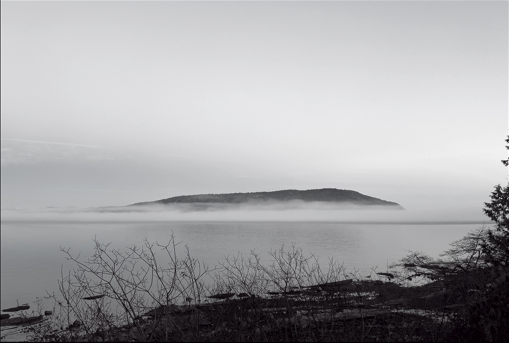
[facebook.com/markprior.images]
Concerned Citizens of Baynes Sound Update
Opinion
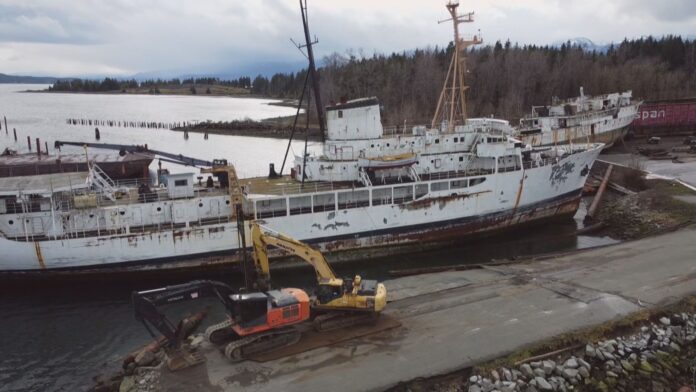
Nearly four years after the Comox Valley Regional District filed its lawsuit seeking an injunction against ship-breaking at Union Bay, there is still no publicly known trial date. This lack of progress stands in stark contrast to Reynolds v. Deep Water Recovery, a private citizen’s case filed around the same time, which moved through substantive motions, produced written court decisions, resulted in significant cost awards, and ultimately concluded.
The comparison is troubling. While an individual litigant advanced a complex case through the courts, the CVRD — with public resources, legal counsel, and a clear regulatory mandate — has yet to obtain even a date for a trial on whether illegal activity should be stopped. In the meantime, ship-breaking operations continue unabated, with potential ongoing pollution and environmental impacts on Baynes Sound.
Reports indicate the CVRD began the case in Vancouver, completed Examinations for Discovery, and then sought a change of venue — a decision which allowed multiple opportunities for objections and delay. The result: years of continued operations with no judicial determination and growing concern for the local environment.
Residents deserve answers. Why has this file stalled so long? Have the CVRD’s procedural decisions undermined its enforcement mandate? If a private citizen can achieve results in court, why has a public agency failed to do the same?
At some point, delay ceases to look like prudence and begins to resemble mismanagement — while Baynes Sound bears the consequences.
Ian Munro, President, Concerned Citizens of Baynes Sound

Shucking Oysters: Are You Lonesome Tonight?

Shucking Oysters: Are You Lonesome Tonight?
By Alex Allen
I’ve always appreciated my times spent alone since childhood. But I also enjoyed hanging out with my friends as well. Today, I barely want to leave the house. When the telephone rings I’m startled. Having a conversation at the local grocery store can be challenging. Even dinner parties have disappeared. And I’m not alone. What happened?
One conversation I did have at the grocery store was on how much we enjoyed not going out and staying at home with our partners. They attested this to getting old. I’m more inclined to point to the great reset of the pandemic. Jo Ellison wrote in the Financial Times that the pandemic “helped extinguish the last bastions of casual interaction: the pop-rounds, the call-bys and cup-of-tea-catch-ups.” Remember those knocks on the door? Now it’s either a scheduled delivery or gawd forbid something “weird.”
I used to call myself a social loner, having traits of both an extrovert and an introvert. Not so much now. Colin DeYoung, a psychology professor at the University of Minnesota explains that one reason introverts need alone time is related to how they respond to rewards. For adults, rewards can be things like money, social status, social connections, sex, and food. Introverts are wired differently and are simply less motivated and energized by those rewards. It’s as if “extroverts see big, juicy steaks everywhere, while introverts often see overcooked hamburgers.”
In a series by the New York Times reflecting on how American lives have changed in the years since the pandemic, the most striking details are those things that have not gone back to what they were before. People returned to airports and hair salons, but restaurants and bars are still feeling the negative effects. We’re spending much more time at home, both working and at leisure. According to one study, the time spent with others has fallen to less than 35 minutes on an average day since 2021.
These small shifts are playing out in the long term. We’re finding it harder to connect with people. We have to practise “making friends.” For some Ellison wrote, “the creeping isolation has ushered another pandemic: loneliness.” For others, the ease of social media has seen many of our interactions move and stay online. In entertainment, as in dining, “modernity has transformed a ritual of togetherness into an experience of homebound reclusion and even solitude.”
Derek Thompson wrote an article in the Atlantic calling our times the “anti-social century.” An invisible enemy is causing us to spend more and more time in our homes, “consolidated as refuges of comfort and leisure.” This has reinforced two types of human connections: the closest ones with our family and a couple of friends and the most distant ones, the dozens, hundreds, or thousands of human beings with whom we interact randomly on social media.
American men who watch television now spend seven hours in front of the TV for every hour they spend hanging out with somebody outside their home. The typical female pet owner spends more time actively engaged with her dog Piper than she spends in face-to-face contact with friends of her own species. Since the early 2000s, the amount of time that Americans say they spend helping or caring for people outside their immediate family has declined by more than a third.
In 2023, Joe Biden’s surgeon general published an 81-page warning about America’s “epidemic of loneliness,” claiming that its negative health effects were equal to tobacco use and obesity. A growing number of public-health officials seem to regard loneliness as a critical public-health issue. The United Kingdom has a minister for loneliness and social connection. So does Japan.
But solitude and loneliness are not one and the same. “It is actually a very healthy emotional response to feel some loneliness,” NYU sociologist Eric Klinenberg noted. “That cue is the thing that pushes you off the couch and into face-to-face interaction.” The real problem here, “the nature of America’s social crisis, is that most Americans don’t seem to be reacting to the biological cue to spend more time with other people.” Good news for us islanders, a study by the University of Minnesota showed that people in rural areas experience less loneliness than those living in cities.
Smartphones and computers have made solitude more crowded than ever but the crowds are more solitary. Our social time as Thompson wrote is “haunted by the possibility that something more interesting is happening somewhere else, and our downtime is contaminated by the streams and posts and texts of dozens of friends, colleagues, frenemies, strangers.” The always-open window to the outside world makes recharging much harder, “leaving many people chronically depleted, a walking battery that is always stuck in the red zone.” In a healthy world, people who spend lots of time alone would feel that biological cue: I’m alone; I should make plans to visit someone. But we live in a “sideways world, where easy home entertainment, oversharing online, and stunted social skills spark a strangely popular response” that I’m alone, but hooray they cancelled our play date.
One study found that solitude’s effects on well-being may depend on how it is balanced alongside social activities: too little solitude deprives individuals of time to relax and reconnect with their selves; too much can be isolating and lonely. Another study reported that people with high incomes spend more time alone instead of socializing, but are less lonely than those with lower incomes – spending time alone does not necessarily equate to feeling lonely. On the same note, another study linked lower income to loneliness and social isolation.
Maybe it does have something to do with getting older. Our circle becomes smaller and we become more particular about who we spend our time with. Even my odd random conversations with strangers seems to be enough most of the time. As Jean-Paul Sartre said: “If you’re lonely when you’re alone, you’re in bad company.”
REFLECTIONS FROM CUBA
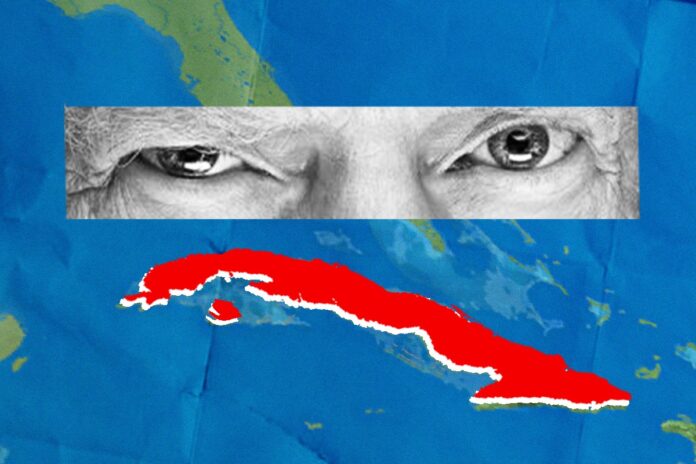
REFLECTIONS FROM CUBA
Many of you have been writing to ask how I/we are doing in Cuba and if we are ok. Short answer: we are more than OK!!
I finally have a moment to relax and reflect on what has been another amazing experience here in Cuba. I was expecting to be here until February 24th but tomorrow I will take what I believe may be the last flight out of Cuba to Canada for the near future. More on this below. This is my 43rd trip to the country and the 28th group I have been able to introduce to the incredible agro-ecological farming and permaculture movements here in the country. Once again, I feel inspired, renewed, grateful and privileged to be able to have this close connection with farmers here, their families and those who work to support them.
But this time around these feelings are mixed with both sadness and anger at what the country and its people are now being forced to endure by the bully rogue state to the west and dismay at my own country’s failure to provide any kind of response, effectively leaving our long time friend to fend for themselves in the face of the fascist imperialism that also now threatens our own country.
Prior to Covid, over 1 million Canadian tourists per year were travelling to Cuba enjoying the winter sun, beaches, vibrant culture, gorgeous architecture and the incredible warm and generous hospitality of the Cuban people. Only Canada and Mexico have maintained constant diplomatic relations with Cuba since the socialist revolution of 1959. In many respects, our relationship with Cuba is one of the few ways in which we have differentiated ourselves from the USA. Our special relationship with Cuba is part of our national identity. If ever there was a time to renew our close ties with the people of Cuba, that time is now!
CONDITIONS ON THE GROUND
It is important to be clear that the current aggression towards Cuba by the USA is nothing new. It is just the latest chapter in the intensification of economic terrorism against this small island that started 60 years ago. Cubans are, unfortunately, very used to dealing with this. The latest American blockade of fuel at a time when Cuba was already struggling is a “tightening of the noose” and is definitely making life harder for most people. But it is not the whole story.
NOBODY is panicking. There is no looting, hoarding (as far as I can see) or overt conflict between people as the fuel and electricity crisis worsens. There is still lots of food available though prices have risen sharply and appear poised to continue to rise.
For Cubans who have financial resources (i.e., mostly the self-employed), they can continue to get pretty much anything they need or want. For the majority of the population who depend on their state wages to meet their needs, these are very tough times. For vulnerable people, we can say these are becoming desperate times.
For the past decade or so, much economic activity has shifted to the black market and to small private businesses, both of which are subject to high inflation. For sure the average Cuban is struggling to make ends meet and is doing without some of the basics.
Our friends at the CCRD in Cardenas, a small organization that supports the most vulnerable Cubans, tell us that more and more people are coming to them looking for food, medicines, clean water and other necessities. As fuel becomes increasingly scarce, this is only going to become worse.
FUEL SHORTAGES
Gas is currently being rationed and only people with vehicles can access it and only 20 litres at a time and not very often. The price of taxis has doubled, except for the many electric small vehicles that are now commonplace throughout most cities in Cuba.
Diesel is almost completely unavailable as we found out on our trip through the countryside when we too had to resort to inflated prices on the black market.
The implications of this are many: people are not going to work, hospitals are struggling to function, ambulances can’t move, food is hard to get from the countryside to the city, tractors can’t operate and there is no more jet fuel (more on this below).
The good news for Cuba is that Russia has already sent two tankers full of fuel, and I just heard today that the president of Mexico is vowing to also defy Trumps ridiculous threats! Viva Mexico! Canada – where the hell are we on this point? Hopefully Mexico’s courage will lead to other nations stepping up and the collapse of Trump and Rubio’s fantasy games.
POWER CRISIS
I am going to start with the good news here first. Cuba is well underway to a massive transition towards solar energy powering the national grid. We were told repeatedly that solar energy now supplies over 30% of Cuba’s power and that the goal is to be over 50% by 2030. Driving through the countryside we saw massive solar installations (parques solares) built by the Chinese government with Cuba over the past months and years.
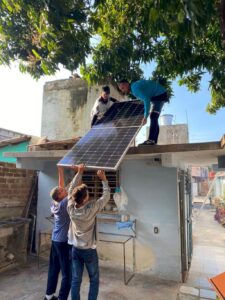
Many homes now have their own solar systems, including the majority of the “Casa particulares” (B & B’s) where we stayed. In a recent speech addressing the current crises, Diaz-Canel, the current president, also pledged to start locating solar systems on hospitals, schools, banks and other critical infrastructure. Cubans have been acquiring a wide range of small electric vehicles which are now used as taxis and utility vehicles.
At this rate, Cuba may soon become a global leader in the transition to renewable energy, and this makes perfect sense for a country with so much sun! It is definitely a critical step towards energy sovereignty for the country that I believe will pay dividends in the long run.
The bad news is that the older thermal electric plants are failing fast and there is little to no fuel to power them. This means that daily blackouts of up to 22 hours in some places are commonplace. This makes everyday life extremely difficult – if the power comes on in the middle of the night, people get up to cook food, wash clothes, charge devices, irrigate crops and do whatever else they need to do – exhausting and frustrating to say the least.
FOOD
Cuba is a country in which seemingly contradictory truths co-exist. Having been going to Cuba regularly over the past twenty years, I have never seen so much incredibly good food available on farms, in farmer’s markets, in restaurants and on the street as I did on this recent trip. We visited around 20 farms, and we ate extremely healthily and well. We had some truly fabulous meals. Yet many Cubans are currently very food insecure. Inflation has made common foods like eggs, milk, meat and vegetables out of reach for many people. If you have the resources, there is a lot of great food available. If you don’t, you go without.
The food ration stores run by the state used to offer all Cubans a guaranteed monthly diet, but these have now all but dried up since tourism crashed and the Cuban economy entered a freefall.
Inflation, driven by the fuel crisis, is making this all the more acute. If fuel supplies do not arrive to the country soon there will indeed be a humanitarian crisis including starvation and malnutrition. Fortunately, China and Mexico have also been sending shiploads of emergency food – another action that Canada could and should be taking.
FARMS
Cuba’s agroecology, urban agriculture and permaculture movements are what first drew me to the country 20 years ago and what keep me going back. I am so grateful to have developed close friendships with so many farmers and permaculturalists over the years. They are smart, visionary, capable, generous and very committed to helping their communities achieve more food security.
Without a doubt there was a consistent pattern at the farms we visited this year: the limiting factor growing more food is the current energy crisis. Without reliable energy, crops cannot be irrigated and cannot thrive. Those farmers who have been able to access funding to obtain their own solar systems were doing far better than those relying on the grid.
For that reason, I am working with our Cuban partners and Canadian/American friends of Cuba to launch “SOLidarity with Cuban Farmers!” This program will raise funds to help provide small solar systems to Cuban farmers to power essential farm infrastructure like irrigation pumps. You can read more below about how you can support this effort.
POLITICS
I am not going to say too much here as this is a huge topic. Like any other country, there is a wide range of opinion in Cuba about the current political situation from hard core support to strong opposition. Given the length and depth of the economic crisis, huge outmigration, and a fairly rarified government bureaucracy, there is indeed a prevalent cynicism about the current government’s ability to solve the problems of everyday life.
Most people say change is needed, even if they strongly support the revolution and Cuba’s socialist framework. They are worn out, frustrated, and tired of empty government slogans that don’t deliver. Indeed, there have been many changes in recent years – a huge opening up to small businesses and self-employment, for example – but at the same time, government wages have stagnated, costs have gone up, and so many families have become fragmented by the emigration crisis.
All this being said, I have met no one in Cuba who wants the country to surrender its future and identity over to the American government or American capitalists. People want change but remain defiant, nationalistic and committed to their own political sovereignty – at least those with whom I interact.
HOW YOU CAN SUPPORT CUBA
Many of you have asked so here are five suggestions:
- SIGN AND SHARE this Petition tinyurl.com/petition4cuba calling on the Canadian government to oppose the illegal energy blockade of Cuba and other acts of economic aggression.
- WRITE to your MP, Prime Minister Carney https://www.pm.gc.ca/en/connect/contact, and Anita Anand Canada’s Minister of Foreign Affairs anita.anand@parl.gc.ca, calling on Canada to condemn the illegal US economic/energy blockade of Cuba, to provide essential humanitarian aid to Cuba including fuel, to encourage economic trade with Cuba and the resumption of travel between Canada and Cuba.
- JOIN a Canada-Cuba solidarity group – there are many: https://www.facebook.com/CanadianNetworkOnCuba https://canadiannetworkoncuba.ca/ http://www.vancubasolidarity.com/aboutus.html https://canadacubafriendshiptoronto.ca/
- PLAN A TRIP TO CUBA I guarantee you will not be disappointed! You can wait until normal flights resume or travel through Mexico or through Miami. I would have no hesitation travelling to Cuba at present, despite what you are hearing in the media. You well be very well received! I’d even be happy to give you some suggestions if you get in touch with me. There are thousands of Canadians who travel to Cuba regularly, some even living there (yes you can!) Catch the Cuba bug – if you know you know!
- CONSIDER DONATING to “SOLidarity with Cuban Farmers” This small project will be providing solar systems directly to Cuban farmers so they can keep growing food for their communities without interruption. Message me on facebook at Foods, Farms and Forests or send an email to theurbanfarmer@shaw.ca. The official roll out of this will be within the next few weeks but donations are already coming to theurbanfarmer@shaw.ca.
Bueno – thanks for reading this far and for your solidarity with the people of Cuba. Cuba has given much to the world: treatment of over 2000 children from Chernobyl, thousands of doctors around the world, first response to the ebola and covid outbreaks, amazing music, art and so much more. It’s time we reciprocate!
The Crisis of Too Much Compassion

*SATIRE
The Crisis of Too Much Compassion By Cylon2036. We/Us
It has come to our attention that food banks and affordable housing initiatives are gravely undermining the moral backbone of our society. How can we expect citizens to build character when they are being recklessly sustained by groceries and shelter?
Food banks, in particular, are a menace. Once upon a time, hunger was a motivational speaker. An empty stomach whispered, “Innovate.” It growled, and howled, “Launch a podcast.” But now? People are simply handed canned beans and rice, and the entire entrepreneurial spirit collapses under the oppressive weight of lentils.
And affordable housing? A catastrophe! Historically, rent functioned as a thrilling monthly lottery to decide whether you pay for shelter or electricity? What an invigorating civic ritual! Affordable housing erases this suspense. By making rent predictable, we are robbing citizens of the adrenaline rush that keeps our world vibrant.
Worse still, these programs foster stability. Stability leads to rest. Rest leads to reflection. Reflection leads to criticism. Before you know it, people are asking dangerous questions like, “Why is housing so expensive?” or “Should children eat every day?” This is clearly a slippery slope toward coherence.
Opponents will argue that food banks prevent hunger and affordable housing reduces housing insecurity, but they ignore the broader philosophical concerns. If basic needs are met, what will people strive for? Without the inspirational poetry of precarity, how will we measure grit? If everyone has shelter, how will we distinguish the deserving from the merely breathing?
No, we must be bold. Replace food banks with inspirational pamphlets titled Have You Tried Budgeting Harder? Replace affordable housing projects with competitive rent auctions where tenants pitch their personal brand to landlords. Hunger and eviction should not be seen as problems, because they are premium motivational incentives that warm the neediest with the blanket of their own struggle.
In conclusion, let us stand firm against the reckless tide of nourishment and roofs. A society that feeds and houses its people risks something far more dangerous than poverty, and that is comfort. And from comfort, there is a risk that other radical ideas might sprout if the housing crisis and food insecurity are solved.
You’re welcome!
Ashes Between Us

Gabriel Jeroschewitz, November 26th, 2025,
Ashes Between Us
I have watched cities burn twice in my lifetime, though one was slower, quieter, and far more complete than the other. The first was when the bombs fell on my youth; the second, when words sharper than shrapnel hollowed out whatever spirit humanity had left. Between those fires, I met her.
Her name was Selene, and she spoke like no one I’d ever known — deliberate, careful, like she was soldering each phrase together, learning the wrong word could kill. In this world, it often did. She was not beautiful in the shabby idol way people crowded their screens for. Instead, she carried an elegance carved from endurance, the kind only those who had stood in ash and kept walking could possess.
I first saw her in the marketplace, though ‘marketplace’ is generous. It was a line of ragged sheets tied between walls, separating sellers from the wind and sand. People exchanged not coins but rumours, jars of clean water, batteries that still held a charge. She was trading information — not news, but truth. A dangerous profession. In this place, truth was hunted.
I learned later that she had once been a painter. Then she had been a teacher. Then, after the second war began, she had hidden families in cellars and smuggled them along forgotten roads. But all of that was before the screens took over. Before the lies grew so vast and braided that reality itself was impossible to grip.
She looked me in the eye when I greeted her. Most people didn’t, these days. Eye contact was a gamble — it could be an invitation, a challenge, or a mark for the wrong sort of attention. I asked her what she was selling. She told me, “I sell something you cannot afford — certainty.”
I became a regular at her ragged curtain stall, though I bought nothing. Perhaps that was my mistake — or my salvation. We spoke of little things: the taste of boiled dandelion roots, the way the desert wind shifted just before rain, what it meant to remember a childhood without screens buzzing in your skull. But every so often, she’d let something else slip: a name of someone hiding; a shipment of medicine diverted to someone’s private estate; a village erased from maps.
The city was suffocating long before the soldiers came. Vanity had replaced virtue. Injustice was lauded in eloquent speeches. Celebrities preached morality while sipping wine paid for by conglomerates stripping the oceans bare. And outside, far from the cameras, bodies piled like misfiled paperwork — not worth remembering.
It was in that suffocating twilight that our lives tangled. She didn’t smile often, but once, when we found a surviving fig tree blooming in a courtyard of cracked stone, she touched my hand without meaning to. Her palm was a warmth I didn’t know I’d been seeking.
I became her shadow after that.
The leaders’ speeches had already shifted from We must protect our future to They are the enemy, and they must be erased. The “They” changed weekly. Sometimes it was a neighbouring state. Sometimes it was a religion. Sometimes it was people who thought differently about how to grow crops. The lies adapted — they were endlessly fertile.
Selene refused to adapt. That was her flaw and her beauty. She copied down fragments of banned texts by hand, sealing them in jars buried outside the city, as though truths were seeds waiting for a gentler century. She whispered to the children that their parents had not been traitors, no matter what the broadcasts said. She painted again, but now her canvases were hidden under a floorboard — visions of forests she’d never walked in, oceans she’d never touched.
The danger was inevitable.
The night before they came for her, she told me about her first love. Not me — someone long before I existed in her orbit. He had been a soldier, one she’d met when she was nineteen. He believed in the war then. He believed in everything the leaders said, until the day he saw a school collapse under his own artillery fire. After that, he was never the same. One morning, he lay down on a minefield and didn’t rise again.
“I think I’ve been mourning him ever since,” Selene said, without looking at me. “And now you. You remind me that I can love something still alive.”
It was a dangerous confession, because here, love was leverage. Attachments could be used to break you open. I told her that if she stayed silent, if she stopped trading in dangerous truths, maybe we could survive. She shook her head.
“If I stay silent, maybe we don’t deserve to.”
They came at dawn. Not soldiers, but men in clean suits, the kind sent when the charge is already decided. They took her without a struggle. Someone had already erased her stall before midday, as though she had never existed. I don’t know where they took her. In this world, absence is a sentence in itself.
The city kept breathing, but it was a corpse’s breath — mechanical, shallow. The broadcasts spun their newest narratives. The war expanded. The oceans retreated. The air tasted of burnt copper. Somewhere, the bombs fell again. Somewhere, the markets traded lies for bread.
I walk the streets now as an older man. I’ve survived wars, shortages, and the collapse of the idea of truth itself. But I am always looking for her, in the corner of my vision, veiled in dust. I imagine her in another city, warning others, planting seeds in buried jars. Or perhaps she is gone entirely, her truths decomposing in soil no one will dare dig.
Either way, her absence is the most honest thing left in this world.
Letter to the Editor – Stewart Goodings

Congratulations to Keith Porteous for his incisive and thoughtful interview with Avi Lewis, one of the candidates for the leadership of the federal NDP. The answers provided by Lewis to Keith’s excellent questions demonstrate that Lewis would be a formidable and well qualified leader of a Party trying to resurrect itself. And with Naomi Klein as his partner, a Lewis victory would bring a wealth of intellectual and literary talent to the NDP’s top job. Reading Keith’s comment afterwards about his own perspectives on the traditional Party system in Canada made me reflect a bit on my own ‘journey’ in that fractious domain.
In my callow youth, I was attracted to the Red Tory side of the Progressive Conservative Party. People like Robert Stanfield, Flora Macdonald, Joe Clark, even Mulroney on his good days—they seemed to have the right balance between fiscal prudence and social justice. Of course, I was a civil servant for most of my career, so never got involved in partisan stuff. If I ever had a ‘hero’ in politics, it was probably the Liberal, Lester Pearson, who was responsible for so much good legislation even while leading a minority government. Yet it had to be acknowledged that much of the best legislation of both Conservative and Liberal administrations would not have happened if not for the ideas and inspiration of NDP leaders like Tommy Douglas, David Lewis, Ed Broadbent and Jack Layton.
You’re supposed to become more conservative as you get older. Didn’t happen to me. Over the last 20 years, my votes have gone to NDP and Green candidates, both federally and provincially. And since it’s unlikely the traditional Party system is going to disappear in the near future, I personally feel it is important to have a dynamic social democratic Party, i.e. the NDP in Parliament to keep Governments as honest as possible and to keep fighting for the needs and rights of ordinary people. Gord Johns to me is an ideal Member of Parliament, and whoever is elected leader of the NDP would do well to find more candidates of the same ilk as him. Parliament needs a more numerous group of NDP MPs, and Avi Lewis may well be the best person to achieve that objective.
Thanks, Keith, for introducing him to us.
Stewart Goodings.
Monster Hunters ch.9

Monster Hunters ch.9
By Quinn Ireland
As Ben, Johnny and Kepler made their way up the steep, rickety bridge to the series of tree-homes, Ben got this at home, a safe sort of feeling. It was hard to believe that after one day, he had really settled into this place.
This school…
This home…
Each solid wood door had a number. There seemed to be at least one hundred doors. On door number eight, Kepler drew out a key from her coat pocket. She slid the key into the lock, turned it, and pushed the door open and walked inside. Ben and Johnny followed. “Pretty nice, am I right?” said Johnny with a huge grin plastered on his face. Ben couldn’t agree more. All of the walls were made of the tree. On those walls hung pictures of waterfalls, rivers, and creeks. Three single beds sat half a dozen feet from each other, Ben’s unused bed was made, whereas Johnny and Kepler’s were in a very messy state. Ben knew Johnny too well, as well as Johnny’s own bedroom. It remained messy and dirty after all sleepovers. His Mom would always bug him about it, but nothing would ever change. Hungry?” asked Johnny holding out an apple. “You bet I am!” Replied Ben. He had not eaten since his bowl of cereal in the morning, seven AM to be precise. After a second apple, three bananas, and five oranges, Ben’s stomach seemed satisfied. He proceeded to brush his teeth, get into PJ’s (that had the Monster school logo), and say goodnight to Johnny and Kepler. He then climbed into bed and immediately felt tiredness set in. He almost couldn’t make sense of that day so far, it had felt good, and it had felt bad. But it also felt like a blur. A blur of information. Some good. Some bad.
But for now, he let sleep take him.
As if sleep was a prison guard, and he was a prisoner.
But the guard was welcoming, making Ben feel like he wanted to be taken to this prison.
And he would not remember being taken to this prison.
But what he would know was that the prison had a warm, cozy feeling.
Unlike the cold, lonely feeling of a typical prison.
“This is sleep,” Ben thought, “A kind, welcoming prison guard.”
Ben let himself drift off to the sleep prison.
Lock him up for the night…
For the night…
The night…