Home Blog Page 145

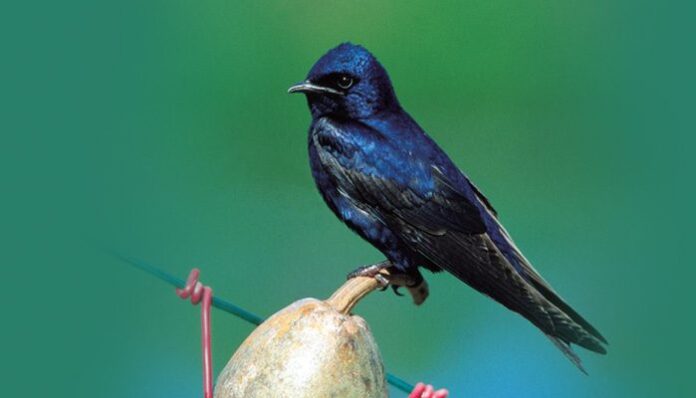
Purple Martin Colony Update 

Passionate purple martin friends have completed a major spring cleaning of the Purple Martin nest boxes. The work started with milling 1-inch-thick Western Red Cedar boards from dying trees provided by Werner Karsten during the winter. They were done with a Swedish Logosol chain sawmill by Peter Karsten.  It takes about 8 feet of 8 inch wide more of less knot-free lumber per nestbox.

The recently organized Purple Martin Preservation Team built 24 new nest boxes to replace the ones on the floating dock and gangway of the Community Dock. The first 6 nest boxes were placed at the dock in 2012 and more were added in 2014. BC ferries replaced 4 pilons which were removed to rebuild the Denman West landing facility. Volunteers mounted 8 boxes on them. That was a bit challenging since the pilons were placed in deeper water to make the use of a ladder at low tide no longer workable. Kevin Behrens and Ian Lark came to the rescue to use a ladder in a boat to put them up. The two just cleaned them in a somewhat precarious maneuver a couple of weeks ago. The mechanisms to raise the cluster of 2 to 3 boxes on the 4×4 post along the gangway were replaced to simplify the maintenance of them. Good maintenance is critical to prevent parasite build up. A martin bug, fleas and lice infestation are a concern. To that end the nest material should be replaced annually and the box sprayed with a bleach solution while the birds enjoy their winter vacation in Brazil. When we removed 17 old nest boxes, we found that most had been occupied but not all. Joan Scruton had discovered that two pairs had nested in between the huge concrete blocks that form the embankment. We hope with the 27 new or clean boxes the martins will all nest in them this season.  Volunteers have collected very small fir twigs and Western White Pine needles for nesting material. We put a handful of it into the boxes to give the birds a head start. The martins use this coarse nesting material to prevent composting. Hay would not be useful here.

Kevin and Ian in the boat

A big thank you to the Purple Martin Preservation Team and other helpers; Dean Heyland, Steve Aberle, Joan Scruton, Graeme Johnston, Daniel Lonsdale, John Mills, Kevin Behrens, Ian Lark, Paul and Vicki Ryall, Laura Pope, Caryn Rea, Peter Karsten to get the nest boxes ready in time for the Martins to return by the end of April. 


CLIMATE BYTES – IMAGINING FUTURES: CATASTROPHE OR SURVIVAL

Climate goals we most hear about are the need to achieve net-zero CO2 emissions and the need to keep global warming to 1.5oC above pre-industrial levels. Admirable and necessary as those goals may be, the simple fact is that we are not on track to achieve either. Scientists project that “Business as Usual” is a fast track to global warming of 2.7oC or more (UNEP, Emissions Gap Report 2023) which would be catastrophic.

Ecological thinkers, like Prof. Emeritus William Rees of UBC, tend to perceive global warming as a symptom of the larger problem that humanity uses nature’s resource capacity and its capability to absorb waste at rates that are not sustainable. Rees’s solution is for humanity to use its intelligence and planning ability to return to living the way we did when we were still in sync with nature. The last time that was so was the 1960s when we left no global ecological footprint, atmospheric concentration of CO2 was only 350 parts per million and the earth radiated out more or less the same energy as the sun radiated in.

The purpose of this note is to hypothesize in a simple way what living conditions might be 1) if we carried on with “business as usual” until the world warms to 2.7oC or 2) if we turned back the human enterprise clock to the 1960s.

So, walk with me to a world where average temperature has reached 2.7oC above pre-industrial levels, unprecedented in humanity’s history. It’s hot! We can barely remember a time when we were not afraid to go outside. We must go out, mostly in the cooler, but still hot, dark hours, because we have to grow or otherwise secure food. Our parents tell us about an earlier time when there was no “off” season because the whole world was our garden.  California, Chile and Asian countries, from whence we used to source our food, now are battered with storms and unreliable weather and depleted water sources just as we are. Now, with the heat, if we’re lucky enough to get sufficient rainfall, crop yields and nutrition content of grains and vegetables is reduced. All the “just-in-time’ logistical systems that once kept shelves of food and consumer goods fully stocked became too complex to administer. Individuals are now singularly focused on self-preservation. We have no surplus resources beyond meeting personal and family immediate needs. Without such surpluses, we can’t pay taxes and, so, democratic governments have pretty much ceased to function. Policing is now done through private armies. Universities are mainly gone and universal childhood education has reverted to simplistic home-schooling. Barter is now our main system of exchange. Years ago, because of shortages of basic commodities, runaway inflation was the final nail in our economic system’s coffin. If there was any joy in that, it was that hyper-inflation reduced to nothing the fortunes of the once-billionaires who, like the rest of us, now have to think consciously about food and water supply. No one is safe from the storms and fires that continually besiege us. Nor do we anymore have the governmental systems and integrity to control population migration escaping northward from  equatorial heat. Not just people, but tropical diseases have migrated and are taking their toll. 

 Back when earth warming was still at 1.5oC, we were warned about pending earth systems tipping points and possible collapse of civilization. We stood by as those tipping points, which we hoped were a theoretical possibility, have toppled like real-time dominoes. Just as predicted, Arctic permafrost, once intact for millions of years, is now largely melted and the microbes and organic material it held have combined to generate more warming, directly and through creation of greenhouse gases: processes that are now unstoppable. Likewise, the “forever” ice of Greenland and Antarctica are unrelentingly on a multi-century march to total meltdown. Most of the major cities of the world and some countries have stopped functioning because of sea level rise. It’s about 3 metres now but scientific records tell us it will eventually be many times that. As if causing sea level rise wasn’t bad enough, all the melt water added to our salty oceans, has disrupted ocean currents causing regional climate shifts, everything from desertification to little ice ages. Somewhere to the south of us (Who cares any more?) what used to be Amazon rain forest has now tipped from self-sustaining forest to grassland. We are on the wrong side of several other tipping points. Our parents and grandparents were consumed with being consumers and they were blind to its effects. Now, it’s Hell on Earth! Civilization is just a word.

*******

On the survival path, turning back the clock means that we will have to give up many of the consuming habits we hold dear. Fortunately, among us there are those who already know, by choice or by circumstance, how to live with less. From the Covid-19 pandemic we learned what public services are truly “essential” and that we can stand government policies on their head without disaster befalling. Especially we learned that fear can be a driving force toward good. It was fear that changed public policy for the good during the Great Depression. Then, immediately after, because we feared losing a war, we converted industries almost overnight from producing consumer goods to making war materials. Those experiences showed that people can be persuaded of the necessity of living with less. If we need less, we can produce less by adopting 4-day or maybe even 3-day work weeks. In parts of the world where people live simply and there is leisure-time, people turn to artistic endeavours of all kinds and there is time to nurture human relationships. We don’t need  to be amused and entertained, we can do it ourselves. Though built for individual use, monster houses can be shared to densify our communities and reduce the need for travel. International travel should only be for necessity and not ever for holidays. Most travel is local. We can still eat animal meats but they are locally farmed rather than “manufactured” in faraway feedlots. As in foregone eras, our cities can be surrounded by small organic farms. Unlike in the original 1960s, we eschew monster gas-guzzling cars—possibly all 4-wheel vehicles–in favour of public transit. And perhaps most important, we teach our children what we didn’t learn until too late, that perpetual exponential growth on a finite planet is an impossibility.

**********

But, it seems that we have, at least for now, chosen the path to a hot-house earth. Dare we hope that, as climate-related disasters accumulate, fear, if not for ourselves, then for our children, will bring about the needed humanity-saving revolution.

Letter to the Editor – Dr. Ron Wilson

I read the letter in last week’s Grapevine in regard to benefits from oil, gas and coal. I will admit that we have indeed benefited greatly from these products. I noticed that the book she referred to by Alex Epstein was published in 2022. Likely any data that was referenced in the book would have been 2021 at the latest. While the benefits have been many from fossil fuels, they have also been causing many problems as well. If they continue to be produced at the same rate, the problems we are seeing in the earth’s environment recently are only going to get worse. I refer to extreme heat waves, severe drought followed by floods when it does rain, rising sea levels and extreme weather events.  These are occurring throughout the world and are affecting those who are least able to cope with them, such as in low lying countries in the South Pacific islands. However, we only need to recall the severe fire season we had in Canada last year. The fires affected every part of Canada with large scale evacuations for prolonged periods. The total land burned more than doubled any previous year. Sadly, early predictions are that this year could be the same or even worse. 

These weather changes have now been linked with certainty to global warming with fossil fuels being far and away the main cause. Burning these fuels releases CO2 and Methane, the 2 main gases that lead to heat trapping in the atmosphere. They are responsible for 75% of this effect. This in turn increases the earth’s temperature leading to global warming. 

The Letter in last week’s issue reported an increase of 1 degree Celsius in the earth’s temperature. Due to 2023 being the hottest year on record, the last 12 months now have the earth at over 1.5 C above preindustrial times.  What is most worrisome is the rate at which the earth is heating up. It is not just the earth’s surface temperature that is being affected. The World Meteorological Organization tracks what are referred to as the Earth’s Vital Signs. Oceans are heating up, sea level is rising, Antarctic sea ice is melting and glaciers are retreating at the fastest rate ever seen. 

I could go on and on. The WMO has put out a RED ALERT for the earth on which we live and depend. It is time for all hands on deck to do everything we can for the Earth’s sake and ours. 

I realize that concerns such as the rising cost of living, housing costs and inflation are very present at this time. However, I quote from the WMO report: “The Climate crisis is the defining challenge that humanity faces”. 

The Denman Climate Climate Action Network will have a booth at the market this Saturday as Earth Day is coming up on April 22nd. Hope to see you there. 

Respectfully submitted, Dr. Ron Wilson (now retired)

A Global Security System – Part 2

When I enroll in a book club through World Beyond War, (WBW) one of my biggest takeaways is the reaffirmation that we who believe humans have the capacity to create a better reality are not simply naïve, unrealistic idealists. Do you ever tire of hearing cynics patiently say that, realistically, it is too late, humans will never change, we’re doomed, we’ve always been war- makers, etc.? I sure do. Enough already! How well has that kind of thinking served us? In my view, cynicism is the easy, lazy route. It is much harder to see the ugly realities we humans have created, to acknowledge our seriously misdirected thinking, and get down to doing the actual work of charting a survival path. That work involves thinking and acting more creatively and inclusively, more concretely and more assertively, and making the radical changes we need to make while we still can. We have to be very engaged locally AND take it global now – it’s not an either/or – we’re part of one small planet we need to care for and share, just as children in kindergarten learn to care for their environment and to share with others who are perhaps not like their own family.

WBW’s inspiring 4 week book clubs are delivered by experienced, knowledgeable and committed progressive thinkers. They serve as small fundraisers for WBW, which is a 10 year old network of individuals and groups in over 75 countries. The last book club I joined was delivered by Edward Horgan, an Irish thinker/journalist. His recent book, around which the sessions very loosely unfolded, is called: Writing the Wrongs of Human Rights – in Letters Words, Sentences. 2023. The book comprises nearly 300 really interesting letters Horgan has written & had published in 3 Irish newspapers over nearly 50 years. His subject matter relates to his lived experience of the world around him – security, defence, neutrality and more.

Having joined the Irish army at age 18, Horgan served as a UN peacekeeper for over 22 years, followed by another 20 years as an international election observer. Along the way, he got a PhD. in International Relations & UN Reform. He has worked in many, many countries during his career, including 10 years (as an Irish army officer) with direct responsibility for prisoners in Curragh military prison, quelling internal disturbances among prisoners and their guards, and preventing prisoners from harming themselves. He works with the realities he finds and finds ways to improve those realities.

When “realists” accuse me of “relentless optimism”, I wish they would spend just a few moments in the company of a man like Edward Horgan, and see the hole they have dug themselves into. It is actually a whole lot easier to live in a state of well-being when you come up for air from that hole, start seeing the possibilities out there, and join a broader group of humanity in our common quest for equality, justice and freedom for all. There are so many of us on this path; it’s not that complicated – for one thing, we simply have to get bolder about truly living our values on a global scale. We have to think bigger.

The current book club I’m enrolled in is studying WBW’s manual: A Global Security System: An Alternative to War, as its authors produce a 6th edition. So we are examining each section of the book with a view to improving upon it. At the very least, I am going to know the current

edition of the book a lot better than I did before, learn how others respond to it, and together imagine ways to improve upon it. As for you dear Reader, I’ll keep you posted.

(Next week: more on AGSS)

Upholding the Canadian Charter and Bill of Rights and Freedoms

“I am a Canadian, a free Canadian,
Free to speak without fear
Free to worship God in my own way
Free to stand for what I believe is right,
Free to oppose what I believe is wrong,
Free to choose those who shall govern my country.
This heritage of freedom I pledge to uphold for myself and all mankind.”
 
The Right Honourable John G. Diefenbaker
  Prime Minister of Canada. July Ist 1960
 
                                                     
On Denman and Hornby Islands, there is a clan of freedom-loving Canadians who gather every couple of weeks for a pot luck, a party and a thoughtful circle, in which ideas, thoughts and concerns are shared. It is a wonderful collection of disparate people who are actively engaged in preparing for tough times  and helping each other in any way that they can.. There is , also, work being done to actively support our Canadian Charter of Rights and Freedoms and ensure that it is never violated again, as it has been in the recent past.
 
I saw an interesting quote today on Liberty.com.
 
“If you allow the government to break the law for an “emergency”
They will create “emergencies” in order to break the law.”
 
In my opinion , this is something that all Canadians who believe in the validity of the Canadian Charter need to be aware of , as we see governments around the world veering in this direction. Here in Canada, we will have the opportunity to correct the course Canada is on next year in 2025,. We need to reflect upon several other issues as well,  along with climate change, mandatory digital IDs and currencies, 15 minute cities, mandatory vaccinations and lockdowns. Each of these issues give the government far too much control over our lives and well-being and contravene the Canadian Charter and Bill of Rights and Freedoms. A significant number of these contraventions have been overturned in the  Canadian court system since 2020.
 
Do you remember the days when Canada was seen as a role model for other countries. A country of peacekeepers not warmongers, who sell military hardware to Ukraine and Israel, to name but a couple of countries. I believe that it is very important. That each of us, in our own inimitable way stand up for the rebuilding of a new version of the Canada we once knew: A Freedom-loving, inclusive and peaceful nation of people of every culture, colour and sexual orientation that can once again become a great example to the world.
 
 
On a local level, it is imperative that we promote the healthy, peaceful and, dare I say it as a “bloody Brit”, myself, “polite” exchange of differing ideas and philosophies in a kind and caring manner and do everything we can on every political level to support Canadian Rights and Freedoms and protect them through rallies, demonstrations and the written and spoken word on both, mainstream and alternate media.
 
                                                                                                                Perri Gorrara

Green Wizardries: Slow Fashion and the Mending Cafe

It started out innocently enough.  I was giving a talk at the Garden Club and I wore a cotton shirt that had been torn in the wash. I had mended it after watching a few Sashiko-mending videos on YouTube.  I explained to the gardeners that cotton is a very dirty crop.  Cotton production uses heaps of pesticides, herbicides, fungicides and synthetic fertilizer that destroys the carbon in the soil and strips the soil of life and fertility.  The current way of cultivating cotton is a disaster for the Living Earth.  

After the talk, Wendy Pope approached me and asked if I would give a Sashiko-mending demonstration at the Mending Cafe she had suddenly decided to host.  I said, “Sure,” because if I can do this sort of mending successfully, and I find it fun, then almost anyone can do it.  I am not a sewing maven; I can barely sew at all.  

Nancy Hoyano will give a talk and demonstration on Boro and Sashiko as she is an expert at it.  Nancy creates beautiful art pieces with Boro which is a Japanese  style of patchwork and Sashiko which is a sort of embroidery style, also Japanese in origin and all the rage at the moment.  

Sashiko started as a way to sew layers of cotton or linen together to make it warmer.  The traditional style is to use navy-blue cotton or linen for the cloth and heavy, white thread for the stitching.  I had a look at this and mended a couple of garments and people liked the work I did.  I used colourful embroidery thread so my mending is Sashiko inspired, not the real thing!  A couple of ladies I know are such talented craftswomen that they can make wedding dresses and they liked the mending I was doing.  

It is common, now, to buy a garment, wear it four or five times and drop it off at a charity shop.  This is called Fast Fashion and the cloth is poor and does not stand up to repeated washing.  The garment is meant to become waste!  Fast Fashion is cheap because it is made using child labour, slave labour or the profiteers simply pay starvation wages to the poor people hired to sew.  Fast Fashion is evil.  It is also wasteful and if you look around at your fellow Canadians, you will see very few of them who look well dressed at all.  Wendy Pope said, “I have been feeling annoyed every time I go into a clothing shop.  I want an alternative to Fast Fashion.”

One woman asked me what alternative to cotton cloth would be better and I had to say there is a production cost to every fabric.  So we can’t simply abandon cotton for linen, silk or wool and continue to waste those resources.  Polyester and other synthetic fabrics degrade over time leaving smaller and smaller pieces of toxic, synthetic material to get into the water supply and from there to poison tiny plankton in the oceans so they are not an option.    

A solution to the wasteful  practice of Fast Fashion is Slow Fashion.  Slow Fashion means buying new clothes with the intention of keeping them for at least forty years, making sure they are well made from durable fabric, not washing them after every wear and doing more spot cleaning.  Not washing so often makes cloth last a lot longer and the garment will keep its shape better.  Our ancestors who had to wash clothes by hand were great ones for spot cleaning and airing garments.  

Other Slow Fashion basics include buying good second hand clothes, shopping at Free Stores and the Free Shop on Northwest Road here on Denman.  Mending, darning and lining the clothes that you have is kind of fun and makes the garment unique.  You can create many pretty embroidered patterns with Sashiko-style mending.

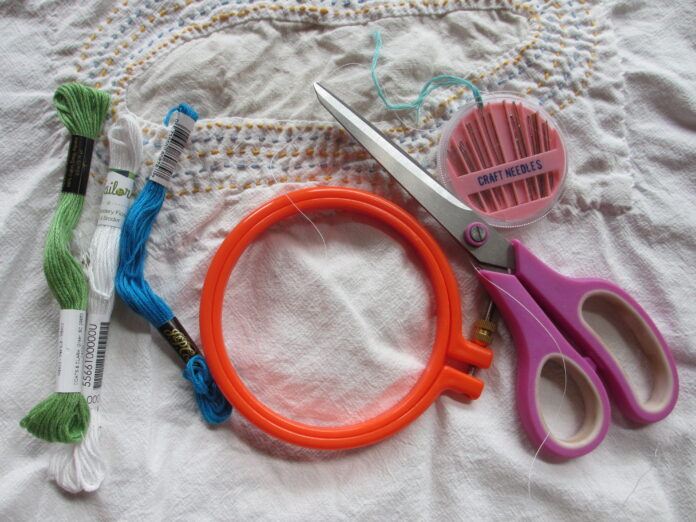
If you would like to get together with other people for a fun and informative Mending Cafe, meet up at the United Church Hall on Wednesday 24 April from 2 to 4 pm.  Bring a mending project but pick a simple one so it will be easy and fun for you.  Bring scissors, thread, needles, pins, embroidery thread and cloth scraps.  If you don’t have all that, come anyway as we will have extra supplies for beginners. If you have a large piece of cloth and would like to make a pillow case or a cushion cover, bring that too as Wendy will have her portable sewing machine there.   There will be a big bag of clean wool to stuff cushions and pillows.  Wool makes the very best pillows.  

We will be making a big pot of ginger tea and bringing a GF fruit loaf to share.  Feel free to bring treats.  Admission is by donation.  

Letter to the Editor – Helen Grond

Letter to the Editor

Is the Advisory Planning Commission a Trojan Horse?

The following are excerpts from an Islands Trust staff report dated January 9, 2017 obtained by FOIA.

The subject of the report was “Vacation Home Rentals Policy Review, Draft Project Charter”

The recommendations were 

1. That the LTC endorse the draft Project Charter for the Vacation Home Rental Review Project.

2. That the Hornby Island Local Trust Committee pursue targeted recruitment for up to three additional members for the Advisory Planning Commission in support of the Vacation Home Rental Review Project.

According to the background section:

“Throughout 2016, the LTC discussed emerging issues on the subject of home vacation rentals on Hornby Island, and identified the need for a review process in 2017/2018 to assess the effectiveness of policies, regulations, and enforcement regarding vacation home rentals on Hornby Island.”

The five year review of home sharing was held in a LTC meeting on December 4, 2017.  There were more staff than the public there.  I thought the meeting was “the” review and had no idea about the extent of the “project”.  At that meeting, questions were asked of the Trustees and staff if there were any problems or complaints regarding home-shares over the last five years and the answer was that no complaints had been received or issues identified.  The consensus was that the important Hornby practice was doing fine and needed no revisions or actions.  The planner was asked to remove language from her report indicating that strict enforcement of the regulations should be introduced as there were no underlying issues requiring such harsh language with respect to enforcement.    Surely, the Trust has better ways to devote their time and budgets than invent issues around activities that had no problems or complaints in the five years preceding?  What exactly were the “emerging” issues referred to by the LTC throughout 2016 that they did not report on in that meeting?

The January 9 staff report outlined the “overarching milestones and timeline for the Vacation Home Rentals (VHR) Policy Review:” as follows:

– A community survey, to be administered by Staff with input from the APC;

– Staff analysis of emerging trends and issues on the topic of VHR:

– A community consultation process facilitated by the APC to further explore the topics raised through

    the survey and identified by staff;

– Referral to the APC of specific policy areas for in-depth discussion and recommendations;

– Possible improvements to VHR policies and guidelines.

I would like to see the results of the above 5 “overarching milestones” that were supposed to have been achieved.  Were they even done?  The results were never included in the March 29, 2022 APC report.  Why not?

Recommendations to the LTC regarding the APC are as follows:

“Because the APC is to have a substantial role in the community review of VHR policies, the LTC has expressed a desire to have an APC that represents the diversity of the Hornby Island community in regards to this topic.  Considering this specific intention, Staff recommends that the LTC identify desired communities of interest it looks to engage in order to provide direction for targeted recruitment of future APC members.”

I responded to the ad looking for members to serve on the APC on January 23, 2017.  The deadline was January 26.  I was not selected.  It was reported that no one responded to the ad when in fact I had.  I have applied 4 times over the years and have never been selected.  My family home-shares.  My family also provides long term, low-cost homes to approximately 15 working Hornby Islanders; homes that are subsidized by our home-sharing practice.  Would that not make me a reasonable candidate for the APC?  I have served on ISLA, HICEEC, The Farmland Trust, Hornby Denman Growers and Producers, Emergency Preparedness and countless other committees over 32 years.  I am a passionate advocate for the working class of Hornby Island and a small business owner.  I guess I don’t belong to a “desired community of interest”.   

If the LTC desired to have an APC that represents the diversity of the community, why did it only choose members that were publicly outspoken against home-sharing.  Is that in the best interests of the community at large?  Is the APC a Trojan horse that can be utilized to over-ride a fair and democratic process whenever elected officials have agendas?  The Trustees at the time (one still in office) have repeatedly stated in public and on social media that they find summers on Hornby too busy and would prefer to have the Island to themselves. 

The loss of home-sharing may reduce summer traffic by a few percent and will unlikely increase low cost housing.  It will almost certainly increase home insecurity.  Unfortunately, hundreds of working individuals including business owners, service folks, retirees and home owners will have their livelihoods damaged beyond repair by a “desired community of interest”.  I can only assume that something else is going on because none of this makes any sense at all.

Respectfully submitted

Helen Grond

The Planet suffocates amidst a Quagmire of Deforestation

In 1983 Eduardo Galeno wrote the following; (my adaptations are in brackets). 

“The sterile machine (of industry) hates everything that grows (old) …It can produce nothing but prisoners and cadavers, spies and police, beggars and exiles……Extermination plan: Destroy the grass (and the forest and the oceans), pull up very last little living thing by the roots, sprinkle the earth with salt (and pesticides) Afterward, kill all memory of grass, (forests and oceans). To colonize consciences, suppress them; to suppress them, empty them of the past.” Eduardo Galeno

Around 440 million years ago, land plants appeared and took hold of land surfaces. Before this there was very little atmospheric oxygen. Plants remove carbon dioxide (but not methane) from the atmosphere through photosynthesis. Before 1988 our atmospheric CO2 was about 350 parts per million. Last year at this time, CO2 ppm were measured at 424.80. If we had stopped cutting down primary/old forests in 1988, the carbon already released could have been sequestered and we could have possibly slowed down our current trajectory towards irreversible harm. Forests are not simply a collection of trees in one specific area but a laboratory for the evolution and diversity of plants and animals, all co-operating to sustain life on this planet.  “…old-growth temperate rainforests are the most extensive and impressive example of temperate rainforest in the world…..are amoungst the most massive ecosystems on earth. Tremendous accumulations of biomass result from the combination of long periods of time between disturbances; the longevity of many north-western trees, their inherent ability to grow large, and relatively slow decomposition rates…..Evergreen conifers can gather sunlight and grow almost all year round ”  Andy MacKinnon and Jim Pojar, 1994. Forests know how to sustain life. Maybe humans can learn a thing or two from them.

Difficult as it is to imagine, the news media is telling us that this summer’s forest fires could be worse than last year. The CO2 released from Canada’s wildfires combined with our GHG emissions from burning coal, gas and oil makes Canada a leading global climate criminal. The on-line climate action information bulletins rarely mention deforestation as a cause of the climate crisis. They rarely mention how forests and their accompanying biodiversity/biomass absorb atmospheric C02. Dr. Stephan Harding explains: “the very structure of an ecosystem-namely which species are present, the depths of it’s roots, the extent of it’s leafiness, it’s release of cloud-seeding chemicals to the air-all have massive effects not only on climate both locally and globally but also on the great cycling of chemical beings around the planet.” 

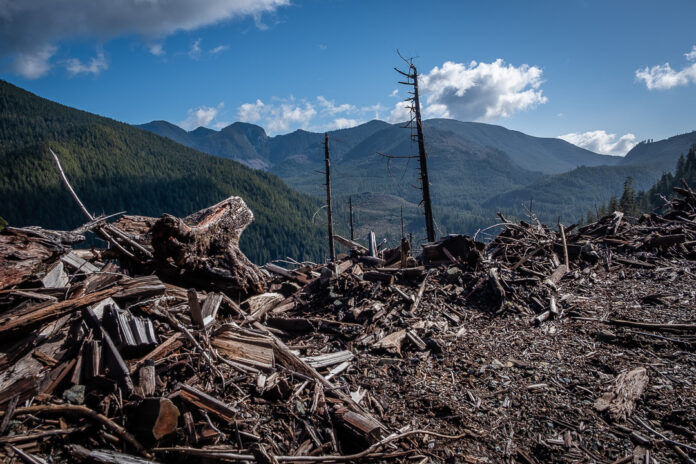
Publicly funded BC Timber Sales continues to allow the clear-cutting of the last remaining old forests, i.e., deforestation, on Crown Lands. Rapid loss of biodiversity is happening each and every day in the forests of BC. “…the current mass extinction is a crime of vast proportions…..cutting down the forest is a catastrophe, not only for the millions of species living in them, but also for the world’s climate.. ” Dr. Stephan Harding claimed in the book Animate Earth, in the year 2006.

Most people agree that random slaughtering of humans is unethical. but rationalists would argue that overpopulation will balance out the loss of those killed. But most people will argue that murder is wrong because each person has intrinsic value. Since there is no divide between human and “more than” human life forms, can we not conclude that it is wrong to dismantle any aspect of the natural world? Until humans humbly respect the sanctity of life, we will not stop destroying the forests, the oceans, and the grasslands. Modern humans have been hoodwinked into ignoring the very basic laws of nature. 

“even if solar, wind, and other green technologies were able to completely replace fossil fuels, an impossible scenario in itself, (they actually have a NET ZERO CARBON REDUCTION PER DOLLAR) as long as deforestation continues, that is not enough to stop global warming…..Stopping deforestation and restoring logged areas would remove more carbon dioxide from the AIR EACH YEAR THAT IS GENERATED BY ALL THE CARS ON THE PLANET. ” Bright Green Lies, co-authored by .Derrick Jensen

Two weeks ago I wrote BCTS, demanding that they take all old-growth cutblocks off their auction list. Not surprisingly, no word back so next up is the Minister of Forests.

Blurry

PFU ScanSnap Manager #S1100

TALENT SHOW  MAY 18

Talent show vector background, poster, template. Inscription bright on red curtain.

                                           TALENT SHOW  MAY 18

VARGAS ISLAND TRIP AND BOOKS TO GHANA  ARE TEAMING UP TO PRESENT AN EXCITING NIGHT OF ENTERTAINMENT.

The Grade 5/6/7 Class, led by Mr. Daniel Farrow, is looking to raise funds for an educational trip to Vargas Island! The Cedar Coast Eco-Lodge on Vargas Island (15 minute boat trip from Tofino) will guide the students through immersive nature experiences, focussing on culture and history, off grid living systems and how they interact with the local ecosystem.

Raising money to supply books to schools in Ghana is an ongoing project and the procedes for this year will go to a school run by an NGO called Theolak Foundation which is headed by an amazing woman who works tirelessly for kids in many ways.

If you wish to participate and you want to do something musical call Bethany Ireland @ 2503351330. For all other performances call Jude Kirk @ 2503350546.