Date: July 31, 2026
Subject: Rejection of Closing File 24006480 as Ferry Commissioner is in Compliance with Mandate
To: Ms. Byrne, Office of the Ombudsperson
From: Sharon Small
Dear Ms. Byrne,
I am writing to formally reject your July 16, 2026 decision to close File 24006480 based on your finding no evidence of administrative unfairness, procedural failure, or no improper exercise of the Commissioner’s exercise of its statutory discretionary authority in balancing the needs of customers, taxpayers and the sustainability of the corporation.
This rejection provides evidence that the Commissioner has violated both principles of regulatory law and the Coastal Ferry Act in uncritically basing decisions on BC Ferries (BCF) unsupported claims, while systematically ignoring opposing documented evidence—customer complaints, industry experts, Marine Workers Union, internal records, and the 2023 Anderson Review confirming the Baynes Sound Connector is a failed experiment. This rebuttal to your findings of compliance also provides evidence for how the Commissioner, in concert with the Ferry Authority and the Ministry of Transportation (responsible for creating and amending the Coastal Ferry Services Contract), acts to preserve the fiction that the independent corporate business model created in 2003 is a success and that BCF is meeting its Coastal Ferry Act (CFA) overarching mandate to provide safe and reliable service in a cost-effective manner to all coastal communities.
Systemic Application of Discretionary Powers Favours BCF
Under established principles of regulatory and administrative law, statutory discretionary power is not an absolute license to substitute unchecked corporate deference for lawful oversight. Administrative law strictly forbids a regulator from fettering its discretion—locking into a rigid routine of automatically accepting corporate claims rather than judging issues on their merits—acting with improper favouritism, or ignoring statutory criteria. A public regulator exercising delegated authority is legally required to act independently, avoid blindly rubber-stamping corporate claims, and hold all decisions to the rigorous statutory standards set out in Section 38 of the Coastal Ferry Act. The CFA stipulates that the exercise of statutory discretion requires strict procedural rigor: the Commissioner must act independently, strictly avoid favouring BC Ferries over customers and taxpayers, balance user needs with corporate sustainability, enforce expense minimization without compromising safety, maintain statutory community engagement, and base every approval on verifiable empirical evidence and documented decisions.
The following evidence-based documentation submitted in support of my application for an investigation confirms the Commissioner’s pattern of arbitrarily exercising the commission’s discretionary powers by systematically deferring to BCF and bypassing rigorous regulatory oversight:
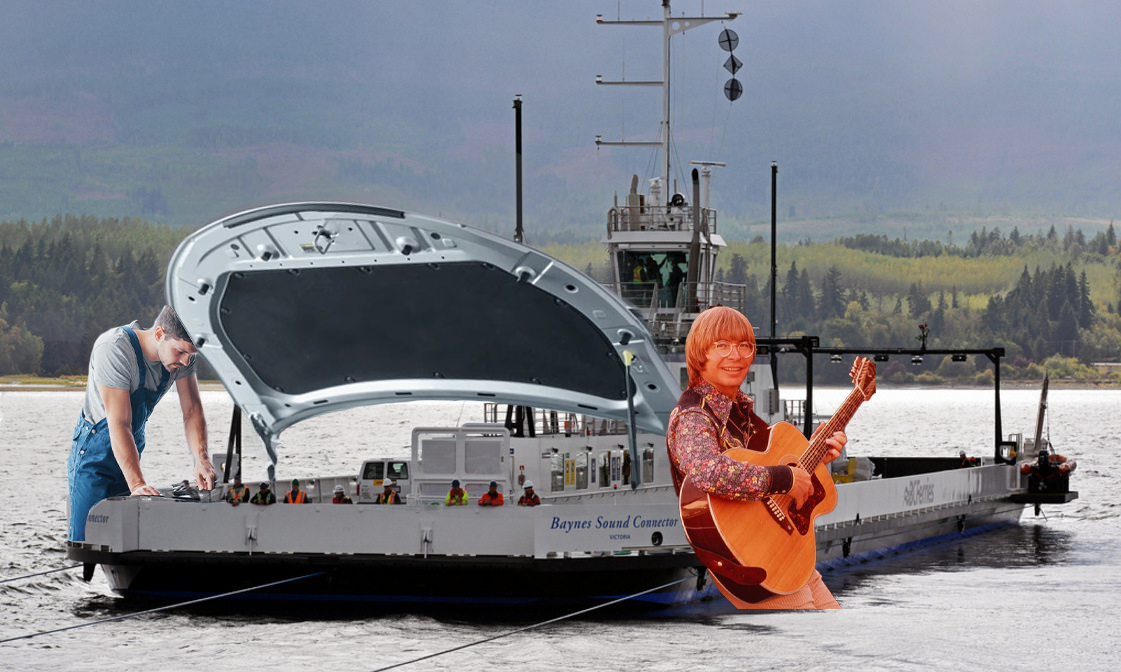
- Approving Capital Funding Claims: When Commissioner Gordon Macatee approved capital funding to build the untested cable ferry in 2014 based solely on BCF’s promises without evaluating supporting evidence, he established a precedent that Commissioners Sheldon Stoilen and Eva Hage have continued. Despite a preponderance of credible evidence—including BCF internal data, seven years of sustained customer complaints, and the 2023 Anderson Review listing five unresolved mechanical problems responsible for breakdowns—Commissioner Hage approved BCF’s application for $15–$17 million to repower and stretch the vessel despite strong pushback from industry critics who predicted the 2026 repowering would not improve performance.
- Applying Regulatory Scrutiny Inconsistently: The Commissioner formally probed BCF’s teething issue claims about the Quadra hybrids that broke down upon their 2022 launch and continued to break down in windy weather especially. She wrote in per posted probe report that the vessels had not met expectations. They are slated for replacement. Despite the cable ferry’s exact same service profile, the Commissioner responds to customer complaints that she lacks the authority to intervene in BCF’s service decisions.
- Uncritically Accepting BCF Reports: The Commissioner routinely approving BCF’s annual performance reports and operational filings without requiring supporting empirical data or conducting independent verification. A direct example of this blind acceptance is the Commissioner failing to challenge or evaluate BCF’s annual reporting claiming that the new digital engagement model is a success—a claim presented without evidence and directly refuted by an outcry from ferry-dependent communities and 35 coastal leaders representing the Union of BC Municipalities, who met with Premier David Eby and CEO Nicholas Jimenez to demand accountability for fleet breakdowns and the reinstatement of FACs as the sole independent oversight mechanism. Accepting unverified corporate self-reporting as self-evident fact represents an absolute breakdown of regulatory scrutiny.
- Validating Cable Ferry Performance Filings: Commissioner Stoilen set a precedent for succeeding Commissioners to uncritically accept BCF’s annual cable ferry performance reports claiming that the cable ferry provides service on a par with the Quinitsa. The Commissioners responded to the one-page form letters from 2021 to 2023 by confirming satisfaction of service parity with the added clause that the Baynes Sound Connector is providing service on a par with the Quinitsa and that BCF is in compliance with its Coastal Ferry Services Contract. This clearly pro forma exchange stopped after 2023, possibly due to my Comox Valley Record editorial citing evidence of BCF systematically underreporting cable ferry mechanical breakdowns.
- Uncritically Accepting Ferry Authority Reports: The Commissioner routinely approves reports from the Ferry Authority without supporting evidence. Amendments to the CFA in 2019 and 2022 granted discretionary power also to the Authority, which also uncritically accepts BCF self-reporting., which explains why the Authority has yet to pass a single resolution in the public interest, as mandated in the CFA while routinely approving executive raises and million-dollar without-cause severances—at the same time of BCF’s record-breaking debt, a negative credit outlook due to weak governance and management, declining service, and skyrocketing fares.
- Shielding BCF from Community Accountability and Oversight: The Commissioner accepted BCF’s unsupported claim that the new digital engagement system met its promise of being more inclusive than the Ferry Advisory Committee system—despite an outcry from coastal communities and 35 coastal leaders and politicians who publicly condemned the system for excluding entirely community engagement and called for reinstating the FACs, which provided the only independent BCF oversight.
- Increasing Tax Burden by Funding an Impaired Vessel: Approving funds in 2014 to build the cable ferry and $15–$17 million in 2023 to stretch and repower a handicapped vessel locks taxpayers into escalating, open-ended financial liability. BCF reported the cable ferry cost $5.9 million to run in 2023. However, because regulators permit BCF’s systematic denial of Freedom of Information (FOI) requests, the exact financial figures are kept hidden from the public. Based on industry estimates, the actual operating cost is pushed to an estimated $8 to $9 million annually—driven by Transport Canada’s directive to add an engineer due to breakdown frequency, double-time night repair labour, biweekly $5,000–$10,000 pulley swaps, and replacing cables at $230,000 each every nine months or when they fall off.
- Dismissing the Findings of the 2023 Anderson Review: The 2023 Anderson Review documented chronic mechanical breakdowns and unsustainable costs on Route 21, listing five unresolved mechanical problems responsible for breakdowns. It outlined choices for BCF to consider in descending order of cost:
- Option 1: Decommissioning the cable ferry completely.
- Option 2: Supplementing with a permanent conventional backup.
- Option 3: Stretching and repowering to increase hull capacity and power.
- Option 4: Status quo operational modifications.
- Commissioner Hage not only approved $15–$17 million for Option 3, but she also accepted CEO Nicholas Jimenez’s rejection of Option 2 based on his claim that supplementing would cost $91 million—a figure refuted by industry experts who claim upgrading the existing dock for a conventional vessel would cost $200,000—less than for one cable. Approving BCF’s selection totally rejects the Review’s evidence for decommissioning a failed experiment. (The refit in 2026 failed upon relaunch, idling the vessel for nearly two weeks while the conventional Quinitsa provided backup.)
The Coastal Ferry Services Contract (CFSC) Defers to BCF
The Commissioner’s deference to BCF is parallel to the Minister of Transportation who is responsible for creating and maintaining the CFSC. The following evidence shows that the contract is engineered to present the fiction that the 2003 independent business model, which shifted full oversight to the Ferry Commissioner and Authority, is a success and that BCF is meeting its CFA mandate to provide safe and reliable service in a cost-effective manner. Like the Commissioner, the Transportation Minister uncritically accepts BCF self-reporting that shields BCF from performance failures through the following mechanisms:
- Relying on Self-Reported, Unaudited Metrics: BCF self-reports quarterly data without third-party auditing, prioritizing corporate operational convenience over verified route-level service.
- Excusing Schedule Interruptions: Under Schedule A of the CFSC, cancellations or service disruptions lasting up to 20 to 30 consecutive days are routinely excused and excluded from BC Ferries’ official reliability counts.Cancellations are exempted from counting against service reliability figures if they are attributed to vessel or dock mechanical breakdowns, scheduled or unscheduled maintenance breakdowns, staffing shortages or labour disputes.
- Legally Permitting Aggregated Concealment: The 2012 amendment to the CFSC legally permits BCF to aggregate financial performance and operational metrics across the entire fleet, concealing chronic cancellations, staffing shortages, and service failures on minor coastal runs.
- Erasing Route Failures via System-Wide Aggregation: Multi-day cable ferry breakdowns vanish when absorbed into major corridor sailing totals, creating a misleading 99.9% fleet reliability metric used to deny specific Route service failures due to a defective vessel.
- Exploiting Weather and Maintenance Exemptions: Breakdowns occurring because the cable ferry or Quadra hybrids were not designed to handle their routes’ weather are excused as disruptions beyond BCF’s control.
- Disguising Design Defects: Core vessel design flaws, such as detached cables or aquaculture equipment tangling in cables, are excused as unavoidable marine conditions rather than inherent design failures for which BCF is responsible.
- Toothless Financial Enforcement and Disruption Allowances: BCF is granted an explicit allowance of up to 20 consecutive days or a cumulative total of 30 days per calendar year of unpenalized disruptions for mechanical breakdowns. Financial penalties are capped at a negligible $1,000 per missed round trip only after exceeding this 30-day disruption threshold, and even then are routinely waived at the Commissioner’s sole discretion. (Fining BFC has no affect on improving performance as executive salary increases and severances that are directly funded by taxpayers.)
- Laundering Performance Failures: Compliance certification is evaluated strictly against aggregate annual Core Service Levels, effectively sanitizing chronic daily breakdowns and severe service disruptions on Routes 21 and 23 served by vessels not designed for their route’s marine and weather conditions.
Your finding of no evidence of administrative unfairness or misuse of the Commissioner’s statutory discretionary authority simply rubber-stamps the Commissioner’s claims, just as the Commissioner rubber-stamps BC Ferries and Ferry Authority unsupported reports. This rejection of your finding that the Commissioner has acted in compliance with the CFA confirms the opposite—that the Commissioner is in breach of Sections 38(a)–(d) through systemic failure to balance priorities by favouring BCF, failure to enforce expense minimization, failure to enforce public and community engagement, and failure to provide rigorous capital oversight. This rejection also confirms that the Commissioner acts in concert with the Authority and the Ministry of Transportation to form a closed loop of accountability for one purpose—to support the fiction that the BCF independent business model is a success and BCF is providing safe and reliable service in a cost-effective manner.