Gabriel Jeroschewitz, August 18th, 2026, inspired by Baruch Spinoza (1632–1677), a radical 17th-century Dutch-Jewish philosopher. His name is shorthand for a revolutionary system of thought centered on pantheism (the belief that God and nature are the exact same thing), strict determinism (the denial of free will), and substance monism (the idea that all reality is a single, unified divine substance).
“Tell me,” said the serpent.
Underneath the timeworn oak tree that dominated the central square of the town was a weather-worn bench with an observer perched upon it. While he had a notebook open on his lap, he rarely wrote in it. The observer enjoyed watching the various families that passed through the market in the morning. The children played among the shops, drawn to the pigeons that roamed the market square, all with the same wonder in their eyes that Spinoza described as imaginatio. From his perch, the observer had a view of the world as an illustration of the three kinds of knowledge that Spinoza described in his treatise; knowledge that, while never written for toddlers, shimmered before the observer like reflections off the waters of the babbling brooks that ran through the town’s green
A mother crouched next to her toddler, attempting to build a tower out of wooden blocks. Each time the toddler attempted to build a tower high, it inevitably fell, leading to a scrunched face and cry from the toddler, but eventually the toddler’s small hands reached up for the blocks again. The mother smiled. Here was the first kind of knowledge, knowledge derived from the senses, knowledge derived from the feelings of the body, and knowledge derived from the memory of associations between those sensations. The infant’s body and mind were incapable of understanding the reason that the constructed tower of blocks failed each time; instead, the infant mind only had fleeting notions in its mind as a result of attempting to perform these tasks. Yet the mother’s soothing voice of “Let’s try again, sweetie” was the first element of stability introduced into the toddler’s mind and body; a routine that provided stability to the trembling conatus (striving) of the toddler.
Nearby, a father was showing his five-year-old son how a magnet could pull a paperclip across the table. The son’s narrowed eyes indicated his fascination with both the toy and the invisible line between the magnet and the paperclip. When the father explained that it was because of the invisible forces of both the magnet and the paperclip, the boy’s brow scrunched in concentration. Here, the second type of knowledge—ratio—started to emerge. The boy’s body, calmed after several months of eating meals and taking naps, allowed his mind to begin to understand the regularities in his world: objects fall off tables when released, pushing moves objects, and crying elicits care from caregivers. These are examples of the adequate ideas of each object—ideas that describe the nature of a thing through its causes. The father’s questions (“Let’s see what happens if we turn the magnet around”) encouraged the child to question and to enjoy the process of gaining such knowledge. The child felt free from fear and responsibility to simply explore such concepts and questions.
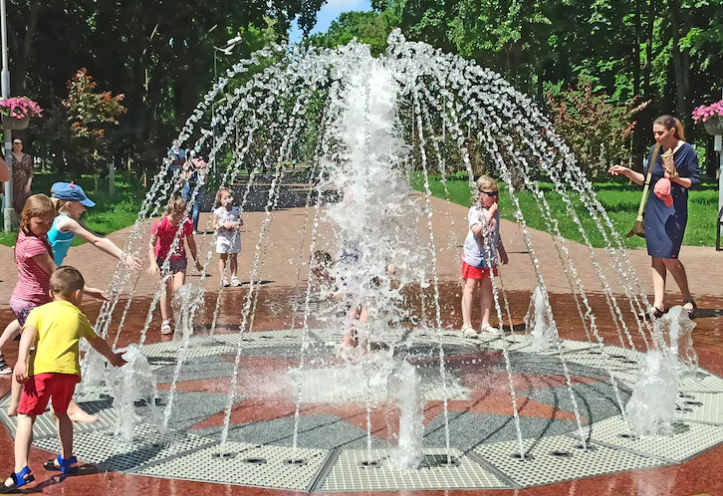
A gaggle of older children stood near the fountain, discussing the purpose of the fountain’s water rising in the center. One girl with braided hair and ribbons remarked that it was due to the pump pushing the water harder in the middle of the fountain. Another boy disagreed, stating that it was actually due to the shape of the fountain’s basin and how the water tends to seek out the lowest point within the fountain. These children’s discussions were as fluttery as a group of sparrows, offering up ideas as to the reasons for the fountain’s water rising in the center. Nevertheless, the girl and boy’s discussions caused a whimsical feeling in the observer regarding the resemblance of the children to a celestial council gathering above the fountain.
Angels—luminescent beings with wings and robes of sunrise—descended upon the square. They hovered around the infants, discussing what they had seen. One angel whose voice sounded like tinkling chimes said: “The infants dwell in imagination—their minds reflecting the world within their bodies. This is not a deficit in their minds, but the necessary ground for their thoughts to form.” Another angel, whose voice sounded like bells and who had silver hair like the moon, said: “When their bodies learn of ratio, the minds of the infants discover adequate ideas derived from common notions of all the bodies in existence.” A third angel, whose eyes shone with a naughty gleam, said: “Look over there at the youth. There is a scintilla of scientia intuitiva within one who has spent much time studying the finer points of geometry or music.”
From the periphery, a silhouette clad in midnight velvet stepped forward. He was the Devil himself, with horns of polished softness and eyes flickering with ember-light, beside his girlfriend, an angelic beauty whose smile is able to melt the sternest statutes. She shone in a gown of starlight and midnight roses, and her giggle sounded like the breeze passing through silver bells. She leaned in close to the Devil’s ear and whispered, “Hold back a little, my love. Let the children see that even darkness can be softened by wonder.” The Devil smirked at his girlfriend’s concern for the children, but softened his features at the sight of a little girl offering an apple to a shy boy. For a brief moment, the Devil felt the tug of restraint of his natural impulses.
Near the fountain stood the serpent, the dragon’s scales iridescent as gloss on water. Its head lifted as it spoke to the presence of the Holy Ghost, who appeared as a shimmering dove with a gentle flame within it. “Tell me, “Said the serpent, “does the ascent from imagination to intuition require the suppression of desire?” “No,” said the Holy Ghost, “desire is the fuel that will carry the mind to higher intuitions. It is not the suppression of desire that will allow the mind to arrive at adequate ideas, but the cultivation of desire for the acquisition of knowledge.” The serpent nodded contemplatively before slipping back into the stone fountain, leaving behind a trail of glittering dust.
Jesus, robed in simple linen, entered the scene among the families. Crouching beside the boy struggling with his shoes, Jesus asked him to allow him to demonstrate how to tie the knot. When Jesus successfully assisted the boy in tying his shoes, the boy’s eyes widened with understanding. Jesus said to him, “Understanding is not something given to us by others, but something that we must cultivate in ourselves, like a garden that must be tended to allow reason to grow.” Jesus turned to the Devil and his radiant companion beside him, a faint smile passing across his face as he spoke these words. “Even those who seem to walk in shade can tend to such a garden.”
The observer’s notebook remained largely blank of writing as the scene itself contained the text. There were families taking care of their young and providing the architecture of stability to their lives. There were educators in the makeshift classroom who were encouraging the young to examine the world around them, to investigate concepts like gravity or why the sky appeared pink at dusk, or even to experience the joy of an “aha!” moment while learning concepts without being provided each step necessary to arrive at the answer—those brief glimpses of knowledge that Spinoza provided for the philosophically mature individuals yet which exhibited in the young as twinkles in the summer dusk.
In the village, he noticed how society provided its citizens with freedom of thought, freedom from fear, and the freedom to question everything around them. The signs read: “Question the world; the answer lies in your own mind.” The angelic discussion above them shared the same thoughts, for they trusted in the power of reason.
Once the sun began to set over the village, the Devil’s girlfriend turned to him and said, “As important as it is to question the world and to explore the how and why of everything around us, it is just as important to provide warmth and comfort to those in need.” The Devil watched as his girlfriend’s words returned to him in thought. Extending a hand to a child, he brushed the leaf from their cheek. An action he had not performed in a long time.
The observer closed his notebook. The heaviness of the day had settled upon him as a blanket. He had seen how an idea ascended from the sphere of imagination to reason to the intuitive insight of an awareness that did not require the pages of a treatise, but of the whimsical motion of the families, the angels, the devil and his beloved, the serpent’s curious query to the cross of Jesus. The square had become a treatise of the world, a Spinozian manuscript on the cultivation of adequate ideas, and how this idea of the world was capable of forming a romance with the idea of the human striving to persist despite the difficulties of an existence.