Shucking Oysters: Still Life With Brain Farts
By Alex Allen
Natural capital. This is a controversial term that refers to the “planet’s stocks of water, land, air, and renewable and non-renewable resources (such as plant, animal species, forests, and minerals).” Governments have now come to this profoundly destructive notion that, “just as all forms of capital provide a flow of goods and services, components of natural capital interact to provide humans and other species with goods and services that are wide-ranging and diverse.” Just think about that for a moment. Ecosystem goods and services commodified.
And before you switch the channel, this is the David Suzuki Foundation. That’s right. When can we ban the sale of KoolAid to all? “The services that nature provides for free are often not accounted for and, therefore, not properly valued by decision-makers. At the David Suzuki Foundation, we evaluate the benefits that nature provides and calculate the economic cost of these services if we had to provide them ourselves.”
Yes, I got a headache as well. That’s how most corporations and NGOs (with extreme agendas) work, just continually toss these Nerf balls of biz-babble, sprinkled with fairy dust and a hint of greed, where you don’t know whether to ask for another double spicy Caesar, sign a petition or nod your head vigorously in agreement. They are clever, watch out. Or you can just look the other way, down at that five by three screen and continue with your game of oyster crush.
My mother never let us drink KoolAid, no matter how much I begged. As an adult, I continually thank her for that. But seriously folks, there is so much stuff going on around us, above us, next to us, behind us, in front us, that it is no wonder most of us just want to stare at the screens of distraction instead of the reality of life.
We need another good distraction. Slow Food is a movement then why not Slow Groove movement or some such thing? I’m just thinking out loud at this point. We do have this opportunity to tweak our dimples as they say. Or maybe our cerebral cortex, but you all get the point. Shake it up. If you can’t stop drinking the KoolAid, then at least mix it up with a shot of vodka or two.
Let’s face it, we live in a disorderly universe, with its numerous paradoxes and inconsistencies. And yet we still seem to manage to navigate ourselves gingerly through this dystopian world. As Barry Lopez wrote in Horizon, not all of us are willing to face this frightening horizon, some “might opt to turn away, decide to become lost in beauty, or choose to remain walled off from the world in electronic distraction, or select catatonic isolation within the fortress of the self.” (Sounds like an all-expenses paid vacation to nowhere, which can’t be all that bad.)
Today, more than ever, our governments should be heeding the warning of Earth. Climate crisis, big boys. Like an abusive relationship Earth can no longer hide her scars and bruises. There are not even enough shelters to protect Earth and her family. Our governments and big business have got to end this marriage of ruthless desire and short-term gain.
Where is our ethical compass? As Lopez eloquently wrote, “the same short-sighted, narrow-minded belligerents” rise up in every era of human history. In BC, we have myopic Premier Eby. Clear cutting, LNG plants, fracking, large scale monoculture farming, polluted mines, and on and on. By the way, Eby, an old growth clear cut is not an outward sign of a healthy economy, it is a sign of an indifference to life.
Everyday, sometimes in harrowing ways, we are reminded that our fate is not ours to control. And yet we all toe the line as we have “grown to believe that this kind of regimented, obesiant, bounded existence actually represents freedom.”
We are crushing our spirits in the constant quest to own better things, to own more things, things that ironically we soon won’t want and will eventually throw away. Ziya Tong in The Reality Bubble, added that “the worse part, is this dependence on acquiring objects tends to worsen when things are tough, because when we feel insecure, having something solid to cling to becomes a coping mechanism.” Our possessions give us some semblance of control over the world.
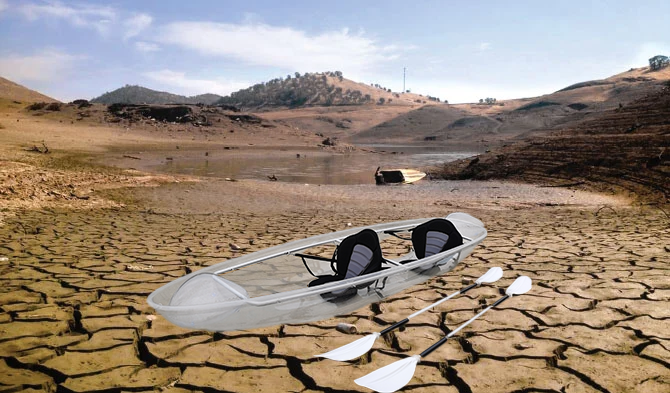
“I don’t care! This $8,000 two-person transparent hull canoe-kayak hybrid is made of Lexan! The same material found in the cockpit canopies of supersonic fighter jets!”
Why do we do this? Apparently, the simple answer is we believe that having things makes us happy. But we all know that the happiness we get from material goods is only ever temporary. Tong writes, “planned obsolescence and the need to upgrade, stay fashionable, maintain social status have us trapped like hamsters on a treadmill.” It’s known as the hedonic treadmill. And around and around we go.
I do sympathize with those of you who are caught up in that undertow of this nightmare, this delusion that a for-profit life is the only reasonable calling for the modern, progressive individual. Micah White wrote in The End of Protest that “our culture is infected by a commercial virus, a disease that keeps us distracted by illusions while the world collapses.” When we cannot name the species of trees, animals and insects around us but instantly recognize commercial logos, that is worrisome.
Of course, it is not possible to live up to one’s own standard of good behaviour every day. Distraction and indifference always offers us a way out of dilemmas otherwise too exhausting or harrowing to face.
Droughts. Water shortages. Wild fires. Parades of storms. Atmospheric tidal waves. Dying species. Ocean acidification and warming. Plastics.
Naomi Klein wrote about “cultural cognition,” which is a process that all of us do, regardless of our political leanings. We filter new information in ways designed to protect our “preferred vision of the good society.” It is always easier to deny reality than to watch your worldview shattered. And speaking of shattered. The climate crisis isn’t just about things getting hotter and wetter. Under our political and economic order, it’s about things getting meaner and uglier.
Resistance is about becoming a complete human being. It is about honouring the sacred. It is about dignity. It is about sacrifice. It is about courage. It is about freedom. It is about the capacity to love..
“The ultimate measure of a man is not where he stands in moments of comfort and convenience, but where he stands at times of challenge and controversy.”
– Martin Luther King