They’re designing park benches
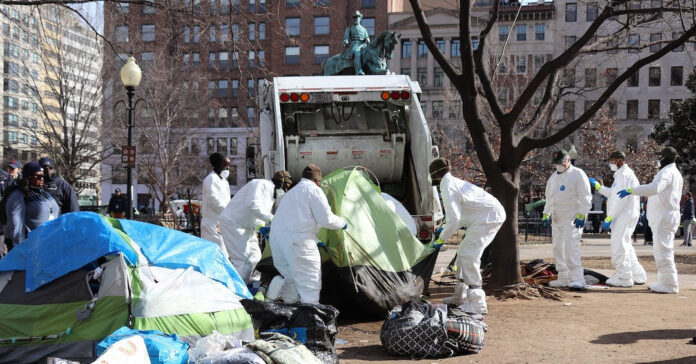
so that homeless people can’t sleep on them
and placing metal spikes beneath overpasses
so they can’t be used as shelter.
Jerry Seinfeld says Palestine doesn’t exist
and that sometimes socks go missing in the dryer,
wocka wocka
ha ha ha
it’s funny because it’s a witty observation
about life’s everyday little goofy goofs.
Fast food wrappers blow in the wind
like the leaves used to do.
Duct-taped gargoyles with garbage bag wings
peer down at the din of civilization
as we march over the sidewalk sleepers
to our Jobs,
stepping over dead bodies
while staring at our phones
and counting the minutes
til we can go home to our sofas
and watch wocka wocka comedians
and shovel SSRIs into our faces
from large plastic bowls
so the crushing beauty of our world
and the knowledge of our mortality
doesn’t topple us like Jenga blocks
and make us weep like open fire hydrants.
In this din they don’t want you to feel.
They don’t want you to think.
They don’t want you to hear.
They keep it all CLANG, CLANG, CLANG,
BUY, BUY, BUY,
WORK, WORK, WORK,
WOCKA, WOCKA, WOCKA,
so that you can’t feel your body.
So that you can’t hear the songs.
There’s bird song
and whale song
and heart song
and lung song.
There’s fire song
and sea song
and wind song
and tree song.
There’s ancestor song
and mountain song
and sun song
and wolf song,
and lots of others I bet;
I can’t hear any of them.
Oh, except thought song,
which blasts through my head
like a sonic homeless deterrent
in a shopping center alleyway,
and,
like them,
I have nowhere else to go.
________________
Caitlin’s Newsletter is a reader-supported publication. To receive new posts and support my work, consider becoming a free or paid subscriber.
Helliwell habitat work reduces fire risk and helps butterflies
By Chris Junck on behalf of the Taylor’s Checkerspot Butterfly Recovery Project Team
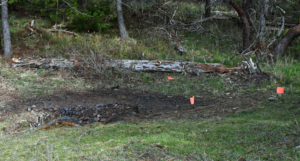
Did you hear chainsaws or see smoke in the Saint John’s Point area of Helliwell Park this spring? If so, don’t worry. It’s part of a multi-year BC Parks project to reduce forest fire fuels and improve habitat for butterflies and other pollinators. Selective removal of branches and a few trees was followed by native plant seeding of sites where piles of tree materials were burned.
The initiative is succeeding. The Taylor’s Checkerspot Butterfly Recovery Project Team (TCBRPT) is excited to confirm that endangered Taylor’s checkerspots successfully overwintered in the park for the third consecutive year! Larvae were found in Helliwell’s coastal bluff meadows this March by Jennifer Heron, TCBRPT Chair and Provincial Invertebrate Conservation Specialist for the B.C. Ministry of Water, Land and Resource Stewardship. The caterpillars are the offspring of butterfly larvae raised by Wildlife Preservation Canada staff at the Greater Vancouver Zoo and released by the project team in Helliwell in previous years. “This is a good news story. It’s a positive sign that Taylor’s checkerspot butterflies are re-establishing a population in the park”, said Heron.
The Taylor’s checkerspot population in Helliwell received a boost with the release of approximately 1,350 zoo reared larvae in late March. During the adult flight period in April and May, more than 15 Taylor’s checkerspot butterflies were observed by local naturalists and TCBRPT biologist Nick Page. Hopefully at least some of them mated and produced eggs that will go through several larval stages before overwintering.
While these are very hopeful signs for Taylor’s checkerspot butterfly recovery in Helliwell Park, their future is not assured. The caterpillars are tiny, delicate and vulnerable. Trampling by park visitors, dogs and bicycles are a key threat to the larvae and the plants they need to survive. Helliwell Park visitors can help the caterpillars by following park rules: leave bikes in the parking lot, stay on marked trails and keep dogs leashed and on trails. If you visit Flora Islet, stay on the shore, and avoid the fragile meadows. This will reduce the possibility of stepping on a caterpillar or their host plants.
Don’t move or pick up Taylor’s checkerspots. Instead, report sightings to Taylors.Checkerspot@gov.bc.ca, or by using the free iNaturalist app (www.inaturalist.org). It is an easy-to-use species identification tool that enables citizen scientists to record and contribute important species data for projects around the globe.
The project team would like to thank the Cowichan Tribes, Halalt, Homalco, K’ómoks, Lake Cowichan, Lyackson, Penelakut, Qualicum, Snaw’Naw’As, Stz’uminus, Tla’amin, We Wai Kai, and We Wai Kum First Nations for allowing us to restore ecosystems in their traditional territories. Several local volunteers from Conservancy Hornby Island, the Hornby Island Natural History Centre, the Hornby Island Parks Committee, and others also contributed to the success of this project.
The recovery project has benefited from funding and in-kind contributions from the BC Parks Licence Plate Program, the Habitat Conservation Trust Foundation, the Environment Canada Habitat Stewardship Fund, and the B.C. Ministry of Environment and Parks, B.C. Water, Land and Resource Stewardship (Wildilfe and Ecosystems Branch) Canada Pollinator Partnership and others.
The Taylor’s Checkerspot Butterfly Recovery Project Team includes biological consultants and representatives from the B.C. Ministry of Water, Land and Resource Stewardship, B.C. Ministry of Environment and Parks, Denman Conservancy Association, Garry Oak Ecosystems Recovery Team, Greater Vancouver Zoo, Mosaic Forest Management, Wildlife Preservation Canada, and others.
Learn more about the Taylor’s checkerspot butterfly:
All photos by Chris Junck, except the adult butterflies by Jennifer Heron and Nick Page.
Native plant seeds are scattered on sites where piles of tree material were burned during the forest fire fuel reduction project.
Taylor’s checkerspot butterfly larvae were observed in Helliwell Provincial Park this spring. It’s a sign that some of the endangered butterflies released in previous years reproduced, successfully overwintered, and are re-establishing a population in the park.
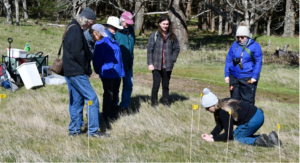
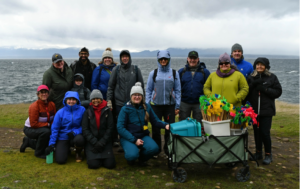
Conservancy Hornby Island and Hornby Island Natural History Centre members released 100 Taylor’s checkerspot larvae in Helliwell Provincial Park on March 25th. Left to right: Bill Hamilton, Kayt Chambers, Bill Caywood, Neil Wilson, Heron Selkirk, Anita Stjernberg (BC Conservation Foundation), and Jennifer Heron (B.C. Ministry of Water, Land and Resource Stewardship).
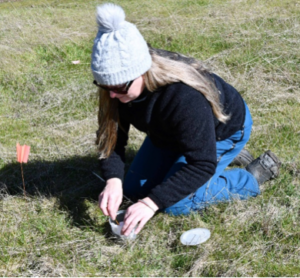
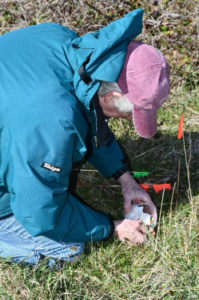
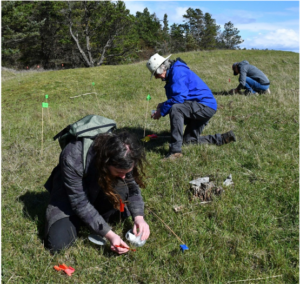
Taylor’s Checkerspot Recovery Project Chair Jennifer Heron demonstrates how to use a paintbrush to gently transfer larvae from their temporary home to food plants (ribwort plantain) in the meadow.
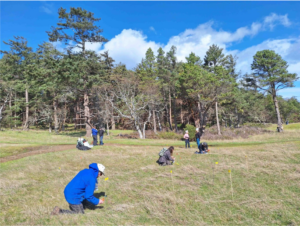
Many park visitors stopped by to ask questions about Taylor’s checkerspot butterflies and the larval release.
Neil Wilson.
Heron Selkirk, Bill Caywood, Kayt Chambers.
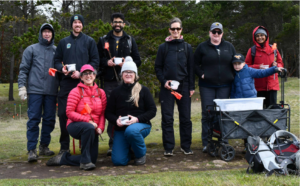
The Taylor’s Checkerspot Recovery Project Team and guests released over 1,350 larvae on March 26th and 27th.
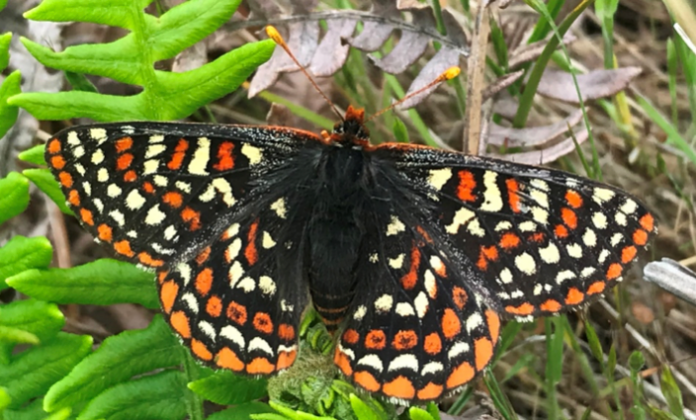
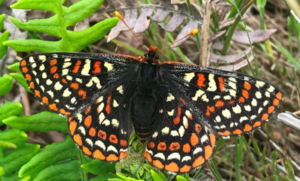
Taylor’s checkerspot butterflies were observed in Helliwell in April and May. Photo by Jennifer Heron.
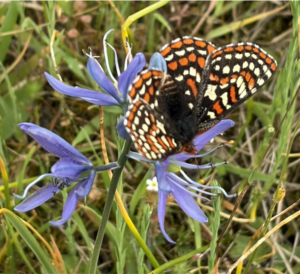
Camas is an important nectar source for Taylor’s checkerspots. Photo by Nick Page.
Historical range was Hornby Island, southeastern Vancouver Island, Puget Trough and to the Willamette Valley in Oregon. In B.C., they were once abundant at 10 sites in the Greater Victoria Area, one site each near Mill Bay and Comox, and sites on Hornby Island (including Helliwell Provincial Park).
They were thought to have been extirpated (became locally extinct) from Canada by 2000 when no Taylor’s checkerspots could be found in their last known sites on Hornby Island despite intensive searches. However, new populations were discovered on Denman Island in 2005 and near Campbell River in 2018.
It is federally listed as Endangered (COSEWIC, SARA Schedule 1), and is on the BC Red list of at-risk species.
Taylor’s checkerspot butterflies need open sunny meadows where they can find suitable host plants (food for larvae and nectar producing flowers for adults), such as native woolly sunflower, common camas, small-flowered blue-eyed Mary, wild strawberry, sea blush, and yarrow, as well as non-native species such as ribwort plantain and common plantain.
Habitat loss, degradation and fragmentation are major factors in the species’ decline. For example, the meadows along the coastal bluffs in Helliwell Provincial Park became less suitable for butterflies due to invasions of non-native plants and encroaching forests.
Habitat enhancement work (weeding, selective limbing +/or removal of conifers, re-planting and seeding with native species) has been ongoing in Helliwell Provincial Park for several years.
The Taylor’s Checkerspot Butterfly Recovery Project
The Taylor’s Checkerspot Butterfly Recovery Project is led by Jennifer Heron of the B.C. Ministry of Water, Land, and Resource Stewardship and is guided by the Garry Oak Ecosystems Recovery Team’s Invertebrates at Risk Recovery Implementation Group. It is a collaborative effort to restore Taylor’s checkerspot populations in British Columbia through habitat enhancement, captive butterfly rearing and release, monitoring, public outreach, and other activities.
Team Members
Jennifer Heron (Chair), B.C. Ministry of Water, Land, and Resource Stewardship, Vancouver, B.C.
Erika Bland and Andrew Fyson, Denman Island Conservancy Association, Denman Island, B.C.
Menita Prasad, Greater Vancouver Zoo, Aldergrove, B.C.
Eric Gross, Canadian Wildlife Service, Environment and Climate Change Canada, Delta, B.C.
Crispin Guppy, Entomologist, Vanderhoof, B.C.
David Vey and Rachel Shanner, Mosaic Forest Management, Nanaimo, B.C.
Chris Junck, Garry Oak Ecosystems Recovery Team and B.C. Conservation Foundation, Victoria, B.C.
Suzie Lavallee, University of British Columbia Faculty of Forestry, Vancouver, B.C.
Patrick Lilley, Private Consultant, North Vancouver, B.C.
Iain Reid, BC Parks, Black Creek, B.C.
Kristen Miskelly, Satinflower Nurseries, Victoria, B.C.
Derek Moore, Area Supervisor Von Donop Area, BC Parks, Black Creek, B.C.
Nick Page, Raincoast Applied Ecology, Vancouver, B.C.
Hazel Wheeler, Andrea Gielens and Jag Athwal, Wildlife Preservation Canada, Guelph, ON.
Bonnie Zand, Independent Consultant, Fanny Bay, B.C.
Supporters
B.C. Conservation Foundation
B.C. Ministry of Environment and Parks
B.C. Ministry of Water, Land, and Resource Stewardship
BC Parks License Plate Fund
Conservancy Hornby Island
Denman Conservancy Association
Environment Canada Habitat Stewardship Fund
Garry Oak Ecosystems Recovery Team
Greater Vancouver Zoo
Habitat Conservation Trust Foundation
Hornby Island Community School
Hornby Island Co-op
Hornby Island Natural History Centre
Hornby Island Provincial Parks Committee
Mosaic Forest Management
Sea Breeze Lodge
University of British Columbia
Wildlife Preservation Canada
For more information about the Taylor’s Checkerspot Butterfly Recovery Project, visit: www.goert.ca/activities/taylors-checkerspot/
Or contact:
Project Lead/GOERT Invertebrates at Risk RIG Chair
Jennifer Heron
Provincial Invertebrate Conservation Specialist
B.C. Ministry of Water, Land and Resource Stewardship
Office: 778-572-2273
Jennifer.Heron@gov.bc.ca
Public Outreach Coordinator
Taylor’s Checkerspot Butterfly Recovery Project Team
The K’ómoks First Nation treaty includes what the Nation calls the Southlands, a large parcel in Royston between highways 19 and 19A. Photo by Dave Flawse/The Discourse
At the end of May, the B.C. government gave a third and final reading of the K’ómoks Treaty Act, which will now go to the federal legislature to be ratified, a moment that has been over thirty years in the making. If passed, the treaty will give K’ómoks First Nation the ability to self-govern and bring economic development to newly acquired lands in the Comox Valley.
“The economic opportunities are huge,” says K’ómoks First Nation Chief Nicole Rempel in an interview with The Discourse, adding that “it’s all about working together.”
What are the potential economic benefits for the First Nation and wider Comox Valley community? And how does the Nation’s economic development plan compare to other nations with treaties in B.C.?
Here’s what you need to know.
How will the treaty affect private lands?
The treaty includes the transfer of Crown land and private land already purchased by the province of B.C. for the treaty settlement to the Nation.
The B.C. treaty process is designed to get Crown or government lands back into the hands of First Nations and does not impact private property without special agreements in place.
“Any private lands in our treaty are on a willing seller, willing buyer basis. So, [K’ómoks First Nation is] not expropriating anybody’s property,” Rempel adds.
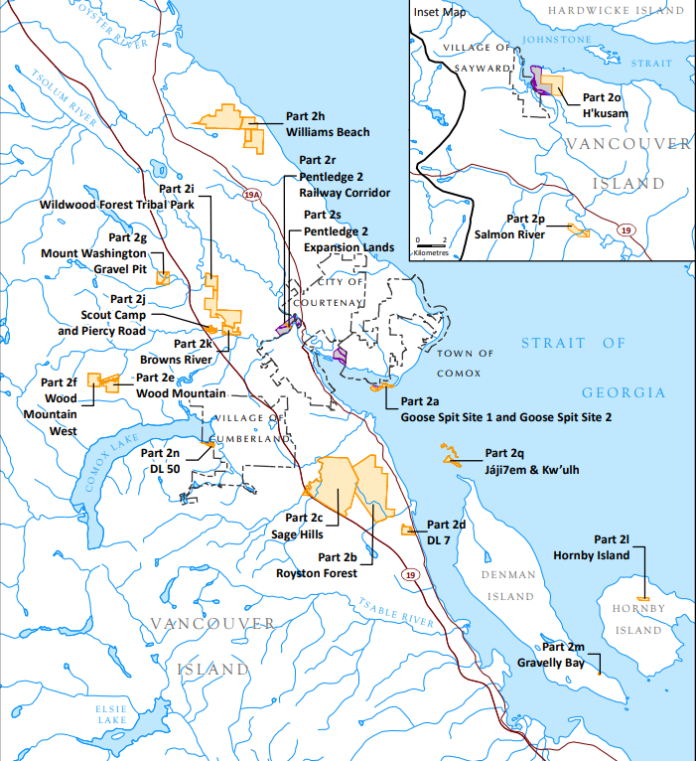
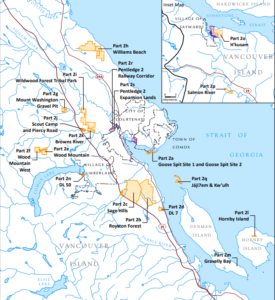
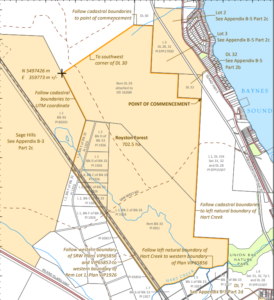
The treaty lands include several parcels throughout the Comox Valley and K’ómoks traditional territory. The largest is what the Nation calls the Southlands, a section in south Royston between highways 19 and 19A, marked as “Part 2b Royston Forest” and “Part 2c Sage Hills” on the map below.
Map showing the parcels K’ómoks First Nation will acquire in its treaty, totalling more than 5,000 hectares. Map from K’ómoks treaty appendices
Plans already exist to bring sewer infrastructure to the Southlands area, which Rempel says is probably the Nation’s “most immediate opportunity for growth,” noting that septic systems in the area are failing and “they flow right into Baynes Sound, the shellfish breadbasket of Canada.”
“To be able to partner with the regional district and the city to provide services to better opportunities there is also really important,” Rempel says. “Just the economic opportunities for the whole region and throughout our territory, I think, are really important as well.”
Opportunities to build housing
Providing critical infrastructure, such as sewer, to the Southlands will also make way for housing to be developed according to Rempel. And she says the Nation hopes to address housing needs not just for K’ómoks people, but for people in the Comox Valley as a whole, with Rempel noting the importance of partnering with local governments for any future projects.
“You look across the country and there’s just a housing crisis for everybody,” Rempel says. “If K’ómoks can utilize some of our treaty lands to address that, I think that it’s all about working together.”
Daniel Arbour, Area A Director with the Comox Valley Regional District, agrees.
“The treaty is welcomed by the Comox Valley Regional District, and I think it will bring opportunity for the Nation but also for the Valley as a whole,” Arbour says.
“It’s going to be a change in growth in the south if everything comes through.”
Some of the land covered in the treaty is adjacent to Union Bay Estates, a large, master-plan development that had promised to change the community. But all work by the regional district related to the project “has been paused until further notice,” according to the regional district’s website.
The developer, Kensington Union Bay Group, is under receivership and the partially developed land is under a court-ordered sale.
Union Bay Estates, the regional district and K’ómoks First Nation had partnered to bring sewer infrastructure to the area. With Union Bay Estates no longer able to commit funding to the Sewer Extension South Project, the regional district and Nation are seeking additional grant funding to cover the shortfalls.
“There will always be some unknowns around how the relationship will evolve but [K’ómoks First Nation] has been excellent to work with,” Arbour says, adding that the Nation is “very open-minded and forward-looking.”
A portion of the Southlands, which includes private land that was previously purchased by the province in anticipation for the K’ómoks First Nation treaty. Map from K’ómoks treaty appendices
Melissa Quocksister, a K’ómoks member and communication and engagement consultant with the Nation, says the treaty also provides the Nation the ability to “build differently.”
“We have to match or beat the B.C. Housing standards and codes, but I think there’s a real opportunity to look at how to develop in a different way,” Quocksister says. “No urban sprawl, really green technologies. [We can] build it in a way where it fosters community and gatherings and really exciting stuff like that.”
Quocksister says the Nation could also be a future employer for the region. She says the treaty is a benefit to everyone involved on a greater scale.
Other examples of First Nations with modern treaties
Several nations in the province, including Tsawwassen First Nation, have fully ratified modern treaties, which gives them the right to self-govern their land.
The Tsawwassen Economic Development Corporation has leased land for several residential, commercial and industrial projects, including the Tsawwassen Mills shopping centre and a Vancouver Fraser Port Authority and Canada Border Services Agency inspection facility, according to an implementation report on the treaty.
“Every nation has something unique and special about how they can prosper,” Quocksister says. “The possibilities are potentially endless with the amount of land we have.”
But Quocksister also notes that with so much happening, K’ómoks First Nation will need a lot of support.
“That’s one of our key messages. This is a Comox Valley treaty. This is a Vancouver Island treaty, a B.C. treaty, a Canada treaty. It’s for everybody. Everybody will benefit,” Quocksister says.
Rempel says the Nation approaches partnerships with neighbours, “whether it’s Indigenous communities or local governments,” with collaboration, asking, “How do we all move forward together in the same canoe, building something bigger and better for everybody?”
The beauty of capitalism is that every human interaction can be transformed into a revenue stream. Friendship? Subscription service. Romantic relationships? Premium membership tier. Breathing? Freemium model with pop-up ads in between inhalations. Everything can be monetized, confirming the expert consensus that global free market capitalism has never failed us.
It is time to put to rest one of the most outrageous myths ever propagated upon humanity, that free market capitalism is fatally flawed. The evidence to the contrary is overwhelming. Whenever there is a financial crisis, a housing crisis, an environmental crisis, a healthcare crisis, a debt crisis, or a crisis involving people being unable to afford food, shelter, or medicine, it simply demonstrates that there was not enough free market capitalism. The solution, as always, is more of the thing that critics allege caused the problems.
If a bridge collapses, privatize the river. If wages stagnate, deregulate industries. If children cannot afford school lunches, introduce a competitive bidding process for calories. The market knows best. Critics often point to economic inequality and complain that a handful of billionaires possess more wealth than entire nations. But this merely reflects the natural order of things. In nature, lions eat gazelles and eagles eat rabbits. Hedge fund managers purchase their third super-yacht while teachers compare grocery prices. This is what smart economists refer to as “efficiency.”
Market forces are so wise that they can solve every problem, except those they allegedly create, with the best ideas ever conceived by the human mind. History teaches us that providing universal healthcare leads to catastrophe. First, people receive medical treatment, then they become accustomed to surviving illnesses. The next things they’ll want are affordable education and transportation, clean drinking water, and retirement pensions. Before long, citizens will begin expecting affordable cellphones and internet. Civilization will rapidly descend into chaos.
The slippery slope is obvious. Today it is public healthcare, tomorrow it’s affordable food and housing. The next day, children will be reading books without first obtaining venture capital funding. Soon enough, grandmothers are receiving prescription medication without maximizing shareholder value. Society cannot endure such recklessness. Imagine a world in which housing is viewed as shelter rather than an investment vehicle. Imagine a world in which corporations do not possess constitutional rights, and lobbying divisions larger than some national governments. The horror is too difficult to contemplate.
Opponents to the free market point to countries with universal healthcare, affordable education, lower poverty rates, and strong social safety nets. Fortunately, free market advocates have developed a sophisticated rebuttal by simply changing the subject. Besides, non market based solutions suffer from a serious flaw where they assume that society should occasionally organize itself around human needs rather than quarterly earnings reports and higher stock market capitalization. Such dangerous extremism threatens the very foundation of civilization.
Thankfully, free market capitalism continues to guide humanity toward a brighter future in which every forest can become pulp and paper, every conversation can become data, every hobby can become a side hustle, and every waking moment can be optimized for shareholder returns. Some pessimists claim this trajectory is unsustainable, yet these same doubters have been wrong for decades. They warned about financial bubbles, ecological collapse, monopolization, regulatory capture, and wealth concentration. Fortunately, their concerns are irrelevant, evidenced by the rising stock prices over dozens of consecutive quarters.
Free market capitalism has never failed us. Any appearance of failure is merely evidence that reality itself requires further deregulation. Meanwhile, non-market based solutions remain the greatest threat to humanity because they stubbornly insist that economies should occasionally serve citizens rather than investment portfolios. Let us therefore celebrate the market’s unmatched wisdom. Let us privatize the moon, securitize rainfall, tokenize affection, and auction naming rights to the atmosphere. Only then can humanity finally achieve its highest aspiration, with perpetual and unlimited economic growth on a finite planet.
Ukraine: Yet Another War Based on Liesby Keith Porteous
The greatest lie of the Ukraine war is not the lie that Ukraine can still win, propagated by PM Mark Carney and the European leaders, but that this war was ever primarily about the well being of the Ukrainian people. The majority of people in Europe do not support the NATO proxy war in Ukraine.
For more than three decades following the Cold War, influential Western strategists viewed Ukraine as the decisive geopolitical battleground of the twenty-first century, a central piece in the vision to retain U.S. hegemony in a unipolar geopolitical world. As former U.S. National Security Advisor Zbigniew Brzezinski argued in 1997’s The Grand Chessboard, Russia without Ukraine would be fundamentally diminished as a Eurasian power. Ukraine was not merely another country, it was the geopolitical prize.
The objective was never openly described as the destruction of Russia. Instead, it was presented as the expansion of security and the rules-based international order, the same idea that PM Mark Carney described as a “pleasant fiction.” Beneath the rhetoric lay a strategic project that sought to extend the U.S./NATO influence ever closer to Russia’s borders while reducing Moscow’s capacity to re-emerge as an independent geopolitical pole. The fundamental assumptions underlying U.S./NATO policy have failed.
NATO expansion, over the repeated dismissal of Russian objections, and the transformation of Ukraine into a frontline state and Western proxy between East and West is not an accident or a mistake, it is a Russophobic policy certain to end in disaster. No Russian government, whether democratic or authoritarian, would passively accept the absorption of Ukraine into a U.S./NATO military sphere of influence. Warnings were treated as heresy by Western governments intoxicated by their own Cold War triumphalism.
The war was intended to weaken Russia, but instead Ukraine has suffered devastation on a historic scale while Russia remains intact. The war was intended to reinforce Western dominance, but instead it has accelerated global realignment away from it. The war was intended to demonstrate the effectiveness of economic sanctions, but instead it has revealed their limits. The war was intended to prove the superiority of the U.S./NATO alliance, but instead it exposed an imperialist project that is collapsing.
Yet despite these realities, Western governments continue to pursue the same failed course. Every military setback is followed by promises of eventual victory. Every failed prediction is replaced with a new prediction, while every escalation is presented as a solution to the failures of previous escalations. This logic resembles a drunken gambler doubling down after every loss. The tragedy is that Ukraine has become the table upon which the game is being played, with millions displaced, and much of Ukraine’s infrastructure shattered.
A generation of young Ukrainians has been sacrificed in a war that is an unwinnable war of attrition rather than the pathway to a U.S./NATO “victory.” Yet Western politicians, safely removed from the battlefield, continue to speak of perseverance and sacrifice, the sacrifice of other people’s sons and other people’s futures, while Ukraine is run by corrupt far-right and undemocratic elements hellbent on extracting more financial and military support from the West, while their own people do not support this war.
Meanwhile, uncomfortable questions remain carefully quarantined from public debate. Ukraine’s entrenched corruption did not disappear when the war began. Nor did the ethnonationalist and far-right movements that Western media outlets regularly discussed before 2022 and then abruptly treated as an awkward subject best left unexplored. These realities define Ukraine, but do not disappear simply because they complicate a preferred narrative. Currently, Ukrainians live under martial law with no press or other basic freedoms.
Convinced of their superiority and righteousness, and insulated from the consequences of their decisions, Western leaders have pursued a strategy that transformed Ukraine into the frontline of a geopolitical struggle and then expressed surprise when that struggle has produced catastrophe. Polls show the leaders of the U.K., France, and Germany holding well below 30% support of their citizens, with British Prime Minister Keir Starmer now forced to resign as a result.
As we move up the military escalation ladder, the world is now facing the possibility of a direct conflict between the world’s largest nuclear powers. History may judge the destruction of Ukraine not as an unavoidable tragedy, but as the predictable outcome of a project that mistook strategic ambition for wisdom, and propaganda for reality.
Arthur sat in the corner of “The Salty Dog,” a pub whose walls were adorned with the brown nicotine and regret of the North Sea’s sailors. Before him was a plate of fish and chips, the vinegar and salt tangs clashing with the newspaper lining the basket. Across from him sat Brother Koji, a man who had spent forty years in a monastery in Kyoto only to realize that the Absolute was manifested in a deep-fryer. Koji stared into his bowl of fish soup, dressed in a pair of vintage four-wheeled roller skates.
“Have you eaten your meal, Koji?” Arthur asked, nudging him with a limp chip.
“I have eaten,” Koji replied softly. “But I am still starving. To be full is to deny my hunger. To be empty is to deny the banquet that the Absolute presented to me. Therefore, I am both full and starving.” He gestured to the plastic vinegar bottle that sat beside Arthur’s plate.
Arthur sighed. He was fifty-two years old and had recently endured another failed marriage and an accounting error that had resulted in another quarter’s loss for his company. He wanted to escape to a place where time stood still – or better yet, stopped altogether – and he sought the Zen lifestyle from Brother Koji.
“Wash your bowl,” Arthur said, mimicking the ancient Zen master Joshu.
Koji’s laughter rang through the pub. “If I wash my bowl, I erase the history of my fish. If I do not wash my bowl, I succumb to the decay of my ego. The Absolute is the grease in the deep-fryer, Arthur. The grease is the filth and the purity that exists in the deep-fryer. It is the contradiction of existence, and it manifests in the grease in my spoon.”
With a creak and a clatter, Koji began to skate on his vintage skates. His outfit contrasted with the absurd act of skating in such a dark and salt-affected corner of the pub.
“You’re obsessed with finding the pattern in all of this, aren’t you?” Arthur asked, stabbing at a piece of cod with a fork.
“It amuses me how much you two are alike,” Koji said, eyes wandering to the ceiling. “You are wearing these skates to avoid the ground under your feet with your meals, just as I wear these skates to avoid the ground of your pub. You seek to escape from the same thing that I do.”
“And what,” Koji challenged, looking back at Arthur with a smirk, “is that thing that we both seek to avoid?”
“The fact that we are not the authors of our own lives,” Arthur noted.
“We are the reels in the film projector of our lives, Brother Koji. We are the film strip of our existence—the moment the lens focuses on us is the moment the light of our existence consumes us. And then we are gone, swallowed whole by the dark bin of ‘what happened’ in our lives.”
Koji stood up straight and began to skate in a tight circle around the small pub table. The man in the faded robe and vintage roller skates was absurd in that corner of the pub at that moment in time. A few patrons glanced over and looked away from the holy man on wheels.
“If the Absolute manifests in dialetheism,” Koji shouted while skidding around the table, “then the contradiction manifests as the truth! I am skating but standing in place. I am eating but feeling hollow. The pattern does not define us, Arthur! Our belief that the pattern of our lives should be ‘fixed’ is the problem!”
Arthur could contain his dark humour. The absurdity of the situation—the holy man in roller skates circling the table—was the only honest thought Arthur had seen in years—the “extra” thought in a life defined by Zen.
“You’re going to fall,” Arthur noted.
“I have fallen,” Koji cried out sharply while skating on his skates. “I have been falling in this life since my birth. It is the only way that I have ever moved through this existence with purpose.”
The holy man suddenly hit a patch of spilled ale on the wooden floor. His legs shot out from under him as he crashed into the booth, his bowl of fish soup flying into the air before splattering onto Arthur’s plate.
Silence settled in the pub like a fog. The smell of vinegar was overpowering.
Koji lay face down on the floor. His legs continued to twitch within the vintage skates as his head turned to one side in profound enlightenment. He looked up at the ceiling of the pub, then to Arthur.
“Did you see that?” Koji asked in a whisper of awe.
“The bowl was the contradiction,” he murmured. “The soup was the Absolute. The table became the reality of my existence.”
Arthur looked at the remains of his meal. The salt had transformed the fish into a gray mass. The pattern of his existence began to take shape before him—as both a problem and a solution. He could not fix it. He could not change the pattern of his existence. He was both the man eating the meal as well as the man whose meal had been destroyed. He was both holy and a joke.
Joshu would have made Brother Koji finish the fish.
Koji struggled to stand on his skates. He did not unstrap them from his feet. “The meal is over when the film breaks,” he said, looking down at his plate. “The film is always breaking.”
Arthur chuckled. “You’re drunk.”
“I am,” Koji said, smiling sadly. “But I am also perfectly sober—in this very crowded space of existence.”
Arthur leaned back in his booth. The moth outside swayed against the overhead dim bulb. He thought of the pattern of his existence—the times he had sabotaged his own happiness and denied the life he had authored for himself. He had been waiting for the end of his existence for years—yet there was no backstage pass.
He was the soup on the table of his existence.
He was the man who had eaten too much.
He was both the author and the character of his existence. He was the problem and the solution to the contradictions in his life.
In that dying pub in the corner of town, Arthur realized he was okay with being the man that he was.
“Wash the bowl, Koji,” he said to the bartender.
“I can’t,” Koji said, staring at his plate. “I’m wearing the skates.”
“Then we’ll leave it,” Arthur said. “No need for anything extra.”
The two sat together in the dark of the dying pub. The film would play on in the mind of the holy man—and in the dying one of Arthur—but for the first time in his life, Arthur did not wish to end it.
He watched the film of his existence play out on the screen of his mind—frame by flickering frame—until the light in the pub went out altogether.