
Home Blog Page 110

NATO – Not A Tenable Option (Part 2)

NATO – Not A Tenable Option (Part 2) Sally Campbell

Many of my learnings about NATO are found in the excellent little book: NATO: What you need to Know, by Medea Benjamin & David Swanson, published this year, in time for NATO’s 75th “anniversary celebrations”, which sounds so benign to describe the world’s largest arms trading cabal.

Some of the book’s key points are:

NATO is run by the US

NATO is unaccountable to its members NATO’s primary function – weapons dealer

NATO has “partnerships” worldwide, including many dictators NATO members violate international law

NATO has an expansionist agenda

NATO partnerships

This was new information for me. NATO has dozens of “partners” circling the globe, from Columbia to Mongolia, including Iraq, Pakistan, & Afghanistan. A key concept of partnership is interoperability, which means “partners buying the same weapons, relying on the same people to maintain and repair and upgrade those weapons…to train military personnel on those weapons, and organizing militaries to function under the same command” (NATO@ 66). It involves the integration of new partner militaries into NATO through war drills such as are held in the Baltic Sea each year, and by participation in wars like Afghanistan & Libya. Training & war-preparation are also offered to NATO partners, through NATO’s 30 “National Partnership Training and Education Centers”, the NATO School in Germany, and the NATO “Defense College” in Rome. NATO has been a way to tie Europe to the US’ military, geopolitical and economic interests. (NATO@13) Of the US’ more than 900 military bases around the world, NATO forces use 54.

Canada is already deeply enmeshed in the US military machine. We have had interoperability with the US for years. (In fact, Amlo, Mexico’s very popular outgoing President, described Canada as “almost an associate State of the US”. Because of that, Mexico included Canada in their recent “pause” in diplomatic relations with the US. What does that say about us?)

NATO members and partners account for 69% of the world’s military spending. China spends 19% of what they spend. Russia spends 6% and Iran spends .4% of what they spend. (NATO@76)

Israel is a special partner, with a permanent “official mission” to NATO headquarters since 2017. There is close cooperation between Israel and the weapons industries of NATO members, who have bought billions of dollars’ worth of weapons from Israel (NATO@ 77). American- Israeli anthropologist Jeff Halper’s eye-opening book: War against the People: Israel, The Palestinians & Global Pacification (2015) exposes Israel’s mastery of technologies of control –

exporting high-tech weaponry, security systems and means of pacification around the world, “field-tested in Gaza”.

NATO Support & Procurement Agency

Even though I knew a big part of NATO’s purpose was to benefit the arms industry, I underestimated the extent to which arms-dealing is foundational to NATO. This agency lines up weapons deals between manufacturers and governments, is headquartered in Luxembourg, and has “operational centers” in France, Italy and Hungary. It actually has a greater number of staff, and handles greater amounts of money than does NATO itself. NATO has a relatively small budget, about $3.6B. It’s Procurement Agency has over 1,400 civilian staff and a budget of over

$5B Euros annually. NATO obligations are not really about dues; they are about how much money each country spends on its military, most of which spending goes into US coffers.

The NATO “Defense Ministers” decided amongst themselves in 2006 that each NATO country should spend a minimum of 2% of its annual GDP on military spending. (www.nato.int) In 2014, only 3 NATO members met that goal. In 2023, with much pressure from the US, that number had climbed to 24! (NATO@87) Canada is still not there, but our military is lobbying for our country to “meet our obligations” by increasing our spending to this arbitrary number, tied to our economy. NATO Secretary General Jens Stoltenberg now calls this target a ”floor, not a ceiling”. The US spends 3.5% of its GDP on the military, but somehow even that sounds more benign than $1 Trillion/year which is the actual tab if you include nuclear weapons (under the “Energy” budget), Veteran’s Affairs & Services, and Department of Homeland Security.

Naturally, the US military is much bigger than all other NATO militaries combined which perhaps gave members some false sense of security that “Big Bro” would protect them if need be, when actually our “protector” uses NATO as a cover for its global hegemony agenda.

Here at home, our military budget has nearly doubled in the last decade, from $20B to $39B per year. In 2023, we spent $3B on environment and the climate crisis. Canada is the 6th highest military spender of NATO nations and the 14th highest military spender in the world in 2021!

NATO’s expansionism is well-illustrated by its describing Western Asia & North Africa as “our southern neighbourhood”, a chilling parallel to the US Monroe Doctrine claiming Latin America as its “backyard” (NATO@124). NATO plans for world dominance are well-described in the book, which I recommend reading.

(Next week: NATO & the Parliamentary Petition)

Revolution Is Now

CAITLIN JOHNSTONE

SEP 06, 2024

People are always asking me what we can do to fight the tyranny and depravity of the empire and create a healthy world.

“But what can we do?” they ask. “You always talk about the problems, but we need solutions! How do we solve the problems you keep pointing to?”

It’s especially common during US election season, because I tend to spend a lot of time pointing to the fraudulent nature of western electoral politics and saying Americans will never be able to vote their way out of their problems.

Which is of course fair. If I’m saying “Not that way, it’s a dead end,” it’s only fair that I should be asked which way actually leads to the exit.

Trouble is I talk about solutions all the time here, and I’m always practicing what I preach and leading by example; some people just can’t seem to hear what I’m saying. It goes in one ear and out the other, because I don’t have any solutions that are as easy and immediate as “Cast your vote for Donald Trump, he’ll fight the Deep State” or “Cast your vote for Kamala Harris, she’ll stop fascism.”

The truth of the matter is that in the here and now there are no easy and immediate solutions to the problems we face in our world. The system is far too deeply entrenched, and people are far too deeply indoctrinated with propaganda to be persuaded to fight against it right now.

And I emphasize the words “right now”. My solutions might not be easy or immediate, but unlike voting for Trump or Harris in November, they will actually work if put into practice in sufficient numbers. 

An effective solution that we can all begin applying in the here and now is working to foment a revolutionary zeitgeist by spreading awareness of the depravity and deceit of the empire. The primary obstacle to real change is the fact that far too many people are far too brainwashed by propaganda to rise up against our rulers, so our first task is to begin working to wake people up out of that propaganda-induced coma so they can see how desperately real change is needed.

The tyrants won’t end their tyranny until they are forced to, and they can’t be forced to as long as enough people are propagandized into believing things are fine. That’s why so much energy goes into narrative control measures like mass media propaganda, censorship, government secrecy, the war on journalism, and Silicon Valley algorithm manipulation. They wouldn’t pour so much energy into protecting that part of the imperial machine if it wasn’t very vulnerable to attack.

So we attack it. We cultivate a habit of small acts of sedition, trying to do something every day to de-normalize the abuses of the empire in the eyes of the public. Our historically unprecedented ability to share ideas and information around the world in real time makes circulating unauthorized materials much easier than it used to be, and much more democratic. This is something we can all dedicate ourselves to.

The machine is far too big and powerful for us to take down on our own, but if enough minds can become unplugged from the narrative matrix, we can definitely bring it down together. Once enough minds are pointed at this project, more concrete solutions will emerge and begin gaining traction in our collective consciousness.

It’s too early for an uprising right now. Ever seen Les Miserables? The part with the barricade? That’s what it would look like if we tried to take the machine head-on right now. The people wouldn’t come. It would be unwinnable. History is full of such failed revolutions. So in the here and now we dedicate ourselves to the project of making sure there will be many others joining us at the barricade, in whatever form that direct concrete resistance might wind up taking.

The good news is this brings the revolution into the here and now, since right now the revolution looks like something we can all start doing today. Each and every one of us.

None of us can do everything, but we can all do something. Anything you can do to help open the next pair of eyes to the horrors the empire is inflicting upon our world, the injustices our rulers are imposing upon us in our society, and the lies we’re being told to justify it all. 

You can do this using any means at your disposal. Talking to people. Distributing literature. Making videos. Making TikTok skits. Making tweets. Making art. Making memes. Writing on the wall. Writing blogs. Printing zines. Writing letters to the editor at your local paper. Anything you can do to help get unauthorized ideas into eyes and ears which may not otherwise have encountered them, using your own unique set of skills and personal conditioning.

The more eyes are opened to what’s going on, the more hands we will have working toward the task of waking up the others. This allows for the possibility of nonlinear growth, which means things could move very quickly from looking impossible to looking inevitable.

All positive changes in human behavior are always preceded by an expansion of consciousness, whether you’re talking about changes of the behavior in an individual or changes in the behavior of our entire species. So let’s get to work expanding it.

It is my sincerest wish that one day before too long what I do here will be seen as nothing special, because there are so many others doing what I do that I no longer stand out in the crowd in any way. And ideally this project here will then fade into total obsolescence, as we create a healthy world together which makes it completely unnecessary.

________________________________________________________________________

My work is entirely reader-supported, so if you enjoyed this piece here are some options where you can toss some money into my tip jar if you want to. Go here to find video versions of my articles. If you’d prefer to listen to audio of these articles, you can subscribe to them on Spotify, Apple Podcasts, Soundcloud or YouTube. Go hereto buy paperback editions of my writings from month to month. All my work is free to bootleg and use in any way, shape or form; republish it, translate it, use it on merchandise; whatever you want. The best way to make sure you see the stuff I publish is to subscribe to the mailing list on Substack, which will get you an email notification for everything I publish. All works co-authored with my husband Tim Foley.


Bitcoin donations: 1Ac7PCQXoQoLA9Sh8fhAgiU3PHA2EX5Zm2

Featured image via Adobe Stock.

Letter to the Editor – Bob Morley

‘Wine Wisdom’

Upon opening the latest vintage of 2024 Grapevine, an article by ‘alcohol’ Alex, with a 13.5 vol content, poured into my cheeerful cup. Numbed by his buzzed words and worship of the Roman god Bacchus, whose ‘sheer hedonic pleasure’ if crossed, could become vengeful, driving one into madness – ‘alcohol’ Alex ‘releases us from the stress of being conscious of ourselves’? And this is a joyful encounter!

Is there really a need to justify Your behaviour? As a member of the self-confessed ‘philosphical hedonist’ society of ‘modern drunkards’, you are drinking from ‘old wineskins’, and you can’t put a new patch on an old wineskin. 

There is a ‘new wineskin’ that is not a part of your old ‘wino wisdom’ status quo. The wine inside is inspired by a shared joy that subltly rises from the soil of community, revealing how true freedom springs from the pleasure of our company.  We don’t ‘need’ to go to AA, but if you’d care to investigate one of the ‘greatest contributions…to human life’, there is abundant  joy to imbibe from their prayer:  ‘God grant me the serenity to accept the things I cannot change, courage, to change the things I can, and ‘Wisdom’ to know the difference!   

 Cheers!  Bob Morley  

Letter to the Editor – Eric Atlee

CHINA

Canada will put a 100% tariff on Chinese EV’s. China will retaliate by not buying Canadian canola oil. Nobody else wants the stuff.

Canada, as a pre-emptive strike should switchable canola fields to wheat. With the disturbance in the Ukraine the world is screaming for the stuff. 

This hasn’t occurred to the government economists, all of who make a very healthy six figures.

The solution is obvious to a retired (semi-crippled) yard worker and lawn mower.

It is China’s goal to destroy all economies of western democracies thus proving dictatorships are superior. Chinese goods are cheap because their workers are paid one or two bucks an hour and their industries State subsidized by the above profits.

Those of us who buy their goods (it’s hard to get away from now. Chinese wages and State policy have killed American manufacturing), buying their crap is treason.

Me? Guilty as charged.

Clairvoyant not buoyant

Court Orders Sale of Union Bay Estates Developer Kensington Island Properties

Court Orders Sale of Union Bay Estates Developer Kensington Island Properties

A court has ordered the sale of Kensington Island Properties (KIP) as a result of $100 million in debt. As of December 31, 2023, the total amount due and owing to the Petitioners, pursuant to their Loan B Agreement, their Loan B Security, and their Forbearance Agreements, was $78,867,149.52, plus interest of 30% per annum, compounding monthly. This development proposal has been stalled for many years as the developer was not able to fulfill promises made to the Union Bay community, and requirements of the CVRD relating to sufficient water supply, and investments in sewage and other public infrastructure.

It’s important to note that this may not be the end of the story for this massive development project that was slated to be built over many years, starting with a “”200 slip marina” and a residential village, a hotel, and large retail amenities. The primary creditor is listed as Fox Island Development Ltd., owned by Advanced Venture Holding Co. Ltd., which may find a way to reorganize the project and debt, and attempt to continue with this project, but would be subject to the water and sewage regulations pursuant to the the Province, the CVRD and the Union Bay community. 

Significantly, Kensington Island Properties had also made commitments to K’omoks First Nation, in an agreement to share the cost of public infrastructure, all of which are now in doubt. (original reporting by allthingsunionbay.com) edited by TIG.

Shipbreaking in Baynes Sound: A Deepening Environmental Crisis

Shipbreaking in Baynes Sound: A Deepening Environmental Crisis

Introduction

Baynes Sound, a crucial part of the marine ecosystem off the coast of British Columbia, has recently become the center of an environmental controversy involving shipbreaking activities. This area, known for its ecological sensitivity and importance to marine life, is now facing significant threats from industrial practices that may be compromising its environmental integrity. Despite multiple inspections, warnings, and a detailed report from the Environmental Appeal Board (EAB), acute toxic discharges continue to pollute the waters, raising concerns among local communities and environmental groups. This article delves into the shipbreaking situation in Baynes Sound, examining the ecological implications, regulatory challenges, and the ongoing legal and administrative proceedings.

The Ecological Importance of Baynes Sound

Baynes Sound is a biodiverse region home to various marine species, including shellfish, which thrive in its nutrient-rich waters. It is also the largest and one of the last remaining herring spawning areas on the British Columbia coast, making it essential for the survival of herring populations that are critical to the marine food web. The sound is integral to local fisheries and the aquaculture industry, particularly oyster farming, which relies on the clean and healthy marine environment for sustainable production. This area also serves as a habitat for birds and other wildlife, making it a key ecological site that supports both biodiversity and local economies.

Shipbreaking Activities and Environmental Concerns

The controversy centers around the operations of Deep Water Recovery Ltd., a company engaged in the maintenance and recycling of marine vessels in Union Bay, part of Baynes Sound. The practice of shipbreaking, or dismantling old ships for parts and scrap, inherently carries environmental risks due to the hazardous materials involved, including heavy metals like copper, lead, and zinc. These materials, when not properly managed, can leach into the surrounding waters, posing significant risks to marine life and water quality.

Inspections and Warnings

The site operated by Deep Water Recovery Ltd. has been subject to numerous inspections and warnings from environmental authorities. Since early 2022, evidence has accumulated indicating that effluent discharged from the shipbreaking site contains heavy metals at concentrations exceeding the British Columbia (BC) Ambient Water Quality Guidelines. These discharges, which have been documented through regular sampling, show levels of copper, lead, and zinc significantly above what is considered safe for marine life, suggesting ongoing pollution that threatens the ecological balance of Baynes Sound.

The Environmental Appeal Board Report

The Environmental Appeal Board (EAB), an independent body that reviews decisions made under the BC Environmental Management Act, has been involved in this case. A key report from the EAB highlights the gravity of the situation. According to the report, Deep Water Recovery Ltd. was issued a Pollution Abatement Order in March 2024, which mandates the cessation of discharges containing high levels of heavy metals and requires the company to develop a comprehensive Effluent Sampling and Management Plan.

The EAB’s findings are alarming, as they indicate that the discharges from the site are not only above acceptable environmental thresholds but are also acutely toxic. This term refers to the immediate harmful effects on marine organisms, which can lead to long-term ecological damage if not addressed. Despite Deep Water Recovery Ltd.’s request for a stay of this order, arguing that compliance would cause irreparable financial harm, the stay was denied. The company continues to appeal the decision, highlighting ongoing tensions between environmental protection efforts and industrial interests.

Regulatory and Legal Challenges

The enforcement of environmental regulations in Baynes Sound has proven challenging. While the Pollution Abatement Order is a critical step, the appeal process is ongoing, with the EAB balancing the company’s economic concerns against the pressing need to protect the public interest and the environment. The board’s decision-making process is guided by the principle that the public’s right to a safe and healthy environment takes precedence over individual business interests, especially when evidence suggests significant ecological harm.

Impact on Human Health and Local Residents

The toxic discharges from shipbreaking activities not only pose a risk to marine life but also have significant implications for human health. Heavy metals such as lead and zinc, found in the discharges, are known to accumulate in the tissues of fish and shellfish. This bioaccumulation can enter the human food chain, potentially causing serious health issues, particularly for children, who are more vulnerable to the toxic effects of these substances. Long-term exposure to these heavy metals can lead to neurological problems, developmental delays, and other chronic health conditions.

Concerns are heightened by the close proximity of the shipbreaking operations to residential areas. One particular family, with small children, lives near the site and is directly exposed to potential contamination from air and waterborne pollutants. This situation raises urgent public health concerns, underscoring the need for stringent environmental regulations and proper containment measures to protect vulnerable populations.

Results of Toxic Discharge and Impact on Marine Life

Sampling data from various points around the shipbreaking site have shown disturbing levels of heavy metals. For instance, copper concentrations in the discharge points have been found to exceed the chronic exposure guidelines by up to fifteen times. Such levels pose serious risks to marine organisms, which are sensitive to even low concentrations of these metals. Chronic exposure can lead to physiological stress, reproductive failure, and increased mortality rates among fish and shellfish, thereby disrupting the entire food web in Baynes Sound.

Community and Environmental Advocacy

Local communities and environmental advocacy groups have been vocal in their opposition to the shipbreaking activities in Baynes Sound. Groups such as the Concerned Citizens of Baynes Sound (CCOBS) have raised awareness about the environmental degradation caused by industrial discharges. They have called for stricter enforcement of environmental regulations, better monitoring of industrial activities, and greater transparency from both the government and the companies involved.

CCOBS is also working to implement governance measures that would protect the coastline and advocate for Canada’s adoption of international shipbreaking regulations, including the Hong Kong Convention for the Safe and Environmentally Sound Recycling of Ships and the European Union Ship Recycling Regulation. These frameworks emphasize that shipbreaking should occur in heavy industrial, deep-water ports with full containment measures and strict regulatory oversight to prevent environmental contamination.

Conclusion

The shipbreaking situation in Baynes Sound represents a complex interplay of environmental, economic, and regulatory factors. While shipbreaking is a necessary industry, especially for recycling valuable materials, it must be conducted responsibly to protect sensitive ecosystems. The findings of acute toxic discharges into the waters of Baynes Sound are a stark reminder of the potential ecological and human health costs of inadequate environmental oversight.

Moving forward, it is imperative that all stakeholders—government bodies, environmental groups, local communities, and industry players—work together to ensure the protection of Baynes Sound. Strict adherence to environmental guidelines, coupled with proactive monitoring and enforcement, will be essential in safeguarding this ecologically valuable region and its residents for future generations.

Shucking Oysters: I’ll Drink to That

Shucking Oysters: I’ll Drink to That

By Alex Allen

Warning: Please do not read the following if you are pregnant, operating machinery or driving a car. 

I like drinking. I like the buzz. What I don’t like is when I don’t eat enough and get a little too buzzed. Which, thankfully, is few and far between. Perverting our sense of decorum is a very normal thing. In fact, getting buzzed helped humans advance civilization. 

UBC philosophy professor, Edward Slingerland, author of Drunk: How We Sipped, Danced, and Stumbled Our Way to Civilization, and self-confessed “philosophical hedonist,” reminds us to never lose sight of one of the greatest contributions of intoxicants to human life: “sheer hedonic pleasure.” Alcohol releases us from the stress of being conscious of ourselves. 

Slingerland points out that, “while it is socially acceptable to talk in purely aesthetic terms about our interest in fine wine, micro-brewed beer, or designer cannabis, we remain uncomfortable talking about our need for embodied pleasure for its own sake….This is the hang up we need to get over.” People masturbate. People get high. People drink. Why? Because they find it enjoyable and pleasurable. If their not harming anyone or being an a-hole, so what? 

Today, alcohol is still seen through a “medicalized lens” of addiction and public health impacts. The prejudice against chemical intoxication is deeply seated in our popular consciousness. We have no problem with people altering their mood by watching a cute puppy video, going for a jog in the woods, or dare I say it, taking antidepressants. Why is your neighbour, who meditates an hour a day, a better person than you, even though you can achieve the same result by drinking a couple of glasses of wine? 

In 2023, Canadian experts recommended two drinks per week versus the previous two drinks per day. Australia’s quota, published in 2020, recommends a maximum of 10 drinks a week. France the same. The US recommends no more than two drinks a day for men and one for women, while the UK suggests around six glasses of wine, or pints of beer per week. Australia, France and the UK base their alcohol guideline recommendations on a one in 100 mortality risk limit. Canada’s are based on a one in 1,000 chance of premature deaths related to alcohol which is two standard drinks per week, while the one in 100 risk limit is six standard drinks per week. Complicated. 

Am I a hedonistic anomaly? An outlier? Apparently not. “Modern Drunkard Magazine” answered my wet bar dreams. Put out by a group of functioning alcoholics, from novelists and English gentlemen, to barflies and comedians, the magazine celebrates all that is boozy. Their goal is to “return drinking to the glorious Rat Pack/Jackie Gleason Era.” I won’t quibble, but I am surprised they mention Jackie, and not Frank or Dean. Fun fact: The most prolific writers, artists and journalists of history drank before, during, and after work. One of the editor’s shared, “Personally, I’m amazed that magazines are produced by sober people.” Indeed.

One celebrity interview in “Modern Drunkard” was with 90s punker, Lydia Lunch, who, quote, “knocks a backhand of defiance into the face of the status quo like a shot of tequila spat into a gaping wound. Without apology, comparison or compromise, she blazes a multimedia trail of eloquently slung insults, revelations and seductions into the waiting glass of anyone thirsty enough to swallow her harsh, ferocious and intoxicating truth.” How about that for an intro?

Lunch explains her drinking philosophy: “In America, so many of my friends, if they have to go to NA or AA they have to go, and it has saved some people’s lives. Personally, I don’t understand ‘all or nothing.’ I’m for all and something more. All of this and more. One of them asked me, why don’t you have to go? I figured it out: because I don’t hate myself. I love myself; I am my biggest fan, and I don’t call that narcissism. I am self-ish. I think if more people loved themselves, they wouldn’t have to get blackout drunk.”

“Modern Drunkard” offers a wealth of information from Wino Wisdom, Helpful Hints for Hoochers to a Guide to Manly Drinks. For the uninitiated, manly drinks must be clear and brown. Vodka or gin. Better bourbon or whiskey. “If it’s brown, suck it down, if it’s pink, don’t you drink.” The name should never be trendy, clever, or have sexual innuendos in it. Even if your drink is a mixture of bourbon, bitters and Tabasco sauce; if it’s called a Fuzzy Slipper it’s not manly. A Rusty Nail or a Boiler Maker are good manly drinks. “It’s a cocktail, not a punch line.”

From weddings to wakes, and everything in between, alcohol plays a huge role for many people to experience the phenomenon of fun. The Sociologist website explains: “Fun is more than a laugh or smile; it is a euphoric sensation that temporarily removes any concerns and allows one to feel psychologically free.” Having a few drinks leads to more enjoyment, better sociability and less pressure. 

Some may say, the fact that alcohol is required for many people to experience fun is a sad reality. But hey, fun is serious business, in moderation. 

NATO – Not A Tenable Option

Polish soldiers hold a NATO flag after a training demonstration with the NATO multinational battle group eFPon at the Orzysz training ground on July 03, 2022 in Orzysz, Poland. A Russian State TV guest said Poland would soon be attacking the Russian city of Kaliningrad. Less GETTY

NATO Not A Tenable Option Sally Campbell

This great acronym came from the book NATO: What You Need to Know, 2024, by Medea Benjamin & David Swanson, co-founders of Codepink and World Beyond War, respectively. NATO was the subject of a 4 week book club through World Beyond War that completed last week.

I’ve been interested in NATO for some time now, primarily wondering why they were continuing to grow, why their “terrain” seemed to be spreading so far beyond the North Atlantic region, why Trump repeatedly chastised NATO nations for not contributing “their fair share” to NATO and leaving the “burden” to the US. His declaration that NATO nations were required to spend 2% of their GDP on their militaries (and most weren’t doing so) was a total surprise to me. I certainly don’t remember Parliament formalizing any such commitment into Canadian law. Who made that decision for us? At the time (2020), our government was spending 1.3% of our GDP on the military and that amounted to plenty. 2% of GDP would mean an increase of $11 Billion for 2020 alone. I decided to investigate NATO and I learned that several groups were working hard at opening our eyes to the realities behind this seemingly benign alliance – Just Peace Advocates, Canadian Voice of Women for Peace’s No to NATO campaign, Global Women for Peace United Against NATO, to name a few.

I had some questions: Why did NATO go to Kosovo? Why Afghanistan? Libya? Why were Canadian soldiers in Latvia doing war drills before Russia invaded Ukraine? And why is NATO now in the South China Sea for heaven’s sake? It’s a big learning curve and I’ll be on it for awhile. Here is some of what I’ve learned this last while and why we need to rethink our blind allegiance to this war-making organization.

One of the most disturbing aspects of NATO is that it is utterly controlled by the US. Ever since its inception, exactly 75 years ago, the head of NATO’s military branch has been a US General. He (yes, always a man) is known as the Supreme Allied Commander Europe, and he is simultaneously, the Commander United States European Command. Go figure. NATO’s Secretary-General (now Jens Stoltenberg) plays an administrative, public relations role and is always a European.

As I wrote earlier in The Grapevine (Letter to Trudeau, 11th May, 2020: Canada’s Membership in NATO), NATO’s original purpose in Europe was: “to keep the Soviet Union out, the Americans in, and the Germans down” (Lord Hastings Lionel Ismay, NATO’s first Secretary General). NATO according to David Swanson, “gives cover” to US interventions, as many think NATO is part of the UN, or its actions at the very least, to be authorized by the UN.

Article 5 of the NATO Charter states that any armed attack against a NATO member is considered to be an attack against all members, and all members will take the actions deemed necessary, including the use of armed force, to assist the Ally attacked. (www.nato.int) NATO members have intervened militarily in Kosovo, Libya, Iraq and Afghanistan although none of those nations have attacked a NATO member.

Going back to the 90’s, when the USSR disbanded, the Warsaw Pact which was established as a response to NATO 6 years after its founding, was dissolved. Swanson & Benjamin write that “according to declassified US, Soviet, German, British & French documents posted in the National Security Archive at George Washington University, Western leaders gave multiple assurances to Soviet President Mikhail Gorbachev and other Soviet officials throughout the process of German unification that NATO would not move toward Russia’s borders.” US Secretary of State James Baker’s famous promise of “not one inch eastward” was only one of these promises. (NATO @ 25) Shamefully, those promises were all broken, and NATO quickly expanded to Eastern Europe, taking in Poland, Hungary and the Czech Republic as members in 1999, followed by Bulgaria, Estonia, Latvia, Lithuania, Romania, Slovakia, and Slovenia in 2004. NATO troops (including 20,000 Canadians) began conducting war drills on Russia’s very borders. The US is now in the process of constructing its largest European base – on Romanian land, right up against Russia – which will house nuclear weapon capability planes, missiles and drones.

Russia’s invasion of Ukraine was a great gift to NATO. Since then, formerly neutral Finland and now Sweden have joined, and the NATO countries have significantly increased their military budgets, which means they are buying more (mostly US) weapons. Ukraine, which could easily have opted for neutrality and avoided a grinding war on its soil, still wants in. Surprisingly, NATO’s Secretary General Jens Stoltenberg, in a NATO conference opening remarks September 7, 2023, claimed outright responsibility for provoking Russia’s invasion. He said that in the fall of 2021, Putin sent a draft treaty he wanted NATO to sign, promising no more NATO enlargement in Europe. “It was a precondition for not invading Ukraine. If course we didn’t sign that, he said. “We rejected that. So he [Putin] went to war to prevent NATO, more NATO, close to his borders”. (NATO @ 100) What clearer statement of NATO provocation could there be? Yet NATO (and that includes Canada) and the US’ massive propaganda machines have labelled this tragic and unnecessary disaster: “The Unprovoked War”. This in no way excuses the Russian invasion of Ukraine, but it does invite reflection on our role in the current cycle of “endless wars”. Militarism breeds militarism. Is this our vision for a peaceful world?

(To be continued next week)

Green Wizardries: Elecampane

Green Wizardries, Elecampane by Maxine Rogers

I got the flu the other week.  I went to bed with a headache and muscle aches and woke up the next morning feeling much worse.  There was a deal of fatigue too.  I had to take part of the day off from work but luckily, I was not too ill to enjoy reading in bed.  Alas, the time off was not to last.

You see, I had a bit of elecampane syrup already made up in the fridge along with some elderberry syrup made from my first crop of elderberries last year.  I had several tablespoonfuls of each syrup over the course of the day.  I also made some tea from chamomile flowers which was recommended to me by one of my friends who was raised by her Grandmother who was a wise woman from the Balkans.  One of her Grandmother’s remedies for flu is chamomile tea with homey.  Chamomile is very anti-inflammatory.  

The next morning, I woke up, early, feeling fine and bounced out of bed and went off and did my first chores of the day.  Such is the power of herbs to treat our illnesses.  Elecampane is native to Europe and Western Asia but it grows very well on the Coast as it likes our acidic soils.  It is a stately plant reaching six or seven feet tall in my garden and it is crowned with a bunch of large yellow flowers. Elecampane is related to the sunflower family.  It’s leaves are huge and are favoured by small children who wish to dress up as faeries as the leaves make very good, huge wings.    

It is the roots that make the medicine for curing lung problems.  The autumn is the time to harvest the roots of a two to three-year old plant.  This means digging the whole very large plant up and washing the root ball to get rid f the soil and to see what you have.  Then, the roots are peeled, chopped and can be used fresh to make a tea to counter colds and flu and is even used to treat asthma and other lung complaints.  

One plant gave me several pounds of roots to work with.  To make a tea, I put 6 to 8 tablespoons of chopped elecampane roots into a saucepan and add one quart of cold water. The potion must be simmered on a low heat for  30 to 45 minutes.  To make a stronger decoction, I set the hot pan on a mat and swaddle it in towels or a tea cozy and leave for several more hours or overnight.  I can tell you it did wonders for my flu.  

Another way to preserve the roots is to make a tincture.    I filled a glass quart jar within a few inches of the top with the fresh herb.  The plant material must be covered with vodka two or three inches above the level of the herbs and put it away in a cool dark place where it can be shaken every day and left to tincture for four to six weeks.  Strain and bottle the tincture.  For colds and flu, I take a couple of teaspoons full two or three times a day.  It is really important to label containers at every step of the production as a bottle of tincture that cannot be identified must be thrown out.  

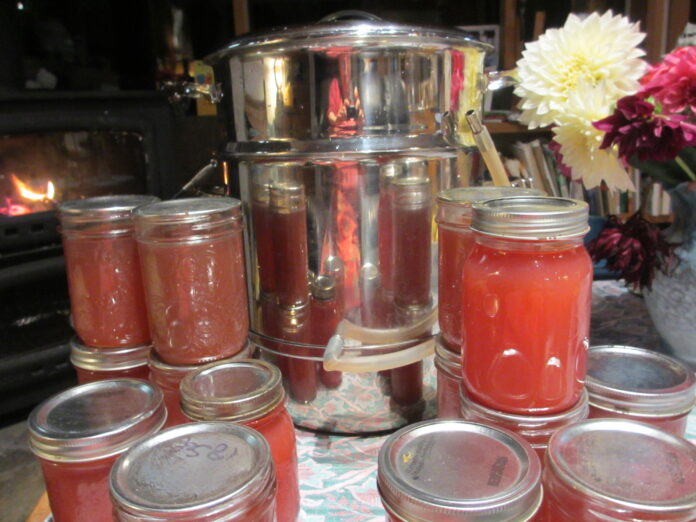
I like to take elecampane as a syrup as it has an odd taste that I find better sweetened.  To make a syrup, I chopped up a large quantity of the fresh roots and put them in a saucepan with a quart of water.  I simmered the roots gently for several hours until the fluid was reduced by half.  I strained the roots out, measured the decoction I had left and added half as much honey which I warmed gently until it was melted.  The finishing touch was a quarter cup of dark rum to make the syrup keep better.  I bottled it, labelled the bottle and put it in the fridge.

I have a lot of fresh roots right now so I cut some of the roots up into short lengths and put them on a cool setting in the dehydrator.  The dry roots can be used later to make tea, syrup or tincture but fresh is best when making tinctures.  The early autumn is a good time to harvest elecampane roots.  I have several plants growing in my garden that will produce seed which I will be happy to give to anyone interested in growing this herb either as medicine or just to add interest to the back of the border.

Herbal medicines made at home out of plants grown locally are inexpensive for us to make and so much less energy intensive and less polluting than commercial pharmaceuticals.