Home Blog Page 21

The Book Report

Book report 10

By A. Bae Hel

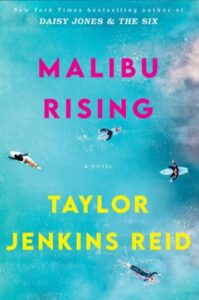
Malibu Rising

Taylor Jenkins Reid

If you have read anything by this author you know it falls into the Chic Lit genre. Daisy Jones and the Six was enjoyable, if only because it took me down some old memories of a walk on the rock and roll side of life. 

Malibu in the 1980 was no longer the beckoning light for the chill culture. The party till you die culture had taken over. The story focuses on the Riva family and flips back and forth between the parents’ time line and the siblings’ timeline. Stories about dysfunctional families are rather common right now, and this family was memorable only in the location they lived. Malibu, on the cliffs above the ocean, with a stair down to the beach. Who wouldn’t want that? The dysfunction is typical – father is an irresponsible famous face, mother is an alcoholic waiting for him to come to his senses, and the kids are growing up trying to find their place in it all.

The story is entertaining, a perfect beach read. Easy language, easily followed and expected outcomes. It does not require much of you as a reader and sometimes that is ok.

Parade of Horribles

Matt Dinnamin


I laughed. I cried. I cried again. And at least another time. This is the supposed final in the series, but the universe is often weirder than we anticipate.  I think the thing I like the best about this series is the late-stage capitalism satire.  Each book has mirrors to our current mess and the dungeon crawl is a perfect metaphor for our scrambling fight against the syndicate as it slides into failure.  

This is also about dysfunctional family and survival, but the dungeon family elicits more interest, more emotion and more commitment than the beach family of the other book. Carl trying to be a good man, Donut becoming a more human cat, and sometimes good people do horrible things for the greater good. How do they live with that?  Well, that is the meaning of the crawl, to remain human despite, or in spite of the overlord’s cruelty and capriciousness. 

This series looks superficially like a niche fantasy, but the complexity of themes, characters and world building slowly reveals it is greater than a story about a talking cat and a 28-year-old west coast male. It is so much more, yet defies a meaningful synopsis without sounding like a toddler telling a story.

I anticipate it might need a rereading to try to understand the complexities better. Regardless I recommend the series, though I think this one is the best of all.  I strongly recommend seeking out the audio version if you decide to jump into the dungeon. It is amazingly well done.  Plus, there is a whole sub-culture developing out there on the net if you are so inclined.

Calypso

David Sedaris

This book came up when I searched for something funny. Reviews tell me it is very, very funny.  Apparently, my humour is broken, because I did not find it funny. Especially not, very, very funny. It was mildly amusing in places, so I guess that was a bit of a win.

Here David Sedaris writes about himself and his family and his interactions with the world. He is a slightly awkward friend who either doesn’t know and doesn’t care about social conventions so makes the irreverent observations in his outside voice. Like describing a fellow passenger who is incontinent of stool on a flight. This is apparently hilarious rather than demeaning and humiliating. All it did for me was make me feel even more of a weirdo since I didn’t find his stories funny, or even understand the point. Perhaps he is just trying to convey that he, a famous writer who lives in both London and in a beach house of the east coast, is just a regular guy, like all of us. Unfortunately, for me, regular guys don’t have to luxury residences nor can they afford to summer on the east beaches and jet around the globe reading passages from their other books.  He is not relatable, and barely amusing. If I found myself sitting at a dinner table with him I would excuse myself and hide in the coat closet.

He has written a few books, and perhaps the others are more engaging. I am willing to give him another chance.  I can’t really recommend this one though, unless like many, you find the tragedy of humans amusing.

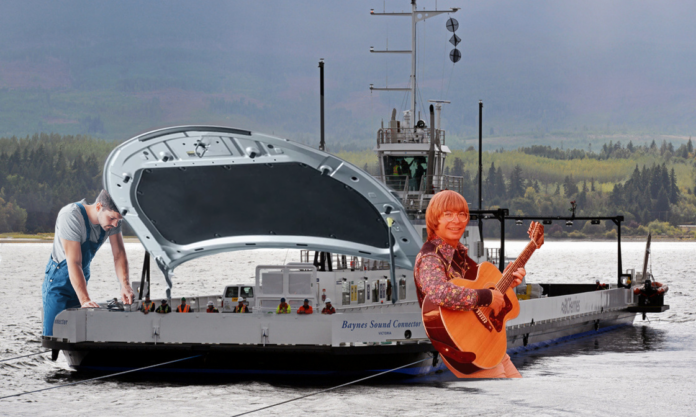
Love on the Denman Island cable ferry at 4 PM, and the young people are coming home from a long day at school.

Gabriel Jeroschewitz, May 12th, 2026. “The story you are about to hear is true; some of the names, vehicles, and dates have been changed to protect the innocence of love.”


Love on the Denman Island cable ferry at 4 PM, and the young people are coming home from a long day at school.


There is a particular hour of the afternoon when the world seems to hold its breath. The sun has begun its slow descent towards the horizon whilst the Georgia Strait glows with the colours of liquid copper and rose gold. During that time, the ferry terminal at Buckley Bay sees the usual mix of those making a weekday return trip and adventurers coming for the weekend. Leslee and I were coming back from Courtney and the dentist. Leslee was savouring the aftertaste of her dental work, a crown, but not the kind a king wears, and I chuckled at the memory of her spending a small fortune on that crown. Still, she must have felt relieved after the anesthesia wore off. We were headed for Hornby Island, our home. We had gotten to the ferry lineup early, so we were third in line to board, which would put us on the so-called bow. Still, the story isn’t about the dentist or the dental work; it’s about two children, though I hesitate to call them out. Still, kids don’t kiss away; these two did so with such urgency that it was suggested the world might end if they stopped. They were spotted as soon as I arrived on the ferry deck, driving my Toyota RAV up the ramp with a degree of dignity I certainly could muster. The young couple occupied what ferry workers would no doubt refer to as the bow end of the vessel—though referring to the ferry as such is almost absurd for a craft that reverses upon destination arrival. The cable ferry certainly does not feature a proper stern or bow end—it merely features two ends and a cable that pulls the craft back and forth across the water like a giant aquatic yo-yo. Nevertheless, if one were to attempt to orient oneself within the vessel, these two youngsters had claimed the forward-facing section—standing pressed up against each other like the last two people on earth to discover something wonderful whilst attempting (at the same time!) to reveal it to all who pass by.

He was tall, bless him, with hair that had both desired to curl yet succumbed to surrender following a lifetime of such fighting. Through his clear-framed glasses, he watched her face in the same way one might gaze upon a sunset or some remarkable work of art seen within a museum for which forty dollars had been paid—not entirely believing in one’s luck whilst noting a slight worry that someone may tell the viewer to move along. His hands lived upon her waist—and mine certainly wasn’t the only pair of eyes to note how these hands had developed their very own mind and reach towards her back as if two explorers investigating an unfamiliar land.

And she. Oh, she. So beautifully lovely that one finds oneself wanting to write poetry, though I haven’t written any since I was seventeen, attempting to win over a girl named Donna who wore bell-bottoms and had the scent of cinnamon gum. Her blonde hair cascaded past her shoulders despite the humidity’s effort to do so—and when she tilted her head back to catch laughter at something he whispered (which I’ll never know but would have given my left foot to hear), there was a quality to her joy that made the entire ferry deck feel somehow lighter.

They were indeed—in the language of our generation—all over each other. And I mean that in the most literal sense possible. Every square inch of available space between them had been eliminated—made non-existent through sheer force of desire. Their lips moved together in a rhythm suggesting either hours of practiced performance or that natural synchronicity which poets have so far unsuccessfully attempted to describe since the dawn of language. At one point, her hands made their way into his hair—and his response was to lift her slightly off the ground. Such a gesture is classically romantic—and I found myself smiling despite the aching left knee developing from leaning back in a twisted kind of way. So they couldn’t see me, within the car window.

The ferry was filled with the usual ferry cargo—a handful of weekenders making their camping trips, clusters of elderly ladies from the Hornby and Denman Island Quilters’ Guild upon completion of their common outing to the Courtenay Costco, and then a man seemingly sleeping in one corner of the boat whose snoring suggested some form of competitive sleeping sport. Most of the travellers exhibited good sense to ignore such a young couple—opting instead for glances and the use of phones, novels and private thoughts. But not everyone.

In this scene, I noticed a woman wearing a navy cardigan—because, of course, she was wearing such an article of clothing—as some people do to fulfill others’ expectations. The woman studied the pair of young lovers with an expression suggesting she’d bitten into something sour. Her lips were pressed tightly together into near-disappearance, and she sent a nudge in the direction of her husband, who remained locked into viewing his phone with that same vacant look suggesting he’d located something of far more interest than his wife might be attempting to show him. He glanced upwards at the couple but immediately returned to his phone; yet she remained watching—disapproval radiating from her in visible waves across the ferry deck.

I wanted to tell her something. I wanted to tell her that she used to be that girl once—probably—before life and disappointment and the weight of others’ expectations became calcified within her. I wanted to tell her that such a pair of children—this boy showing an earnest face and trembling hands—this girl possessing impossible beauty and complete lack of concern for others’ thoughts—were performing an activity celebrated throughout all human history—one inspiring songs, poems and indeed no fewer than three of Shakespeare’s plays had the subtext included.

But I did not say anything—recognizing both how I was raised not to intrude upon others’ business and how I had a newspaper to read and that elderly gentleman’s reputation to maintain.

The girl sensed the disapproval—or perhaps she just had that extraordinary level of self-confidence common amongst teenagers who feel themselves to be the main characters in the world’s most interesting stories. Whatever the actual reason, she drew back from the kiss just enough to look at him—three cars away, I could see her eyes shine with that mixture of defiance or pure joy or both—for such aspects are often the same when dealing with young people.

Her voice was unexpectedly loud, though she hadn’t quite shouted, but the clarity of her voice made everyone within earshot realize they were about to witness something, whether they wished to or not.

“I don’t think my father would like this.”

A pause fell within the space created by possibility. The quilters paused their efforts. The sleeping snorer stopped—for however brief a moment. The woman in the cardigan leaned forward with the predatory interest of a cat spotting an especially interesting bird.

Then she said it again—except not the same words at all.

“Fuck. Fuck. Fuck. Fuck. Fuck. Fuck. Fuck.”

She said it seven times—each one creating a small bomb of liberation into the quiet ferry deck. A teenager passing on foot and wearing earbuds paused and stared. One of the quilters—Margaret’s friend Helen, I recognized upon squinting through the window—broke into laughter that she quickly tried to smother within her hand. The woman in the navy cardigan saw me with exactly the same expression of witnessing a fundamental violation of the natural order of existence.

But here’s the thing that filled me with such unreasonable hope: the girl wasn’t angry. She wasn’t sad, nor even defiant or trying to shock people. She was indeed laughing—yet as she did, she pulled the boy even closer together whilst resting her head upon his chest as though the words she’d uttered meant nothing more than a sneeze.

He looked down at her with what I can only describe as worship—before placing a kiss upon the top of her head, followed by looking out across the water. For just a moment, though, his eyes did meet mine.

I smiled—as did he. Then he looked away—towards the girl sporting that blonde hair and explosive vocabulary. At this point, I understood exactly how he felt.

Somewhere deep within my chest—within the region set aside for memories of my own youth—something unclenched itself and expanded. I thought again of the world in which we live today—a world of violence and darkness and entertainment focused upon reminding people even more about humanity’s worst aspects. I thought of climate change and political divisions—all the price of eggs. And then I thought of these two children—this boy from Denman Island and this girl from Hornby Island who had to take no fewer than two ferries regularly to see each other—choosing such a venue and time in the presence of a whole bunch of strangers throughout history.

Power to them—I thought. I hoped their love would indeed last—though I also knew the nature of such affairs at this age and within the world as it presently waits to teach one otherwise. I hoped they remembered this moment—this absurdly beautiful moment upon a cable ferry within the Salish Sea in the Strait of Georgia while they were still young and in love—and completely unashamed of either fact.

The ferry groaned against its moorings at the Denman Island terminal. I gathered my Things. The boy and girl remained together, whispering sweet things into each other’s ears that prompted both grins. As I drove past them upon leaving the boat, I saw one final glimpse—her looking up at him whilst he looked down upon her—all set within late afternoon gold tones.

I gave a small wave—almost certainly she saw it, for she laughed and responded with a wave of her own.

The world may indeed be bleak in so many ways—dark, violent and featuring people in cardigans who disapprove of nearly everything. But somewhere out there on a ferry heading to Denman, Hornby Island, two kids are in love—and there is no hiding it. They don’t care who knows.

That, I thought, is more than enough hope to carry me through another week.

Cupcakes & Cow Pies

A Song for Denman

Dear Friends

A Few weeks ago, our Denman Community Choir had our spring concert and my grandson, Timber and I did a duet.  Tim is 12 and is part of Poulson Moose, and is already a much better guitar player than I am, but we did a duet.

A number of years ago Wendy Boothroyd, had modified the words to John Denver’s song Country Roads, and that had been one of my grandsons first real favorite songs.  We would listen to it again and again we drove.

We decided to modify Wendy lyrics, and so we sang a new Denman version.  Several people afterwards asked me to submit the lyrics to you so you could share it with others.

Country Roads  (By John Denver. /adapted by Wendy Boothroyd/ David Hayward)

Almost heaven,  Denman Island, Beaufort Mountains, beloved cable ferry

    Farmers Market,   and Bethanys sweet choir

   Stores and school and churches, so that we can thrive

DENMAN road, take me home, to the place I belong

On Denman Island,  to my family, take me home, Denman road.

Many  memories,   focus on her,   Emerald Island nestled on blue water.

    Eagles lazily,     circle in  the sky, 

    Waiting for the herring run, as kayakers glide by,  

LACON Road, Take me home….

    When I’m away, in the mornin’ hours she calls me,

    Tree Frog radio reminds me of my home across the way.

    And rollin in to Buckley Bay I get a feelin’ 

  That I should have been home yesterday,  (but the ferry broke  down)

Buckley Bay, take me home, to the place I be-long

On  Denman Island,  to my family take me home, country roads.

Chickadee and Graham     where we fish and swim

Trails for bikes and hiking, keeping us pretty trim

Peace and natures beauty all around to see

There’s no other place where I would rather be

NORTHWEST road,  take me home…

And we have a golf course, a pickleball court too

With a community hall and seniors centre just for you

Lot’s of entertainment,      often local too

And Corlans winery, in case you’re feeling blue

CENTRAL Road.  Take me home…

All the people,        help each other, 

       life is good here, far from earth’s great troubles

       Let us try to make this place so sweet

    We can serve each other, build a space of peace. 

BAIKIE Road, take me home…

Letter to the Editor – Edina Johnston

Dear GV Editor:

The number 1 question that comes up every year about the DIRA Community Dock is- why do I have to pay to tie my boat up to the dock? The answer is you don’t, if it’s there 6 hrs. or less. If your boat is there longer than that, you pay because an island needs a dock and it costs money to maintain it. The original dock was torn down after it fell into disrepair because locals refused to pay to use it. Denman needs a dock to:

  • Transport medical emergencies when the ferry or air ambulance is unavailable which is becoming more and more frequent. Without a dock, loading a patient from the shore to a heaving boat is not only dangerous but impossible!
  • Allow RCMP and other Emergency Responders access to Denman by boat to deal with life saving emergencies when the ferry is unavailable.
  • Evacuate large numbers of people during a disaster if the ferry can’t or won’t.
  • Allow water taxis access to pick up those needing to get to Vancouver Island when the ferry is unavailable.
  • Allow those with boats and even float planes easy access and somewhere secure to leave their boat or plane. Without a dock you would have to haul your boat out after each use or anchor it.
  • Allow Fishers to come and sell their products direct to islanders.
  • Generate revenue from tourists who come and visit.
  • For recreational opportunities for fishing, crabbing, swimming, lounging, storm watching etc.

As well, the boat ramp and green space is a well used facility that any island would be lucky to have. Those waiting for the ferry, walking their dog or needing somewhere to meet friends that has an incredible view and easy access to the beach use it frequently.

The DIRA Dock is not government funded and needs users to pay for the privilege of having this incredible amenity. An island without a dock is like being completely reliant on BC Ferries!

edijohnston@gmail.com

Blind Submission To Authority Is Caused By Bad Parenting

Blind Submission To Authority Is Caused By Bad Parenting

Blind submission to authority is the result of propaganda and indoctrination, but it’s also the result of bad parenting. Raising kids who aren’t allowed to say no to you is raising adults who don’t think anyone should be allowed to oppose their rulers.

That’s mainly what you’re seeing in the comments section of any viral police brutality video with people defending the cop’s actions and saying the victim should have complied with commands more perfectly. All they’re really saying is “Don’t disobey Daddy and you won’t get smacked!”

You can see their parenting in their faces when conversing about politics and news in person. Discuss the latest act of war or abuse with someone who’s been trained to reflexively obey authority and you can watch them running calculations trying to find excuses to justify why the powerful are correct in this given instance, even if you’re presenting them with brand new information. They never pause to reflect on whether their apologia is grounded in facts or morality; they begin with the assumption that the authority figure must be correct and work backward from there.

All the worst things that have ever happened were the result of people obeying authority when they should have disobeyed. Genocides. Wars. Slavery. Tyranny. Injustice. They were all made possible by obedience, not disobedience. And that remains the case today.

If you want to raise kids who’ll help make the world a better place when they grow up, then you’ve got to put your ego in the back seat and let them say no and walk their own path, because you are teaching them how to relate to authority in a world where the authority figures are the villains causing all our problems.

Obviously you can’t let your kid do things that will cause actual concrete harm to themselves, but most of the limits parents set on their children from day to day have nothing to do with protecting them from harm. If they don’t want to kiss Grandpa then don’t make them kiss Grandpa. If they don’t want to eat this or that food then don’t force them. If they reject you or hurt your feelings, don’t put the needs of your ego in that moment ahead of your desire to raise a citizen who can defy authority when that is what’s called for. The real material harm they cause by defying this or that social convention or going against your personal wishes is basically nothing, especially when compared to the harm that would be caused by training them to blindly obey authority in a world that is ruled by psychopaths.

It is absolutely necessary to set boundaries with your children at times, because you need to be modeling what healthy boundary-setting looks like, and because you don’t want to raise a malignant narcissist who thinks the world revolves around them and their desires. But it is equally necessary to show them that their own boundaries are legitimate and permissible, because otherwise they won’t set them in their own lives.

So many abusive dynamics arise from the erosion of people’s healthy “no”. That’s how people wind up joining cults and getting trapped in abusive marriages, and it’s how they wind up consenting to the rule of abusive governments who should have been overthrown long ago. Their healthy “no” was gradually worn down, first by their parenting and then by the psychological manipulation of the abuser.

“No” is an essential skill. Giving your child a healthy “no” is as important as teaching them how to meet any other developmental milestone like walking, speaking, reading or preparing food. That’s how you keep them free from abusive relationships, and that’s how you keep their minds free from the propaganda of the powerful.

_________________

Caitlin’s Newsletter is a reader-supported publication. To receive new posts and support my work, consider becoming a free or paid subscriber.

The best way to make sure you see everything I publish is to get on my free mailing list. My work is entirely reader-supported, so if you enjoyed this piece here are some options where you can toss some money into my tip jar if you want to. Click here for links for my social media, books, merch, and audio/video versions of each article. All my work is free to bootleg and use in any way, shape or form; republish it, translate it, use it on merchandise; whatever you want. All works co-authored with my husband Tim Foley.

Bitcoin donations: 1Ac7PCQXoQoLA9Sh8fhAgiU3PHA2EX5Zm2

Feature image via Adobe Stock.

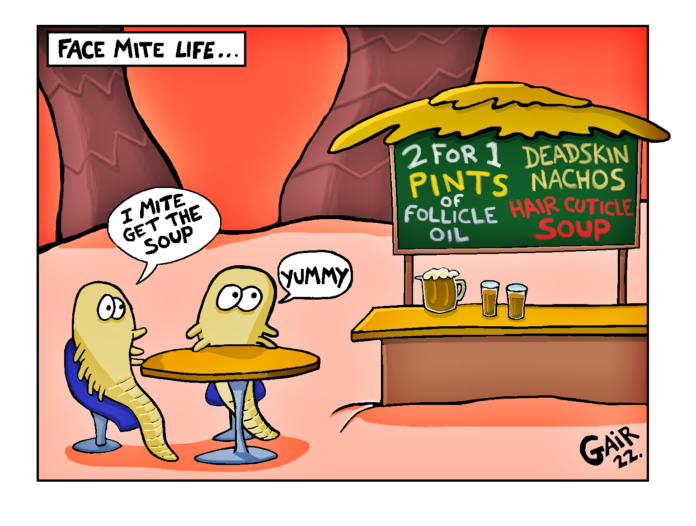
face mite life

#1739

Celebrating Denman Island Cross Trail

Celebrating Denman Island Cross Trail

June 9, 2026

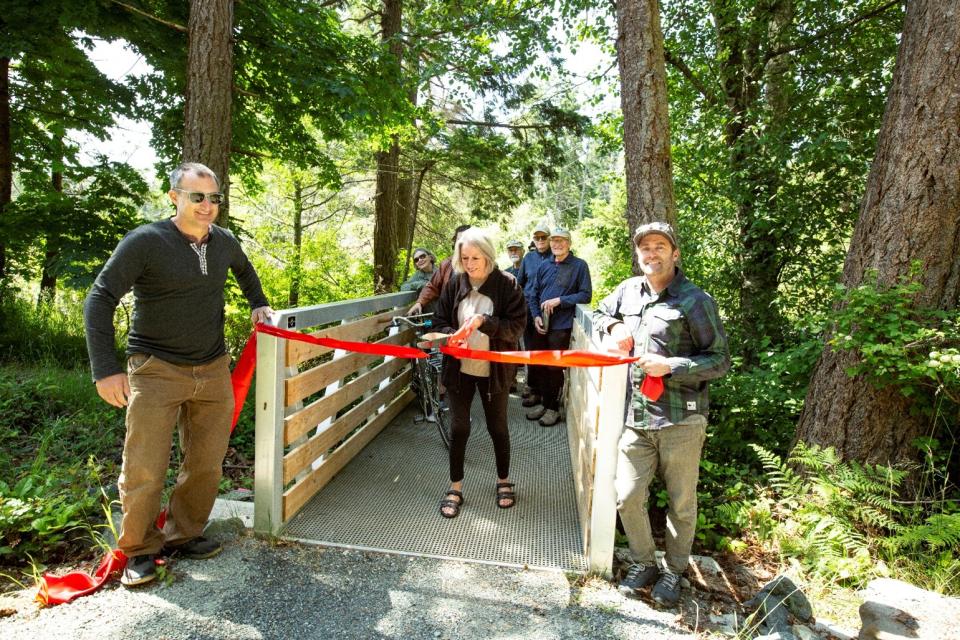
Denman Island, BC –  The Comox Valley Regional District (CVRD) celebrated the official completion of a 3.5 km portion of the Denman Cross Island Trail from Owl Crescent to Gravelly Bay, and a 180-metre portion in downtown Denman Island.


Photo Caption: Doug DeMarzo ( General Manager of Community Services), Chris Danks, Daniel May (CVRD Senior Parks Technician), Stirling Fraser (DIRA Co-President), Laura Pope (Chair DIRA Parks Committee), Jan Jansen (Chair DIRA Trails Committee), Graeme Johnston (DIRA Parks and Trails Committee), Kasian Russel (DIRA Trails Committee)

“Completion of these two sections provide improved safety and connectivity in the Graham Lake and Gravelly Bay ferry area,” explains CVRD Electoral Area Director Daniel Arbour. “This investment in the Denman Cross Island Trail by the Province of BC, and supported by our local MLA Josie Osborne, shows what we can accomplish through collaboration and perseverance.”


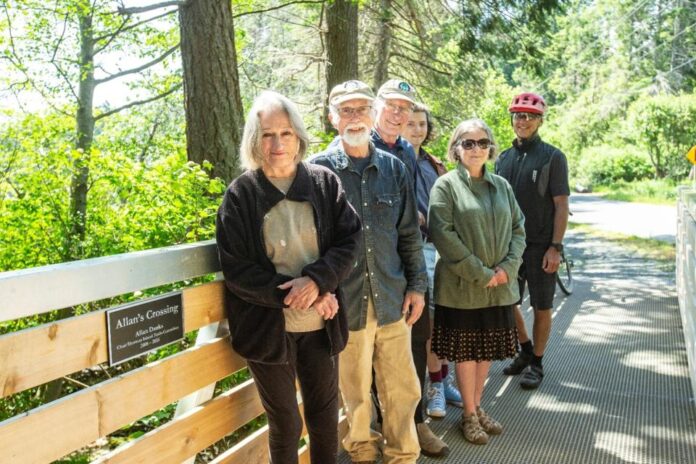
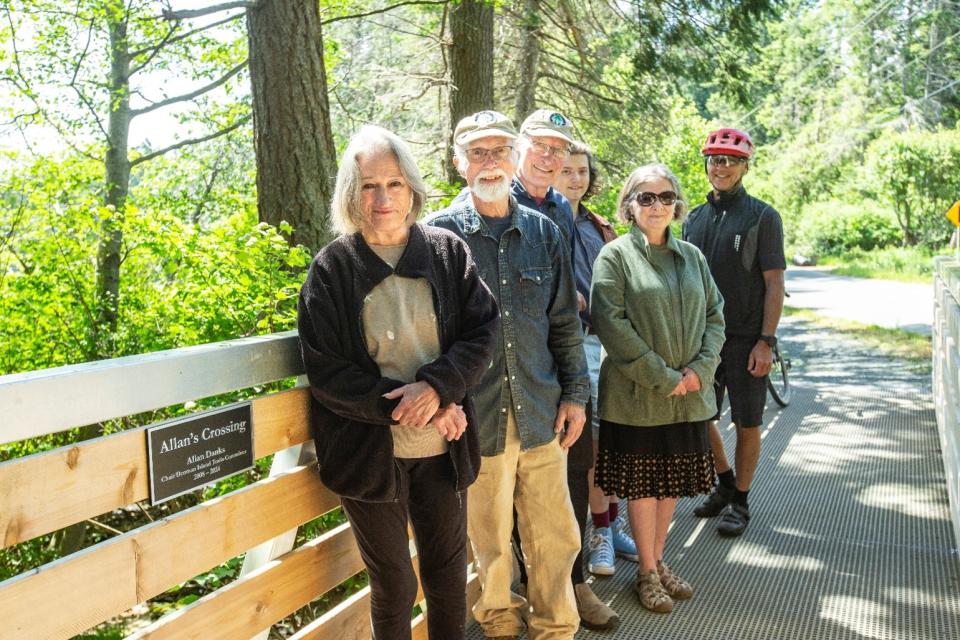
Photo Caption: Bridge and commemorative plaque in recognition of Allan Danks, DIRA Trails Committee Chair 2008-2024 (passed in 2024). In picture: Chris Danks (Allan’s wife), Graeme Johnston (DIRA Parks and Trails Committee), Stirling Fraser (DIRA Co-President), Laura Pope (Chair DIRA Parks Committee), Kasian Russell (DIRA Trails Committee), Jan Jansen (Chair of DIRA Trails Committee)

This trail construction project was made possible because of funding from a B.C. Active Transportation Infrastructure grant and Community Works funding.

To find more information about the Denman Cross Island Trail, visit https://www.comoxvalleyrd.ca/denmanCIT

The Comox Valley Regional District is a partnership of three electoral areas and three municipalities operating on the unceded traditional territory of the K’ómoks First Nation, the traditional keepers of the land. The members of the regional district work collaboratively on providing sustainable services for the benefit of the diverse urban and rural areas of the Comox Valley.