
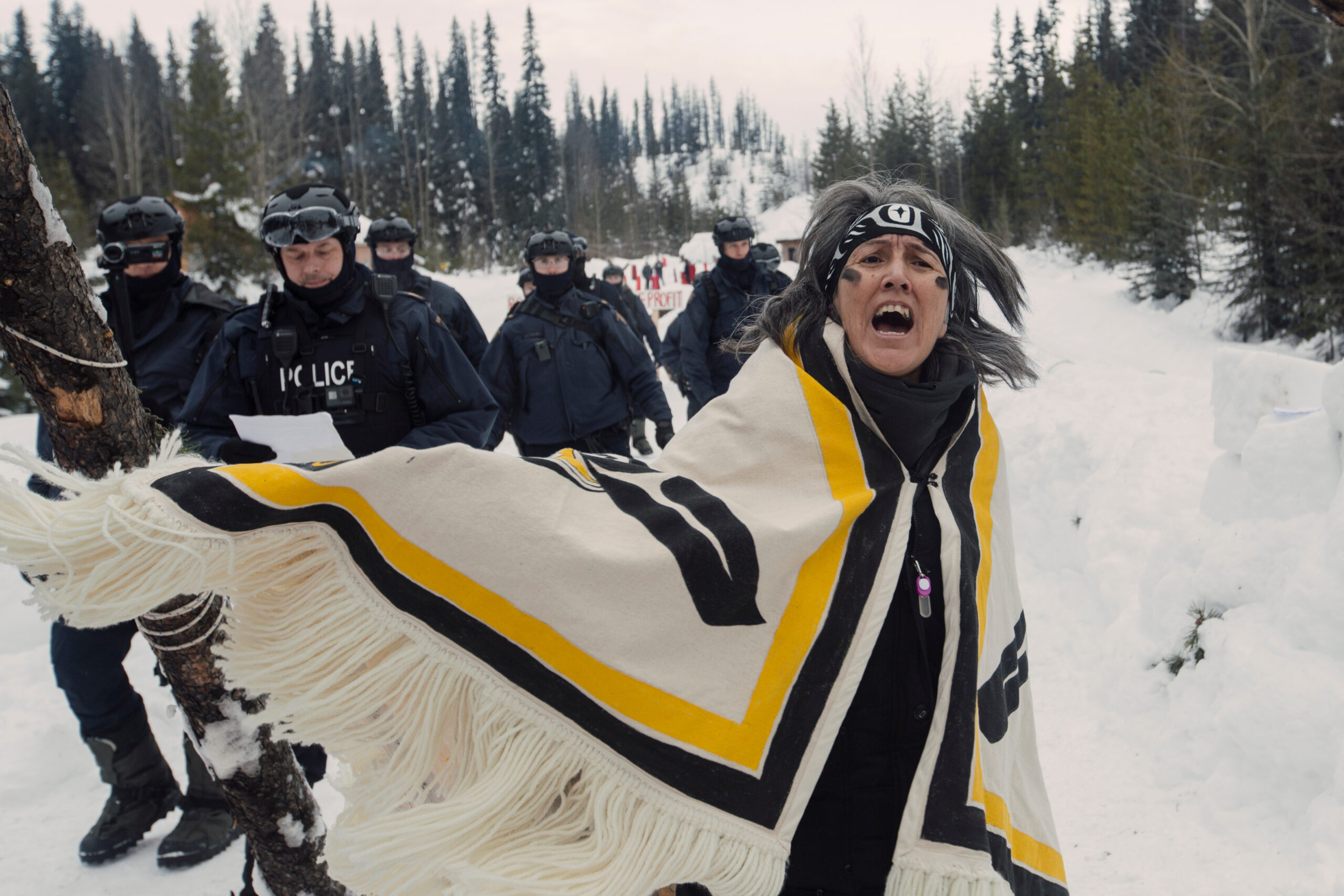
Police Brutality on the Barricades of Resistance to Resource Extraction
By Cylon2036. We/Us
British Columbia’s specialized RCMP unit, now known as the Critical Response Unit–BC (CRU-BC), cannot be understood in isolation. It represents the institutionalization of police strategies aimed at suppressing dissent, and a renewed political and economic push to accelerate resource extraction projects. Together, these forces have intensified longstanding violations of Indigenous rights, sovereignty, and environmental governance in the province.
The CRU-BC reflects a shift in how the state anticipates and responds to resistance. Originally formed in 2017 as the Community-Industry Response Group (C-IRG), the unit was designed to manage anticipated protests linked to pipeline expansion and other extractive projects. Over time it has evolved from a temporary task force into a permanent, specialized policing body with a broader mandate. Internal documents show that the unit is now embedded in provincial committees that coordinate intelligence, surveillance, and enforcement responses to opposition against major infrastructure and resource projects
.
This institutional embedding suggests that policing is no longer merely reactive and responding to protests as they occur, but are proactive and integrated into governance structures that anticipate dissent. The CRU-BC participates in governing bodies such as the Critical Incident Secretariat and Civil Disobedience/Public Order committees, which facilitate information sharing between government, law enforcement, and industry actors. The opposition to resource development is treated not simply as a political or legal disagreement, but as a matter of “public order” requiring coordinated surveillance and suppression.
The unit has faced hundreds of complaints alleging excessive force, unlawful tactics, and racism, particularly in its policing of Indigenous-led resistance to projects like pipelines and old-growth logging. A 2025 court ruling found that officers violated Charter rights during a raid on Wet’suwet’en territory, reinforcing concerns that the unit operates without accountability. Expanding its role, especially before oversight investigations are complete, signals an Orwellian prioritization of enforcement over rights protection.
The Federal and Provincial governments, amplified by corporate pressure, have intensified efforts to accelerate extraction in a “corporate resource rush” of the timber, mineral, and fossil fuel industries. The false promises of economic growth and export revenue (corporate profits and environmental degradation) have allowed governments to reduce regulatory barriers and expedite project timelines. Yet this acceleration collides with the legal and moral requirement to respect Indigenous rights, including the duty to consult and, increasingly, the principle of free, prior, and informed consent.
The resulting resistance is being sharpened by the speed and scale of current policy changes. Fast-tracking inherently compresses consultation timelines and limits opportunities for meaningful engagement. When Indigenous nations assert jurisdiction over their territories or oppose projects, their actions are framed as obstacles to economic progress rather than as exercises of constitutional rights. In this context, the deployment of a specialized policing unit to manage opposition is less like law enforcement and more like the enforcement arm of a corporate development agenda.
The RCMP has long been implicated in the enforcement of colonial policies, from the imposition of the reserve system and The Indian Act, to the suppression of Indigenous resistance. Contemporary conflicts, such as the Wet’suwet’en pipeline standoff and the Fairy Creek logging blockade, echo these dynamics. At Fairy Creek, for instance, over 1,000 arrests were made during protests against old-growth logging, amid widespread police violence and targeting of Indigenous land defenders. There is plenty of evidence that policing in resource conflicts is not neutral but structurally aligned with state and corporate interests.
The integration of CRU-BC into intelligence-sharing frameworks deepens this concern. Reports indicate that the unit monitors opposition to projects, shares information with industry actors, and engages in community outreach aimed at mitigating potential disruptions. While officials describe this as coordination and preparedness, in reality it is the surveillance and pre-emptive criminalization of dissent, particularly dissent rooted in Indigenous sovereignty and environmental protection.
The backlash against Indigenous rights is not solely a product of state policy, as it is also shaped by corporate media discourse and narratives. The framing of Indigenous consultation as a “barrier” to development, or of land defenders as threats to economic stability, contributes to a climate in which rights are seen as negotiable in the face of corporate market imperatives. This narrative is amplified during periods of economic uncertainty, when governments emphasize rapid project approval as a solution to external pressures.
This is not just about a single RCMP unit or a set of provincial laws, it is about the alignment of state power with extractive corporate priorities in a context where Indigenous sovereignty remains unreconciled. The CRU-BC is a focal point because it embodies this authoritarian alignment in a specialized, institutionalized mechanism for managing the conflicts between rapid development approvals and rights-based resistance.



, the unit was designed to manage anticipated protests linked to pipeline expansion and other extractive projects.)