
Home Blog Page 15

The Book Report

Book report 16

By A. Bae Hel

Some heavy books this report, but life isn’t always flowers and fairies. Sometimes you must veer into the darkness to understand the light.


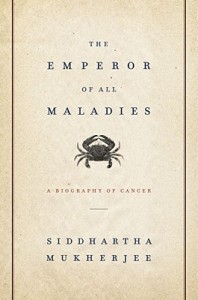
The Emperor of All Maladies: A Biography of Cancer

Siddhartha Mukherjee
 

5 years ago when I found the lump my initial thoughts were not that this was cancer.  In fact, I pretty much ignored it for several months assuming it was related to something else entirely.  When I brought it up to my GP about 6 months later she waved it away as well.  It was only 6 months after that when I returned to her and said it was getting bigger that she took a closer look and with a stricken look said she was sorry and hustled me off into the jet stream of cancer.

I have always liked to understand what the hell is going on.  I like details and knowing the secret knowledge of healthcare.  So, before I saw her this last time I had begun googling possible things it could be.  I can up with some fairy obscure and rare cancers, so was PREPARED.  I knew I had cancer, just what type remained to be determined.

Know your enemy is essential advice for all kinds of things and I was fortunate to have a very well-rounded experience in healthcare that gave me a lot of broad knowledge on various different specializations. I entered into the battle with my cells secure with an understanding of what was to happen.  

Trying not to die is exhausting and traumatizing beyond anything I ever expected.  I could not have read this book until now.  During my Trying-not-to-die period I could not have held the concepts in my befuddled brain.

 Initially I was a bit put off because it seemed the entire book would be about cancer discoveries in America, but fortunately he rapidly delved into the history of cancer.  Going back to ancient mummies and records of early surgeries built the bedrock of the dramatic options to come. 

This is a very sciency book.  Extreme science. Details of cell division, genetic codes, drug mechanisms of actions on the cells are interspersed with narratives about the people who not only sought to treat and find a cure, but the patients they struggled to save.    It is also deeply traumatic.  It does not gloss over the horrors that was the early radical surgery protocol and the zeal with which those surgeons approached a mass.  Similarly with the early radiation treatment regimes and discovering of how to poison right up to the edge of death. 

The writing is often beautiful and full of compassion as well as science. The level of details is often into the textbook genre, but in spite of this, the biography of cancer brings the disease into the personal realm. We will all be touched by this and the desire to understand the hows and whys driving those looking for a cure. Can you skip over the parts about genetic code details mutations on which genes turn it on or off? Absolutely! You can still come away from this book with a more profound understanding of the enemy that lurks within us all.

Nobody’s Girl

Virgina Roberts Giuffre
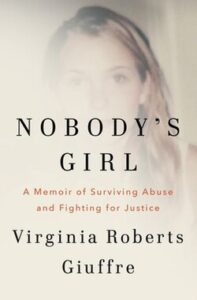
 

This is a difficult book to read. Yet Virgina herself acknowledges that and asks us not to stop.  Take a break, takes as many breaks as you need, but please hear her story.

Very likely you have heard her name before and you know she spoke up about being trafficked by that billionaire to other billionaires, yet her story is so much more than that.  It is a story of how such abuse as a child will form who you become and how you respond. It is about how trauma shapes us and about how difficult the struggle is to break free of the bonds which constrain those trafficked and abused.

Virginia shows us such courage and bravery. She knows that she will be cast as the whore and a liar by very powerful people, and who has ever known the powerful to lie?  She steps up and refuses to accept that tag. She built a new life. One with a burning to ensure these monsters are held accountable.  

We continue to wait for that accountability to happen.

The book ends with a hopeful note in 2024. Can it possibly be more tragic to discover that behind this hope was continuing abuse at the hands of the man she portrayed as supportive and loving. Her need to matter, to find protection and safety even though she could speak out about past abuses would not allow her to name the one she protected for so long. I find this the ultimate tragedy of her life. 
Food Insecurity and the Loss of Denman’s Farmland

Food Insecurity and the Loss of Denman’s Farmland   By Cylon2036  We/Us

Farmland makes up roughly 4.9% of B.C.’s total land base, protected under the Province’s Agricultural Land Reserve (ALR). B.C.’s geography heavily limits large-scale agriculture, as it is dominated by mountain slopes and forests. Because arable land is scarce, B.C. records the highest average farmland prices per acre in the country, while ranking #1 in farm productivity yields per acre.

Only 3% of the Vancouver Island and Gulf Islands region is designated as usable farmland. The actual amount of land actively farmed is even smaller, at 1.5% of the region’s total land base. Vancouver Island farmland is limited to the southeast coast of Vancouver Island, the Comox Valley, and specific pockets on the Gulf Islands, including Denman Island, where farmland prices keep rising.

Due to the extreme scarcity of arable land and intense competition from development, farmland prices on Vancouver Island and the Gulf Islands are exceptionally high. And because usable farmland is so limited, the islands are heavily reliant on food supply chains, with well less than 10% of the food consumed on Vancouver Island grown locally, a vulnerably low level of food security.

British Columbia has lost roughly 1.1 million acres of farmed land, marking an overall decline of 16% in active farmland over a two-decade span. Because the land is prohibitively expensive, it is often bought by non-farmers as real estate investments and for development other than food production. Nearly half of the ALR sits unused for agriculture because aspiring young farmers simply cannot afford to buy it.

Areas like the Comox Valley and Gulf Islands have faced steady declines in farming acreage. Land has increasingly shifted out of food production into other non-farming uses, where a massive cost barrier of island real estate has made it nearly impossible for a new generation of food producers, leading to older farmers retiring, and making any loss of farmland here highly critical, especially for food security.

Farmland loss on the Gulf Islands follows the same downward trend as the rest of British Columbia, but it plays out on a much more fragile, hyper-local scale, and because the islands have such a small agricultural footprint to begin with, even a minor loss of farmland has a major impact. This problem is amplified by the islands’ status as a luxury real estate and retirement destination. 

Land values routinely match the highest rates in the Province, with a high percentage of the islands’ ALR land owned by speculative investors or part-time residents. Because these owners do not rely on farming for an income, the land simply falls out of active cultivation, widening the local food security gap.

Several local groups help protect and support food security, like the Denman Island Growers and Producers Alliance (DIGPA), the Denman Farmers Market, Farm to Family Society, the Food Bank, the Gather Farm and Kitchen, with big shoutouts to 2 Roads and Ruby Slipper farms, The Snag, Corland Vineyards and others, for delivering Denman Islanders the valuable gift of delicious local food.

The Canada Investment Garage Sale

The Canada Investment Garage Sale   By Keith Porteous (editorial)

Prime Minister Mark Carney is throwing a party for the people who already own the house. He calls it the Canada Investment Summit. The government calls it nation-building, while investors will presumably call it an opportunity. Working people will be encouraged to call it independence, but it’s not independence, it’s customer service.

The summit is scheduled for September 14–15 in Toronto, where the federal government plans to gather the world’s biggest investors and pitch Canada as a destination for $1 trillion in new investment over five years. The guest list includes American billionaires, global CEOs, institutional investors and the financial giants who have never encountered a public asset they couldn’t imagine turning into a revenue stream. 

Apparently, the best way to make Canada more independent is to invite the people with the deepest pockets to decide what the land and resources are for. Carney insists this is about independence, and that is a particularly exquisite joke. We are told Canada must become stronger and more independent in an unstable world, so Ottawa is shopping the country around to foreign investors.

Fossil fuels, critical minerals, ports, infrastructure, data, technology and defence is what the government proudly boasts that it is catalyzing for a trillion dollars of investment, while offering investors the most tax-friendly environment in the G7. Nothing says economic independence quite like putting the national economy on the showroom floor and inviting multinational corporations to make an offer. 

And this is where Carney’s particular brand of political theatre becomes almost perfect. The former broker and central banker speaks the language of national resilience, strategic autonomy, and economic strength. But beneath the hyperbole and rhetoric lies an older, simpler creed, where capital must be made to feel comfortable. Canada must be “competitive.” Translation: make sure investors like the regulatory climate.

“We must build at scale and speed.” Translation: get projects approved and financed before anyone asks too many inconvenient questions. We must become an “energy superpower.” Translation: there will be plenty of room at the table for fossil-fuel capital. We must build a “defence industrial base.” Translation: the military-industrial complex has discovered a new market with a maple leaf on it.

It is remarkable how often the magic of trickle-down economics returns wearing a hard hat. The government says the summit will direct investment toward “clean energy”, critical minerals, new technology and AI, but the broader investment drive encompasses oil and gas, shipping and transportation, data and defence.

The “green” future and the war economy arrive together, hand in hand, like two corporate executives sharing a limousine. We are told that independence requires military spending, pipelines, ports, mines, and gas. Apparently, the final ingredient is reassuring investors that the government is prepared to absorb all the risk. What could possibly be more independent than socializing the risk and privatizing the profit?

Money does not arrive virtuously, it arrives looking for a return, and where investors are very good at finding one. Who will own what they build, who will profit from it, and who will pay when it fails? Those questions are considerably less glamorous at a Toronto ballroom full of billionaires. 

Carney’s answer to foreign dependence is to deepen Canada’s integration with global pools of private capital. The problem is about the political power lost when governments become desperate to attract capital, and capital acquires even more leverage. 

A climate policy that simultaneously treats Canada as an “energy superpower” and accelerates massive resource development cannot simply be baptized “green” because the press release contains the words “clean energy.” The climate does not care who writes the cheques. 

Do the raw resources belong to a public with control over their future, or is this land destined to become one enormous investment opportunity with a national anthem, where the State will provide the infrastructure, absorb the risks, accelerate approvals, cultivate the investors, and subsidize industrial exploitation? Private capital will always arrive to collect the upside.

Call it what you like, but the rest of us will call it a garage sale with a flag on the door. 

Cupcakes & Cow Pies

Monsieur Housefly took a breather.

Gabriel Jeroschewitz, August 1st, 2026, inspired and dedicated to, all House flies Hornby’s Fire brigade and Tom Waits


Monsieur Housefly took a breather.


It was in the kitchen where the fire started. There was an orange flame that was exploring the pantry door in the kitchen. Outside the house, the garden was settling into twilight with ladybugs on the rose bushes. Inside the house, the two children in pajamas were on the sofa with a biscuit and a rabbit who had lost an ear in the laundry. Their mother was searching for the cell phone to call the fire brigade while her husband was arriving through the back door with a water bucket.

Amidst this chaotic scene, a house fly named Buzz was hovering over the bedlam. Buzz was keeping watch over the fire, the children, and the mother, who were attempting to extinguish the kitchen fire with nothing but a dishcloth. The wings of Buzz emitted a faint buzz that hovered just beneath the buzzing of a mosquito.

Buzz is a reincarnated insect who came out of the trash can behind the bakery, where he had lived as a maggot. While in the trash can in his pupation phase, Buzz emerged from his cocoon as an insect who had been a man. And reincarnated that defied the sensibilities of humankind. Buzz had a relatively short lifespan, reflecting his weariness of existence.

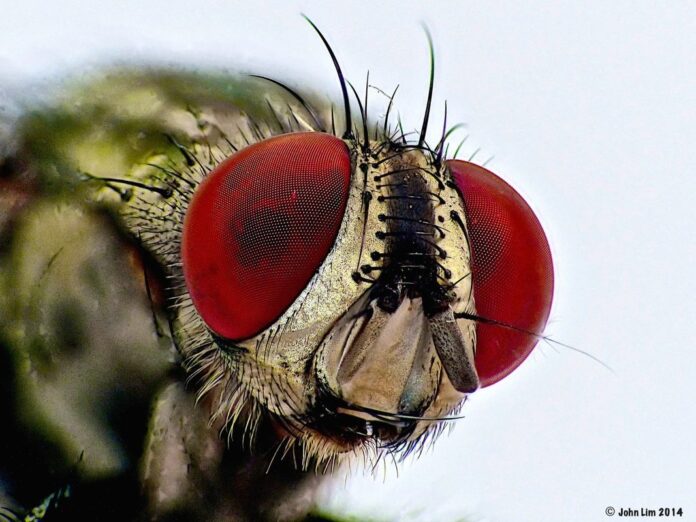
Buzz had 360-degree see-around eyes, which always allowed him to see the fire from any angle in the kitchen. Buzz had wings that buzzed whenever he flew through the kitchen, creating a cacophony of sounds ranging from the hiss of the culinary flames to the crackle of the fireplace, the kitchen smoke alarm, and the distant siren.

When Buzz was young, he was a larva and did not know of the world outside of his creation. During this stage of his life, Buzz experienced famine due to a lack of food in his pantry, conflicts with other flying insects that inhabited the kitchen year-round, and danger from the ceiling fans that seemed to be on constantly.

Despite the threat of destruction to Buzz during this phase of his life, Buzz had endured. Buzz eventually found himself landing on a trombone at a FIFA game orchestra. During that same game, on a discarded hot dog of Mick Jagger’s, he regurgitated the mustard and left it on a FIFA cup. In a Singapore Chinese restaurant, Buzz tasted the eye of a dead fish, a delicacy among the Chinese, yet no one cared about Buzz’s opinion on the matter. Finally, Buzz landed upon the clothing of a reincarnated child monk visiting Vancouver and attempted to taste the sweetness on the child’s fingertips after the child had consumed a piece of candy.

Buzz’s experiences in this house took a tragic turn in a comedic fashion. A fire started in the old wiring behind the refrigerator and began to eat into the house’s furnishings. The children, unaware of the danger of the fire, were having fun and laughing at the idea of the fire’s flames dancing on the wallpaper in the living room.

A neighbor who came to borrow a half-cup of sugar found themselves in a situation of horror and fascination at the sight of the flames and smoke in the house. Buzz landed on each object of beauty and shit within the neighborhood with the same opportunism.

 With which he approached each object in Buzz’s own burning house. The pesky house fly took a breather on each object to reflect on the absurdity of its existence as a creature with limited ability to move and to experience danger in the burning household.

House fly, house fly,

Go to sleep, say goodbye.

No one will weep when you die.

The lyrics to this nursery rhyme seemed appropriate for the insect who was getting no attention from the humans in the house—a somber lullaby for a fly overlooked by all.

The fire burned hotter into the kitchen. The heat distorted the air in the kitchen, transforming the space into an illusion. Buzz’s wings, typically a blur of blue-green, flashed red spots in the fire’s blaze. Buzz hovered over the children, using his proboscis to sip on the tears on their cheeks in the smoky space.

Despite the chaos around him, the insect displayed a form of dignity. Buzz was an adventurous insect who endured the world’s indifference and experienced the full range of human emotions in the span of a life. Buzz had observed the world from within a couch, under a ladybug’s wing, and atop a burning match. He had seen the world’s history from his unique perspective, if no one else ever knew of it.

When the fire brigade arrived at the scene of the accident, they worked hard to extinguish the fire. The fire brigade hoses shot torrents of water into the broken kitchen window until the fire was extinguished. And the living room walls were just scorched, but the kitchen was now steam-filled, as if it were a sauna within a surreal dreamworld. Buzz lay upon the kitchen floor, still holding onto the charred spoon. Despite Buzz’s efforts to fly out of the kitchen one last time, his wings prevented him from doing so. He fell. The observer saw Buzz fall from the kitchen shelf to the floor. The children, escorted out of the kitchen by the firefighters, passed over Buzz on the floor where he had fallen as they became engrossed in the firefighters and trucks escorting them out of the house.

No one mourned the life of the house fly that perished in the house fire. No one acknowledged the passing of the house fly whose existence was limited to alighting upon cakes, windowsills, and the passing brows of humans. Yet, an unusual elegy emerged in the mind of the individual who watched the house fire destroy all that lay before it.

He thought of the ladybugs stuck on the roses, helpless to escape the disaster befalling their home and destroying their neighbors. He thought of the children who would tell tales of the parents’ and the fire brigade’s bravery, leaving out the insignificant fly that shared in their fears that fateful night.

He thought of the lines from the poem about the house fly: “You’ve got those 360-degree see-around eyes… You’ve got wings so fast, they buzz when you fly… A maggot is what you are in your early cocoon… They probably find flies all the way on the moon… Even weeds don’t ever want to die, is it any different for a fly?” These lines, spoken with humor, express the absurdity of a house fly’s existence yet also the remarkably resilient nature of its species.

When the last ember of the fire faded and the firefighters began to gather their equipment, the narrator remained in the midst of the destruction caused by the fire. The smell of the burnt wood and the sweetness of the burnt cake filled the air. He sighed with a half-hearted attempt to clean up his jacket sleeves and contemplated the nonsense of it all.

Despite the destruction of reality that evening, he found humor in the existence of the houseflies that buzzed around the area. Even in the midst of the destruction of the home, a buzz would occasionally fill the air, reminding him of the potential of even the shortest lives to leave a mark on the world.

Colonial Menality

Colonial Mentality

First they came

for the elk.

Then the haven.

Now its AI money

that they’re cravin’.

Poe me,

says the raven.

Never more! 

            Ron Sakolsky

Too Pee, Or Not Too Pee

Too Pee or Not to Pee

It was a Saturday, and waiting to be re-cycled by Mike, I chanced to see an octogenarian lady looking, looking as it turned out for a place to pee.

So, I escorted her to a hidden outhouse which was padlocked to prevent a B&E to pee. For me to pee I would venture into the woods, but this would not do to poo so, a toilet thought occurred and it was directed to ye old school house which might not be barred and within its bowels might possible, contain said toilet. It did!  Although no sign on our farm market grounds informs the people where they might pee – (a pause for a toilet tune) T is for time, O is for overtime, I, is for incontinence, L is for leak, E is for Emergency, T is Too Late!  

I keep seeing signs to keep Denman Weird, but where are the weird porto potties when one needs to urgently urinate? Running is an unnatural act, except to the bathroom, but where to run?

Mahatma Gandhi, when asked what he thought of Western civilization replied, ‘I think it would be a good idea.’ Having recently returned from the civilized nation of Japan where there are lovely lavatories opened everywhere, 24 hours a day, I believe being civilized would be a ‘good idea’. The alternative is we can give up smoking, drinking, sex, rich food and AI and be healthy right up to the time we need to pee!

This disease is not limited to Denman, it is rampart in all of the B&C.          ‘As old age is the only disease you don’t look forward to being cured of’, let us be a forerunner of providing prudent potties inviting us to leisurely partake in the act of relieving us on the seat of ease.  Cheers!

Bob Morley 

Letter to the Editor -Harvey Abramson

trump paper: a new name for toilet paper

In retaliation for the attempt to rename Lake Ontario here is a new

name for toilet paper: trump paper. The name “trump” conveniently

contains the word “rump” as a reminder of what “trump paper” is used

for.

Harvey Abramson

Denman Island, BC

Canada

Phoenix Riting! – September 3rd, 2026

Hi community, it’s been a minute… I’ve had a very busy summer at the market. As often happens over the years, I’ve heard comments, received a bit of side-eye, and I have thoughts in the aftermath.

What I do isn’t exactly mainstream, I admit. Doing card readings and astrology is the very definition of woo to those who don’t understand what it is. Complicate that with the many practitioners who love to play up the woo and act like they are elevated all-knowing seers who know everything about you, who promise to guide you through the maze of occult visionary knowledge that only they can navigate, and it’s understandable why I am so often side-eyed.

But here’s the thing. When I do a reading it isn’t about me. I am not a psychic. I don’t read people’s minds, auras, pasts or futures. I am barely able to read facial expressions in fact, and it’s taken many years to puzzle those out. 

I look at the pictures and symbols, and I find a story that weaves them together and makes sense of them. The pictures on the cards, the symbols on the chart tell a lucid and meaningful story. My skill lies in translating that story into words that make sense to you.

It’s a process similar to the one behind the creation of a song, or a novel, or a theatre piece. I do it because it is fun, I love it. It is incredibly rewarding to witness and experience the connection that the story makes with my audience of one.

I’ve come to believe that the universe and everything in it is composed of intelligence and meaning, just as much as it is matter and energy. I have learned to engage with that intelligence, to tease out meaning and to translate the story. The magic is not in me. It’s in everything. Everything is alive, in us, around us, above and below us. It’s a living, breathing, interactive universe.

I don’t see myself as a fortuneteller. I find the label off-putting. I don’t tell fortunes. I tell stories. I am a storyteller. It’s not my doing that the stories turn out to be true. I can’t take credit for that. I am tapping into a rich vein that has been mined by creatives, mystics and intellectuals since we first began noticing the stars overhead and seeing the living stories that play out among them and noticing the connection to our human relationships and experiences.

My point is, I won’t read your mind. I don’t know anything about how to find a missing person, or how to speak to your spirit guides, though I could probably make something up and who knows, maybe it would turn out to be true. 

What I offer is validation. The one thing nearly every one of my clients says, in one form or another, is, “There are no surprises here. I already knew this.” That is the most surprising thing. We do already know what we need to know. But we don’t know that we know it. We have been trained out of trusting our own sense of the world. 

But the world is available, right there, in the random fall of the cards, in the vast ponderous movements of the planets, talking to us, validating what we know about ourselves and our choices. It never fails to astonish me. I do what I do because I love the sense of awe, of meaning, of profound connection to something vast, strange and deeply personal, that cares, that speaks intimately to each soul that quests.

It’s something that society tries hard to train us out of. But reality is alive, talking to us all the time, and it won’t go away just because we don’t believe in it. I love reading for skeptics; they are the most fun. They walk away puzzled, unchanged for the most part, saying variations of, “I don’t believe in this stuff, but that was exactly right.” And perhaps some of them are given food for thought, enough to open up a crack to wonder, even awe.

Reality is strange, and extremely responsive to consciousness. I believe that what I do is, yes, weird, because the nature of existence is weird. Or maybe it only seems weird because we are trained to believe in some sort of linear, mechanistic illusion of ‘normal’ that has no connection to reality.

I find this deeply comforting. 

That’s what I think. What do you think? Email me at phoenixonhornby@gmail.com

Unsedated And Undeterred

Unsedated And Undeterred

Reading by Tim Foley:

The empire shall not dull your kindness.

The cruelty of the bank boys
shall not drain the brightness from your eyes.

You are not like the others.
The dollar-drilled and Pentagon-pilled.
The ones whose youthful rebelliousness
prolapses out their assholes
the second they have a kid
and buy a minivan
and inherit that property in Gentrificationville.
The ones who stop caring
because things didn’t turn out as they’d hoped
and because that protest they went to didn’t work,
and because online leftists are annoying,
and because that mountain of corpses
on their chest at night
keeps getting heavier and heavier.

No.
You shall not turn out like those ones.

You shall retain your tenderness.
Protect it like a baby hummingbird in your hands.

You shall not let them numb you,
as hard as they might try.

You shall feel.
Feel it all.
The awe and elation.
The disappointment and decay.
The stars and the Starlink satellites.
The stunning seagulls in the sunset
and the screams in Sudan.

You shall not deprive yourself
of one second of this treasured existence.

You remain unsedated and undeterred.

You stride through this glorious madhouse
with your chest cave splayed wide open
to the world.

___________________

Caitlin’s Newsletter is a reader-supported publication. To receive new posts and support my work, consider becoming a free or paid subscriber.

The best way to make sure you see everything I publish is to get on my free mailing list. My work is entirely reader-supported, so if you enjoyed this piece here are some options where you can toss some money into my tip jar if you want to. Click here for links for my social media, books, merch, and audio/video versions of each article. All my work is free to bootleg and use in any way, shape or form; republish it, translate it, use it on merchandise; whatever you want. All works co-authored with my husband Tim Foley.

Bitcoin donations: 1Ac7PCQXoQoLA9Sh8fhAgiU3PHA2EX5Zm2

Feature image via Adobe Stock.