
Gabriel Jeroschewitz, March 9th, 2026, abridged
The Memoirs of a Small Object, or, How I Learned to Stop Worrying and Love the Corporal
I am seventy-one. Today, I found a cicada shell on my olive tree. It is perfect—translucent, the color of tea I once forgot to drink. I looked through it and saw the cloud in the sky. This is all that remains of glory.
When I was eleven, in the autumn of 1965, I wrote an essay for my Teacher, Sister Mary Ignatius. This is what I wrote: “Napoleon Bonaparte: Hero or Tyrant?” I chose hero. I wrote this in blue ink with a fountain pen on lined foolscap. I received an A minus. The minus was for not mentioning the restoration of the Catholic church and the body politic.
Sixty years later, I find myself thinking of a different body—well, part of a body. Since I retired from my work in the accountancy field, I have been thinking of this object. It is allegedly in a briefcase in New Jersey. I have never seen it and do not wish to see it. But I have dreamed of it. And in my dream, it speaks to me in the voice of my father.
This, then, is the tale of how the Emperor came to the end of his campaign.
I. The Island
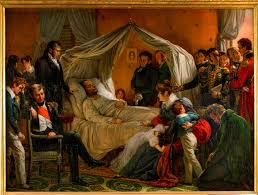
On the afternoon of May 5, 1821, Dr. Francesco Antommarchi stood in the drawing room of Longwood House and felt that history had become plumbing. The greatest military mind of the modern age lay in bed, looking like a wax fruit. Outside in the South Atlantic, the wind whistled against the shutters. The English commissioners entered the room. They wanted to see the corpse and specifically the organs.
Antommarchi performed the autopsy. The sternum split. The organs were a pale yellow. The liver looked as though it were full of Saint Helena’s rains. Then, as he turned, the Abbé Vignali came up to him.
Vignali had spent three years with the Emperor trying to minister to him. Yet on one rainy afternoon in 1819, the Emperor had told him that he was impotent. Not just celibate, but mechanically impotent. Vignali smiled when he heard this.
As soon as Antommarchi turned to look at the liver, Vignali snipped at the appendage with his pair of scissors. The object came away as easily as a bookmark from a Bible.
No one saw this. Yet everyone understood immediately that this was a theft of a certain kind. The commissioners were discussing the gallbladder. Antommarchi was thinking about going home to Palermo. Vignali slipped into his cassock pocket and felt the thrill of possessing something that belonged to the Emperor.
II. The Relic
They tell us that objects have no consciousness. At seventy-one, I know better.
In 1927, a small appendage from the life and death of the Emperor Napoleon made its way to New York. This time in the city’s Museum of French Art—a brownstone on Fifth Avenue—was displayed in a case labeled: Personal Effects of the Emperor Napoleon. This object was displayed beside a toothpick, a lock of Josephine’s hair, and another object known as le petit empereur.
The curator was a woman named Mrs. Abernathy Whitmore. This woman had strong opinions about Impressionism and had written in her diary, “It is not seemly. It is not French.” The museum board overruled her.
The opening night in the museum featured a cultural event that drew a diverse crowd of people. In that case, people turned to stare at a dehydrated penis. One businessman fainted. A suffragette nearly broke her jaw laughing. The woman in the corner, Mrs. Whitmore, realized how utterly absurd it was that people saw this as important.
The following newspaper reviews stated that the exhibit was “an unusual addition to the exhibition” and “provocative.” In the cloakrooms, however, the relic had become a legend. The wealthy flocked to see it. The wives of these wealthy men came to see it and smiled knowingly.
III. The Urologist
In 1970, a man named Dr. John K. Lattimer purchased the object. This man, a urologist, had spent most of his life studying Napoleon’s plumbing. He bought the object—for what amount is not recorded—yet placed it in a leather briefcase and slid the case under his bed.
Dr. Lattimer was no vulgar man. He had testified before the Nuremberg trials and performed Kennedy’s autopsy.
But it hid under his bed.
His wife, Eleanor, knew about it. A guest at one of their dinner parties dropped a napkin and bent to find the briefcase under the table. The guest looked pale. “There is a briefcase,” he said quietly to his wife in the cab on the way home.
What a man in his position would think impossible is true: the object, dry and mummified for over a century and a half, had acquired new meanings. So, under the bed, the remains of the Emperor’s pride continued to live.
Dr. Lattimer refused to take a photograph of the object. He also refused to display the object. When journalists called on him—both the National Enquirer and various historical journals, as well as other collectors of morbid objects—Dr. Lattimer told them, “I treat it with dignity.”
This, of course, is the great joke—and perhaps the most profound truth. Dignity! Given to something that had no place in a museum, was sold, was exhibited, was offered for sale—dignity is what it was allowed to reclaim.
Dr. Lattimer died in 2007. The possession passed to his son. Several offers were made. $50,000, $75,000, $100,000. The son declined. Having read his father’s journals, he understood the great lesson that the object taught him.
IV. The Essay
I am sitting here in the twilight, looking out the window at the ashtray and the shell. I have been trying to write this for three days. When I was twelve, I got the story wrong. I thought Napoleon was a great general, a warrior. I thought he was somehow distinct from the other humans.
I now see him differently. I see him on Saint Helena, arguing with the guard about the wine. I see Napoleon’s body, the fluids oozing from him. I see the small object in a box, travelling from one end of time to the other.
This, I believe, is the dark comedy that both Kafka and García Márquez understood. The ceremonies that we all perform in the name of our institutions, even of the greatest cultural achievements, serve but to distract us from the fact that we are all merely pieces of meat in motion.
The man who crowned himself in Notre-Dame in 1804 ended up in a small box. The codes that Napoleon wrote are still taught in law schools. Yet this object is what most people remember.
Isn’t this fitting? For this is what Napoleon dreamed of all along—the continuation of himself. Throughout his life, he sought to be the greatest contributor to the development of France. His efforts paid off in the end. In this way, though grotesque, he achieved immortality.
While the French government dissolved under Louis the nephew, the codes that Napoleon wrote endured, and changed little. And this small object of the man continued on in its campaign.
I think of what happened when Lattimer saw the object under his bed, the implication of what this meant for the rest of his life. In that moment, the object was a metaphor for what would happen to all of humanity.
Sister Mary Ignatius is dead. The foolscap that I wrote on is now dust. Yet somewhere in New Jersey, and under the dark of the bedroom, the Emperor is waiting for the next person to see him. He does not need to be resurrected—he is too intelligent for that—but for the next person to observe him.
I touch the cicada shell. It is lighter than I remember. The sun is setting in the colour of the dress that Josephine wore to one of the balls. I am seventy-one. My knees ache. The essay is finally finished.
I give it an A.