Gabriel Jeroschewitz, September 30th, 2026
The Garden of the Vulture
When the world finally concluded that the “end” was not an event but a sort of prolonged hangover, the sky became the color of battered lavender, and the atmosphere held the fragrance of charred sugar and ozone. Even the most hardened mortals would have questioned whether they were still living or only performing the act. I stood upon the balcony above the bare bones of The Sinners—a temple of rotting pews, abandoned factories, and flashing neon. The town’s outskirts were covered by a blackened forest known as the Schwarzwald—old oaks there chatted in tongues older than all of mankind had ever recorded. From above, I watched the end play out like a slow-motion ballet as I stood, a detached observer, pen suspended above a page already marked with ink that seemed to bleed on its own.
First, I did not see the mushroom cloud rising in the distance—a soft pastel cloud that resembled cotton candy more than an omen of the end—but rather the way the light shattered through it, forming prismatic shards that fell like confetti upon the remains of the fallen city. In the midst of that light I also saw the angels. Yes, I saw angels, but not the kind seen in Sunday school picture books. These angels were in fact pornographic. Made of molten moonlight, their bodies were shaped like flowing streams, wings like silk scarves laced with glitter, skin pulsing from within like circuitry along the path of their venous systems. Their eyes contained galaxies, and when they laughed—a noise like chimes played by a wind from heaven—light would trail from their eyes like tears, which would then evaporate on contact with stone.
The angels flew low over the blackened forest. In the midst of the forest, a pair of angels appeared, causing even the angels to pause in mid-flight.
There stood Mr. Death. He was made of midnight and obsidian. Silver horns, resembling a question mark, spiraled up from the tips of his head. Mr. Death wore a tuxedo made of night itself. Each seam in the garment beat with an assurance of inevitability. Next to Mr. Death stood Mrs. Death. Mrs. Death could stop a heart and start a riot at the same time. Her long eyelashes would brush the floor whenever she blinked. Each of her eyelashes was a black feather that appeared to drink in the darkness and then re-emit it as a soft purple glow. Mrs. Death’s fingernails were painted deep arterial red and arched, resembling claws capable of both ripping through silk and caressing skin. Mrs. Death wore six-inch stilettos made of shiny onyx. The heels of her stilettos tapped the forest floor in a pattern that seemed oddly like a heartbeat.
Out from the shadows came dwarves and elves. The dwarves had beards braided with small copper gears. The elves had hair braided like bark. All were drawn to the movement of Mr. and Mrs. Death. They moved in a macabre waltz that combined the elaborate footwork of a Viennese ball with the frenzied stomps of a pagan ceremony. The dwarves stomped, sending vibrations through the fungal systems along the forest floor, causing dormant fungi to glow phosphorescently in emerald and amethyst. The elves laughed like the sound of air through silver bells.
Above the angel flight, the angels continued their flight. They ascended into the troposphere, then into the stratosphere, and eventually into space. In space, the angels did not disappear but instead became constellations. Each angel wing became a line of stars representing forgotten mathematical equations scattered throughout the universe. The quantum strings in the universe appeared to vibrate in tune with the angels as they ascended. For a brief moment, it seemed as if the cosmos itself warbled a serenade made of pure probability. The serenade was dedicated to the endless lives of vampires who had drunk the eternity of night and were now mirrored in the glittering surfaces of distant quasars.
Below the scorched earth, saints and sinners, people who had spent their lives compiling lists of each other’s good and bad, found themselves mysteriously coming together. The nuclear autumn had removed the world of religious facades. All that remained was an urgent need to feel something real before the end. In the remains of an old opera house—now reduced to a bare steel-and-glass structure—a sinner in a leather jacket emblazoned with the logo of a dead corporation met a saint in a ragged cassock patched with pieces of a rebel flag. Neither spoke; instead, they reached out and touched. The touch caused a brief aurora that painted the remains of the opera house roof in ribbons of gold and green.
They started to dance. Not the movement of a liturgical ceremony, nor the movement of a mosh pit, but something in between. The dance seemed to be a confession set to music. Each spiral seemed to be a forgiveness, and each dip, a release from judgment. Others soon joined them. Ex-preachers shared a flask of moonshine with ex-bankers. Mercenaries taught children how to fold paper cranes from shredded propaganda. Nurses traded sutures for sarcastic remarks with anarchists who once dreamed of burning the very hospitals they now served.
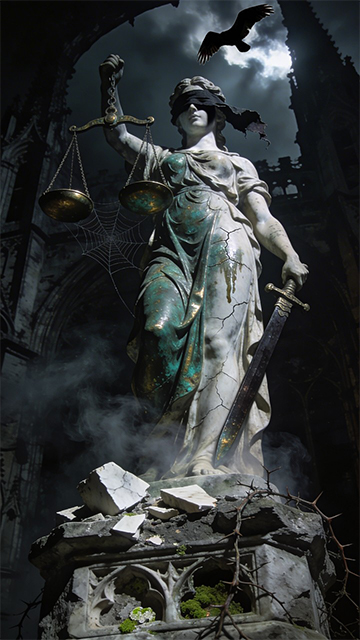
There was still a sense of whimsy in the midst of the horror, lingering at the periphery of sight. A kid laughed from the remains of a playground. The scent of singed wiring and roasted chestnuts mingled. A wolf’s howl came from a distance, oddly like a minor-key version of a cradle song. Even the vultures, which had followed since the first sirens, seemed to adopt a more ceremonial demeanor. One particularly regal vulture, with its feathers the color of an oil slick, perched on a broken statue of Lady Justice. From the remains, the vulture plucked a shiny trinket. The trinket was a ruby-set locket. When opened, inside the pendant was a miniature portrait of Mr. and Mrs. Death. Mr. and Mrs. Death were caught mid-spin, and their grins were both wicked and soft.
At that moment I realized why the lyrics that had been playing through my head for weeks—“I’m picking up the shovel… I’m gonna build a garden and bury you in the ground… I’m the poison in the water, I’m the shadow in the show…”—did not seem threatening but instead seemed to be an invitation. This garden was not a grave but instead a greenhouse of possibilities. It was tended by hands that have both given and taken life. The poison was the memory of betrayal and transformed into fertilizer for unusual glowing plants. The shadow was not emptiness but the contrast against which the light became visible. These pornographic angels, the glittering Death couple, the dancing dwarves and elves, all existed within a world that had attempted to erase itself.
At the witching hour—although time had become a relative concept, now measured more in heartbeats than in seconds—I felt the need to write down the ridiculous beauty of this situation. My pen scratched on the paper, leaving behind symbols that did not resemble numbers or letters but instead resembled sigils that glowed when stared at too long. When I finally lifted my gaze, the sky had cleared enough for a single star to pierce through the cloud. That star shone in an understanding way, as if at some other place in some other version of this world a similar garden was being built, a similar vow was being made, and a similar vulture would emerge from the dirt, jewels formed from pain and ready to play its part in the next scene.
In the distance, the dwarves and elves broke into a jovial reel. Sparks were kicked from their feet and wafted into the air as glowing embers. Mr. Death tipped his hat to Mrs. Death, who responded by twitching her red nail. The resulting red flow spread through the air, causing the angels’ wings to glow more brightly. Somewhere, a sinner and a saint shared a kiss that had the flavor of rebellion and forgiveness. Their lips touched amid the wreckage, and they made a vow that would outlast even the faintest echo of the nuclear wind.
In the end, amid the apocalypse, the fanciful prevailed. There was indeed horror—present within the cracked concrete, in the still streets, and in the constant presence of invisible particles—but it was covered in lace and glitter and absurdity. The observers (including myself) could only observe, document, and marvel at the transformation of fear into dance and destruction into a decadent and ever-flowering garden teeming with vultures adorned with jewelry made from pain and love, however unlikely, daring to blossom in the shadow of the mushroom cloud.