
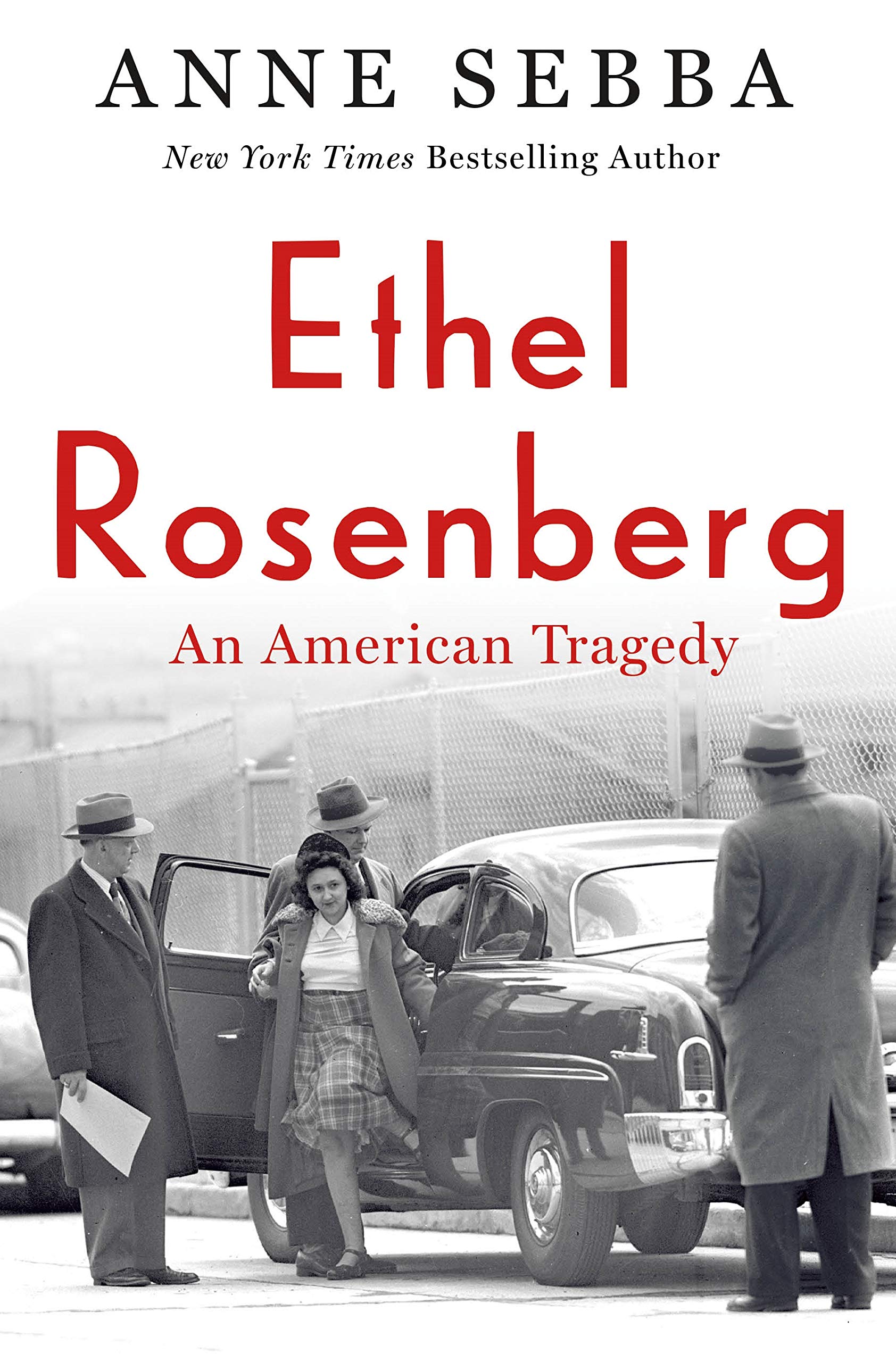
Book Review – Ethel Rosenberg: An American Tragedy – by Anne Sebba, pub. 2021, St. Martin’s Press
by Amanda Hale
From the front cover: “In June 1953, Julius and Ethel Rosenberg, a couple with two young sons, were led separately from their prison cells on death row and electrocuted moments apart. Both had been convicted of conspiracy to commit espionage for the Soviet Union, despite the fact that the US government was aware that the evidence against Ethel was shaky at best and based on the perjury of her own brother.”
After three years of imprisonment, two in solitary confinement, Ethel’s execution was horrifyingly bungled. After three charges of electricity she was taken down from the chair, her heart still beating, then returned, strapped in, and given a further two jolts, taking a total of four and a half minutes to die.
Sebba gives a vivid account of Ethel’s unwavering devotion to her husband and two sons, aged 7 and 10 at the time of execution, having already been deprived of their parents for 3 years. Ethel was a talented singer with operatic ambition but, as a 1950s housewife, she prioritized her family. Ironically, her own mother and brother betrayed her, the brother lying about Ethel to save himself. In an era of anti-communist phobia, accompanied by the antisemitic association of Jews with Communism, the States were united in fear, and the Rosenbergs became scapegoats. Despite enormous global protest on their behalf, the US government was relentless in its persecution of Ethel and Julius. Roy Cohn, a 23-year-old lawyer, was assistant prosecutor at the trial. He made his name with a vitriolic pursuit of the death sentence for Ethel, who in fact was innocent of direct involvement in her husband’s politically naïve activities as a recruiter of spies for Soviet intelligence. Cohn eventually became mentor to the young Donald Trump, teaching him how to effectively evade the rule of law. (See the movie – The Apprentice, 2024.) Toadyism and blackmail were Cohn’s survival nets as a Jew and a closet homosexual during that dangerous era. He eventually died of AIDS.
Anne Sebba is a British biographer and former Reuters foreign correspondent. Her subjects include Wallis Simpson, the women of Paris under Nazi occupation, and the Women’s Orchestra of Auschwitz – always focusing on injustice and the fate of women in extreme situations. Her sharp focus on Ethel Rosenberg widens into a history of Ethel’s time which was one of Communism, cold war espionage, and McCarthyism. The phrase ‘Iron Curtain’ had been popularized by Churchill in a 1946 speech delivered in Fulton, Missouri, as it came clanging down with an enduring resonance of fear and hostility between nations The post WW2 era was rife with fear – fear of spies and traitors, of homosexuality, of speaking out, stepping forward, of the press, of imprisonment, politics, pacifism.
Sebba’s book shows the dehumanizing effect on a population held hostage by fear-mongering – bringing to mind examples throughout history as well as more recent phenomena such as pandemics, wars, tariffs, and other divisive and diverting factors. She shows how prejudice and irrational judgement are woven into the fabric of society by corrupt government, and how easily people slide blindly into their roles as victims. One day Ethel is caring for her sons, the next day she is arrested and separated from them for the rest of her life.
When the Rosenbergs were arrested, their sons were 7 and 3 years old. In 2016 those boys, as aging men, sought to clear their mother’s name with a request to Obama to nullify the original jury verdict. They were refused.
On January 22nd 1953 Arthur Miller’s play, “The Crucible,” about the Salem witch trials, opened on Broadway, “written as a more general response to ‘the Red Scare’ that had paralyzed a whole generation and in a short time dried up the habits of trust and toleration.” Miller’s audiences, reports Sebba, made a direct parallel with the Rosenbergs’ execution, observing a minute’s silence on June 19th 1953, the day of their execution.
Apart from being a tragic tale of injustice and cruelly bungled punishment, the Rosenberg’s story is emblematic of the vast nets of corruption that go unchallenged in this world. It is one thing to look back through history at such stories, but quite another to acknowledge them in “real time.”