Shucking Oysters: The Deadening Effect of Wealth
By Alex Allen
There are two groups of people who have to think about money all the time: the very poor and the very rich. On Hornby we see a lot of rich people. Some are lively, curious and engaged, but others display this “dullness in spirit.” There’s a sense that nothing is sufficiently stimulating to hold their attention, that they have lost their capacity for wonder. George Monbiot said we are all consenting to the “Earth-eating, soul-sucking mode of exploitation we call capitalism.” One day we too might live the “affectless life” of the ultra-rich.
What if most rich ass holes are made, not born? What if the cold-heartedness so often associated with the upper crust – known as the Rich Asshole Syndrome (RAS) – isn’t the result of “having been raised by a parade of resentful nannies, too many sailing lessons, or repeated caviar overdoses, but the compounded disappointment of being lucky but still feeling unfulfilled?” We’re told that those with the most toys win, that money represents points on the scoreboard of life. But what if that narrative is just another grift in which we’re all getting ripped off?
In his essay “Extreme Wealth is Bad for Everyone – Especially the Wealthy,” Michael Lewis noted, “It is beginning to seem that the problem isn’t that the kind of people who wind up on the pleasant side of inequality suffer from some moral disability that gives them a market edge. The problem is caused by the inequality itself: It triggers a chemical reaction in the privileged few. It tilts their brains. It causes them to be less likely to care about anyone but themselves or to experience the moral sentiments needed to be a decent citizen.”
Of course, there are exceptions. Plenty of wealthy people have the wisdom to navigate the difficult currents their good fortune generates without succumbing to RAS – but such people are rare, and they tend to come from humble origins. Perhaps an understanding of the debilitating effects of wealth explains why some who have built large fortunes are vowing not to pass their wealth on to their children. Several billionaires, including Bill Gates and Warren Buffett have pledged to give away all or most of their money before they die. Buffet has famously said that he intends to leave his kids “enough to do anything, but not enough to do nothing.”
Brooke Harrington, a professor at the Copenhagen Business School wrote that “when the wealthy are revealed to be drug addicts, philanderers, or work-shy, the response is – at most – a frisson of tabloid-level curiosity, followed by a collective shrug.” Behaviours indulged in the rich are not just condemned in the poor, but used as a justification to punish them, denying them access to resources that keep them alive, such as healthcare and social assistance. We are seeing this played out with utter cruelty in the US.
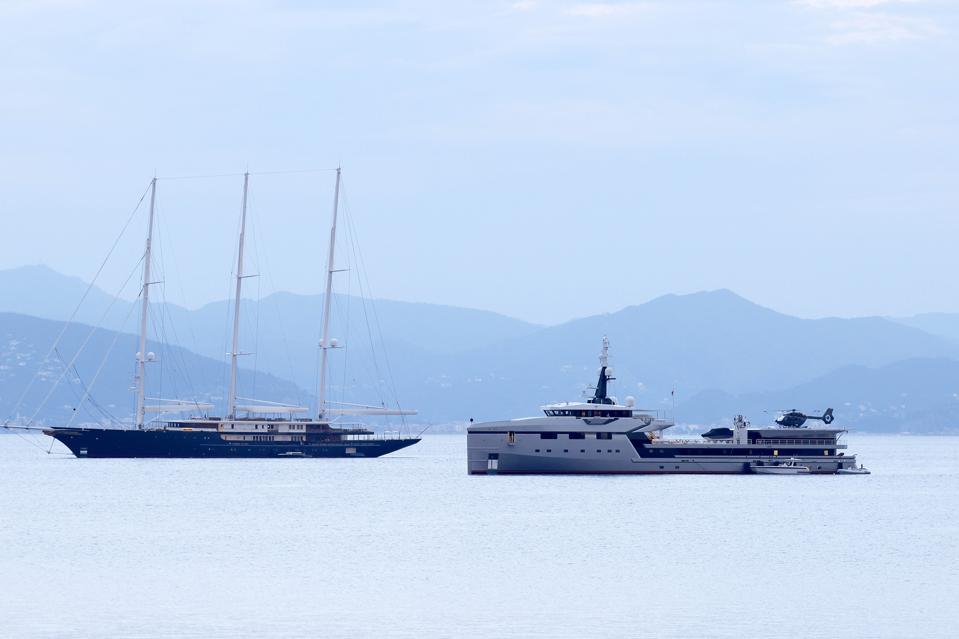
In 2016 Jeff Bezos purchased two adjacent houses in Washington, DC for $23 million in cash. Bezos then hired an architect to oversee a $13 million renovation. One house for the family headquarters and the other for entertaining guests featuring a 1,500 square foot ballroom with floor to ceiling fluted columns. Shortly after this purchase, Bezos bought David Geffen’s Beverley Hills estate for $165 million (believed to be the highest ever paid for a home in California), where he now flies back and forth in his $66 million Gulfstream jet, when he is not schmoozing on his $500 million super yacht, Koru, the largest sailing yacht in the world. Anointed the fourth richest man on the Earth, Bezos’ net worth is estimated to be over $270 billion. Musk is number one at over $800 billion.
The rich didn’t get rich by thinking a whole lot about others. Getting rich involves ignoring most people while you pursue wealth, and at worst, it involves screwing other people over. Either way, it’s naturally the more selfish among us who will pursue wealth. Nicer people, by nature, take most of their pleasure and satisfaction in life through interacting with others. They have love in their lives and are thus less likely to need to pursue wealth despite the cost of doing so.
In the Atlantic this month, Noah Hawley touched on how billionaires have conveniently left the world of consequences. “They float in a sensory-deprivation tank the size of the planet, in which their actions are only ever judged by themselves.” Being truly rich doesn’t just mean amassing enough money to afford super yachts, private jets, or a million acres of land. It means everything becomes free, and if everything is free and nothing matters, “then the world and other people exist only to be acted upon, if they are acknowledged at all.” Empathy is gone. Elon Musk once called empathy “the fundamental weakness of Western civilization.” If empathy is the problem, then lack of it isn’t a deficiency – it’s an advantage.
The world has always been run by rich men. Hawley writes that although today’s billionaires are clearly manipulating society to maximize their own profit, something else is also happening – a “disassociation from the reality of cause and effect, from meaning and history.” These men no longer feel the need to change the world in order to succeed, because their success is guaranteed, no matter what happens to the rest of us.
As Linda McQuaig and Neil Brooks wrote in The Trouble With Billionaires: “Today’s gigantic fortunes seem to be less a reflection of the innovative genius of current billionaires and more a reflection of how uniquely adept they’ve been at elbowing their way to the front of the trough.”