

Book report 18
By A. Bae Hel
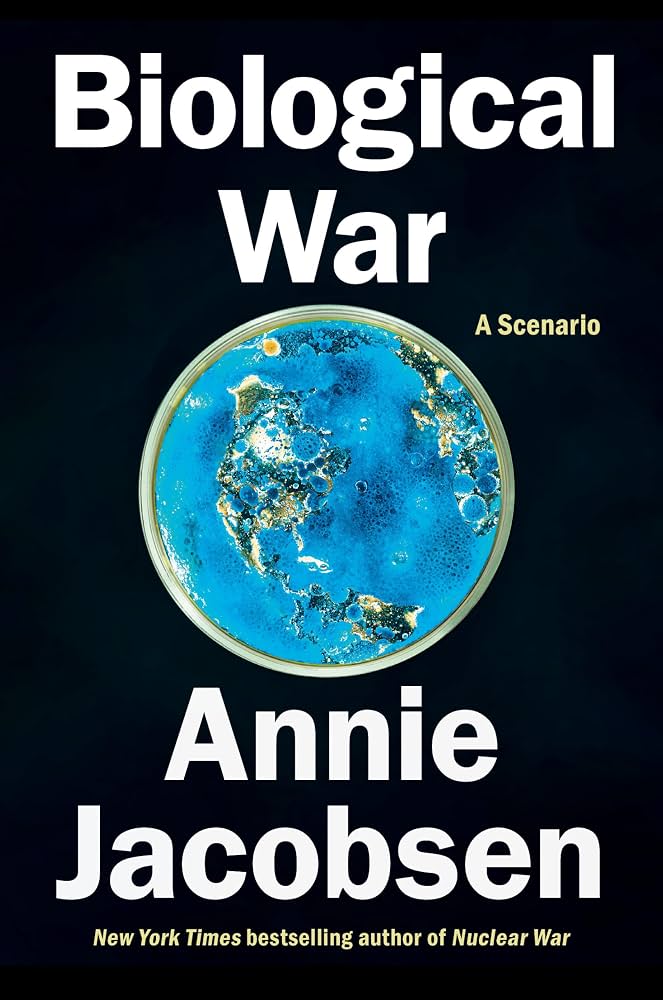
Biological War
Annie Jacobsen
In 2009 when the H1N1 pandemic arose I had the great fortune to be assigned the coordination of the site pandemic response and working with multiple different departments to ensure that a safe response was in place. In 2014 when Ebola burst its African containment and the mass hysteria was loosened into the world, I was again tasked with establishing a containment unit in case there were any patients to house. Pandemic response is a highly complex, often chaotic system involved so many teams and programs.
Having worked with professionals that respond to a multi-casualty event with precision and calm I was absolutely blindsided by the absolute hysteria of the individuals who were the front line for providing critical health care. They lost their collective minds.
Despite good knowledge about the disease, how it was transmitted and what the appropriate infection control steps were to prevent becoming infected none of that mattered. the media hysteria had contaminated the staff. Knowledge was irrelevant.
These were educated, trained individuals used to handle contagious patients. So, imagine what will happen when a novel illness is discovered and people start dying. Well, if you were on this planet in the last decade, you may have some memory about how bad it was for some.
This book described what will occur when that organism is genetically altered to be immune to treatments and worse. It is based on actually historical events that have occurred as well as an absolutely tsunami of information about the US plan to ensure the government survives this apocalypse. There is the history of biological warfare, how the USA and Russia started developing organisms to use against an enemy, the number of level 4 labs and research facilities and the number of 3, 4 and 5 letter organizations involved is staggering.
An infectious disease is around the world in hours. It takes days to activate biohazard response teams, days to launch the response. But first it has to be recognized as what it is. Frequently when a new organism first shows it is described as an atypical pneumonia and treated as such. It is only when the WHO, CDC or other organization tracking emerging diseases notices a trend of similar reports across several countries that alarms start to go off. By now it is spread by air travel to multiple countries. Closing the air traffic is simply bolting the ban after the horse has escaped.
This is a fascinating description of disaster response program in the US and how such a scenario will pay out, based on history and table-top exercises. I have little doubt that it would go any other way.
I recognize not everyone shares my fascination with infectious disease transmissions and outbreaks and responses, so this may not be for everyone, in particular if you were deep in the healthcare crisis during the last pandemic. It paints a deeply terrifying scenario. But for me, it was a full on 5 stars