
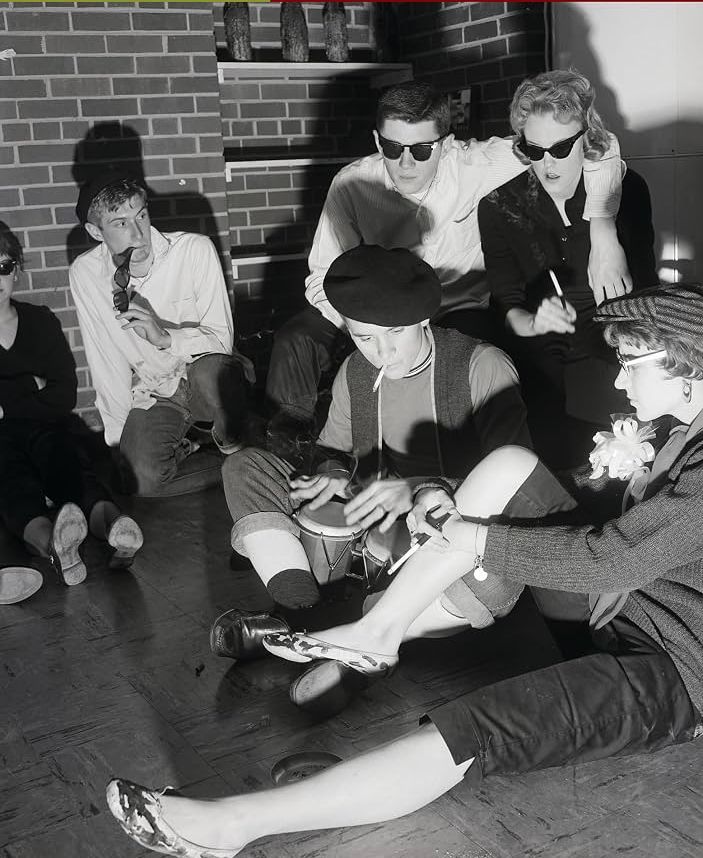
Gabriel Jeroschewitz, May 8th, 2026. This is dedicated to all the beatniks who lived in our neighborhood back in 1964. And in 1965, on Fridays and Saturdays, they had their outdoor parties. Usually, on the flat roofs of their homes, with their bongo drums and guitars, singing wild lyrics, I was 10 years old, living in Toronto. Two blocks away from Yorkville Avenue
She smiled, the kind of smile that didn’t need a punchline.
The night’s air was a low-humming saxophone; a sound heavy on the heart. I stood in the doorway of the Vesuvio, one of the only establishments in the city with neon lights so faint they resembled a broken semaphore. The long room featured tables coated in cigarette ash and walls plastered with newspapers ripped in half and pasted in haphazard ways to suggest some fever dream of a rebellion that had happened weeks earlier, and which was being lived that night by a sea of women in tight tights and rimmed with soot-black kohl around their luminous irises. I’d only shown up on a whim for a rent-a-beatnik gig posted by Fred McDarrah on a flyer slipped under the door of City Lights a week before.
To attend the gig, I was required to wear a beard (synthetic, of course) and a turtleneck and sandals; my outfit choices indicated that I intended to blend in with the rest of the beatniks congregated in the café’s window where Wally Hedrick sat as a paper-cut man representing the lifestyle of all those who wore black and listened to jazz plays on loop.
The saxophone player sounded like a man who had once played the drums like a cascade of rain on a tin roof, while the pianist played chords like exclamation points in a poem never written. Allen Ginsberg, himself thin as a reed, leaned on a barstool while the saxophone and jazz notes seemed to roll over his lips like a lover’s sigh. When he tossed out a line, “whoever you are-whoever you have loved…” the crowd inhaled and exhaled the line as if it was water to a dry throat. It was not the words he spoke that were important, but the sound of his voice, the cadence of his voice, the suggestion that language could be used in the same way as a drumbeat – something to be repeated over and over in a ritualistic way without needing to understand what was being said.
In one corner of the café sat a woman in a high-collared black shirt, a black sheath dress, and a pair of black sea-shoe loafers polished to shine with the polish of moonlight itself. Her dark hair cascaded over her shoulders into a mane of black velvet, while her heavy eye makeup featured kohl-black wings that extended over the wide rims of her eyes like the bars of a saxophone playing in the background. She wore a smile that indicated she knew the story I had yet to tell.
I named her Luna. When she turned and saw me, the world seemed to dissolve into one cut-up page of some newspaper. The papers rained from the ceiling in a frenzy as the letters seemed to rearrange themselves in a frantic rush to tell my story to the woman who had my attention and whom I had just named Luna. For a split second, we both existed as the signifiers and the signified to each other. Yes, we were two strangers in a room full of others who shared some common identity in the mind of the world – the beatnik woman, the observant poet, the friend of the night. To share such an identity made us laugh – softly and lowly – like a joke shared in the middle of a drum solo.
I walked over to her, my feet leaving scuffs upon the sticky café floor as I took the seat across from her. “You’re a muse or a myth?” I asked the woman seated across from me.
She smiled. “Both,” she said, “and neither. I’m just a woman who wears black because black is the color of everything we are trying to hide – and what we are trying to see.”
We spoke of cut-ups, of Burroughs and the way Gysin played with the scissors like lovers, using them to make a new narrative out of the pages of a daily newspaper. Her hand moved as she spoke – she was tracing the edge of her glass while her heavy eye makeup caught the fluorescent lights of the café. Her voice had a cadence, a rhythm to it; each word landed like a bead upon a rosary of significance.
Then, from the back of the café, someone shouted out, “Rent-a-Beatnik, make it quick!” A young poet in a pink beret rushed over to me with a note that said: “Show us the sign – make us see the unseen.” Wally, standing in the café’s window, lifted his paintbrush and smeared charcoal upon his face. He became a sign in motion, one of the living canvases of the beatnik movement. The audience whooped as they had just inhaled the “who” and the “why” of the evening.
The saxophone player took the stage one last time to play a slow solo. Ginsberg shouted out the words “Whoever you are-whatever you have loved – call your name, 50-named, I have discovered a God.” Luna’s eyes shimmered, and a tear of pure silver clung to the edge of her eye.
I leaned over to her, whispering the words, “Do you think we are just symbols, Luna, or are we trying to become something beyond the symbols?”
She frowned into her drink. “I know what I am, Jack,” she said. “I wear black to be invisible. I am the most visible thing in the room. I wear the black shirt, the turtleneck, the bearded man who claims to love all the right people and shares the same lyrics on the radio because it makes him feel good. Somehow it makes him feel free.”
At the time, I did not realize that the romance of the evening would become the romance between all who were gathered that night – the scene and the possibility of a sign for all who desired to say “I love you” in a way that did not use clichés. Perhaps in some small way, the night was dark but revealing – perhaps there was a flicker of a candle’s flame visible in the distance signaling something about the future of all those gathered that night.
When the saxophone player finished his solo, Luna leaned over to the table with a light brush of her fingertips upon the wood and whispered to me something over the din of the band. Maybe she was speaking of signs, or maybe she was sharing some secret about the lives we all led in the presence of darkness and the desire to be seen by others in the same way that we see ourselves reflected in the mirrors of our own homes.
She said to me, “Maybe we are all just trying to find a place to be read without being understood. Maybe love can be a line break in a poem, a space in the air between two people who need to speak to each other. I leaned over to her, my breath almost touching her lips when I whispered back, “Then let’s be the cut-up of love, something that no one can ever rearrange. Let’s make our love a symbol of what it is — something that cannot be translated from language to language, but understood in the space between two notes of a song. The band ended the evening with a final note on the saxophone. Luna stood, her black turtleneck shimmering in the neon light of the Vesuvio’s sign that was cast off like a dying signal when she passed me and stepped outside into the downtown streets of New York.
Outside, it began to rain. The drizzle cleared the ash upon the streets, it cleared the ink of the city’s signees, and it cleared the tears of the night. Yet I stood outside that café, a rent-a-beatnik who was more than just a sign for the beatniks, but a man who had been seen in a world that rarely looked upon others. Perhaps the heart of New York was still dark, covered in black shirts, tight tights, and women with coal-black kohl around their eyes. But perhaps somewhere in the middle of the city streets, between the cut-up pages of the city’s newspaper and the remnants of the saxophone that played well into the small hours of the morning, perhaps somewhere there was a new sign being written – a sign that said “love” – eternal, untranslatable and written in black ink upon a night that would never be forgotten by those who knew of its existence.