Gabriel Jeroschewitz, June 19th, 2026,
Such a puzzle will never be fully solved
I have spent the better part of forty-seven years reading verses of this old and half-mad nature – verses that the British Library keeps in one of its back-shelved corners. The poem that started it all was more of a tangled riddle than a lament, but one loaded with references to the Green Man, Merlin of the borders, the Picts and the coming of the Gaels – and a whole host of other half-remembered mythic names that make one’s head spin. The verses referenced elements like “the knee-high nineteen forties”, “the waist-high nineteen fifties” and even “the middle row” that would “put the answer down”. Such nonsense tends to come from children scribbling after long nights of history lessons – so I, a wry old observer of absurdity, could not help but smile.
The tone was decidedly dark, as if the writer had swallowed an entire tankard of mead whilst reciting the lineage of Britain from the days of Noah’s brother Parthenon to the arrival of the flaxen sons of Mil. The verses spoke of “the green the garden and poetry attest their artistry thus and otherwise” and of “the comings and the goings in the high and far off times stacked and dried”. I saw it all in such a dim corner of the reference room, whilst watching the motes of dust dance in the light of one of the museum’s cracked windows. It was a perfect example of how we – the living – try so desperately to piece together a past that refuses ever to solve itself.
It was on a blustery Thursday afternoon when I took a wander through the museum’s newly developed wing – a glass-covered annex built to exhibit Ancient Britain. The walls were a sombre grey, as befits the displays of axes, bowls and stone circles that always seem to spring up where either Romans or Druids have trodden. The exhibit I paused at featured a group of statues – described in the catalogue as “celestial guardians, rendered in a contemporary medium.” While somewhat vague descriptions applied to both group and statues, I thought this was an ideal spot to linger – something I am wont to do when confronted with such order outside the world.
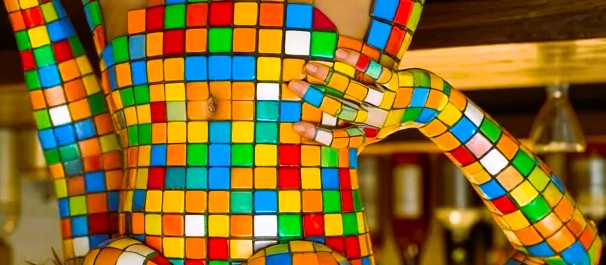
The statues featured impressive heights – far beyond any human figure – and were formed entirely from Rubik’s cubes. Each cube occupied a different shade of the original six colours. The group nonetheless presented an impression of a body – a torso of red, blue and green squares, long and slender legs that ended in a point at the ankle and arms that stretched outward towards the air. The most striking aspect was that each figure was completely nude; the limbs, marked out by the cubes, featured a faint, translucent glow in the spaces between the squares. The entire creation appeared as though fashioned from light trapped inside a child’s puzzle game.
Standing here, my eyes adjusting, I heard a soft rhythmic clicking – the sound of a Rubik’s cube being turned somewhere in a quiet room. The figures appeared to be moving – albeit without any particular purpose or intention – taking tentative steps to find a comfortable resting position upon the floor. The long legs of interlocking squares featured a gentle sway whilst the cubes that formed torsos made very small increments of rotation. It was as if the figures engaged in an endless silent game, endeavouring to solve themselves – a puzzle that could never be completed in any state of completion.
I could not help but laugh – a short dry chuckle at such an echoing corner of stone walls. The vision was utterly absurd yet profoundly beautiful and faintly unsettling all at once. The figures of cold plastic possessed a naïve innocence – like newborn angels exploring existence in its naked state. The long legs – each a column of interlocking squares – displayed a mechanical grace but also a whimsical element. Such faces – if they could truly be called faces – were just a single row of cubes slowly rotating in one direction after another.
One of the angels paused as its torso rotated a full ninety degrees – as if it saw me directly. The cubes lining the “face” aligned for only a momentary fraction of time to form what almost looked like a smile – before scattering once more. I felt a chill – not from fear but from understanding that these creations were attempting to answer a question that has haunted humankind since the dawn of staring up at the stars. What are we? The angel’s cubes made a soft, soft noise, as if the answer lay just out of reach – perpetually just a twist away.
I stepped closer and whispered the words: “You are the answer to a puzzle that never was.” The cubes shivered – the red squares flashing in recognition – and the whole figure deepened to a shade of amber. Yet just as quickly as it brightened, the glow faded, and the statue settled once more into its silent shuffling.
The rest of the exhibit passed before me as a blur of ancient stones and even older stories, but my mind remained fixed upon those Rubik’s cube angels. The long legs brought thoughts of the verses describing “the knee-high nineteen-forties” and “the waist-high nineteen-fifties” – arbitrary references to time and humanity. I thought of the Picts who were “clean as clams, witty and thick as thieves,” followed by the “flaxen sons of Mil” who came after them, each trying to make their mark upon the land and upon the riddle of belonging. I thought of Merlin – the wizard of the borders – who, legend says, turned in his river grave whilst waiting for a time when the stones would speak again.
When I exited the museum, the sky was a bruised purple – twilight at work upon the old stones and making them look like bruised fruit. The wind carried the scent of damp earth and the distant tolling of a church bell for vespers. I made my way home with the verses of the poem still rattling through my head like a half-solved Rubik’s cube. The night remained dark, yet the streetlights flickered with the same glow as the angels’ cubes. Such was the feeling I could shake – somewhere deep in the hidden corners of this grey old island there surely are beings formed out of coloured squares attempting to work out what they truly are.
I am an observer – a man of middle age who watched the world try to solve itself. The poem, the museum and the angels all fit – a jumble of history, myth and absurdity. Such a puzzle will never be fully solved. Yet perhaps that is precisely the point – we are all Rubik’s cubes in our own ways. The angels, beautiful and nude, with long legs formed of interlocking squares, will continue to shuffle and click and wonder about existence – whilst I, for one, will continue to watch the show – a wry smile adorning my lips until that very day when the cubes finally align.