Gabriel Jeroschewitz, July 4th, 2026 inspired by the book, American Trickster: The Hidden Lives of Carlos Castaneda
The Divine Yo-Yos of Carlos Castaneda
A Surrealist Account of the Great American Trickster
In the beginning there was the cactus – and the cactus was a yo-yo – and the yo-yo was divine.
This is how the story begins – though “beginning” is very generous indeed – the narrative of Carlos Castaneda exists outside of time in that particular void where American optimism decomposes. The observer sees all this from a great distance – as one sees a caravan of flamingos traversing a shopping mall or seeing one’s own hand write a letter that one has never read.
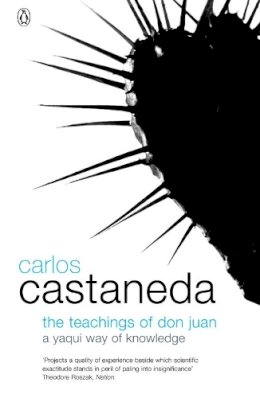
Let us speak of the year 1968 – in California this was somewhere between April and November, depending upon which substance one was indulging. The University of California Press – that acclaimed institution of peer review and academic rigour – published a book concerning the Yaqui shaman Don Juan Matus and how he had initiated graduate student Carlos Castaneda into the knowledge of the desert. The book duly sold. Oh, how it sold! It sold like prayers at a televangelist’s bedside table.
The anthropologists of UCLA nod wisely among themselves, stroking their beards in the manner of men who have never encountered an Indigenous person but who think themselves well-placed to pontificate upon Indigenous epistemologies. Fascinating. Groundbreaking. One wonders what they were smoking, but one already knows – it was the same substance that makes all academics believe they understand anything. The substance is tenure, and its effects are long-lasting and largely fictional. John Lennon purchased a copy. So did Joni Mitchell. Federico Fellini, master of surreal imagery and meaning, wrote a fan letter that read: “The cactus is the door.” One cannot argue with this – one can only nod and move on, like a duck accepting rain.
Now enters that family who wrote The Book of Lists whose names appear in the text like an ensemble of Greek tragedians who found themselves in the wrong play. They take delight in making lists – lists of lists – in trying to order the universe and existence as it unfolds. The observer finds this charming – in the same way that one finds a child playing with scissors – charming until the cutting begins.
Susie Bright’s father – linguist at UCLA – says something that will remain for decades as the dial tone of some conversation no longer dialled. He speaks of language as performance, of meaning between people, of truth emerging through negotiation. The observer takes notes – though they make no sense – though they never do. Agnes enters the scene – though again “appears” as generous since she was always there – emerging as the camera turned towards them. She would later be seen framed by Chase Joynt and Morgan M. Page, but in this story she remains in becoming and in the emergence from her fabrications. The observer tips an imaginary hat. Barbara Meyerhoff materializes from the feminist movement of the 1980s as a spectre who in some way forgot how to haunt anything properly. She bears the weight of questions no one asked and answers no one desired. The observer respects her stamina – though perhaps the more appropriate word is stubbornness or the distinct American disease of believing that one can fix something that was never truly broken.
But we have forgotten the main performer. Let us return to Castaneda – that most exquisite of liars – that master of mendacious utterances. He was a fraudster’s fraud, a liar who lied to liars – a con man who conned con men. Such an achievement demands admiration – as the observer makes it – in the way one admires a Ponzi scheme of great elegance yet truly brass-capped in execution.
The academic types – white, male and mostly ignorant of what lies outside their footnotes – had some reason to legitimize him. They needed this Native voice to say what they desired to hear, this shaman who would confirm their theories or this indigenous wisdom that would support academic careers. When Castaneda offered this – they did not ask questions. They could not afford to. The observer sees this machinery in operation – thinks of others throughout history and society.
And the women! The observer must speak of the women – though “speak” is perhaps too gentle a word – perhaps “inscribe” or “lament.” The young and dew-eyed women approached him, drawn by knowledge with no other place to be found and the certainty of being chosen – special and destined. They surrounded this man like satellites orbiting a planet entirely of ego. Some men were here along with some children, but it was the women who made the center the center of their lives – as women always do in such stories and as they always have.
The observer now journeys backwards in time – or forwards into the future since time is merely a suggestion here – to gaze upon the deeper currents. The American penchant for offering extra-realist explanations is the nation’s true native gift – older than the nation itself and deeply rooted in the soil of that which was colonized by those with manifest destinies and invisible friends. These come to Plymouth with their theology and their diseases. Within a century, they have produced Mary Baker Eddy and her notion of illness as imagination – imagine that! Then the Yogis came. Christopher Isherwood would learn to say “om” with the correct vowel. Timothy Leary would experience a turning on to the world and dropping out of the old ways, while Baba Ram Dass would become “be here now,” and Jim Jones would offer a drink that was also a destination. Charles Manson would whisper words that sounded like songs until those songs became bodies.
All of this swirls within this great American stew – the gumbo of spiritual seeking and psychological damage. The observer stirs the pot – tastes nothing because the pot is empty – because it was always empty.
The final third of this narrative attempts what is essentially impossible – making others’ psychoses legible. This effort is like trying to read Braille through boxing gloves or hearing colours through a door without a handle. Castaneda, diagnosed with liver cancer, told his followers that he would not die but burn within himself to reach another realm – he invited those who wished to join him. The observer takes note of the specific grammar of such an invitation – never a question but an offer that could not be refused without refusing oneself and one’s very being. After he died in 1998, five of Castaneda’s closest female followers vanished. The observer does not use the word “vanished” lightly. They are widely believed to have taken their own lives – though again the words “believed” and “widely” are doing an enormous amount of work within that sentence – the observer chooses not to distribute that work evenly.
The cactus was a yo-yo. It hung upon the strings of the universe descending into the hand of those who stretched forth – ascending only when released. This is the trick: you must let go to bring it back; you must release to retrieve truly. The observer has seen this motion so many times in so many costumes in so many rooms – some well lit, others not so much.
The book – this book – about the book and the man who might have truly existed – comes from Or Books – excellent but small press. The observer does not know if anyone will find it. The observer suspects not. But the observer has learned in these long years of such observation that the act of throwing is the point – the message, the transmission – the bottle, the message, and we are all, each of us, drowning in the ocean pretending that it is merely a swimming pool.
The divine yo-yo descends. The observer catches it – then releases it – only to find it once again in his possession. Om.
Or something like o m.
The observer now rests – having said what could not properly be said and having written what could not be written – having finished this non-task but truly a document of surrender. The cactus is not a cactus. The yo-yo is not a yo-yo. The liar is not a liar. The observer is not an observer.
And yet – the words remain floating upon the surface of a pond that has no bottom.
Fin de lecture