
Gabriel Jeroschewitz, April 29th, 2026, translated from Aramaic into English
The Beach at the Edge of Everything
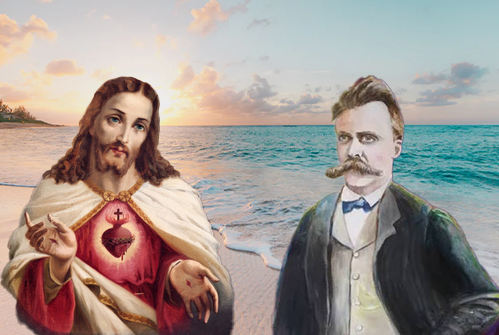
The tide was going out when I saw them – two figures sitting on the beach. One had a beard like seaweed; the other wore a mustache like a relic from a dead regime. I was looking for solitude, but instead found Nietzsche and, beside him, Jesus of Nazareth.
“You keep talking about how God is dead,” Jesus said, picking up a shell with his fingers. “But you never offer an answer as to what comes after.”
“What comes after is the Übermensch. That’s the whole bloody point of creating beings that do not need permission from some almighty deity to live their lives.” Nietzsche crossed his arms over his chest. “When the old priest dies, the new man can come into the world and live.”
“What you said,” Jesus said, setting the shell on the sand, “is true. But what you felt when you wrote about the death of God was in Turin, alone, watching your horse get beaten up. You weren’t eating well, and no one spoke to you kindly in months. The man who wrote about the death of God was falling apart.”
“I know you feel pity for me, Jesus,” Nietzsche said. “But the angels came to me.”
“They did?”
“They came to me, in my house in Turin. When I was alone in the dark and crying over all the pain in my life. When I was weakest, they came to me. All of them. Nude, of course. They lay beside me on my bed and spoke to me in languages that told me I was chosen and that the universe loved me.”
Jesus remained silent for a while.
“And did you believe them?”
“What other choice did I have?” Nietzsche laughed. “My mother wrote letters to me that I could not bring myself to read. My sister hated humanity and all it did to the world. I had enemies from every university who spoke poorly of me in every journal. I was alone in my life. To survive, I accepted the comfort from the angels.”
“You are the dancing star,” Jesus said with a smile. “The one who creates meaning in a chaotic world.”
“But I didn’t do it for meaning,” Nietzsche said softly. “I did it to survive. To convince myself that a world without meaning was not winning over humanity.”
Jesus looked at him with sorrow in his eyes.
“Why are you here doing this to me?”
“Because I read your work. Because I know what it is to have your words misunderstood. You said the world needed to be free of God. It became an excuse for cruelty. Your Übermensch became monsters. You died before you could stop it.”
Nietzsche looked at Jesus with his blue eyes. “I died in 1900. For over a century, I have been dead. What does it matter what the world did with my words?”
“It matters because you’re still here.”
“I am?”
“You’re still sitting here on this beach, arguing about meaning in a chaotic world. I know what you did was beautiful, but the greatest terror of man is realizing that most cannot create meaning for their lives. Most need to feel loved and seen by someone greater than themselves.”
“And what did you do instead of offering comfort as I did?”
I placed the wine bottle on the sand and approached the pair.
“Jesus said you had a problem with loneliness, despite your great gifts to the world.”
“So I did.”
“You created stories to explain your pain. Your longing to be connected to something greater than yourself.”
“Which is?”
“That one is the loneliest number,” Jesus said, staring off into the distance. “That no matter what you achieve in your lifetime, on the final night of your life, you will eat dinner alone.”
The dog howled somewhere on the beach.
“I loved them,” Nietzsche said of the angels. “Even though they were not real.”
“But they were to you?”
“To me, they were real enough to make my existence bearable. To make my loneliness not so terrible.”
“They are not unlike what I offered you.”
“They are not,” Jesus said. “You said the infinite loved you. I said we were alone in the universe.”
“Which is more comforting?”
“Both are terrifying,” Nietzsche said. “But you chose to lie about it.”
“Perhaps. Or perhaps I chose to hope about it.”
“The whole purpose of God being dead,” Jesus said with a small smile, “is that it doesn’t really change anything. People needed meaning from God, even before you spoke of it. They do now. But you gave people an altogether different word—instead of ‘God loves you,’ you said you must love yourself.” Instead of saying “God has a plan for your life,” you said you must make your own plan. It’s the same fear of being alone in the universe, Friedrich. The same need to not have to suffer in silence by existing in a universe devoid of meaning.”
“You gave them a reason to survive.”
“But you didn’t.”
“I did.”
“How?”
“I gave them meaning,” Jesus said. “You gave them a reason to believe in a higher being, but not one that cared for them.”
“So what happened to the angels?”
“They were never real.”
“I know.”
“But what happens to them?”
“They become the reason at three in the morning when you’re lying awake, trying to ignore the silence in your bedroom. You wake up thinking of all the victories you had in your lifetime, what incredible things you said in your lifetime, and how they all brought you nothing but a more comfortable chair in your lonely room. They become the costume for your loneliness.”
“That’s a terrible thing.”
“It is the only honest one,” Jesus said. “Despite what people say about your death and the Übermensch, I think you were brave to speak up about it. In fact, I think you were right about most of what you said. The world is in chaos. Meaning is something that humans must create for their lives. God died, or rather, the deity that humans once worshipped passed on. But you were also dying inside and hiding it from the world by speaking in prophecies and ultimatums. You were lonely men showing desperation for one who would understand their pain.”
Nietzsche said nothing. He just sat on the beach as the tide went out.
I finished my wine.
I almost went over to introduce myself to the man who spent his life arguing against the humanity of human connection.
But I did not.
The angels would not come tonight. Never had they come to anyone. Yet, Nietzsche remained on the beach, staring at the horizon, wondering if they would appear.
Sometimes, in the face of loneliness, the simplest of choices to remain on the beach with your thoughts and your pain is the most human of all.



Well this is a powerful piece ripe for more than one read and much reflection!!! Thankyou