
Shucking Oysters: Free-Floating Anxiety
By Alex Allen
“Man is an arrogant fool who vainly believes that he knows all of nature and can achieve anything he sets his mind to do. Seeing neither the logic nor order inherent in nature, he has selfishly appropriated it to his own ends and destroyed it. The world today is in such a sad state because man has not felt compelled to reflect upon the dangers of his high-handed ways.” – Masanobu Fukuoka
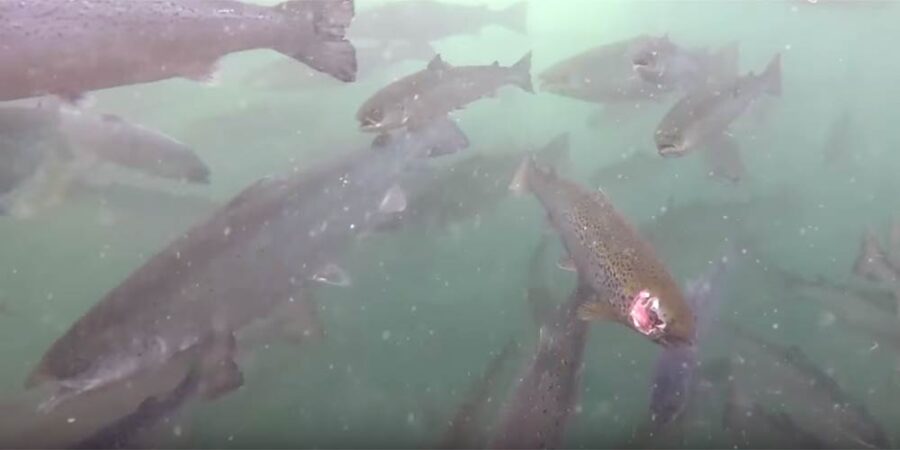
Imagine being held in one room for your whole life, crammed with a bunch of restless people, with no opportunity for privacy, let alone space to move. Now imagine a swimming pool muddied with excrement and filled to the brim with thousands of drugged fish swimming aimlessly in circles. This is what factory fish farming (“concentrated animal feeding operations”) looks and feels like. Confined for their short miserable lives, commodities simply for corporate profit.
One study found that up to a quarter of fish on fish farms float listlessly at the surface of the water of their enclosures. These fish were found to have elevated levels of cortisol, the hormone related to stress, and their brain chemistry was eerily similar to that of a human suffering from depression. As someone said, “considering the conditions that farmed fish are forced to endure, their depression seems only natural – and something they did nothing to deserve.”
Charles Clover warned in The End of the Line: How Overfishing Is Changing the World and What We Eat, that fish farming, even with conventional techniques, “changes fish within a few generations from an animal like a wild buffalo or a wildebeest to the equivalent of a domestic cow.”
As soon as you add the word factory to farming is where you see our taste for cruelty, from eggs to beef and all the sad creatures in between. Salmon raised in open-net pens will spend up to two years trapped in a world of plastic mesh, suspended from a floating platform, in a farm with as many as 16 pens, each holding over a thousand fish. With these conditions fish become chronically stressed and diseased. And this is where the drugs kick in, “an overused tool in the cruel arsenal of factory farming.”
Much like an ill-designed soil sifter, the plastic mesh allows excrement and excess artificial feed to flow freely into the surrounding ocean, like open sewers. What’s worse, the sea bed surrounding the pens is suffocated under a murky layer of faeces, feed and dead fish. This toxic stew contains viruses, bacteria and parasites all capable of infecting juvenile wild salmon and other innocent creatures. In the Discovery Islands off Campbell River, researchers found the bacteria, Tenacibaculum maritimum, which causes scale loss, skin lesions, fin necrosis, mouth rot and gill ulceration, was twelve times higher near fish farms.
If that’s not enough, farmed fish are often produced through a process known as “induced triploidy,” which is a fancy term for making fish sterile. The process, like every other aquaculture “innovation,” results in horrible deformities, crooked backs and deformed jaws which can affect the fish’s ability to swim or feed properly.
Sea lice outbreaks are the norm. These parasites often eat down to the bone on fish’s faces, resulting in what is sometimes called a “death crown.” The cure? A “thermolicer” which pumps the live fish into a tube of seawater heated up to 34°C (93°F) to knock off the lice, and then dumps the fish back into their cages. Little wonder that so many have died as a result. Killing fish by overheating, whether accidental or not, is simply mean and nasty. The stress alone from the suction and power-washing, already kills up to 10% of the farmed stock.
Not a month goes by without reading about a massive farmed salmon die off or salmon escape. A 2024 study by researchers from the University of Victoria, Texas A&M University and Memorial University of Newfoundland and Labrador, revealed that 865 million farmed salmon have died worldwide in the last decade. Scientists blamed the increasing number on ocean warming caused by climate change, the aquaculture industry’s overuse of antibiotics and drugs, and its tone-deaf attempts to increase profits.
At one salmon farm operation off the Sunshine Coast, 3.8 million fish died in just one month. The operation naturally disputed the number, contending that only “166,676” fish died. Last summer, 185,000 fish died at three fish farms just north of pristine Clayoquot Sound. A Cermaq spokesman without any hint of psychological trauma explained: “The mortality levels observed at three of our active farm sites were attributable to the ongoing presence of the harmful plankton, and despite best efforts by our farmers and mitigation systems, has resulted in this unfortunate event. It is always difficult to lose animals that you have been rearing, and we appreciate the efforts of all our staff and the work that goes into farming our salmon. The environmental conditions have since improved and the salmon our farmers care for are now back to favourable performance.”
BC still allows open-net farms, as opposed to our enlightened neighbours – Washington, Oregon, California and Alaska – who have all banned the practice. In August 2017, over 250,000 Atlantic salmon escaped a collapsed open-net salmon farm into Puget Sound, which helped convince the state to ban salmon farming the following year. The Canadian federal government originally pledged transitioning away from open-net farms by 2025, but last June, it pushed the deadline to 2029.
In July, Cermaq (owned by the Mitsubishi Corporation) purchased Grieg Seafood British Columbia, Grieg Seafood Newfoundland, Grieg Seafood Finnmark, and Grieg’s North American sales for $990 million, making it the largest salmon farming company in the world. Cermaq CEO Steven Rafferty said the acquisitions are “the perfect fit with the company’s ambitions to expand its biomass.” Now they are able to produce 280 thousand tons of it, which will “ensure that the seafood industry is not only profitable but also meets societal needs and requirements.”
In 2023, there were 214 lobbying interactions by fish farm industry proponents, almost 27 times more than reported in 2010, illustrating how lucrative the farming business is. Members of the industry have lamely expressed concerns about transitioning to land-based systems, especially within the five-year timeline. Some have said it’s not economically feasible, citing high costs and logistical challenges. The future looks even murkier, particularly the dual role the federal government plays as both regulator and promoter.
Whether open-net or land-based, the belief that fish cannot feel any pain continues to be stubbornly persistent and is part of the reason why people find it acceptable to keep fish in such appallingly disgusting conditions. But the science demonstrates that not only are fish able to experience physical pain, they experience psychological trauma as well. As ever, when it comes to the bottom line, pain and suffering have little to do with profitability, let alone even acknowledged in the cruel, cruel world of factory farming.