Gabriel Jeroschewitz, April 17th, 2026,
It wasn’t a moth.
The rain upon the windowpane of the third-floor office was a steady, rhythmic percussion, a gray clock signalling the slow passage of a dull Tuesday afternoon. Dr. Aris Thorn sat behind his mahogany desk, the fragrance of vintage paper and Earl Grey tea drifting in the air. He was listening to his patient, Elara, speak of a recurring dream, but his attention was drifting toward the window, where a storm was gathering strength.
Elara’s voice was soft, trembling gently as she narrated the imagery that had plagued her sleep for the past week.
“It was a bird,” she said, her fingers twisting the hem of her pullover. “Not just any bird. A crow. But it was heavy, Aris. It felt like it was made of lead. It sat on the roof of my youth residence, and it wouldn’t fly away. It just watched the front door with one glassy eye.”
Aris nodded, making a note on his pad. Bird. Weight. Omen.
“And when you woke up?” he inquired softly.
“I experienced a crushing feeling of fear,” Elara admitted. “Like the air had been sucked out of the room. And then, yesterday, I saw it.”
“Saw the crow?”
“No. I saw the omen,” she corrected, her eyes growing wide. “I was walking past the antique shop on 4th Street, and in the window display, there was a taxidermied crow, exactly like the one in my dream. It was posed on a branch, but the glass eye… it was the same. I hesitated on the sidewalk. I couldn’t breathe.”
Aris leaned back in his chair. He was a man of science, of cause and effect, yet he had read Jung. He knew the concept of synchronicity—that acausal connecting principle. He knew that sometimes the universe did not move in straight lines but in loops, folding over itself in deliberate coincidences.
“That is a powerful image, Elara,” Aris said. “Jung might say your unconscious was preparing you for a confrontation with mortality or a crucial transition.”
“But it felt like a warning,” she uttered quietly.
As Elara herself spoke, Aris found his gaze drawn back to the window. A small, dark shape was fluttering against the glass. A moth, perhaps, or a fly seeking shelter from the rain. It knocked rhythmically, a tiny percussion against the pane.
“Transitions are often frightening,” Aris replied, trying to refocus. “The scarab beetle, for instance, in Jung’s famous case—a symbol of rebirth, yet appearing literally in the room at the exact moment the patient described it.”
Elara shivered. “Do you think the universe sends signs?”
“I think,” Aris said deliberately, “that the unconscious is vast. It perceives things outside our linear perception of time. Sometimes, a thought matches an event, and the coincidence creates meaning.”
The tapping at the window became louder. Tap. Tap. Tap.
Aris finally turned his head fully toward the glass. The rain had obscured the view, but through a clear streak where the water ran down, he saw the creature clearly.
It wasn’t a moth.
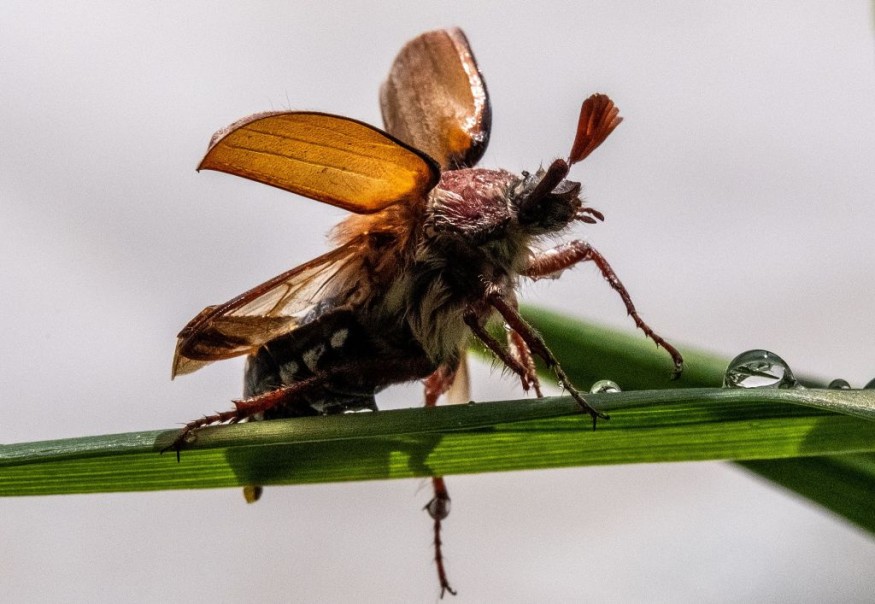
It was a beetle. Large, iridescent, its shell shimmering with an oil-slick sheen of green and purple against the dull gray afternoon. It was pressing hard against the glass, trying to push through the invisible barrier into the warm feeling of the office.
Aris perceived a sudden, sharp intake of breath.
He had been reading Jung’s essay on synchronicity just that morning, specifically the passage about the scarab beetle—the symbol of transformation that had appeared at the very moment his patient was describing her dream of the same creature.
And here was a beetle, not a scarab specifically, but the archetype was the same: a hard-shelled creature seeking entry, seeking transformation from the larva of the moist ground to the winged adult.
“Dr. Thorne?”
Elara’s voice pulled him back. She was looking at him, then following his gaze to the window.
“Oh,” she said, her voice softening to a soft tone. “A beetle.”
“Yes,” Aris said, his heart beating against his ribs. “It seems the universe is insisting on the theme of transformation today.”
He stood up and walked to the window. The beetle was persistent, its legs scrabbling against the glass. Aris unlocked the latch and slid the window open an inch—the sound of the rain rushed in—cold, fresh, and smelling of ozone. The beetle tumbled over the sill and onto the oak floorboards of the office.
It righted itself instantly, its antennae vibrating as it explored this new territory.
Aris crouched down, watching it. It was advancing with intent, a tiny, armoured tank crossing the rug’s landscape.
“It’s not a scarab,” Aris murmured, half to himself, half to the memory of Jung. “But the timing…”
He looked at Elara. She was staring at the beetle, her fear momentarily replaced by curiosity.
“It’s strange,” she uttered softly. “I was terrified of the crow, the heavy bird. But this… this feels different. It’s not heavy. It’s… persistent.”
Aris watched the beetle pause near the leg of his desk. It was an entity of the earth, emerging into the air, seeking the light of the window.
“Jung believed that when an unconscious image rises to the surface,” Aris said, standing up slowly, “and coincides with an objective event, it’s a message. A bridge between the psyche and the physical world.”
He motioned to the beetle. “You referred to a transition. Of a heavy bird that couldn’t fly. And here, a creature that can fly—or at least, has wings underneath its shell—arrives at the exact moment you describe your fear.”
Elara viewed from the beetle to Aris. “So, the crow was the fear of the transition, and the beetle…?”
“The beetle is the transition itself,” Aris suggested. “Hard armour protecting soft wings. Moving from the dark earth to the open air.”
The beetle reached the center of the room and stopped. It seemed to orient itself, its head turning as if surveying the space. Then, with a sudden, audible buzz, it extended its wing cases. Underneath, delicate, membranous wings vibrated, lifting the heavy body from the floor.
It circled once, a lazy, spiralling ascent, passing between the two humans, a mute observer in the therapy room. It flew directly toward the open window, maneuvering the air currents with invisible precision.
It didn’t hesitate. It flew out into the rain, disappearing into the gray mist.
Aris stood near the window, watching the vacant spot where the beetle had been. The rain was slowing, the light shifting as the storm moved east.
He turned back towards Elara. The apprehension that had knotted her shoulders seemed to have loosened. She was sitting upright, her hands resting palms-down on her knees.
“I don’t feel the weight anymore,” she uttered softly, a look of wonder on her face. “The crow… It’s gone.”
Aris returned to his chair. He didn’t have to analyze the moment further. The coincidence had done the work. The unconscious image—the heavy bird—had met the objective reality—the ascending beetle. The tension of the opposites had resolved.
“It wasn’t a cause and effect,” Aris said, settling back into his leather chair, the leather creaking softly. “The beetle didn’t fly in because you dreamed of the crow. But they met here, in this moment, to create a meaning that neither could create alone.”
Elara smiled with a genuine, relieved expression. “Synchronicity.”
“Yes,” Aris said. “A meaningful coincidence. The universe mirroring the psyche, reminding us that we are not separate from the world, but woven into it.”
The room was quiet again, save for the ticking of the clock and the receding sound of the rain. The space where the beetle had landed was empty, but the air felt charged, as if the barrier between the inner and outer worlds had thinned, just for a moment, allowing something primeval and symbolic to pass through.