
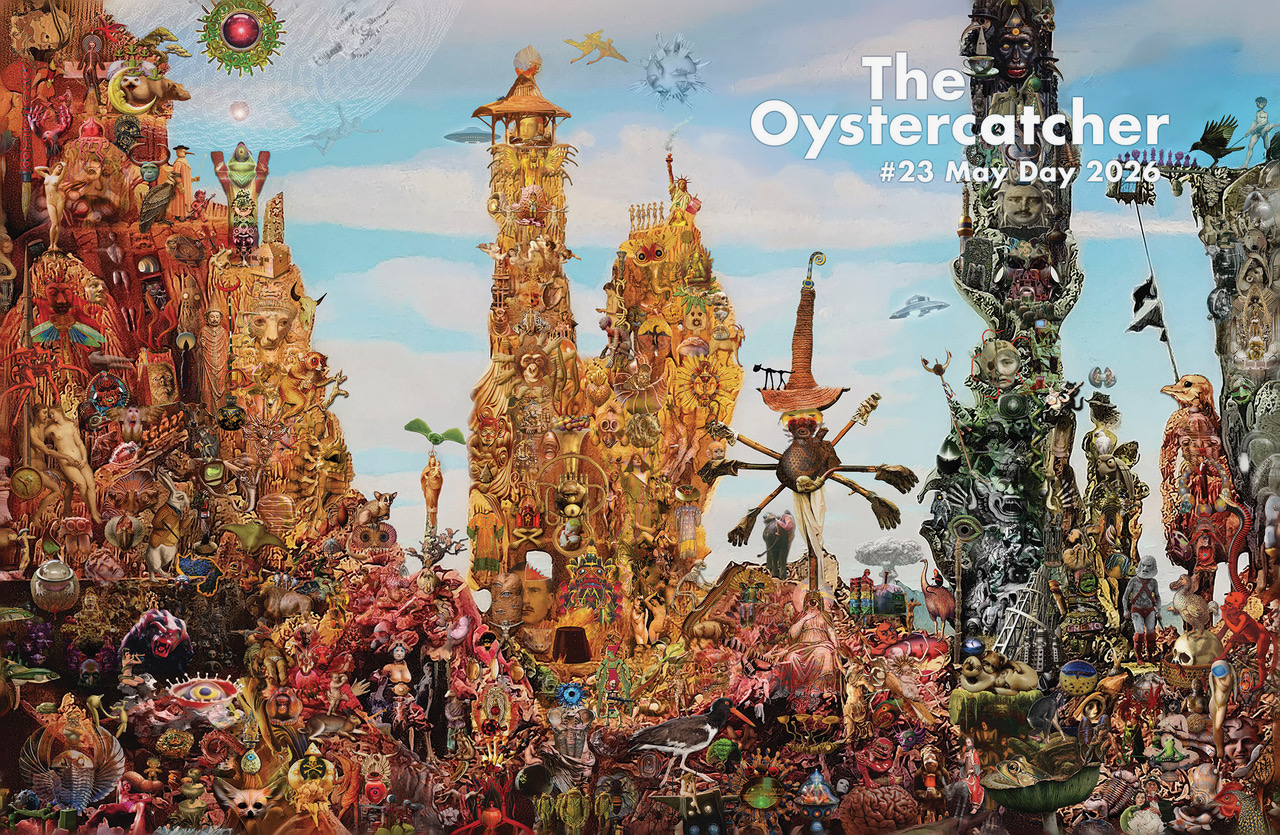
The Oystercatcher, A Review
by Cylon2036. We/Us
Published annually each May Day from Denman Island, and shared internationally, The Oystercatcher is a defiantly unclassifiable anarchist-surrealist periodical curated and compiled by Ron Sakolsky and Sheila Nopper. Part literary journal, part political broadside, and part dream-log from the fringes of late stage capitalism, the magazine blends poetry, essays, visual art, correspondence, and experimental prose into a singularly unruly offering first published in 2004.
Deeply informed by anarchism, surrealism, pirate radio culture, anti-fascist solidarity, and unconstrained imagination, The Oystercatcher occupies an unceded cultural territory far outside the polite boundaries of mainstream literary publishing. Its pages drift between ecstatic reverie and fierce political critique, often treating rebellion not simply as ideology, but as a lived aesthetic practice. The publication’s sensibility reflects Sakolsky’s long engagement with anarchist theory, free radio, and radical cultural resistance, alongside Nopper’s involvement in alternative broadcasting, art, poetry, and radical underground media.
Surrealism originated in Paris in 1924, led by French poet Andre Breton, drawing on 20th Century theories of dreams and human desires, as a literary and art movement of “pure psychic automatism”, bypassing conscious control, and treating dreams as portals into hidden “super realities.” With the rise of fascism in Europe, surrealists became more focused on active political resistance to war, seeking to dismantle the political and cultural structures that fuel nationalism, imperialism, and colonialism. Surrealists continue to argue that it is the “rational” values of capitalist society that cause the violent conflicts and wars.
A review in the anarchist publication Fifth Estate described The Oystercatcher as evoking “a Lost Utopia,” praising its atmosphere of fleeting radical possibility and imaginative escape. Rather than offering rigid doctrine, The Oystercatcher embraces contradiction, spontaneity, poetic disorientation, and what the surrealists call “the marvellous.” It ruptures the deadening routines of contemporary life through imagination and revolt, while rejecting “miserabilism”; the joyless belief that corrupt capitalist democracy is the “lesser of evils” in structuring our communities.
Physically modest, and beautifully printed, The Oystercatcher has the feel of a hand-crafted artifact from an enduring underground tradition that is part artistic intervention, and part signal flare from the margins. In an increasingly homogenized media culture, it remains a rare example of a publication devoted not to branding, careerism, or literary fashion, but to radical curiosity and uncompromising creative freedom in resistance to the poverty of imagination.
Issue #23 of The Oystercatcher is available now through the unconscious psychic portals into the unceded territory of dreams.