Home Blog Page 93

Seedbeds of Liberation

“We are not separate beings, you and I

We are different strands of the same Being.

You are me and I am you

and we are they and they are us.

This is how we are meant to be

each one of us,

each of all of us.

You reach out across the void of Otherness to me

and you touch your own soul.” 

from Prison Writings: My Life is My Sun Dance, by Leonard Peltier

I could not seem to escape some very unpleasant reactions last week when I learned on Facebook that 4 Canadian friends are proud to be supporting Trump. My mind seemed stuck in waves of shock, betrayal, rage and disappointment. After feeling wretched for a day, I remembered to practise self-compassion in order to stay out of the grip of panic and anxiety. Tears of grief flowed as I rode my bike on a clear magical morning. I have known Linda for 32 years; I hired her as a live-in nanny when my kids were young teens and I was away working. Nature lover, artist, kind and dependable, a passionate voice for girls’ liberation. Her husband is the same; into permaculture, Fairy Creek actions, playful and a patient father. I knew they were vaccine hesitant but did not realize they were anti-vaxxers; they lived in a different town and I only saw them twice a year. Now they are spewing conspiracy theories to their FB followers; Satan-worshipping pedophiles and communists lurking at every corner, type thing. I emailed and asked them to send me their main source of information. He sent me 2 long emails explaining “what is really going on.” After I sent her a Democracy Now clip about Trump I was told to stop harassing her and to stop sending “political propaganda.” 

I keep reading the above poem by Leonard Peltier because if he could love his enemies, then maybe I can as well. I want to share some other strategies that help calm down the fear response, that might help you when you realize anxiety is building. Yawning, laughing, crying, singing are some ways to discharge stuck emotion. Long, slow exhalations, shaking out the limbs, exercise, dance, being outside in nature, getting a hug from a pet or friend, or making a list of safe places, people, music, memories, sensations and commitments that you can read aloud. My commitment evolves and is based on this one: “From this moment on, I cheerfully promise to do what I can to allow safety to soothe me, from the inside out.” Instead of saying “Oh no” I say “Oh well.” I also bring to mind my PLAY acronym: P= Pause with Presence, L=Listen to Learn, A= Attend with Awe, Y= Yield for Yin and Yang. Also, I received a Reiki treatment from Gerly Metsar and felt my mind and body melt into ease and release. 

Leonard Peltier wrote this after 24 years of being in prison: “We need more compassion; that compassion is our own highest possibility.” To have compassion for others, I also have to cultivate it for myself. Letting go of imagined threats feels better than building walls of paranoia. There are real threats coming at us for sure and I will be more effective in the long term fight if I am well-regulated and relaxed.

The air in Los Angeles

Inspired by William S. Burroughs   

Feb 21, 2025

 The air in Los Angeles

 In the summer of ‘73, hung thick and heavy, a miasma of smog and simmering resentment. The sun, a malevolent eye in the hazy sky, did little to burn away the city’s perpetual twilight edge. I was drifting then, fresh off the Greyhound, lured by the whispers of a different kind of life, the kind found lurking in the shadowed alleys and dimly lit bars that lined the fringes of Hollywood. It was in one such establishment, ‘The Void,’ a dive that smelled perpetually of stale beer and forgotten dreams, that I first saw him.

He sat alone in a corner booth, a figure seemingly carved from shadow itself. Lean, with eyes that held the hard glint of chipped flint, exuded an aura that was both magnetic and deeply unsettling. This was not the manufactured unease of the movie sets; this was something primal that seeped from the very fabric of his being. Later, I learned that his name was Silas. He spoke in clipped, precise sentences, each word a carefully placed shard of glass. He talked of frequencies, of unseen currents that flowed beneath the surface of reality, shaping and controlling the lives of the oblivious masses. He spoke of words as viruses, of language as a weapon. It was pure Burroughs, unfiltered, raw, and utterly captivating in its strangeness.

Silas became my guide, of sorts, leading me through the labyrinthine underbelly of Los Angeles, a world populated by artists pushing boundaries, musicians chasing echoes of sound, and writers who bled ink onto the page in a desperate attempt to capture the unravelling edges of consciousness. We would meet in dimly lit apartments, the air thick with the scent of incense and something else, something sharper, more chemically acrid that clung to the back of the throat. The conversations were always fragmented and hallucinatory, bouncing between esoteric theories and stark pronouncements of societal decay.

One evening, in a cramped room overlooking a neon-drenched street, Silas introduced me to ‘the technique.’ He explained it was a way to unlock the mind, to bypass the conscious filters and tap into the raw, unfiltered stream of the subconscious. “Relax,” he’d said, echoing the man’s words, “Your mind will answer most questions if you learn to relax… into the silence.”

The technique involved prolonged sensory deprivation, a ritual of darkness and stillness designed to strip away the layers of everyday perception. The room’s windows were blacked out, and the air was heavy with a cloying sweetness I couldn’t quite place. Silas lit a single, thin candle, the flickering flame casting elongated, dancing shadows on the walls. He instructed me to lie on the floor and focus on the silence, the absence of light, and the stillness of my own body.

At first, it was just darkness, profound and absolute. Then, slowly, the silence began to hum, a low, resonant thrumming that vibrated through my bones. Shapes began to form in the darkness behind my eyelids, shifting, amorphous figures that coalesced and dissolved with unsettling fluidity. The hum grew louder, morphing into a chorus of whispers, sibilant and unintelligible yet undeniably insistent. It felt like the room was breathing, expanding and contracting around me.

Cold and sharp fear began to prickle at the edges of my awareness. The relaxation Silas had promised was nowhere to be found. Instead, a growing unease coiled in my stomach, a visceral sense that something was fundamentally wrong, that I had ventured into a territory not meant for human exploration. The air seemed to thicken, pressing in on me from all sides as if the room was alive and breathing, a malevolent entity that had been disturbed from its slumber.

The whispers intensified, becoming distinct voices, though still garbled and indistinct. They were coming from everywhere and nowhere, from the walls, shadows, and within my head. The shapes behind my eyelids became more apparent and sharper, taking on disturbing forms—geometric angles that shifted into monstrous visages, faces that seemed to writhe and decompose before reforming into something even more grotesque.

I tried to stop, to pull myself back from the edge of this sensory abyss, but I found I couldn’t move. My limbs felt heavy and unresponsive as if weighted down by an invisible force. Panic began to bubble up, hot and frantic, threatening to overwhelm me. The voices were no longer whispers; they were shouting, screaming, a cacophony of rage and pain and something else, something ancient and malevolent.

Suddenly, the candle flickered violently, spitting and sputtering before plunging the room into absolute darkness. The voices ceased abruptly, leaving an even more oppressive and terrifying silence than the noise. In the void, I felt a presence, something unseen, something close, breathing down my neck. The air grew colder, and a metallic tang filled my nostrils, like the smell of old blood.

Then, just as suddenly as it had begun, it stopped. The oppressive presence receded, the cold lifted, and the silence became silent again, still pregnant with dread. I scrambled to my feet, fumbling blindly in the darkness until I found the door, wrenching it open and stumbling out into the relative sanity of the neon-lit street. But the dread lingered as a heavy weight on my shoulders, a constant reminder of the horrors that lurked just beyond the edge of perception.

Silas was gone. The room was empty save for the lingering scent of incense and the faint, almost imperceptible metallic tang. I never saw him again nor attempted ‘the technique’ again.

But sometimes, late at night, in the quiet hours when the veil between worlds seems too thin, I still hear the whispers. Faint and distant, they drift in on the edges of the silence, a chilling reminder of that night and the unsettling truth I glimpsed within the darkness – that some questions are best left unasked, some doors are best left unopened, and some silences are best left undisturbed. Because in the vast, untapped resource of the mind, as Burroughs suggested, there are answers, yes, but there are also things best left undiscovered, horrors that slumber just beneath the surface, waiting for the careless hand to wake them. And once woken, they might never let you sleep again.

This is the Life

This is the Life

A friend recently gave me a biography of Joni Mitchell and I’ve kept it in the car as a casual read while I’m waiting for the ferry on either side. There’s a lot of waiting around involved in living on an island. I worshipped Joni as a sixteen year old and memorized all her great hits word for word. I can still break into “The Last Time I Saw Richard” “This flight tonight” “A Case of You”, etc. I might have difficulty with the high notes. She was like a god to me. Now, of course, I feel like we could talk across the kitchen table. Funny how age is such a leveller. Our stories are both done. We’ve both lived a life. We can chat. Now. Almost as equals. Isn’t that strange?

I was skimming through the book and came to a part where she found herself pregnant at forty-two while she was on a concert tour. She realized it was a last chance for a baby, but she’d been drinking heavily, staying up all night doing lots of cocaine, not eating, was worried about all this and then she started to bleed.  She went to a clinic and as the doctor was giving her a d&c she heard him keep saying, “I can’t believe I’m doing this to Joni Mitchell”. Her partner, music producer Larry Klein, was on a concorde jet on his way to London at the time. Joni says a few pages later that the music world has always been run by gangsters, gangsters who happened to like music. 

And as I sat there at the ferry landing the antique phrase from the 1920s, “racketing around” came into my mind, a life of racketing around, along with an image of my dead beautiful, singing auntie, Glenice. There is a blonde singer in my family too. Not as famous as Joni, and she didn’t write her own songs, but she was even prettier than her. Joni had a rather long, horsey face. The Vikings swept down into the middle of England and there are a lot of blue-eyed blondes in my family, and everybody else’s family in the region, as a result. I was an insipid blonde. My sister Deb is the stand-up blonde. But Glenice was a world apart.

Glenice swept into my eleven year-old world on a dark and stormy night. I was staying with my aunt and uncle in Derby and we must have been getting ready for bed when there was a knock on the door. The rainy night revealed my auntie Glenice standing at the threshold in a long black wool, hooded cloak. She entered the house with apologies for being so late and her speaking voice was so velvety and low I was mesmerized by it. She had black eye-liner rimming her eyes, long straight blonde hair with a fringe, pale pink lipstick, a short mini-dress and black knee boots. She was the most glamorous thing I had seen in my life, outside of a movie or magazine. She was a visitor from another world. A better, more fun world. She asked if I would “be a love and get me an ashtray”. She then proceeded to smoke using a black cigarette holder. Everyone smoked in those days, if you didn’t you were a bit suspect, like being a non-drinker. Perhaps you were a homosexual? But nobody smoked like that! No one I had encountered in my eleven year-old life. Who was this exotic woman in my world of fluffy slippers and “house coats”. I could hardly sleep.

There were other encounters with Glenice over the years. I remember rummaging through her wardrobe in London looking at her clothes, the rhinestone jackets, tulle-skirted dresses, fur coats. I remember her banging on the ceiling with a broom handle and swearing and shouting at the people upstairs to be quiet and it was so shocking. I had never heard anyone talk like that. And like Amy MacDonald  sang in “This is the Life”:

And you’re singin’ the songs

Thinkin’ this is the life

And you wake up in the mornin’  

And your head feels twice the size

And you’re thinkin’ where you gonna go

Where you gonna sleep tonight?

But it was the crooks in the business and the constant rip-offs of pay and one thing or another and all the accumulated madness of her life that killed her at fifty-three of liver cancer. And when she went I was thirty-six and I remember thinking, where’s the tragedy in this? She’s had a child, husband, she’s lived a life, she’s old enough to die, but now, of course, at seventy I realize that wasn’t old. Although she’d lost her looks already, and not everybody has, at fifty-three. But, she was sick and nobody knew. Least of all the London doctors who kept diagnosing lumbago. 

The last time I saw Glenice she told me to buy leather boots in Brindisi, on the heel of Italy, if I was going traveling in Europe. Everyone knew that was the best place to buy boots.

The last word from Glenice was through a Ouija board many years ago. I apologized for not helping her out with her rent money for that month in 1975 like I said I was going to. I had spent the money on something else. She said she knew that, of course, because she had all the information in heaven, and it was all water under the bridge and she said she wanted me to live a happy life. 

The family still has a recording of her from the late 1950s, when I guess she was about 18, singing Rosemary Clooney’s song, “Sentimental Journey” and it’s the most mellow, glamorous voice ever. The life of an artist is hard. On the other hand, you don’t need to pinch yourself to know you’re alive.  

Some Thoughts On Ukraine

MAR 03, 2025

Listen to a reading of this article (reading by Tim Foley):

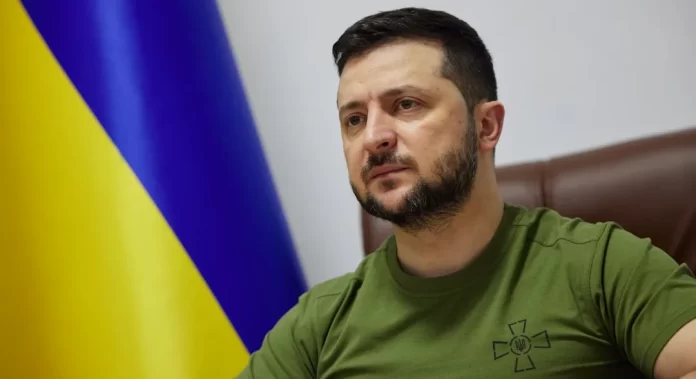
As the Trump administration pauses military aid to Ukraine and western liberals continue their shrieking meltdown over Trump hurting Saint Zelensky’s feelings, it’s probably worth reminding everyone that the Russian invasion of Ukraine was indisputably provoked by western aggressions. That’s why so many western experts and analysts spent years warning ahead of time that western aggressions were going to provoke an invasion of Ukraine.

Now, some may hear this and say “Okay but Russia still shouldn’t have invaded even though our western leaders were aggressively provoking them to.” But before you do that it might be a good idea to look inside yourself and ask where that impulse is arising from. Why are you so eager to skip past the part where you criticize your own rulers for their role in starting this war and focus solely on criticizing the leader of an eastern government who has no power over you? What is it inside of you that’s flailing all over the place trying to avoid any forceful scrutiny of the reckless warmongering of your own government and its allies?

The last time a foreign rival placed a credible military threat near the border of the United States, the US responded so aggressively that the world almost ended (if you want to know just how close we came to nuclear annihilation during the Cuban Missile Crisis, look up the name Vasili Arkhipov). Western liberals have been conditioned to insist that Russia should have responded differently to the US empire amassing proxy forces on its border than the US would respond to the same kind of threat on its own borders. The frenetic mental contortions needed to justify this ridiculous double standard are only possible because the west is saturated in domestic propagandamanipulating the way they think about the world.

It makes sense for there to be criticism of Russia for its role in this war, and for people to be horrified by the nightmare that’s been happening in Ukraine these last few years. What makes absolutely no sense whatsoever is for western liberals (or “progressives” or whatever they want to call themselves) to assign ZERO PERCENT RESPONSIBILITY to their own government and its allies for their extensively documented role in sparking this conflict and ONE HUNDRED PERCENT RESPONSIBILITY to a foreign government with no power over them. That’s pathetic, bootlicking behavior, and it’s utterly inexcusable.

Stop performing mental gymnastics to defend the abuses of your rulers. Have a little dignity for god’s sake.

It is good that Trump appears to be moving toward ending an unwinnable proxy war that Ukrainians no longer want to fight. Anyone who disagrees with this is a dogshit human being.

I am not grateful to Trump for ending this nightmare, I’m just disgusted with anyone who’s against doing so. The proxy war in Ukraine was going to end sometime relatively soon anyway; the only way for NATO to reverse Russia’s steady gains at this point would be to intervene more directly in ways that would risk nuclear consequences that western leaders aren’t willing to receive. This was always a chess game for them; they’re not going to put their own necks on the line. So the war had to end  to make way for other imperial projects— the Trumpists are just the faction that the empire has tasked with advancing this agenda.

I will not waste any gratitude on Trump rolling back a failed imperial bid to weaken Russia, but I will absolutely scream my fucking lungs out at anyone who insists Ukrainians should keep throwing their bodies into a war that Ukrainians themselves no longer support. If you want the Ukraine war to continue, then go enlist and put your body on the line so that Ukrainians don’t have to. The Ukrainian Foreign Legion is still accepting volunteers. If you want this horrific war to continue, either go and fight or shut the fuck up. Stop tweeting from the sofa in your safe, comfortable home and get your ass to the frontline. Bring along as many western liberals as you can convince to join your cause.

The western empire provoked this war. The western empire sabotaged peace talks in the early weeks after the invasion. They refused off-ramp after off-ramp in pushing Ukraine into this situation, and as a result Ukraine is going to be much worse off than before this all started. Wanting Ukraine to keep throwing human lives into the meat grinder in the hopes that they can recover all their lost territory is just sunk cost fallacyat this point.

Ukrainians now recognize that it’s time to cut their losses and negotiate a peace. Western armchair warriors need to recognize this too.

_______________

Caitlin’s Newsletter is a reader-supported publication. To receive new posts and support my work, consider becoming a free or paid subscriber.

My work is entirely reader-supported, so if you enjoyed this piece here are some options where you can toss some money into my tip jar if you want to. Go here to find video versions of my articles. If you’d prefer to listen to audio of these articles, you can subscribe to them on Spotify, Apple Podcasts, Soundcloud or YouTube. Go hereto buy paperback editions of my writings from month to month. All my work is free to bootleg and use in any way, shape or form; republish it, translate it, use it on merchandise; whatever you want. The best way to make sure you see the stuff I publish is to subscribe to the mailing list on Substack, which will get you an email notification for everything I publish. All works co-authored with my husband Tim Foley.


Bitcoin donations: 1Ac7PCQXoQoLA9Sh8fhAgiU3PHA2EX5Zm2

Featured image via Wikimedia Commons/President of Ukraine (CC BY 4.0)

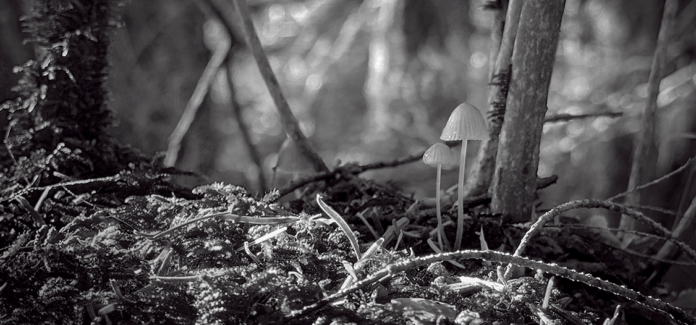
Forest Dwellers

https://printartphotography.ca

Bully Worship

Bully Worship

A society that rewards power, wealth and control

worships bullies 

From the schoolyard to the boardroom, to politics.

Bullies rule

In our communities, our governments and big business

 Bullies rule

They control the police, the rules and the courts

Bullies rule

They control the money, the land and most assets

Bullies rule

They control education, media and cultural norms

Bullies rule

They control the food, the energy, the water and our health

Bullies rule

They tell us who to believe, who to hate and who to cheer

Bullies rule

When bullies brawl, everyone suffers

 The poorest always pay the highest price

There will never be an end to the bullies

 Bully worship, however, is a choice.

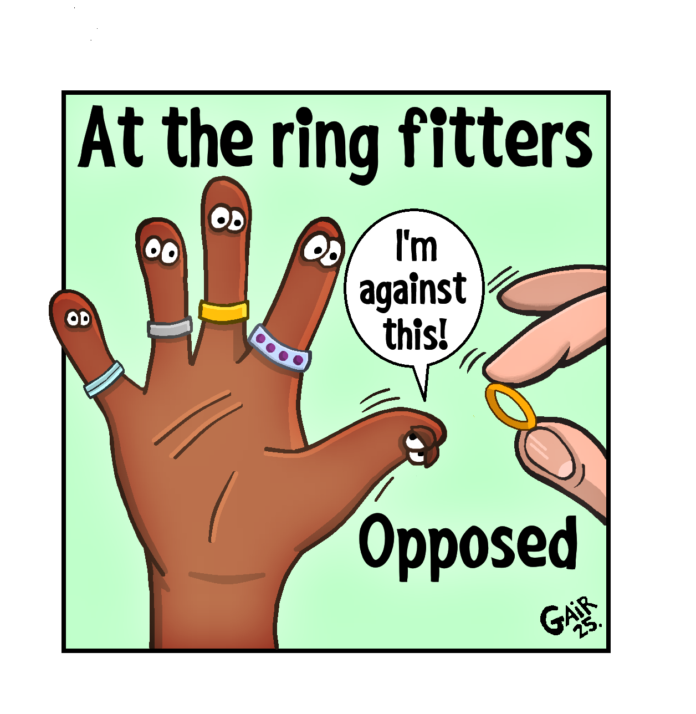
opposed

Jean Gordy: Artist, Jeweller – Earth Medicine Jewelry

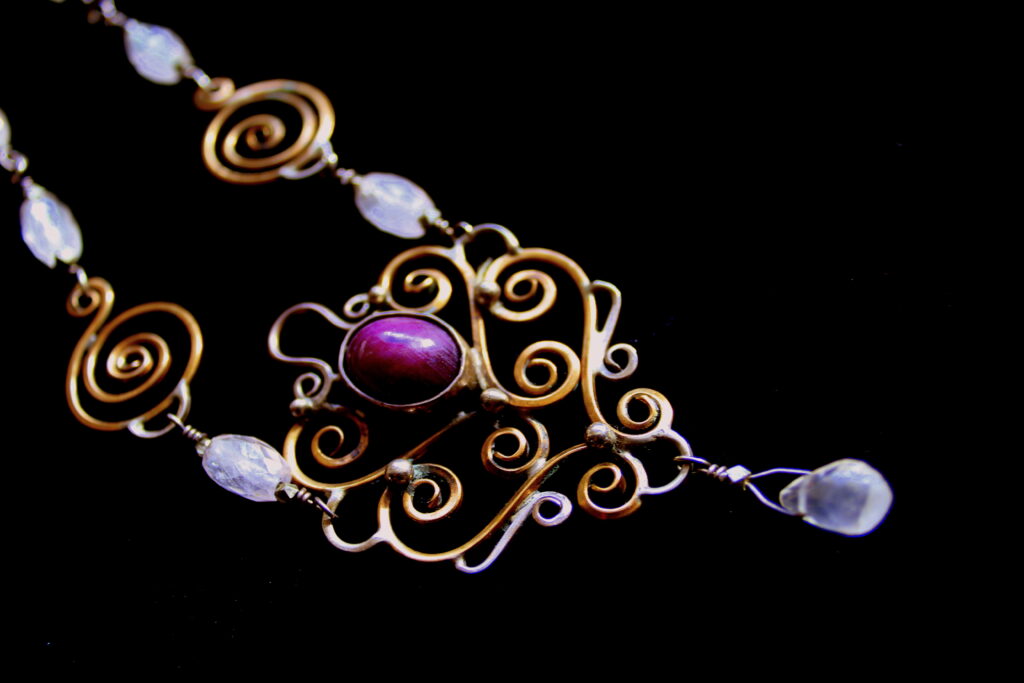
It’s a cold snowy afternoon when I stroll up to Jean Gordy’s place to see her work, and talk about her jewelry. The first thing I notice is the music in the background, she’s playing some kind of hippy meditation track that’s honestly pretty relaxing.

All around me are beautiful batik hangings she has done, and amazing pillows and stuff on the floor. I can see she has just finished doing yoga or something.

Jean offers me tea; it’s an amazing blend she created herself. Mint, lemon balm and nettle, with just the right amount of honey. Do I need to tell you it was served in a beautiful mug?

I sat for a while, sipping my tea, just absorbing the ambience.

I’m not sure what questions to ask a jeweler, so I just started.

How do you see yourself as an artist?

“Am I an artist? Can I see myself as an artist? It’s more like a path.”

I realize quickly that Jean is not one to differentiate her life from her creative work. It’s all one thing. She is not the commercial artist at all. Jean speaks more about the healing properties of the stones. About where they come from in the world. About how most of the turquoise in the world has been mined out. She knows a lot about chakras and the history of jewelry making.

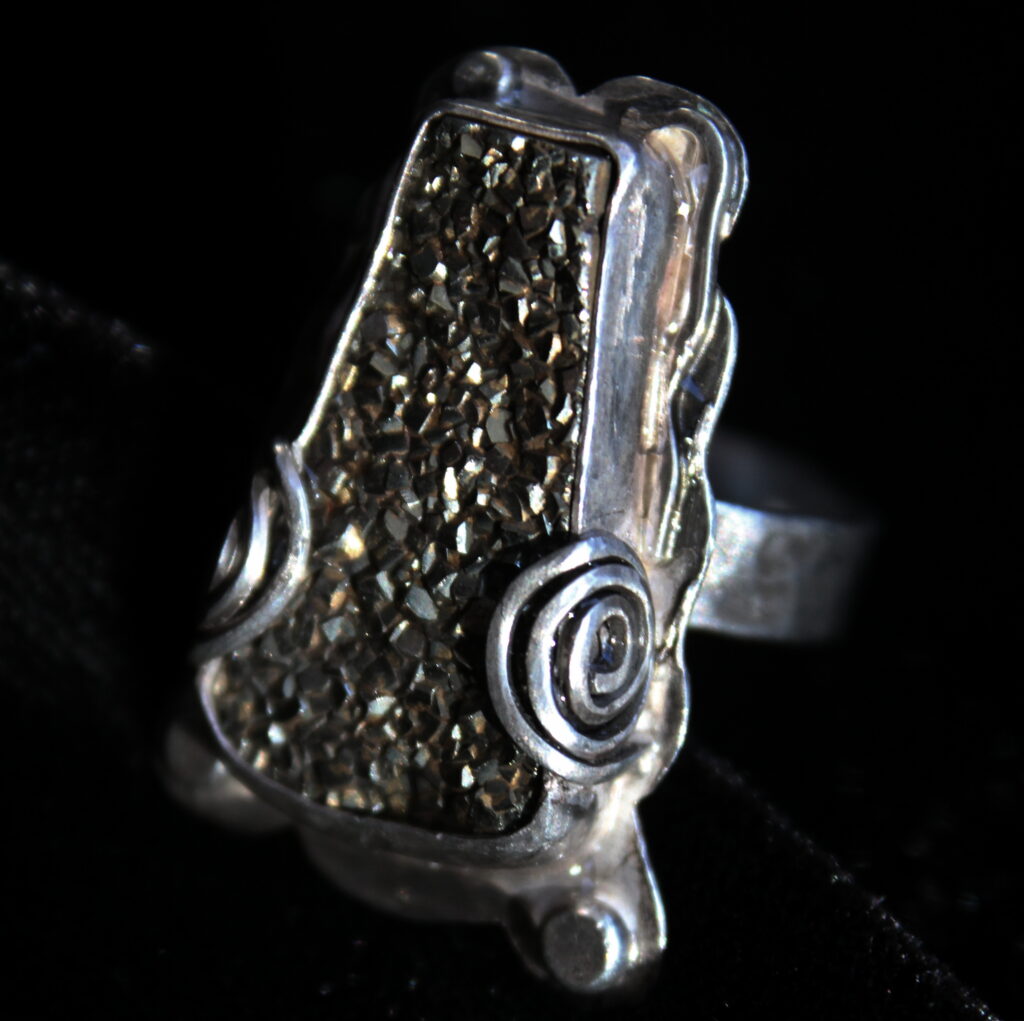
I ask about the spirals that are so present in her work.

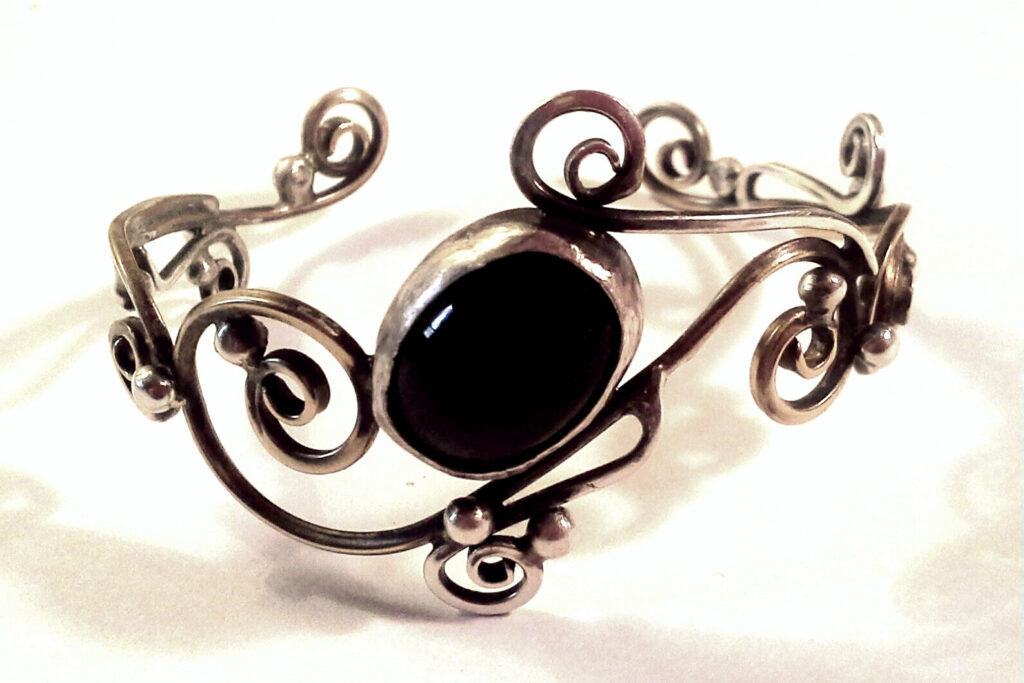
“When I started working with metal, I became obsessed with spirals. It’s the magnetic way the feminine moves. The feminine universe moves in spirals. All forms in creation reflect the spiral. I wanted to see how far I could take the spiral in my jewelry making.”

Jean continued to speak about the milky way, how it spirals. Eternity. And always about healing. About the healing properties of natural stones. Jean explains that gemstones are piezo electric and can affect your electromagnetic field. I don’t know anything about the healing properties or meanings of different gemstones, but handling the pieces was enough to convince me these things are more than just pretty rocks in beautiful settings. I am prepared to believe they are magical somehow.

After spending a lot of time touching the jewelry, noticing the sturdy craftsmanship and attention to detail, my mind turned to more pragmatic things. I asked about her process.

“This is not casual stuff. Metal has to be heated to red hot before it’s malleable. You need a torch and the right set up. Ventilation. Masks. Tools. Gas. Magnification.”

Jean explains the technical side of metal smithing. She is knowledgeable, and talks about flow temperatures of different metals. About how some pieces require three different temperatures because they are  made with multiple metals. She talks about the importance of patience, and creating quality that lasts.

“The objective is the jewelry feels good to you, wears well, and could last a lifetime. You can always carry jewelry with you no matter where you go, or how life changes. It’s a timepiece, a memory keeper. Psychics can learn about you from holding your jewelry.”

I ask about the form her work naturally takes.

“It’s ancient and earthy. Like Pagan royalty. I don’t follow trends, I like to do showpieces, Goddess pieces. You have to be open to the attention it draws. My work is not for wallflowers. It’s for women who are comfortable being seen.” 

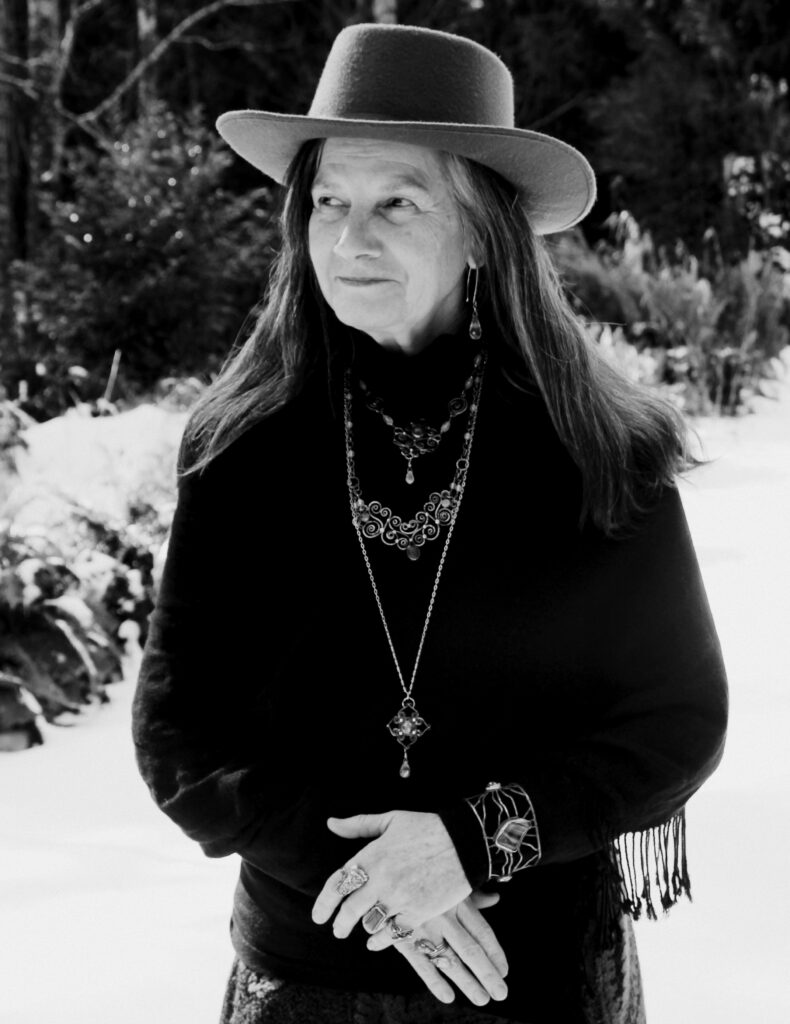
We step outside so I can take a few snapshots of her. She casually piles on a few necklaces, and adds the bracelet as well. It all looks amazing together. I look at Jean through my lens and see a woman completely at ease with herself.

I spend a bit of time photographing her jewelry while she talks alternately about thermal conductivity, and the more esoteric aspects of the finished pieces. About how the stones vibrate and affect your chakras and stuff like that. I am mesmerized by it all.

I am imagining this woman with blow torch and goggles and grubby hands. Right now, she is wearing jewelry and looking divine.


Jean Gordy is at once spiritual and feminine, and a woman who bangs on red hot metal to create Pagan Goddess jewelry.

Jean Gordy accepts commissions, and will work with your special stones. As I mentioned, she’s not very commercial. Look her up on Hornby. No website.   jeaute@yahoo.com

Shucking Oysters: Still Life with Donald

Shucking Oysters: Still Life with Donald

By Alex Allen

Did you hear the one about…? Neither did I. Being funny today seems to be as popular as having a cough and sniffles. Remember when having a sense of humour was considered attractive? Now, it’s socially awkward being the life of the party. It’s become a sign of disrespect and immaturity. Oh, grow up. Are we suffering from a new strain of world chronic humour fatigue syndrome or just losing our humour?

In his first term in 2016, Donald Trump was the perfect target to joke about. Topics of the day like police brutality and Black Lives Matter were not exactly late-night fodder. For the writers – whose job was to come up with something funny out of the absurd and horrifying news feeds – figuring out how to joke about Trump was a challenge. The challenge was not for lack of material, it was that he was already a parody. He was the punchline. 

In interviews with the comedy trio Colbert, Kimmel, and Fallon, a theme emerged during Trump’s first presidency: Writing Trump jokes sucked. All wondered that if they just stopped writing about him, would he go away? At the time, it was still considered laughable that he would be the nominee, let alone the president. 

Fast forward to 2025. When things start going really crazy, satire becomes too true to be funny. As Trump begins his second term, late-night hosts are back with their anti-Trump jokes, yet the tone and mood seems hollow. Instead of funny, this time around, many are finding Trump-bashing tiresome. How many more at best, amateur Trump impersonations do we have to watch, let alone find funny this go-around? In the Daily Mail, Alex Hammer wrote that it’s “not necessarily disagreement with the message conveyed by most of late-night television that Trump is a malignant force in American life,” it’s about sheer fatigue. And it’s just the beginning of a four-year roller coaster ride. 

I read somewhere that comedians ultimately want to be philosophers. Think about the great philosopher-comedian, George Carlin, his comedic brilliance was his unfiltered social commentary. Can you imagine if he was alive today? Or perhaps, comedians ultimately want to be politicians. Zelensky was a Ukrainian comedian who played a teacher in a show who becomes president. The TV program, “Servant of the People,” was about a high school teacher who rises to the top of Ukrainian politics after a viral video “shows him waxing lyrical about government corruption.” 

Trump had a similar career trajectory with the show “The Apprentice,” which featured aspiring, but otherwise unknown, business people competing for a chunk of money to promote one of Trump’s properties. In Trump mode, the show always ended with the encouraging words “You’re fired!” Trump then proceeded to be fired by NBC when the studio disagreed with remarks he made about Mexican immigrants during his presidency announcement in 2015. Soon other upstanding individuals played host to different versions of the show, notably former California governor Arnold Schwarzenegger in a reverse career move, and lifestyle mogul Martha Stewart, who has yet to announce her run for presidency.

Or maybe politicians ultimately want to be lifestyle moguls. In between upending the world, Trump seems to be channelling Martha in the felony interior decorating department, making the White House a Washington version of Mar-a-Lago. 

The most controversial makeover is to the iconic Rose Garden, which will be stripped of its greenery and replaced with limestone or other hard surface. Trump wants to recreate the “patio experience” that he has at Mar-a-Lago. Apparently, Trump has been known to spend hours of his Florida evenings soaking in the Gulf of America air and receiving his minions. He especially likes to blast Luciano Pavarotti and James Brown tunes at earsplitting volumes. And just to complicate things, the Rose Garden is not technically part of the White House; it comes under the purview of the National Park Service, which is controlled by the Department of the Interior. So, maybe he’ll do a little exploratory drilling before he pours the cement. 

The Trumping of the interior would not be without its gold veneer – gold vases, gold statuettes, and gold figurines. It’s all about gilt and mirrors, marble-and-gold, canopy beds, and fresco-style ceilings. Trump plans to hang – the ultimate symbol of the nouveau riche – a GREAT BIG chandelier from the ceiling of the Oval Office. Just outside hangs his infamous scowling mug shot in all its felon glory. (Trump once again monetized the moment with t-shirts and bumper stickers emblazoned with the mug shot and phrase: “Never Surrender!” Within 24 hours, he made more than $4 million. Not bad for a convicted felon.)

Trump has also hinted that he would like to build a ballroom at the White House at a cost of a $100 million. He is not the only president to put his personal imprint on the White House. Gerald Ford built the swimming pool and Barack Obama got the basketball court. 

The Trump look, Peter York wrote, “is miles from the architectural tradition of Washington, whose neoclassical public buildings evoke stability and trustworthiness through their restraint.” The capital was designed to project a message of simplicity, democracy and egalitarianism – precisely the opposite of the new brand in town. Dictator interior decorating, which simply means, “I am tremendously rich and unthinkably powerful.”

FW25: The Portal  

FW25: The Portal                                              

Gabriel Jeroschewitz

Feb 13, 2025

Of all the places I’d expected to find myself on a Saturday evening, standing in the middle of a former industrial warehouse in Greenpoint, Brooklyn, while humanoid AI attendants dressed like extras from Blade Runner circled a disconcertingly glamorous woman, was not one of them. But there I was, pressed shoulder to shoulder with Manhattan’s finest—critics, influencers, museum curators, that guy who invented some app everyone deleted after two weeks—all with wine glasses in hand, staring at the curious spectacle unfolding before us.

This was FW25: The Portal, Alexis Bittar’s bold debut into the theatre of New York Fashion Week. It had been hyped mercilessly on Instagram for months: “A performance to bend time, blur perception, and shatter convention.” The enigmatic nature of this description left us all in a state of bewilderment, and from the murmured conversations around me, most of the crowd was as baffled as I was, yet undeniably intrigued by the mystery unfolding before us.

“Is it…art?” someone whispered behind me.

“No, it’s a jewelry line,” their equally mystified companion replied. “I think.” The uncertainty in their voices mirrored the confusion that seemed to be a shared experience among the audience.

The lights dimmed, and a hush settled over the room. A spotlight blinked on, illuminating the central setup—a vintage vanity table, ornate and gold like it had been plucked from the set of Dynasty. But where the mirror should have been, there was an oval-shaped screen, rippling like disturbed water. The woman seated at the vanity was a vision. She had the kind of presence that made you feel inadequate just by existing in the same room. Her hair was a sleek, silver waterfall, and she wore shimmering gold ornaments—bracelets, earrings, necklaces—all from Alexis’s new collection. Draped over her was an iridescent cape with a strange, otherworldly texture that I could only describe as “space couture.”

But it was her expression that hooked me. She wasn’t smiling. She didn’t even look particularly interested. Instead, she exuded a kind of serene detachment, a mysterious aura that made her seem both above and entirely removed from the chaos of the crowd gawking at her.

That’s when the robots arrived.

—

Calling them robots feels reductive. These were humanoid AI attendants, and they moved with an unsettling grace that was neither entirely human nor fully robotic. Their silicone-coated faces were eerily flawless—no pores, no expression, just a bland neutrality that made my skin crawl. Each was clad in a tailored suit with subtle iridescent accents as if they were part of Bittar’s futuristic vision.

The attendants began performing tasks around the woman: one gently brushed her hair, another polished her jewelry with exaggerated reverence, while a third refilled her invisible teacup because, of course, this strange future dystopia involved tea. It was done with the precision of choreographed theatre, their movements so fluid they seemed to glide rather than step.

Above the vanity, the screen portal shimmered to life, displaying fragmented radio signals—numbers, voices, snippets of songs. The sound wasn’t clear; it was more of an atmospheric hum, like a distant station you couldn’t entirely tune into. The woman glanced toward the portal and tilted her head slightly as if contemplating it. Then she reached out a hand, her fingers brushing the glassy surface of the screen.

Was she looking into the past? The future? Was this supposed to mean something?

I turned to the fashion editor standing next to me. “Do you know what’s going on?”

She shrugged. “It’s about ageism,” she said knowingly, sipping her wine. “Or possibly technology? Whatever, it’s chic.”

—

The atmosphere in the room shifted as the performance continued. The air felt heavy with meaning, but it was meaning none of us could decipher. My attention was drawn back to the woman. She remained impossibly composed as the humanoid attendants swirled around her like moths to a flame. She exuded a quiet confidence that made it clear that she didn’t need anyone—not the crowd gasping at her jewelry or the soulless attendants doting on her.

It was both inspiring and, frankly, a little intimidating.

“What do you think she’s thinking about?” someone whispered to their date.

“Probably whether or not her Uber’s arrived yet,” the date replied.

And yet, there was something undeniably poignant about the tableau. The woman was caught between two eras, surrounded by trappings of old-world wealth and futuristic technology. The jewelry she wore—pieces inspired equally by the chunky gold of the ’80s and the sleek industrial minimalism of imagined futures—seemed to represent that, too. It was as if the entire performance was a meditation on identity: what it means to belong to a time and what happens when you don’t.

My phone vibrated with a text from my friend Tamara, who had skipped the event in favour of Netflix and pyjamas: “How’s it going? Are you still staring at shiny things?”

Tamara had once joked that fashion was just “expensive existentialism,” and for the first time, I thought she might be right.

—

As the performance peaked, the woman stood from her vanity. The humanoid attendants paused, their heads tilting in eerie unison as if awaiting her command. She clicked her golden stiletto heels—another exquisite Bittar design—against the floor and turned her back to the vanity, facing the crowd for the first time.

She looked at us—not with warmth, but with a steady, appraising gaze that made us all feel highly seen, and not necessarily in a good way.

“I,” she declared in a voice smooth as velvet and deceptively commanding, “am not your reflection.”

The room was dead silent. Somewhere in the back, someone audibly dropped their wine glass.

She turned back to the portal, her figure silhouetted against the shifting waves of light and sound on the screen. Extending a single hand, she pressed her palm flat against it. There was a flash—a brief, blinding burst of light—and then she disappeared, leaving us all in shock.

I blinked. The humanoid attendants bowed in unison, their movements perfectly synchronized, before gliding sensibly offstage. The crowd erupted into applause.

“What…” I started, but the words failed me. Everyone else seemed equally confounded, though that didn’t stop the praise from flowing.

“Brilliant,” declared a man in a velvet blazer.

“A masterpiece,” agreed his equally bejewelled companion.

“This is going to look amazing on TikTok,” someone near the front added as they uploaded their video.

—

The evening concluded with a press conference-slash cocktail party, at which Alexis Bittar addressed the crowd in a metallic blazer reminiscent of David Bowie in his heyday.

“Fashion,” he said with a mischievous smile, “is about raising questions, not answering them.”

We all nodded in solemn agreement as if that explained anything.

Later, as I walked out into the crisp Brooklyn night, I thought about the woman at the vanity. Was her solitude by design, or had technology stripped her of something essential? Was technology her jailer or her liberator?

But mostly, I wondered if Alexis would ever create a handbag that could hold more than lipstick and a single Tic Tac.

For now, though, that was a question for 2050.