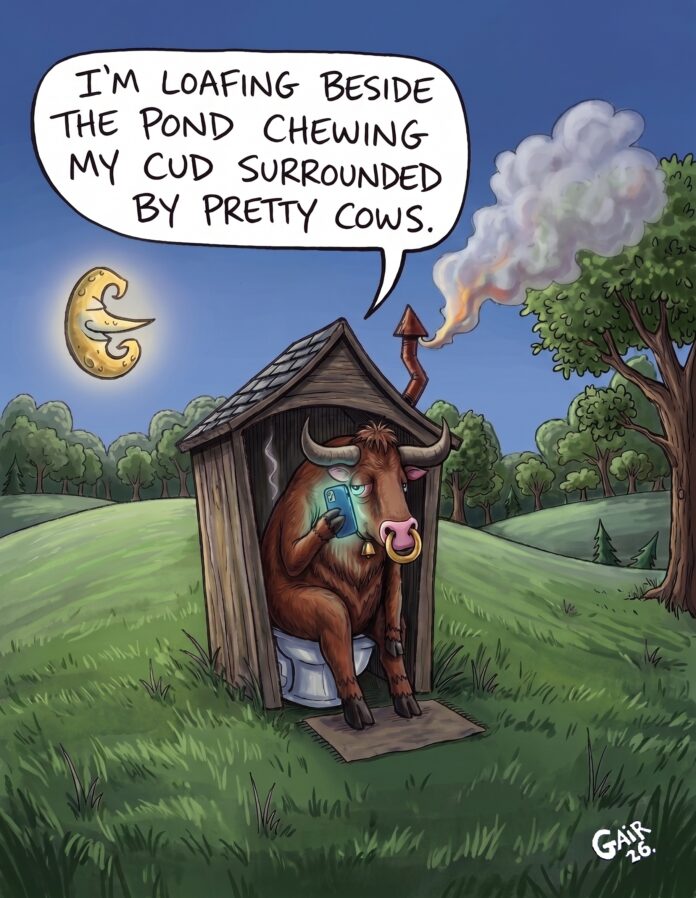
The USA should be renamed the United States of Northern Mexico and
Southern Canada.
Harvey Abramson
Denman Island, BC
Canada V0R 1T0

The USA should be renamed the United States of Northern Mexico and
Southern Canada.
Harvey Abramson
Denman Island, BC
Canada V0R 1T0

facebook.com/markprior.images
Ready to Load
This week marks the 35th anniversary issue of the Grapevine, so choosing an image for it called for something particularly connected to Denman and indeed Hornby, as it’s the first port of call on that journey.
There is something about the combination of the practical and the elemental — steel, water, forest, mountains and sky, all meeting in one place — that sums up island life. And the ferry is perhaps the most omnipresent example: the point where we leave, return, and connect with the wider world.
Shown here dramatically framed by the monumental infrastructure that brings us aboard, with the mountains and weather beyond, I hope it will be seen in a new light.
So, for the 35th, Ready to Load.
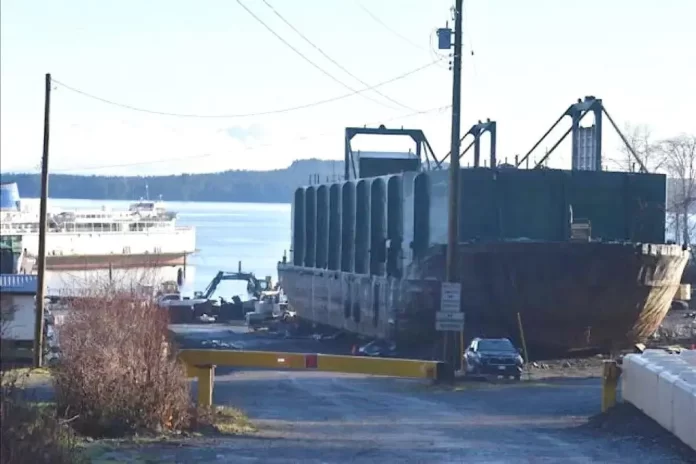
K’ómoks First Nations call shipbreaking fines ‘toothless’
re-printed with permission from All Things Union Bay
Aug.29th, 2026
The K’ómoks First Nation has said it finds shipbreaking fines “toothless” when it comes to protecting Baynes Sound from contamination.
According to a press release issued on Aug. 25 from the First Nation, the Province of B.C. has issued more than $95,000 in fines to Deep Water Recovery Ltd. due to unsafe shipbreaking activities in Union Bay over the last six years.
“The operators continue to pollute the land and water with heavy metals and toxic chemicals – contaminating B.C.’s biggest hub for shellfish harvesting and the local marine food chains in Baynes Sound,” reads the press release. “K’ómoks people have a deep connection and stewardship obligation to these lands and waters, appreciating the interconnected nature of all things, harvesting resources sustainably, and ensuring the ecosystem is balanced.”
The press release also says there are currently significant gaps between federal, provincial and municipal regulations on the ship-breaking industry, calling the industry a regulatory grey zone with limited enforcement.
The most recent fines, say the First Nation, are not a true deterrent.
“We rely on government regulations to protect people, lands and water from harm. The regulations are failing us. These fines don’t go far enough,” says K’ómoks First Nation Chief Councillor Nicole Rempel. “Shipbreaking has been contaminating Baynes Sound for six years, and nothing has changed. We’re calling on the federal government to step up, to finally stop these heavy metals and chemical toxins from leaching into this delicate ecosystem. What are we waiting for? 50 per cent of B.C.’s shellfish are harvested here. No one wants more lead and copper in their food.”
The Nation says they have been working with local and provincial bodies to stop the contamination for six years, without success.
“The federal government needs to start taking action to enhance and better enforce shipbreaking regulations to end these reckless practices.”
Shucking Oysters: How Was Your Summer?
By Alex Allen
Aaah September: my favourite time of the year for many reasons. September has always represented a new beginning. It must be a school thing. The January new year has never resonated with me. Why should I be forced to stay up until midnight and make resolutions that I will never follow? No, September is when I start new projects and ponder deep thoughts (like the varying surface tension of coffee). Another reason. We get our island back.
I don’t know about you but each year I find myself saying, “that was the busiest summer, ever.” Like the weather, every year we get hotter. Sometimes I ask myself, can our island even handle getting busier every year. Is it sustainable? Why can’t we be like a nightclub and only let the same amount of people in when the same amount of people leave? Six of you? Sorry, only two couples have left, and no, children do not count as pets.
Let’s be honest, living and working on Hornby in the summer can be a challenge. Everything we take for granted in the off season is null and void in the summer. A seemingly simple jaunt to the Co-op can provoke road rage, where a six-minute journey turns into 20 minutes. Even if you time your commute with the ferry arrival, it doesn’t work because they’re constantly shuttling. So just sit tight and wait for the 40 vehicles to go by and relaaaaaax.
The Urban Dictionary defines an emotional meltdown as “what happens when a person freaks out, cracks, or loses control of themselves.” We know the feeling. You’re following a group of bicyclists who insist on taking the entire road, oblivious to your need…to get….home…now. Instead of honking, you gun the engine, and the bicyclists scurry to the side of the road like startled wood bugs. I can hear you laughing crazily as you drive by. Why do we even use the word meltdown to describe a loss of decorum? Joel Hinrichs writes: “This is one of those over-the-top exaggerations. A nuclear meltdown is pretty dramatic don’t you think? Chernobyl, anyone?” Umm, I’ll get back to you.
Lie comfortably on a couch or bed. Make believe that you are floating on a cloud. Be the seaweed in the ocean floating back and forth.
There seems to be four kinds of summer drivers this year, the:
1. I brake for anything driver: an approaching car, a bicyclist on the other side of the road, the view, a driveway, possibly a pine cone, I’m not sure.
2. No, I won’t pull over driver. I know where we’re going. OK, I lied, I have no idea. But I sure as hell, won’t admit it. Ever!
3. 40K then 30K then 20K driver. Often talking on their cell phone. Completely oblivious, but one with Hornby, oh yeah.
4. The aggressive, giant diesel truck driver. Stinky fumes and attitude. Likes to drive in the middle of the road and usually brings his propane BBQ, ATV, and SeaDoo along.
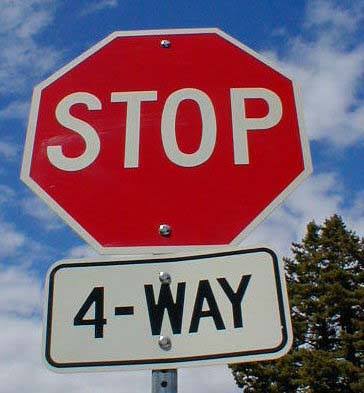
The four-way stop. What is it that people don’t get? It’s not a duel. It’s not a contest on who has more attitude and or who will win. Repeat after me, if two vehicles arrive at the same time, the driver on the right goes first. Otherwise, be prepared to have a staring match with the guy in the diesel truck over who has the entitled right of way.
Start with your feet. First, turn each foot a few times; then think of your feet as being very loose, dangling like a pair of socks, Now relax your thighs. Then let your legs lie heavy. Think of your legs and feet as completely relaxed.
Back in 2005, an article on Hornby Island in BC Magazine noted: “It’s not always easy, on an island of 1,000 free spirits, to find consensus. But there are two topics sure to get islanders nodding: the rare beauty of their island and the impact of visitors on it…You can understand, then, why islanders might feel some ambivalence toward visitors: in peak periods holidayers may outnumber residents 10:1.” The author added, “yet we tourists are the lifeblood of the economy…It’s ecology versus economy, a paradox acknowledged annually in a symbolic Hornby ritual..the Wave-Off.” There lies the paradox, indeed, and that was 21 years ago.
Take a few breaths as deep as possible. Breathe gently out and then in. Feel your body sink. Get rid of every thought of tension. Instead, tense your arms; stretch them as far as you can. Tense your fingers, spread them as apart as rigid as you can. Make tight fists as though you were boxing.
As someone said, “everybody wants Hornby to stay exactly the same as the day they moved here.” How do we grapple with the ever-growing influx? How do we move together toward a future we want, in all our different ways? Maybe a good place to start is to ask ourselves: What’s important about this place and what made us all come here? Sure, Hornby has managed to retain some of its unique ways, but it’s not what it was seven, let alone 15 years ago.
In the meantime, I’m going to go to the woods and hug a tree and complain to it for 15 minutes. Next summer? Like a piece of seaweed in the ocean, I’ll probably be in the fetal position daily rocking back and forth on the living room floor.

Book report 16
By A. Bae Hel
Some heavy books this report, but life isn’t always flowers and fairies. Sometimes you must veer into the darkness to understand the light.
The Emperor of All Maladies: A Biography of Cancer
Siddhartha Mukherjee

5 years ago when I found the lump my initial thoughts were not that this was cancer. In fact, I pretty much ignored it for several months assuming it was related to something else entirely. When I brought it up to my GP about 6 months later she waved it away as well. It was only 6 months after that when I returned to her and said it was getting bigger that she took a closer look and with a stricken look said she was sorry and hustled me off into the jet stream of cancer.
I have always liked to understand what the hell is going on. I like details and knowing the secret knowledge of healthcare. So, before I saw her this last time I had begun googling possible things it could be. I can up with some fairy obscure and rare cancers, so was PREPARED. I knew I had cancer, just what type remained to be determined.
Know your enemy is essential advice for all kinds of things and I was fortunate to have a very well-rounded experience in healthcare that gave me a lot of broad knowledge on various different specializations. I entered into the battle with my cells secure with an understanding of what was to happen.
Trying not to die is exhausting and traumatizing beyond anything I ever expected. I could not have read this book until now. During my Trying-not-to-die period I could not have held the concepts in my befuddled brain.
Initially I was a bit put off because it seemed the entire book would be about cancer discoveries in America, but fortunately he rapidly delved into the history of cancer. Going back to ancient mummies and records of early surgeries built the bedrock of the dramatic options to come.
This is a very sciency book. Extreme science. Details of cell division, genetic codes, drug mechanisms of actions on the cells are interspersed with narratives about the people who not only sought to treat and find a cure, but the patients they struggled to save. It is also deeply traumatic. It does not gloss over the horrors that was the early radical surgery protocol and the zeal with which those surgeons approached a mass. Similarly with the early radiation treatment regimes and discovering of how to poison right up to the edge of death.
The writing is often beautiful and full of compassion as well as science. The level of details is often into the textbook genre, but in spite of this, the biography of cancer brings the disease into the personal realm. We will all be touched by this and the desire to understand the hows and whys driving those looking for a cure. Can you skip over the parts about genetic code details mutations on which genes turn it on or off? Absolutely! You can still come away from this book with a more profound understanding of the enemy that lurks within us all.
Nobody’s Girl
Virgina Roberts Giuffre

This is a difficult book to read. Yet Virgina herself acknowledges that and asks us not to stop. Take a break, takes as many breaks as you need, but please hear her story.
Very likely you have heard her name before and you know she spoke up about being trafficked by that billionaire to other billionaires, yet her story is so much more than that. It is a story of how such abuse as a child will form who you become and how you respond. It is about how trauma shapes us and about how difficult the struggle is to break free of the bonds which constrain those trafficked and abused.
Virginia shows us such courage and bravery. She knows that she will be cast as the whore and a liar by very powerful people, and who has ever known the powerful to lie? She steps up and refuses to accept that tag. She built a new life. One with a burning to ensure these monsters are held accountable.
We continue to wait for that accountability to happen.
The book ends with a hopeful note in 2024. Can it possibly be more tragic to discover that behind this hope was continuing abuse at the hands of the man she portrayed as supportive and loving. Her need to matter, to find protection and safety even though she could speak out about past abuses would not allow her to name the one she protected for so long. I find this the ultimate tragedy of her life.
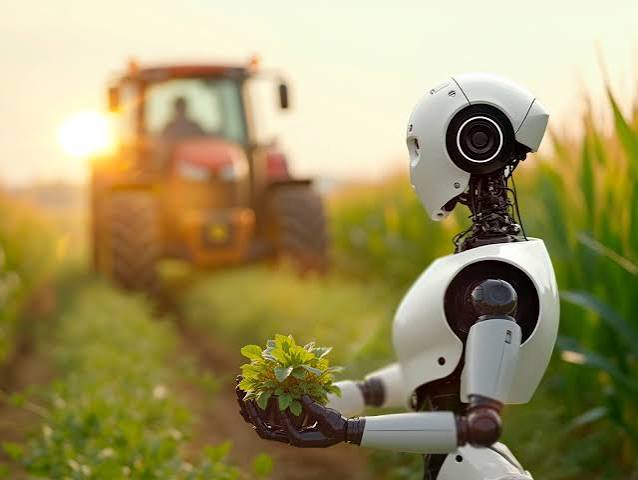
Food Insecurity and the Loss of Denman’s Farmland By Cylon2036 We/Us
Farmland makes up roughly 4.9% of B.C.’s total land base, protected under the Province’s Agricultural Land Reserve (ALR). B.C.’s geography heavily limits large-scale agriculture, as it is dominated by mountain slopes and forests. Because arable land is scarce, B.C. records the highest average farmland prices per acre in the country, while ranking #1 in farm productivity yields per acre.
Only 3% of the Vancouver Island and Gulf Islands region is designated as usable farmland. The actual amount of land actively farmed is even smaller, at 1.5% of the region’s total land base. Vancouver Island farmland is limited to the southeast coast of Vancouver Island, the Comox Valley, and specific pockets on the Gulf Islands, including Denman Island, where farmland prices keep rising.
Due to the extreme scarcity of arable land and intense competition from development, farmland prices on Vancouver Island and the Gulf Islands are exceptionally high. And because usable farmland is so limited, the islands are heavily reliant on food supply chains, with well less than 10% of the food consumed on Vancouver Island grown locally, a vulnerably low level of food security.
British Columbia has lost roughly 1.1 million acres of farmed land, marking an overall decline of 16% in active farmland over a two-decade span. Because the land is prohibitively expensive, it is often bought by non-farmers as real estate investments and for development other than food production. Nearly half of the ALR sits unused for agriculture because aspiring young farmers simply cannot afford to buy it.
Areas like the Comox Valley and Gulf Islands have faced steady declines in farming acreage. Land has increasingly shifted out of food production into other non-farming uses, where a massive cost barrier of island real estate has made it nearly impossible for a new generation of food producers, leading to older farmers retiring, and making any loss of farmland here highly critical, especially for food security.
Farmland loss on the Gulf Islands follows the same downward trend as the rest of British Columbia, but it plays out on a much more fragile, hyper-local scale, and because the islands have such a small agricultural footprint to begin with, even a minor loss of farmland has a major impact. This problem is amplified by the islands’ status as a luxury real estate and retirement destination.
Land values routinely match the highest rates in the Province, with a high percentage of the islands’ ALR land owned by speculative investors or part-time residents. Because these owners do not rely on farming for an income, the land simply falls out of active cultivation, widening the local food security gap.
Several local groups help protect and support food security, like the Denman Island Growers and Producers Alliance (DIGPA), the Denman Farmers Market, Farm to Family Society, the Food Bank, the Gather Farm and Kitchen, with big shoutouts to 2 Roads and Ruby Slipper farms, The Snag, Corland Vineyards and others, for delivering Denman Islanders the valuable gift of delicious local food.
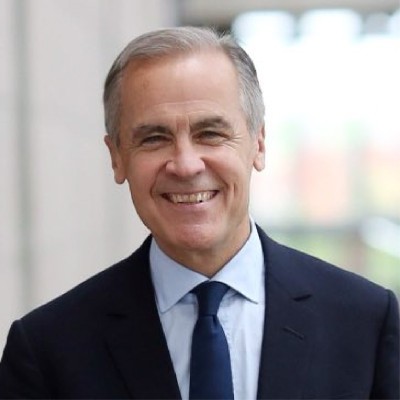
The Canada Investment Garage Sale By Keith Porteous (editorial)
Prime Minister Mark Carney is throwing a party for the people who already own the house. He calls it the Canada Investment Summit. The government calls it nation-building, while investors will presumably call it an opportunity. Working people will be encouraged to call it independence, but it’s not independence, it’s customer service.
The summit is scheduled for September 14–15 in Toronto, where the federal government plans to gather the world’s biggest investors and pitch Canada as a destination for $1 trillion in new investment over five years. The guest list includes American billionaires, global CEOs, institutional investors and the financial giants who have never encountered a public asset they couldn’t imagine turning into a revenue stream.
Apparently, the best way to make Canada more independent is to invite the people with the deepest pockets to decide what the land and resources are for. Carney insists this is about independence, and that is a particularly exquisite joke. We are told Canada must become stronger and more independent in an unstable world, so Ottawa is shopping the country around to foreign investors.
Fossil fuels, critical minerals, ports, infrastructure, data, technology and defence is what the government proudly boasts that it is catalyzing for a trillion dollars of investment, while offering investors the most tax-friendly environment in the G7. Nothing says economic independence quite like putting the national economy on the showroom floor and inviting multinational corporations to make an offer.
And this is where Carney’s particular brand of political theatre becomes almost perfect. The former broker and central banker speaks the language of national resilience, strategic autonomy, and economic strength. But beneath the hyperbole and rhetoric lies an older, simpler creed, where capital must be made to feel comfortable. Canada must be “competitive.” Translation: make sure investors like the regulatory climate.
“We must build at scale and speed.” Translation: get projects approved and financed before anyone asks too many inconvenient questions. We must become an “energy superpower.” Translation: there will be plenty of room at the table for fossil-fuel capital. We must build a “defence industrial base.” Translation: the military-industrial complex has discovered a new market with a maple leaf on it.
It is remarkable how often the magic of trickle-down economics returns wearing a hard hat. The government says the summit will direct investment toward “clean energy”, critical minerals, new technology and AI, but the broader investment drive encompasses oil and gas, shipping and transportation, data and defence.
The “green” future and the war economy arrive together, hand in hand, like two corporate executives sharing a limousine. We are told that independence requires military spending, pipelines, ports, mines, and gas. Apparently, the final ingredient is reassuring investors that the government is prepared to absorb all the risk. What could possibly be more independent than socializing the risk and privatizing the profit?
Money does not arrive virtuously, it arrives looking for a return, and where investors are very good at finding one. Who will own what they build, who will profit from it, and who will pay when it fails? Those questions are considerably less glamorous at a Toronto ballroom full of billionaires.
Carney’s answer to foreign dependence is to deepen Canada’s integration with global pools of private capital. The problem is about the political power lost when governments become desperate to attract capital, and capital acquires even more leverage.
A climate policy that simultaneously treats Canada as an “energy superpower” and accelerates massive resource development cannot simply be baptized “green” because the press release contains the words “clean energy.” The climate does not care who writes the cheques.
Do the raw resources belong to a public with control over their future, or is this land destined to become one enormous investment opportunity with a national anthem, where the State will provide the infrastructure, absorb the risks, accelerate approvals, cultivate the investors, and subsidize industrial exploitation? Private capital will always arrive to collect the upside.
Call it what you like, but the rest of us will call it a garage sale with a flag on the door.