Both of our World Courts have been in the press lately with respect to Israel’s ongoing war against Gazans; it’s very easy to confuse them. A few similarities are that they were both established by the UN and both are based in The Hague, Netherlands. In most respects, they are quite different. Much is written about these courts and I have no expertise in International Law. This and my next week’s article constitute a very surface-level overview, offering a snapshot of each court through the lens of its actions re Israel, Gaza and their leaders.
InternationalCourtof Justice
The first truly World Court is the International Court of Justice (ICJ), established in 1945 by the UN Charter, for the settlement of disputes between States. All 193 UN members are automatically parties to the Court’s Statute, by reason of having joined the UN. Submission to the jurisdiction of the ICJ though, is not compulsory for UN member States. The US withdrew from compulsory jurisdiction of the Court in 1986. Other countries who have not signed the declaration recognizing the jurisdiction of the Court include: China, Iraq, Israel, Libya, Qatar and Yemen.
Focus of the ICJ is on the international obligations and responsibilities of States.
In January, 2024, The ICJ heard South Africa’s preliminary case against Israel for genocide. The ICJ determined it had jurisdiction to hear the case – a necessary first step. If the Court has jurisdiction, the Petitioners in the case must then meet a threshold with their evidence to have the case go forward. That is, they have to convince the Court that they have a “plausible case” that the State in question, in this case, Israel, committed or is committing the offense claimed, in this case, genocide, before the Court can continue. This threshold, the Court determined, was met by South Africa. Now the Court will accept briefs (arguments) from any and all countries who are parties to the ICJ, who apply to join the case. A number of States have already applied to join this legal action. Individual State’s briefs can be either for or against the claim of genocide. So far all the countries joining the action will be arguing on the side of South Africa.
You can go online to hear the arguments made by South Africa’s legal team before the ICJ in January. They are powerful and compelling. The Irish lawyer on the South Africa team, Blinne Ni Granleigh, indicated in her argument that Gaza is the scene of “the highest levels of food insecurity ever recorded. Famine is around the corner”. She was not exaggerating; this was in January and the situation has only deteriorated since then. Both the New York Times and the Washington Post reported on June 19th that as many as 500,000 Gazan residents are facing “imminent starvation because of a lack of food”. (Seymour Hersh, 26 June, 2024.) Starvation as a weapon of war is a form of genocide, and we are seeing it before our very eyes in Gaza.
It may be several years before the case is actually ready to be tried by the Court. That’s why it has issued two sets of Provisional Measures Orders, which are orders that can be made to
prevent “serious and irreversible damage” from being done before a case actually gets to trial. So far, these measures have been ignored by Israel. (I outlined the terms of the 1st Provisional Measures Order in Respecting International Law, Grapevine, 1st Feb.2024.)
The ICJ can also issue AdvisoryOpinionsif requested by the UN General Assembly or Security Council. In 2004, for example, the ICJ ruled that the Israeli Separation (Apartheid) Wall in the West Bank, occupied Palestinian territories, violated international law and should be dismantled. Nonetheless, Israel’s construction of the Wall continued unabated and its dark presence in the West Bank remains, snaking its way through Palestinian lands, dividing orchards, villages, families.
We as Canadians can let our leaders know we respect our World Court, its Advisory Opinions and its Orders. In its most recent (24th May) 2nd Provisional Measures Order in South Africa vs Israel, the Court unanimouslyordered “unhindered access at scale by all concerned of urgently needed basic services and humanitarian assistance, including food, water, electricity, fuel, shelter, clothing, hygiene and sanitation requirements, as well as medical supplies and medical care to Palestinians throughout Gaza, including by increasing the capacity and number of land crossing points and maintaining them open for as long as necessary”. UN-OCHA reports that the number of aid trucks Israel allowed into Gaza actually decreased in June, to an average of 71/day (from 500 /day before this onslaught began 9 months ago.)
If billions of people worldwide have called for a ceasefire in Gaza (World Beyond War Peacewave panel June 22, 2024), why are our leaders not listening? We need to speak more clearly and firmly to them, to make our demands heard, and hold them to account. We need to step up our engagement. We are all diminished if we look away from this immense human tragedy, where ample food waits at border crossings in trucks being attacked by Israeli civilians, who are utterly trapped in a vengeance mindset. The psychic burden and trauma of this ongoing violence is unimaginable for Palestinians; for Israelis it is soul-destroying; we who help arm and support Israel are complicit. We have the power to stop this genocidal violence. Let’s use it.
I pray to powerful Gods such as Priapus, Saturn, Ceres and Jupiter for protection of my farm and livestock.It seems to be working quite well.This spring, we got overwhelmed with project work and we had a hard time getting everything done.We staggered from job to job.We kept looking at the cherry trees and saying things such as, “Tomorrow, we must net the cherries.We didn’t get them netted!
About six weeks ago, during morning prayers, I thought to ask the Gods to send me band-tailed pigeons.These are stately, native pigeons that were nearly wiped out by the settlers with their shotguns in pursuit of pigeon pie and similar.We have seen a few around the edge of our farm over the years but none had ever come to our feeder.I was just hoping a few might come and coo at us from the edge of the forest.
I went downstairs after prayers and was making the morning coffee when I hear my husband shout, “Look at the bird feeder now!”There were five band-tailed pigeons jostling on our small feeding table and they were soon joined by another pair.We have had them every day since and I adore them.They are very pretty, large birds and their coo is very soothing.A friend who grew up here told me they are terrible cherry thieves which may have been one reason the settlers shot them.
Due to what I can only suppose was divine intervention, none of the pigeons or other birds got into our cherries.We were able to go picking every day for a week and collect only the ripest cherries.We did one huge pick of most of the crop and after that, a few birds came in to dine on the remaining few fruit but it was by no means a massacre.
An orchardist came over to help us with a technical issue and he was amazed to see our cherry trees standing, laden with fruit and untouched by birds.He said that if he tried that at his place, there would not be a single cherry left.
We stone and freeze a lot of the cherries on trays and then load them into freezer bags as we love to have them in fruit salads in the winter.They also make great ice cream.We put a can of coconut milk in the blender and drop the frozen fruit in one by one, add a little sweetener and have really nutritious ice cream.
We also like to make Rumtopf.This is an excellent way to preserve fruit and I have this recipe from a woman who made some and gave it to Peter Karsten to try.He said it was just like what his Mom used to make in Germany, so the recipe is really good.
You need a big crock or large glass jar in which you layer fruit as it comes ripe.You put in a layer of fruit and cover it with white sugar and then cover that all with dark rum.The next fruit to come ripe goes in on top with more sugar and rum to cover.Do not stir!You make this in the summer to serve in the winter.
I was told the Germans like to put it on cakes or ice cream which sounds jolly good.I usethe resulting drunken fruit to make Christmas cakes and there is really nothing better.I also make my own candied peel from organically-produced citrus fruit for those cakes and it is very easy to make candied peel.I will put a recipe in a future article as the citrus is only good in the winter.
A lovely friend also taught me to make maraschino cherries and cherry brandy.For this, we use sour cherries, also called pie cherries, and they grow very well here.For the Rumtopf, I use both sour and sweet cherries but for the maraschino cherries, only sour cherries will do.
We bought most of our cherry trees from Beulah Creek Nursery on Hornby and have always found them to be excellent. Our sour cherries do very well here and of the sweet cherries, Bing seems to do the best for us.Your results may vary.
The recipe for the maraschino cherries is three cups of sour cherries covered by two cups of white sugar and two cups of vodka.Keep adding more fruit and so on as people really love these cherries and they make great gifts.Shake the jar every couple of days and leave in a cool dark place for a couple of months.You will have a lot of syrup from this and I bottle it and serve it as cherry brandy.I have had people say it is the best thing they have ever tasted.
“All our agents are currently busy with other calls. Please stay on the line.” “All our agents are still busy, please continue to hold for the next available agent.” “We are currently experiencing a high volume of calls….”
I have spent the last week trying to speak to a Canada Revenue agent, and I am now at that borderline level of customer service rage. All because I filed my income tax differently from previous years, I can’t register on line and have to speak to a CRA representative. I dutifully call Revenue Canada and I am greeted in French to press deux (2) to have a French-speaking agent. That’s it. C’est ça. So, logically I assume that by pressing 1, I will have the English-speaking option. And down the rabbit hole we go. An automated voice tells me to press 1 for something, press 2 for another, 3, 4, 5 options. After pressing one of the five options, I am given three more options. I have to play them all, because none quite explain my situation. Not once do any of the options let me speak to an agent. So, after going through the option tree, I get directed back to the main menu and have a brilliant moment. Don’t press 1 or deux, wait and see. Sure enough, I can speak to a real agent through this loop, but of course, the obligatory “we are experiencing a high volume of calls please call back” is played. So, I try again another day, this time I get in the queue and the wait time is more than three hours. The next day, the queue is full, so I’m told to call back or visit the website. I even tried the number for Yukon, Northwest Territories, thinking that maybe I could interact with a real person. Not. At this point, I am no longer calm nor rational. If I owed them money, it would be a different story — they would be calling me every day. It’s not just the government, every corporation seems to grow more inhuman and unhelpful with every phone call we make.
Whether it’s the relentless hold times, the outsourced agents who can’t speak English, or the multitude of buttons to press and automated voices to listen to before reaching a real live human being — who hasn’t felt exasperated at the abuse, neglect, and wasted time we experience when all we want is help, and maybe a little human tenderness? As someone cautioned, with AI there will be “very little room for the mellowing intervention of a human supervisor.”
Getting caught in a tech support loop, Kate Murphy wrote, “is a peculiar kind of aggravation that mental health experts say can provoke rage in even the most mild-mannered person.” When things don’t make sense and feel out of control, humans instinctively feel threatened. Though you would like to think you can employ reason in this situation, Murphy writes, you’re really just “a mass of neural impulses and primal reactions.” Indeed.
Once on hold, we all know what will come next: “Your call is very important to us.” Of course, after being on hold for a 10 minutes and having heard that message three or four times, you can’t help but think that your call is obviously not important at all. North Americans spend, on average, 13 hours per year waiting in a calling queue. According to a study in the journal Cost Management, a third of complaining customers must make more than two calls to resolve their complaint. And who knows how many who simply give up out of exasperation after the first call.
In the Harvard Business Review, research suggests that some companies actually find it profitable to create hassles for complaining customers. How many products have you tried to return or get fixed to no avail? Since 2015, the study examined the incentive structures within customer service departments at over a dozen companies in finance, technology, and travel to understand why customers perpetually experience hassles. For one, all these companies screen complaining callers using a “hierarchical organizational structure.” Companies deliberately employ this inefficient, multi-step process hoping that you will give up so they can avoid giving you a replacement or refund. Not surprisingly, by forcing customers to jump through a marathon of hoops, the organizations win. They profit from our frustrations. They know that if they ignore us long enough, we will give up and go away.
Even finding the ‘Contact Us’ page on most websites takes five to 10 clicks before you even get close. Every business has reduced its capacity for email contact. Even if a company emails you, it will come from an address that doesn’t accept replies. Of course, emailing complaints would be more convenient and efficient for the customer, but less so for the business that has to read, reply and, dear god, fix the problem.
Plan G. Canada Revenue opens at 6:30 am weekdays and I’m going to put my phone on redial at 5:45 am every morning until I get through. In the meantime, please hold for the next available instalment.
Let’s assume, as I do, that the climate science is accurate, or perhaps even worse than we know. It’s an existential crisis that needs a radical response if we are going to mitigate its devastating effects. Surely, we should all be committed to taking dramatic actions toward real solutions.
What we know in reading the literature from the economic planners of Western democracies, is that a crisis provides the opportunity to do things that the general population would otherwise vehemently oppose. But what are the proposed climate solutions being pushed by the state sponsored economic planners?
While governments subsidize the massive energy extraction corporations to the tune of hundreds of billions of dollars, the working classes are served an ever increasing amount of taxation on their carbon footprint, with the costs of living for working class individuals and families being stressed to its limits. In turn, this has an associated political backlash that is exploited by conservative politicians.
The effects of policies that are perceived as unfair or disproportionately burdensome on the general population create an incentive to support conservative populists who oppose these same policies. Meanwhile, people who have more economic security and identify as liberals or leftists are shocked by the rise of conservative populism in Europe and North America. It’s time for those who oppose the right wing populist threat to see their own part in its manifestation.
While wages have stagnated and fallen in relation to inflation, large corporations have enjoyed record profits. We experience vast attempts at greenwashing by corporate capitalists and the centrist governments they support. Trust in governments and corporate media are at an all-time low. And once again, the public mood is exploited by conservative populists. Political centrists and leftists are fearful of this trend, but unwilling to accept their own part in creating it.
We have far to go in moving toward a more just society, and in securing social and environmental justice, but economic justice seems to have been pushed dramatically downward on the list or priorities, and the top priority of liberals and leftists is perceived to be a kind of identitarian moralism. Indentitarian moralism is adjacent to what some people call “wokeism”, which is a misnomer and is appropriative of a term that came from African American culture.
The chilling effect of the politics of identity has trended as censorship, cancel culture, and support for the worst aspects of state controlled institutions by liberals and leftists. The anti-establishment lane has been ceded to conservative populists who oppose war, censorship, and the surveillance state that intrudes into our private lives, at least in their performative rhetoric. This used to be the boilerplate foundation of liberal and left ideologies. The partisan world has now been turned upside down.
The largest carbon polluter on planet earth is the US Pentagon. And worse, many of these endless wars involve a conflict to control fossil fuel energy extraction that powers their industrial and military operations. Whoever blew up the Nordstream pipeline (nod, nod, wink, wink), was responsible for the single largest release of greenhouse gas into our atmosphere in human history. We are being gaslit into supporting ineffective climate change policies, while sociopaths are pushing us closer to an omnicidal apocalypse.
We fetishize electric vehicles, mostly purchased by people with above average incomes, and with government sponsored rebates, and claim that they are “zero emission” vehicles. While EV owners pay no gas taxes that support transit initiatives and road maintenance, much of the North American electric grid is fueled by coal and carbon fired electric generating plants. Even hydro-electric generation can have devastating environmental effects.
And further, the impact on the environment from mining the necessary elements to manufacture the batteries that support these vehicles are surely not zero emission, even when it comes from exploited child labour in far away places. This is not an indictment of EVs more than any other type of vehicle, but let’s not pretend these are rational solutions to a climate catastrophe, while the worst industrial offenders of releasing greenhouse gases into our atmosphere remain unabated in endless growth and war.
We’ve been successfully atomized, divided by identity, shamed, greenwashed, and gaslit into believing in climate solutions that are substantially corrupt, when we know a real climate crisis is increasingly urgent. Corporate grifters and the partisan politicians they own are not interested in real solutions to the climate crisis or the plight of the working classes. As Chuck D from rap legends Public Enemy said, “Don’t believe the hype.”
Let’s allow the cruelty of the world to break our hearts, kind friend.
Let’s weep together at the shredded and emaciated bodies in Gaza, and at their mocking, cackling tormenters.
At the amputees and orphans in Ukraine and in Russia, and at the icy-eyed swamp monsters who put them there.
At all the gasping plants and wildlife as we make this planet uninhabitable, and at the ambition-clouded minds who keep this cataclysm rolling forward.
Let’s just let it all in.
Let’s let it shatter us.
We are not soldiers. We are not killers. Our hearts are not meant to be calloused.
So let’s let the cruelty of the world smash us to pieces, and scatter us like dust in the wind.
Fully surrendering to the anguish. Letting it immolate us.
And then seeing what remains.
Maybe we will find that life keeps on lifeing, even after we’ve let ourselves be swept away.
Maybe after we stop holding back the heartbreak in our absolute certainty that it will kill us, we — somehow — do not die.
Maybe after the hurricane of sorrow has been fully permitted to tear through us and have its say completely, we go on.
The lungs keep filling with air. The veins keep filling with blood. The light of the rising sun makes its way into our eyes.
And we slowly feel our strength coming back to us.
And then maybe we start to stir.
And maybe we let our bodies have a good shake.
And then maybe, when we are ready, we start to sit up.
And then rise to our feet.
And return to the fight.
Let’s allow the cruelty of the world to destroy us, kind friend.
Caitlin Johnston has apparently been getting her news from Russian internet trolls. Or maybe the dreaded MainStream Media. How else to explain her letter to the editor assuming that U.S. President Joe Biden has dementia?
Experts are in full agreement on one thing about Biden: He is old. Consequently, he has an aging brain, so at times he’ll have trouble with word-finding or lose his train of thought. Combine that with jet lag from international travel and a head cold, and you’ll get a situation like the debate a few weeks back. It’s not pretty—but it’s not dementia.
The candidate who has the experts talking about dementia is the other old guy. If you don’t trust the experts, just listen to one of Trump’s recent speeches. He’s showing the classic signs: Making basic errors of fact (confusing World Wars II and III, Biden with Obama), spewing word salad. Or ask the American CEOs who left a recent meeting with him saying he was incoherent, comparing him to the classic “drunken uncle”.
Not that it matters. Regardless of his cognitive status, if Trump makes it back into the White House he’ll be busy enacting “retribution” against his perceived enemies (and, of course, playing golf). Meanwhile, his aides will be implementing Project 2025, the Heritage Foundation’s 887-page plan for the next Republican administration. The goals: Limit women’s rights (ban abortion nationally, without exceptions for rape or incest; ban contraceptives; end no-fault divorce), replace civil servants with party loyalists, build mass detention camps and deport immigrants, cut pension and medical programs for the elderly and disabled (Social Security and Medicare), deregulate big business, use the military to break up domestic protests, and on and on. In short: install a white patriarchal Christian autocracy. In shorter: fascism.
John Heinegg
Editor’s note: Apparently Caitlin Johnstone isn’t alone in her assessment. The New York Times, The Washington Post, and MSNBC have all opined that President Joseph Biden should resign his Presidency.
Two clocks are ticking on final comments regarding Rogers’ recently “staked claim” on a proposed cell tower site many residents feel would be much better used for community housing on an island that already enjoys myriad connection options.
In light of conflicting published deadlines for comments by July 13 and July 24, your comments are best submitted online here by July 12. (For those using small phone screens, the Submit Comment box is on the lefthand side of this webpage.)
Please proceed to the Crown Lands website linked above to Submit Your Comment regarding your preferred use of this land for community housing, instead of the proposed Rogers cell tower, which cannot be legally operated this close to new residences.
IMPORTANT!
You are no longer dealing with Rogers or the Trust. You are now addressing provincial officials at much higher levels in the Ministry of Water, Land and Resource Stewardship in charge of Crown Land — who are likely unaware of Hornby’s long history regarding community housing and cell towers. Instead of tediously recounting those campaigns, simply let these issues energize your respectful remarks. As HICEEC’s Katherine Ronan emphasizes,“It’s very important when making comments to be super polite and reasonable.”
And succinct.
Sure, many of us are weary of repeating our opposition to Roger’s proposed cell tower. But this time, we are addressing the province in favour of urgently needed “workforce housing” instead of a cell tower. While this terminology might seem too restrictive, in BC’s bureaucratic nomenclature, “workforce housing” is much more inclusive — with fewer boxes to check — than applying for “affordable housing”.
“We use different terms because BC Housing uses different terms,” Katherine explained. “Affordable Housing usually connotes subsidized housing by BC Housing, whereas Workforce Housing is a more flexible definition encompassing housing for all those who work, or who have worked.”
ROGERS AND THE TRUST
Commenting on Rogers’ competing application, she added, “Rogers wants this site because it’s the cheapest place to build as it is close to the road. Rogers is a large corporation and can afford to place the cell tower somewhere else on the Crown Land. This particular parcel is an excellent site for housing as it is centrally located and within walking distance of many community facilities.
The Islands Trust is onboard with allowing housing on this site and work on changing the bylaws has been initiated.
DELAYS EXPLAINED
So how is HICEEC’s housing application progressing?
“The process has been very time consuming and frustrating,” Katherine replied. “Our project does not fit neatly into any of the usual boxes. Crown Land is not usually released for Residential Use unless: 1. It is in a remote location and 2. The applicant is an industrial corporation such as a mine. Our other option would be to purchase the land at market rates which, as we know, would put it out of our community’s reach.
“A lengthy delay occurred when HICEEC started to apply under Residential tenure and discovered that, as a nonprofit housing provider, they were directed to apply under another tenure, Community Institutional. This form of tenure would mean that that land would simply be transferred out of one branch of government, Crown Lands, to another branch.
“This was exciting news as it would mean that we would not have to purchase the land. However, it required tedious further research in order to find the right ministry for sponsorship. It took much emailing and phoning to try to find the correct information as I was often directed to the wrong official or the wrong ministry.
“At last, thanks to our MLA Josie Osborne’s help, we are now in dialogue with the right people at the highest levels of government in the various ministries responsible: the Ministry of Housing, BC Housing and Ministry of Water, Lands and Resource Stewardship. And, more importantly, the different ministries are now in discussions with each other about our project and are working together to determine the solution.
“With time running short we are grateful that our housing project is at long last under consideration at the relevant levels of government. We are hopeful that we will have some definite answers soon.
Given Hornby’s time constraints regarding the Rogers application, these ongoing, high-level inter-department conversations could prove pivotal in securing this land for cost-effective workforce housing.
Post your comments to the ministry in charge of Crown Lands here:
By Chris Junck, Tayor’s Checkerspot Butterfly Recovery Project, with contributions from Pascale Archibald, Stephanie Govier and Neil Wilson
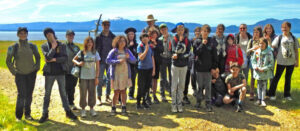
Take 19 excited students near the end of the school term; place them in a meadow of delicate wildflowers in Helliwell Provincial Park; add endangered Taylor’s checkerspot and propertius duskywing butterflies and other insects; mix well and let them simmer for two hours. Does this seem like a recipe for an ecological disaster or potential chaos? Apparently not when they are well-prepared Hornby Island Community School students on a field trip to Helliwell that was carefully planned and managed. The students were guided by their teacher, Garret Holt, BC Parks conservation specialist Stephanie Govier, and butterfly technician Pascale Archibald. Hornby Island Natural History Centre stewards Bill Hamilton and Neil Wilson, Community School staffer Jala Klone, and park ranger Sam Rae Harriss were on hand to provide additional information and field trip support.
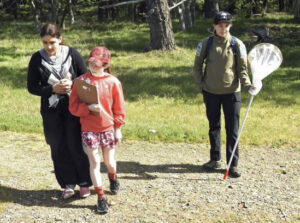
Stephanie Govier and Pascale Archibald outlined the coastal bluff meadow habitat restoration efforts in Helliwell Park over the last several years. Neil Wilson spoke about the contributions of students from the school during that time, which involved the planting of thousands of native butterfly host and food plants, which had been propagated by stewards of the Hornby Island Natural History Centre. Taylor’s checkerspot lifecycle stages were reviewed before students were handed laminated information sheets, surveys, pencils and clipboards and then sent to observe insects. Quite a few species were caught with nets by adults and placed in containers to study for a moment before being safely released.
“It impressed me how careful everyone was to not injure the bugs and by how much care was taken to stay on the trails to avoid trampling,” said Neil Wilson.
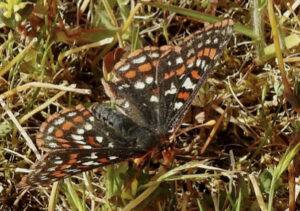
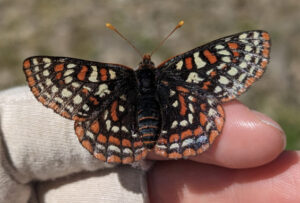
In the catch were several species of bees, flies, beetles and butterflies, including a propertius duskywing and a Taylor’s checkerspot butterfly – one of many spotted by the team of citizen scientists. The two-hour lesson also focused on meadow plants important for pollinators.
The field trip was part of ongoing efforts to increase awareness about the importance of pollinator insects. It also highlighted the collaborative work by BC Parks and the Taylor’s Checkerspot Butterfly Recovery Project Team to re-establish a viable population of the endangered species in Helliwell Park.
Taylor’s checkerspot butterflies vanished from Hornby Island in the mid-1990s. After several years of habitat restoration work and annual releases of Taylor’s checkerspot butterfly caterpillars in Helliwell Park, the project team finally received encouraging news this spring. In March, butterfly technicians Pascale Archibald and Kihan Yoon-Henderson found more than 230 Taylor’s checkerspot larvae that successfully overwintered in the park to continue their lifecycle.
At the end of March, the team released another 100 Taylor’s checkerspot butterfly caterpillars in Helliwell Park near St. John’s Point, and 340 larvae for the first time on Flora Islet. The caterpillars were raised at the Greater Vancouver Zoo by Wildlife Preservation Canada staff Andrea Gielens.
Pascale Archibald recently conducted follow-up surveys of adult Taylor’s checkerspot butterflies and their offspring in Helliwell Park. More than 130 individual butterflies were observed on 14 survey days between May 9th and 29th. She also found 88 clusters of larvae between June 8th and 13th. “There are definitely more out there though as I didn’t manage to search the entire meadow area,” said Archibald.
While these are very hopeful signs for Taylor’s checkerspot butterfly recovery in Helliwell Park, their future is not assured. The caterpillars are tiny, delicate and vulnerable. Trampling by park visitors, dogs and bicycles are a key threat to the larvae and the plants they need to survive.
Helliwell’s visitors can increase the caterpillars’ chance of survival by adhering to park rules. “Dogs must be on a leash according to provincial park regulations, and bikes aren’t allowed in this park,” said Stephanie Govier. Please walk carefully and watch out for caterpillars. Stay on the trails that are delineated by ropes and restoration area signs. If you visit Flora Islet, stay on the shore, and avoid the fragile meadows. This will reduce the possibility of stepping on a caterpillar or their host plants.
Don’t move or pick up Taylor’s checkerspots. Instead, report sightings to Taylors.Checkerspot@gov.bc.ca, or by using the free iNaturalist app (www.inaturalist.org). It is an easy-to-use species identification tool that enables citizen scientists to record and contribute important species data for projects around the globe.
BC Parks and the project team thank the Cowichan Tribes, Halalt, Homalco, K’ómoks, Lake Cowichan, Lyackson, Penelakut, Qualicum, Snaw’Naw’As, Stz’uminus, Tla’amin, We Wai Kai, and We Wai Kum First Nations for allowing us to restore ecosystems in their traditional territories. Several local volunteers from Conservancy Hornby Island, the Hornby Island Natural History Centre, the Hornby Island Provincial Parks Committee, and others also contributed to the success of this project.
The recovery project has benefited from funding and in-kind contributions from the BC Parks Licence Plate Program, the Habitat Conservation Trust Foundation, the Environment Canada Habitat Stewardship Fund, and the B.C. Ministry of Environment and Climate Change Strategy (Ecosystems Branch), and others.
The Taylor’s Checkerspot Butterfly Recovery Project Team includes biological consultants and representatives from the B.C. Ministry of Water, Land and Resource Stewardship, B.C. Ministry of Environment and Climate Change Strategy, BC Parks, Denman Conservancy Association, Garry Oak Ecosystems Recovery Team, Greater Vancouver Zoo, Mosaic Forest Management, Wildlife Preservation Canada, and others.
Learn more about the Taylor’s checkerspot butterfly:
Hornby Island Community School field trip to Helliwell Park, May 2024. Photo by Bill Hamilton.
Students with information sheets and field survey forms. Photo by Bill Hamilton.
Photo by Stephanie Govier.
Several Taylor’s checkerspot butterflies and other insects were observed. Photo by Stephanie Govler
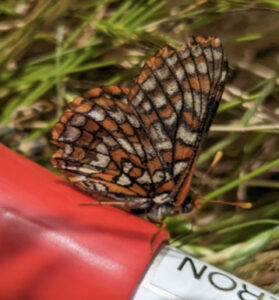
Photos by Pascale Archibald.
More than 130 Taylor’s checkerspot butterflies were found during surveys in May.
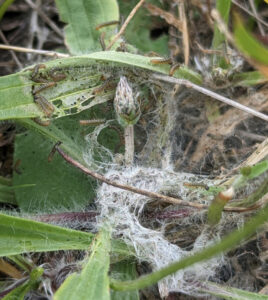
In June, Pascale also located 88 webs containing hundreds of Taylor’s checkerspot larvae. It’s proof that the butterflies are producing offspring, which is a hopeful sign that the reintroduction project is succeeding. Photo by Pascale Archibald.
Historical range was Hornby Island, southeastern Vancouver Island, Puget Trough and to the Willamette Valley in Oregon. In B.C., they were once abundant at 10 sites in the Greater Victoria Area, one site each near Mill Bay and Comox, and sites on Hornby Island (including Helliwell Provincial Park).
They were thought to have been extirpated (became locally extinct) from Canada by 2000 when no Taylor’s checkerspots could be found in their last known sites on Hornby Island despite intensive searches. However, new populations were discovered on Denman Island in 2005 and near Campbell River in 2018.
It is federally listed as Endangered (COSEWIC, SARA Schedule 1), and is on the BC Red list of at-risk species.
Taylor’s checkerspot butterflies need open sunny meadows where they can find suitable host plants (food for larvae and nectar producing flowers for adults), such as woolly sunflower, common camas, small-flowered blue-eyed Mary, wild strawberry, sea blush, and yarrow.
Habitat loss, degradation and fragmentation are major factors in the species’ decline. For example, the meadows along the coastal bluffs in Helliwell Provincial Park became less suitable for butterflies due to invasions of non-native plants and encroaching forests.
Habitat enhancement work (weeding, selective limbing +/or removal of conifers, re-planting and seeding with native species) has been ongoing in Helliwell Provincial Park for several years.
The Taylor’s Checkerspot Butterfly Recovery Project
The Taylor’s Checkerspot Butterfly Recovery Project is led by Jennifer Heron of the B.C. Ministry of Water, Land, and Resource Stewardship and is guided by the Garry Oak Ecosystems Recovery Team’s Invertebrates at Risk Recovery Implementation Group. It is a collaborative effort to restore Taylor’s checkerspot populations in British Columbia through habitat enhancement, captive butterfly rearing and release, monitoring, public outreach, and other activities.
Team Members
Jennifer Heron (Chair), B.C. Ministry of Water, Land, and Resource Stewardship, Vancouver, B.C.
Erika Bland and Andrew Fyson, Denman Island Conservancy Association, Denman Island, B.C.
Deborah Bishop, Denman Island, B.C.
Menita Prasad, Greater Vancouver Zoo, Aldergrove, B.C.
Eric Gross and Ross Vennesland, Canadian Wildlife Service, Environment and Climate Change Canada, Delta, B.C.
Crispin Guppy, Entomologist, Whitehorse, Y.T.
Molly Hudson and David Vey, Mosaic Forest Management, Nanaimo, B.C.
Chris Junck, Garry Oak Ecosystems Recovery Team and B.C. Conservation Foundation, Victoria, B.C.
Suzie Lavallee, University of British Columbia Faculty of Forestry, Vancouver, B.C.
Patrick Lilley, Private Consultant, North Vancouver, B.C.
Erica McClaren and Stephanie Govier, BC Parks, Black Creek, B.C.
Kristen Miskelly, Satinflower Nurseries, Victoria, B.C.
Derek Moore, Area Supervisor Von Donop Area, BC Parks, Black Creek, B.C.
Nick Page, Raincoast Applied Ecology, Vancouver, B.C.
Hazel Wheeler and Andrea Gielens, Wildlife Preservation Canada, Guelph, ON.
Bonnie Zand, B.C. Conservation Foundation, Fanny Bay, B.C.
Supporters
B.C. Conservation Foundation
B.C. Ministry of Environment and Climate Change Strategy
B.C. Ministry of Water, Land, and Resource Stewardship
BC Parks
BC Parks License Plate Fund
Conservancy Hornby Island
Denman Conservancy Association
Environment Canada Habitat Stewardship Fund
Garry Oak Ecosystems Recovery Team
Greater Vancouver Zoo
Habitat Conservation Trust Foundation
Hornby Island Community School
Hornby Island Co-op
Hornby Island Natural History Centre
Hornby Island Provincial Parks Committee
Mosaic Forest Management
Sea Breeze Lodge
University of British Columbia
Wildlife Preservation Canada
For more information about the Taylor’s Checkerspot Butterfly Recovery Project, visit: www.goert.ca/activities/taylors-checkerspot/
Or contact:
Project Lead/GOERT Invertebrates at Risk RIG Chair
Jennifer Heron
Provincial Invertebrate Conservation Specialist
B.C. Ministry of Water, Land and Resource Stewardship
Office: 778-572-2273
Jennifer.Heron@gov.bc.ca
Public Outreach Coordinator
Taylor’s Checkerspot Butterfly Recovery Project Team