Home Blog Page 134

Shucking Oysters: Moving Forward

“We are committed to moving forward and exploring alternative solutions that align with the needs and priorities of our staff and community as a whole.”  “It’s a ‘win-win-win’ for local farmers, for local consumers, and for food security moving forward.” “Going forward, health officials need to give concrete examples of what is and isn’t acceptable social interaction.”  “We’re working collaboratively with BC Ferries to find a way forward.”

Stop it. Going forward. Moving forward. Whatever happened to “in future” or “looking a head”? Every time I hear this “brainlessly upbeat” tag-along, I feel like I’ve been hit with a heated cattle prod (or for the visually impaired, tasered). As BBC writer, Lucy Kellaway wrote, “When someone says ‘going forward’ it assaults the ears just as, when a colleague starts slurping French onion soup at a neighbouring desk.” It is a frustratingly vague term which seemingly has profound meaning, but it doesn’t add meaning to a sentence. In fact, more often, the message would be the same if the positively, irritating, tag-on was deleted. 

CEOs, politicians, bureaucrats, and even professional athletes love adding it to sentences. It has become the corporate equivalent of the full stop; the grown-up version of the word “like.” And if you have been around bureaucrats and politicians, you will note that “going forward” is as contagious as cognitive dissonance. It’s a kind of collective hypnosis. Politicians, especially, seem to find the pretentious term comforting. Ironically, doomed Hillary Clinton earnestly said “We are going forward” back in 2016 when in fact she was going nowhere.

Why do people speak like this? Craig Vann explained that: “The dreaded phrase is almost always used as a superfluous ‘filler’ when the speaker needs to sound knowledgeable and/or important, such as ‘our strategy going forward.’ What is a strategy if not forward-looking? Or, it is randomly tacked onto the end of a sentence, as in: ‘Let’s talk about that tomorrow, going forward.’” For some reason, it shows purpose, action, and direction –  in a really smart way. Not.

Listen to the news, reporters, journalists, continue to drop this phrase with brainless abandon. And, “like some sort of linguistic prickly pear, this unstoppable slogan has spread unchecked, even into the nooks and crannies of our conversational lives.” As someone wrote on the Conversation, “It is loathed by all except those who are too busy moving goalposts and hitting the ground running to notice that this expression does something to the neck hairs of most other speakers.” Why is it so reviled? Maybe because it’s part of big business jargon – a meaningless mantra that if repeated enough will give you an express pass up the corporate/bureaucratic ladder. If it’s not in your lingo and you don’t talk the talk, well, sayonara, baby. 

Prime Minister Justin Trudeau is perhaps, the worst offender of all, which gives an insight into his intellectual prowess. In 2021, Trudeau launched “Moving Forward Together – Canada’s 2030 Agenda National Strategy.” In his words, “Canadians have a clear choice: keep moving forward and build a better Canada for everyone.” It is like a disease with Trudeau.

Let me count the ways… “In October we’ve got a choice to make – keep moving forward and build on the progress we’ve made, or go back to the politics of the Harper years. I’m for moving forward, for everyone,” Trudeau said. “When I think about the biggest, most important economic policy this government, if re-elected, would move forward, you’ll forgive me if I don’t think about monetary policy.” Trudeau told a building trades union policy conference that the Liberals have “made the commitment that we are moving forward on a ban” on asbestos in Canada. Trudeau greeted reporters with the glad news that there had been “real substantive discussions” and that all concerned were “moving forward” in a “thoughtful, constructive way.”As Prime Minister Justin Trudeau insists that despite months of delay, his government is “moving forward” with a foreign interference inquiry, Conservative Leader Pierre Poilievre is accusing him of standing in the way. 

The prime minister admitted progress has been slower than he would have liked but said he believes “things are moving forward.” “I think it’s fairly clear that the US administration has made its decision on that, and we’re much more interested in ensuring that we’re moving forward in ways that are good for both of our countries.” The Liberal Party of Canada concluded their 2023 National Convention in Ottawa, focusing on the work that Justin Trudeau is doing “to move forward on the priorities that matter most to Canadians.” Shall I go on? One more. Prime Minister Justin Trudeau was “focused on moving forward,” following the news that he and Sophie Gregoire Trudeau separated. 

With Trudeau(like most politicians), “moving forward” puts a positive spin on the stuff that matters, like pipelines. Not that anyone has been fooled with his “sunny ways.” He’s a caricature of a Disney prince – youthful, charming, performative and superficial. Rita Panahi of SkyNews called him a “neomarxist Ken Doll.” Instead of constantly moving forward, Justin, maybe it’s time to move on. 

fact-checking the hubris of your certainty

fact-checking the hubris of your certainty

the grifting never ends

socialize your risks

and privatize your gains.

the red ink stains your brains

like blood soaked spreadsheets

the seasons are unfeeling

when the tents are folded again

do you believe in magic?

are you a soldier for the “cause?”

do you ever get the feeling

you’re the one being framed?

surrendering the pretence

your postures slumped in pain

the only thing that’s certain is

no lions will be tamed

Really Think About What It Means That The US President Has Dementia

JUN 28, 2024 

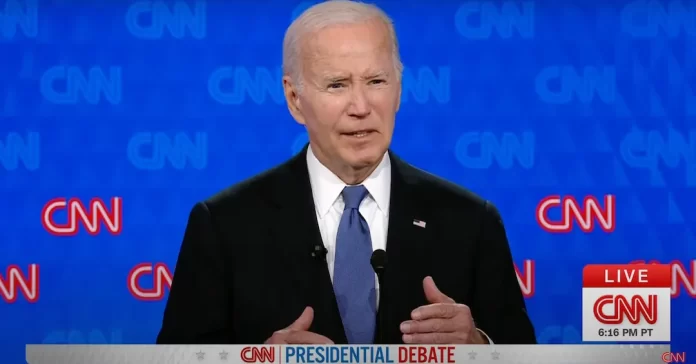
It’s very revealing how everybody’s focusing on what Biden’s dementia-addled debate performance says about his ability to win re-election instead of on the fact that the current, sitting president of the United States has dementia.


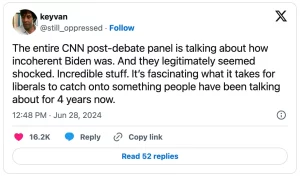
If you were lucky enough to have missed the debate, Biden was so confused and zoned out that not only did CNN’s audience overwhelmingly say Trump won while the word “dementia” was sent trending on Twitter, but it was also uniformly acknowledged to have been a horrifying catastrophe by Democratic Party operatives and liberal media pundits, who are now widely suggesting that the president should withdraw from the race.

But the conversation has almost entirely revolved around Joe Biden as a presidential candidate, with relatively little attention going to the fact that this person is the president right now. Everyone’s talking about whether Biden can assure American voters that he has what it takes to be president, and nobody seems all that concerned about the fact that he is already president and will remain so for half a year.

What this suggests is that people already kind of know on some level that the president of the United States doesn’t really run the United States, but are still mentally compartmentalized away from this reality enough to care who wins the presidential election. 

If people really believed the president runs the country, they’d be freaking out that Biden in his demented haze might order an attack on the Soviet Union or nuke Libya to kill Muammar Gaddafi or something. They’re not worried that this will happen because they know their government is actually being run by unelected empire managers from behind the scenes, and that Biden is just the official face on the operation.

So in order to hold their mainstream worldview together, liberals are simultaneously straddling the two completely contradictory concepts that (A) it doesn’t matter who the president is because the country is actually run by unelected empire managers, and (B) that Biden’s debate performance was very concerning because it means Trump will become president. 

If they let go of (A) then they’re no longer in the mainstream worldview where their country works how they were taught it works in school, and if they let go of (B) then they’re no longer in the mainstream worldview where presidential elections are super duper important and all their country’s problems are the result of Americans voting incorrectly. So they straddle them both and try not to think too hard about the obvious contradictions between them, in order to avoid the crushing cognitive dissonance they’d experience if they looked at them too closely.

In reality the US empire has marched along in all its usual depravity despite its official leader having Swiss cheese for a brain this entire time. They got their genocide in Gaza and their world-threatening proxy war against Russia, as well as China policy that is vastly more hawkish than that of Biden’s predecessors. The imperial murder machine hasn’t skipped a beat in its nonstop campaign of steadily increasing global tyranny.

This has happened because US presidential elections are fake and the results don’t matter. It wouldn’t matter if Americans elected a labrador retriever or a bottle of Tabasco sauce; the empire would roll forward without the slightest interruption. The wars would continue. The economic injustice would continue. The surging authoritarianism would continue. The oligarchy and corruption would continue. The ecocidal capitalism would continue. The imperialist extraction would continue.

US elections are just a diversion to keep Americans from pushing for real change in ways that pose a meaningful challenge to power, and Americans already kind of know this. The sooner they stop compartmentalizing away from this fact that they’re already dimly aware of and face reality, the sooner they can start bringing health to both their nation and the world.


Green Wizardries, Pancakes as Social Glue

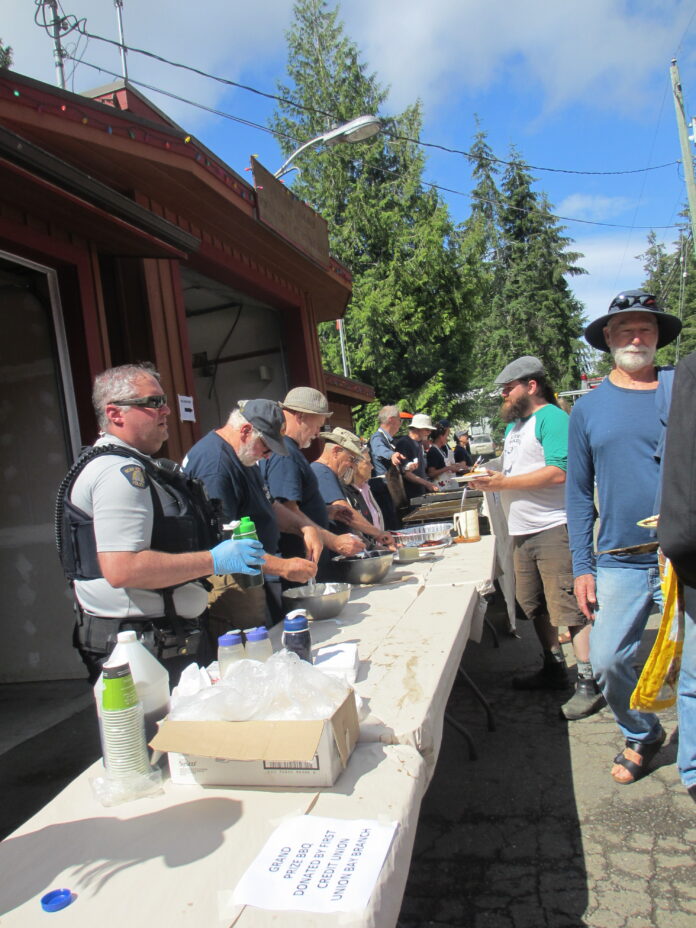
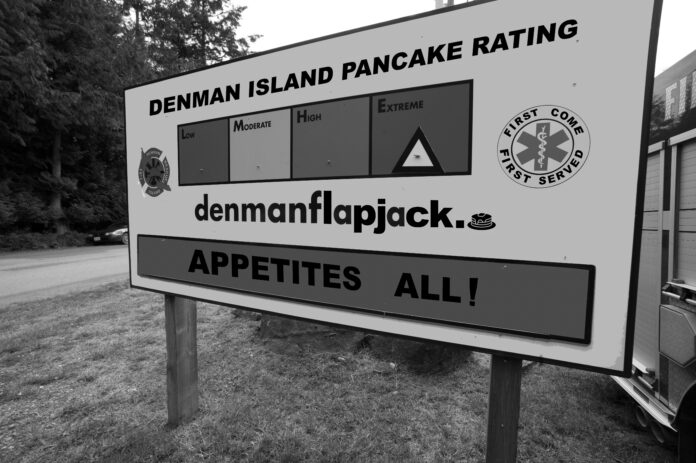
Eating together and working together are the two most potent ways I know to create community.  The Denman Island Fire Department’s Annual Pancake Breakfast on 30 June was a great success as they had the whole Fire Department out there working together to provide a meal for hundreds or more.  This was a great logistical exercise and the experience the Fire Department members acquire will help any of them if they ever need to set up a refugee camp.  

I hear you say, “When are we ever going to need a refugee camp here?”  Well, we have been terribly lucky for a great many years but it only takes some hot, dry weather, a bit of wind and a carelessly-dropped cigarette and a great deal of the island could go up in flames, including a lot of dwellings.  Then, we will need some sort of a camp for the displaced people.  I too hope this does not happen, but it could.

I went up to the event about half-past ten and was surprised to see no line-up worth mentioning.  I think a lot of people try to get there early to avoid the crowds and huge line ups. The first people I met coming away from the breakfast were two ladies and a small boy.  The younger lady grew up here as a little kid and has fond memories of the Pancake Breakfast.  She was delighted to be able to bring her little child to experience it. She laughed and said, “They must have a test for everyone who joins the Fire Department to make sure they can all make pancakes before they are accepted.”  I asked how she liked the pancakes and she pronounced them, “Delicious.”

Next, I caught Sam Croome, showing off the Fire Rescue vehicles. I asked him what he liked most about the Fire Department and he replied, “Bacon!”  What really keeps him serving in the Fire Department is the continuing education they offer. Sam feels that learning different things keeps the brain from atrophy.

The next person I interviewed was Darius the carpenter.  This is only his second pancake breakfast as he moved here, had one pancake breakfast and then Covid 19 hit and that was the end of social gatherings for a while. I asked him if he was interested in joining the Fire Department and he said he would love to join but his wife wouldn’t like it as they have small children.  He feels serving in the department would mean too much time away from home.  “When my kids are a bit bigger, then, I might join.”

I spoke with Kasian Russel, a valuable young man, what he most liked about his service in the Fire Department.  “The experiences and the people.  It is a lot of fun.  I get to learn a lot and work in the community.”  Kasian will soon be seventeen and has already finished the First Responder course except for the final exam.  He plans to do all the training he can with the Fire Department as a means of self and community improvement.  

I chatted with Helen Wilson and she finds the Fire Department to have a lovely community spirit.  “When push comes to shove, they are excellent about what they do.  The get the job done and work hard on professional development.”  Helen also appreciated the line up for pancakes being in the shade this year.

Erika Bland said she likes all the smiling faces at the Pancake Breakfast and she shared with me her appreciation for the generosity of the Fire Department.  If they raise more funds than they need, they share the surplus with other community groups.

Scot MacDonald was there, looking very dapper in his uniform tee-shirt and kilt.  Scot is a retired soldier and what he likes best about the department is the sense of family and the really good training. 

Everyone seems to rave about the training at the Fire Department which must be a great satisfaction to Jamie Prowse who is the Training Officer.  

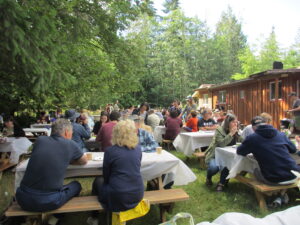
By this time, I was at the picnic tables which were full of happy people tucking into pancakes.  I asked a couple of ladies what they thought of the breakfast and they said, “Very good!  Fantastic.  They love it that we have a Fire Department here on the Island and found the Fire Department members both friendly and efficient.  

I talked to another local lady who said she thought this year’s event was even better than last year’s event.  “They didn’t run out of bacon and  they seemed even more efficient than last year.”  

In 2023, despite heroic efforts of the part of the Firefighters, they were not able to serve the promised gluten-free pancakes.  This year, they got ahead of that issue by buying a new grill specifically for gluten-free pancakes.  They also use it to cook the vegan meat which I hope is gluten-free too.  

I would call this year’s Pancake Breakfast, an unqualified success.  

Can We Fix What’s Broken?

Regardless of all that is presently unfolding in the wider world of politics, industry and money, underneath it all, when the chaff is cleared, if we wish to advance the collective cause, a reckoning must be made with the origins of the human state. In particular, it is imperative to investigate and come to an understanding that Love – in its phenomenal form, not the cliche variety – is in fact the generative form of Light. This is the very phenomena that many ancient esoteric disciplines say drives human consciousness, awareness and existence. Some of the most deep-thinking and profound spiritual belief systems have this notion at the core in some form or another: that love is the driving essence of creation and a compelling force that, at its truest, is called light. By virtue of this perspective, the force of love is thought to be generative because it, like all else, is a product or result of energy and intention in its purest form. 

For lack of proper definition, consciousness is thought to be a product of quantum electromagnetic impulse or energy, the source of which humanity is still largely oblivious – the very reason we are still stuck between clinging desperately to money as the prime driver, rather than adopting an informed grander notion of our inclusiveness with the natural world. 

According to the Law of Conservation of Energy, energy never dies, it only transforms – it undergoes a change in composition or structure, or changes its outward form or appearance, a fact with which the purveyors of ancient wisdom also agree: that energy does not dissolve or waste away, it only transmutes (changes in form, nature, or substance). This notion is said to inform the essence of consciousness as well – an “awareness” energy that is a product of the impelling force of creation – that is compelled to expand and evolve to its highest potential – just as all life on the planet has been shown to do via biological imperative and species evolution. 

“Electromagnetic field theories (or “EM field theories”) of consciousness propose that consciousness results when a brain produces an electromagnetic field with specific characteristics. Johnjoe McFadden, an Anglo-Irish scientist, and Professor of Molecular Genetics at the University of Surrey, United Kingdom, suggests in his theories that “digital information from neurons is integrated to form a conscious electromagnetic information (cemi) field in the brain. As such, consciousness is suggested to be the component of this field that is transmitted back to neurons, and communicates its state externally.” Again, with respect to the field McFadden alludes to, it is, as yet, nebulous and beyond reach of empirical/traditional science. This all suggests to me that we are not a random result of chaotic principles as empirical science has proposed, but that we are the result of a compelling force of consciousness and creation that is not “other than” but is within and subject to its impelling force. Our present state is very much a result of cause and condition.  

All else is, in terms of principles and beliefs, largely contrivance and conceptualization – an imposition of observation and meaning in order to make sense of the world. The struggle for the dominion of modern perspectives and ideologies is the very crux of what now faces humanity in almost every facet of human perspective. Whether it be the Sword of Damocles or the salve that heals, prevalent theories and ideas about how we conduct ourselves, is a product of ingenuity, imagination, perception, perspective and belief that is shaped by cultured learning and belief systems that emerge over time. Lack of careful, mindful scrutiny of what we adopt or what is imposed upon the human mind has driven human culture to walk a razors edge of which the cost may be too much to bear if a concerted effort is not made. Virtue is in action. 

By the virtue of mind, we perceive, comprehend and conceive, then, by virtue of hands, feet, eyes, voice, and mind, we create. The prior mentioned spiritual and utilitarian ideologies hold that the essence of human existence is in fact our ability to imagine and create. The result of our combined efforts with respect to culture and socialization is the physical reality and the belief systems that we bring about by virtue of this ability. 

Can we fix what’s broken? When the physical reality and the beliefs and things and the doings within it are created from the centre point, where love is the guiding principle and the prime driver, a reasonably fair and balanced system could evolve. However, for the most part what we have now is the product of systems within systems that are created and driven purely by undisciplined or misaligned human ego, and fuelled by covetousness, greed, desire, and a system that itself is designed to flourish when those principles are applied to varying degrees of result.  

During the 1950s, a group of Japanese primatologists documented a troop of Japanese Macaque monkeys on the island of Kojima they say had demonstrated what appeared to be a unified consciousness effect. They had noted in their research that a female monkey in the group had figured out that if she washed the sweet potatoes they were consuming in water before eating, that younger monkeys in the troop were quick to mimic the behaviour. Eventually the majority of the troop had adopted the skill, except, apparently, the older monkeys in the group, who did not. Shortly thereafter, observations were made in monkey troops on nearby islands who, it was said, had mysteriously learned the behaviour despite no apparent direct connection. Thus the hundredth monkey phenomenon. From this study, it was suggested that once a certain, though unidentified number, had picked up the skill, it had the potential to enter the collective consciousness and become a common link in nearby troops. There are, as always, detractors of the theory, but efforts to disprove the idea seem to lack teeth to altogether dethrone the 100th monkey phenomena. Whether a tendency toward conscious transmission over distance, or whether, as was also proposed, a monkey had swam to the islands and spread the knowledge, is not likely provable. The point I’m making is that recent discoveries in quantum physics, molecular genetics, and on the fringes of medical science have begun to reveal that field theory is a reality – not a concept. The dynamics of consciousness may well link humans not only within their kind, but to the larger reality inclusive of all life on the planet. In this way new ideas and ways of doing take on a life of their own. Thus, they have the potential to transform the nature of human consciousness and the reality we choose to create. 

I propose a deeper discussion about the state of things, and the erosion of democratic, fair-minded principle we are presently faced with. To help create what Freud might have called a bulwark of necessary origin, I believe as story tellers and chroniclers, it is imperative to connect and expand in some form or fashion – perhaps like the mycelium in the forest, which connects all trees across a given landmass, where it has not been broken by human ingenuity. 

When we impose past belief systems that haven’t worked upon new situations, the result will always be the same. There comes a point where old belief systems must be changed, improved and evolved to better result. This is about how we might fix what’s broken. 

Letter to the Editor – Oakley Rankin

Letter on EMI

Having just returned from five weeks in Quebec I am going through mail piled up during my absence in which there are half dozen copies of the Grapevine.  In the issue of May 23rd I ran across a letter from Leif LeBaron questioning a technical matter in my article (May 16th) addressing Will Thomas’ earlier screed (May 2nd) in which Will advised everyone to have CityWest disable all household WiFi and rely only on direct cable connections for your devices.  LeBaron took issue with this sentence I wrote: “This at the very time most of us are using portable devices which cannot be cabled.”

LeBaron quite rightly took me to task for suggesting that portable devices cannot be cabled.  Of course they can and my definite ‘cannot be cabled’ is quite rightly interpreted as an untrue claim so I plead guilty to failing clarity on what I actually meant.  The operative word in the sentence for me was ‘portable’ so I should have worded it something like this: 

“Manufacturers are building and consumers are purchasing portable tablets and phones in droves and these portable devices are not meant to be continuously attached by a cable.  They are designed and used to be portable; no one wishes to trail a cable behind them; they just want to pull the device out of their pocket wherever they are and begin to use it.  Thus these devices, which currently far outsell desktop and laptop computers, depend on either WiFi or cellular radiation for portability along with whatever EMI such broadcasters emit.”

LeBaron mentions several methods of cabling devices “all in a compact case with a short cable”.  Anyone with grandchildren knows that the last thing they want is a ‘short cable’ connecting their phone or tablet to a modem.  Manufacturers know this as well which is why the most common way of cabling a device to a modem, an ethernet cable, has no ‘port’ built in to any of the millions of phones and tablet sold.  These products are not meant to turn the consumer into a detail techie who knows all about ‘dongles’ and various ports; they are meant to be portable right out of the package and that is exactly what people want and how they use them.  My point was not the very narrow technical one that LeBaron addressed; it was a cultural one of the widespread acceptance of portable devices that do not have to be cabled.  Having just spent five months in a household of five—who all work from home—with four desktop computers, about five laptops, two wireless printers, five or six phones and a few tablets I can attest anecdotally that only the  desktops were cabled; the rest were used with WiFi and those using them would be outraged at the suggestion that they connect these devices with a cable to the single WiFi box in the basement or the secondary router.  I am not a fan of portable computers and I cable nearly all my home devices but my partner does like her tablet and would not want me to start drilling holes through the floor to install a 40 foot cable connecting to the downstairs modem.  But in my article I did fail clarity on this point, as so many writers do when they attempt to second guess the reader’s cultural knowledge.  So, as we all should, I will strive to avoid ambiguity in any future articles.

As for his interpretation of my attitude as ‘conflating EMI with psychosomatic illness and ‘bogus diagnoses’’, I did not use the word psychosomatic anywhere in my article and I did not write of ‘bogus diagnoses’; that phrase was part of a web address to which I referred, it was not a contention of mine.  To paraphrase LeBaron, ‘In contradiction to claims of massive health risks from EMI, a large body of evidence exists, there to be seen, by those who choose to look.

Oakley Rankin

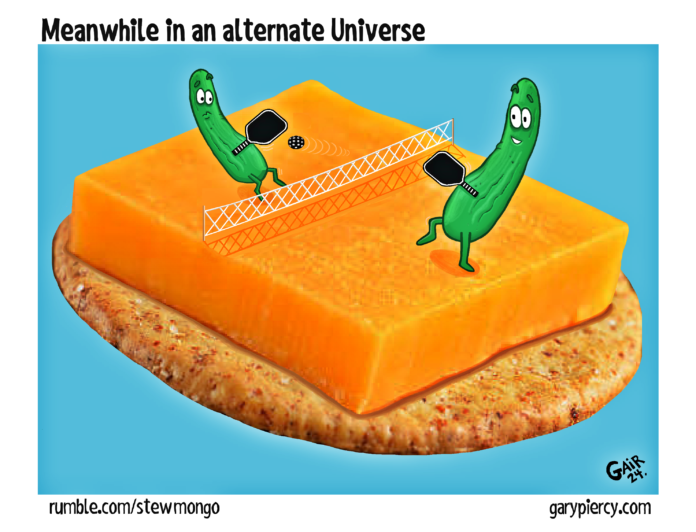
pickle ball

Hell, Maybe ANYTHING Is Possible

Listen to a reading of this article (reading by Tim Foley):

The thing that stands out for me the most when watching the deeply moving footage of Julian Assange arriving home to Australia is how impossible this all felt until it happened. 

If you’ve been following this case for a while, you know what I’m talking about. This was the moment you’d dream of in your quiet, private moments, but could never fully allow yourself to believe would actually happen.

It was very easy to imagine Assange dying in a prison cell, either in the near future at Belmarsh or further along the timeline in some US hellhole. It was possible to imagine him getting out many years from now, his children fully grown and half his life stolen away from him. It was even possible to imagine him getting out one day on some legal technicality or whatever and living out the rest of his life in a nation that has an oppositional relationship with Washington like Edward Snowden, maybe. But coming home, to Australia?? No chance.

And yet there he is. It happened.

It’s easy to get so lost in all the emotion and controversy and discussion about the details of Assange’s case and his plea bargain that you forget to appreciate the fact that an impossible thing just happened. That this was a historic event which very few of us believed was ever going to occur — until it did.

And I don’t know about you but I personally find this all rather humbling. I never voiced my dark pessimism about the future of Assange’s plight publicly because it’s important to push hard for victory even when the odds appear stacked against you, but I honestly did not believe what just happened was going to happen. And I was completely wrong.

Which makes me wonder, what else have I been doing that with? What other battles that feel almost futile right now will one day make a fool of me by yielding an unexpected victory? 

Hell, maybe anything is possible. Maybe what just happened with Assange can happen with any of the other injustices and abuses we see in our world today. Maybe it can happen with Palestine. Or with the build-up to war with Russia and China. Or with the corruption, opacity and malfeasance of our own governments. Or with the empire itself. Or with capitalism entirely.

Maybe we really do win this thing. Maybe that’s not a pipe dream after all. As with the Assange case it might not happen in the most grand and egoically satisfying way we’d want it to, but what does? This isn’t a Hollywood movie, it’s real life. Real life doesn’t move the way Hollywood conditions us to expect it to. Real life produces anticlimactic victories and mundane miracles. And it moves in ways that the ego cannot anticipate.

It’s comfortable to be jaded and pessimistic. You feel less vulnerable. You look cooler. You don’t have to deal with the emotional work of disappointment. And admittedly, you are very often proven right. That is, until you’re not. 

And maybe that’s not the most authentic way to come at this thing. Maybe it’s better to throw ourselves into this fight not just believing we might win, but knowing that we will. Maybe all that pessimism and reservedness is holding us back from really swinging for the fences and leaving it all in the ring. And maybe it’s based on completely false assumptions about what we’re actually capable of anyway.

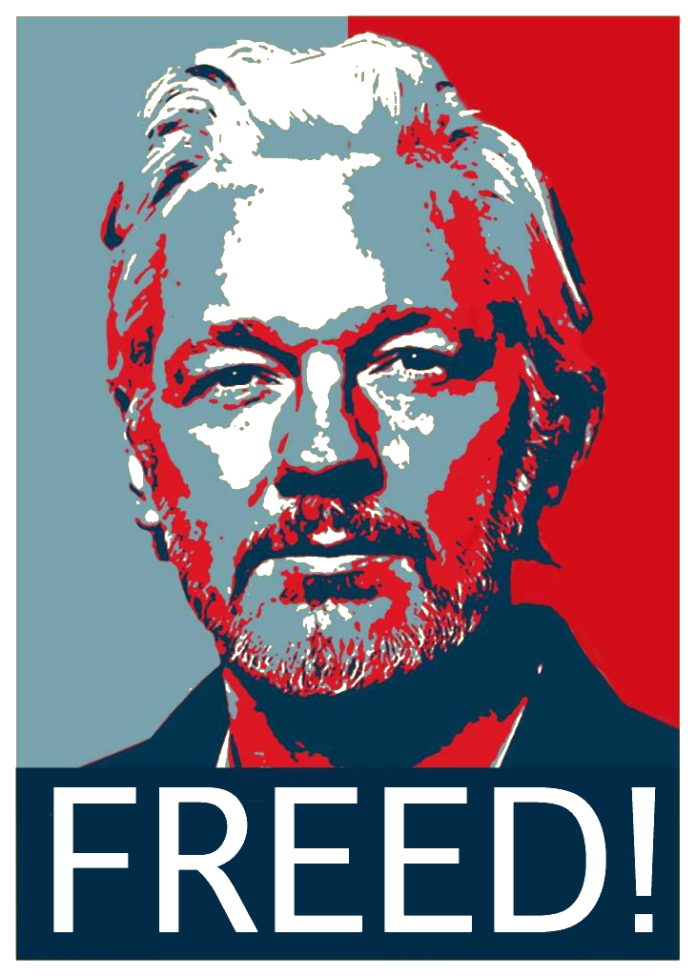
Assange has been freed. Maybe all of humanity can be.

______________


Bitcoin donations: 1Ac7PCQXoQoLA9Sh8fhAgiU3PHA2EX5Zm2


A Kid’s Guide to Plants of the Pacific Northwest by Philippa Joly: A Finalist for the 2023 SWCC Book Awards!

Philippa Joly has been declared a finalist for the Child and Youth category of the Science Writers and Communicators of Canada 2023 Book Awards for kid’s nonfiction book, A Kid’s Guide to Plants of the Pacific Northwest. The SWCC has been recognizing and honouring outstanding contributions to science writing for over 20 years. The winners will be announced on the SWCC website during Science Literacy Week in September 2024. Harbour Publishing’s Amanda Swinimer was also recognized on the longlist for her book, The Science and Superpowers of Seaweed: A Guide for Kids.

A Kid’s Guide to Plants of the Pacific Northwest is a middle-grade-friendly introduction to Pacific Northwest flora, with outdoor activities, games and quizzes that make learning about nature fun. With the increasing intrusion of technology into daily life, and the challenges of climate chaos, it has never been more essential for parents and educators to encourage kids to engage with the natural environment. The book contains plants from the forest to urban areas where parks, empty lots and backyards can offer the opportunity to learn from and connect to nature, increasing children’s self-confidence, independence, attention span and physical well-being, while fostering care for the environment. The book was awarded the Silver Medal in the Moonbeam Children’s Book Awards (2023), and longlisted for the AAAS/Subaru SB&F Prize for Excellence in Science Books (2024). 

Philippa Joly is a clinical and community herbalist, paramedic and outdoor educator. She runs an outdoor school for kids and leads workshops on herbal medicine, plant identification, ethical wildcrafting, herbal first aid, local healing plants and anticolonial approaches to wellness. She lives on Denman Island, BC with her plant-savvy daughter, Breah and their grey cat.