

facebook.com/markprior.images
Kaimerata Summer Chamber Music Festival 2026 on Denman Island “Schubert Meets Beethoven!”

Kaimerata Summer Chamber Music Festival 2026 on Denman Island
“Schubert Meets Beethoven!”
We are back this summer for our 12th season with three concerts of musical masterpieces. Ludwig van Beethoven and Franz Schubert lived in Vienna at the same and despite Schubert’s enormous admiration for Beethoven, they never met. We wish to right this wrong this summer, on Denman Island, for you! To be performed are some of the greatest chamber music works ever written: the Schubert’s Trout Quintet, the Arpegionne Sonata, the Cello Quintet and Beethoven’s Archduke Trio, the Spring Sonata, the Opus 111 Piano Sonata and one of the great late String Quartets.

For those who don’t know about the Kaimerata Chamber Music Festival on Denman Island, here is your chance to have a little taste of yet another hidden gem of our island. The core of the Kaimerata ensemble is a European-based internationally acclaimed violin/piano team, Kai Gleusteen and Catherine Ordronneau. They will be joined by a Kaimerata regular: Beth Root Sandvoss on cello and her two incredibly talented children, Tilman and Sabina Sandvoss, both at the beginning of their exciting careers.
The summer festival, with three concerts programmed for August 7th, 8th, and 9th. The mission of the Kaimerata Concert Series, which originated in Barcelona, Spain is to increase the understanding and appreciation of one great composer at a time. This year’s festival combines two! In a friendly, accessible, and spontaneous fashion, Kai will present the works, talk about Beethoven’s and Schubert’s lives, and have his colleagues join him in world-class interpretations of this exquisite music.
Tickets and information for the summer festival on www.kaimerata.com. Tickets also available at the door. Adults $30. Students $15.
August 7th at 7:00 p.m. Trout Quintet and Archduke Trio
August 8th at 4:00 p.m. Arpegionne Sonata and Beethoven’s Opus 132 String Quartet
August 9th at 2:30 p.m. Opus 111 Piano Sonata and Schubert’s Cello Quintet
SAVE THE DATE: FREE Tax Clinic Returning to Hornby & Denman Islands
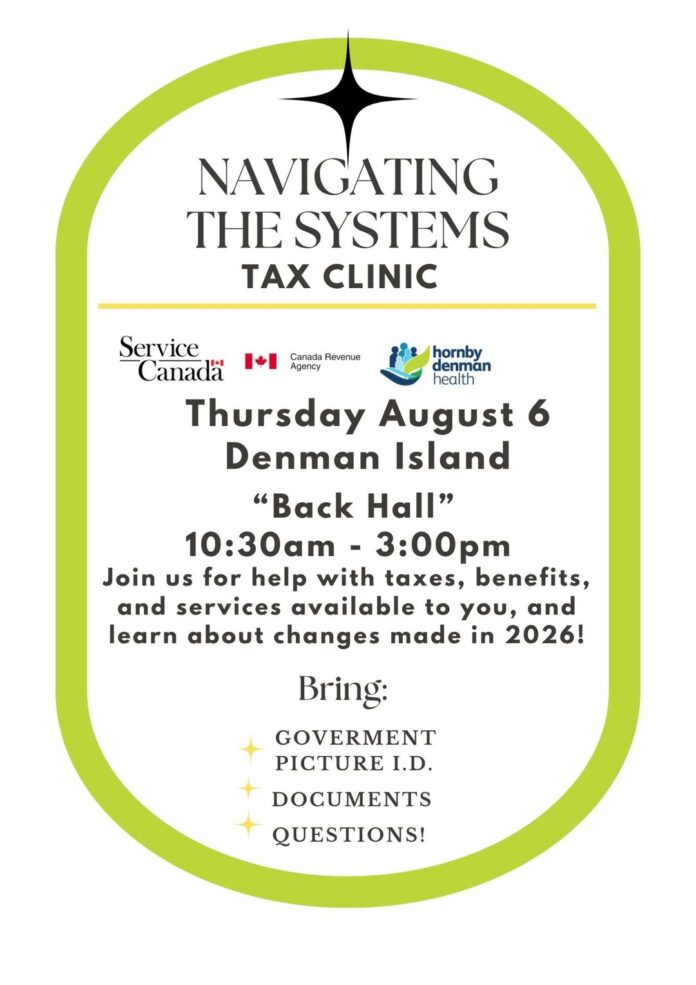
SAVE THE DATE: FREE Tax Clinic Returning to Hornby & Denman Islands
If you missed the chance to speak with CRA and Service Canada representatives during the “Navigating the Systems” event in March, the SUPER TAX CLINIC is making its way back to Hornby Island on August 5th and to Denman Island on August 6th. The clinic brings IN PERSON support and advice. They can print missing tax slips, answer benefit questions, and assist in filing personal taxes. This summer, the GST/HST credit gets replaced with the Canada Groceries and Essentials Benefit (CGEB), which increases credit payout by 25%. If you do not have your taxes up to date, you will not see this payout. So take a break from the sun, and get it DONE this summer! **Please note: while the clinic may be able to answer questions on self employment, they may not be able to file taxes for those who are self employed with their own business. Below are some of the services provided:
CRA:
• Tax Slip information (T4, T5007, T4A -Pension, T4A- OAS and more)
• Notice of Assessments (NOAs) and Assistance with CRA correspondence
• Benefits and Credits information: Disability Tax Credit (DTC), Canada Child Benefit
(CCB), GST/HST credit changes, Canada Worker’s Benefit (CWB)
• Account updates (address, contact number, etc.)
Service Canada:
• NEW Canada Disability Benefit – Information and Application
• Canadian Dental Care Plan – Information and Application/Attestation
• Pension information on Old Age Security and Canada Pension Plan
• Get a Social Insurance Number (birth certificate in most cases will be required)
• Receive an access code to sign up for online My Service Canada
• General Government of Canada information
It is important to bring government issued ID and if you already have your NOAs and tax slips, it will save you time. This will be a one-on-one service, on a first come, first served basis. If you have all your information but need help getting your taxes done, limited volunteer tax filing will be available on premises, after checking in with the CRA rep first. This event is coming up soon, so save the date!
Wednesday, August 5th Hornby Island 10:30am-2:45pm at Joe King Park
Thursday, August 6th Denman Island 10:30am-3:00pm at the Denman Back Hall
If you have any questions, contact Lleilah @ (778) 585-4585 or lleilah@hornbydenmanhealth.com
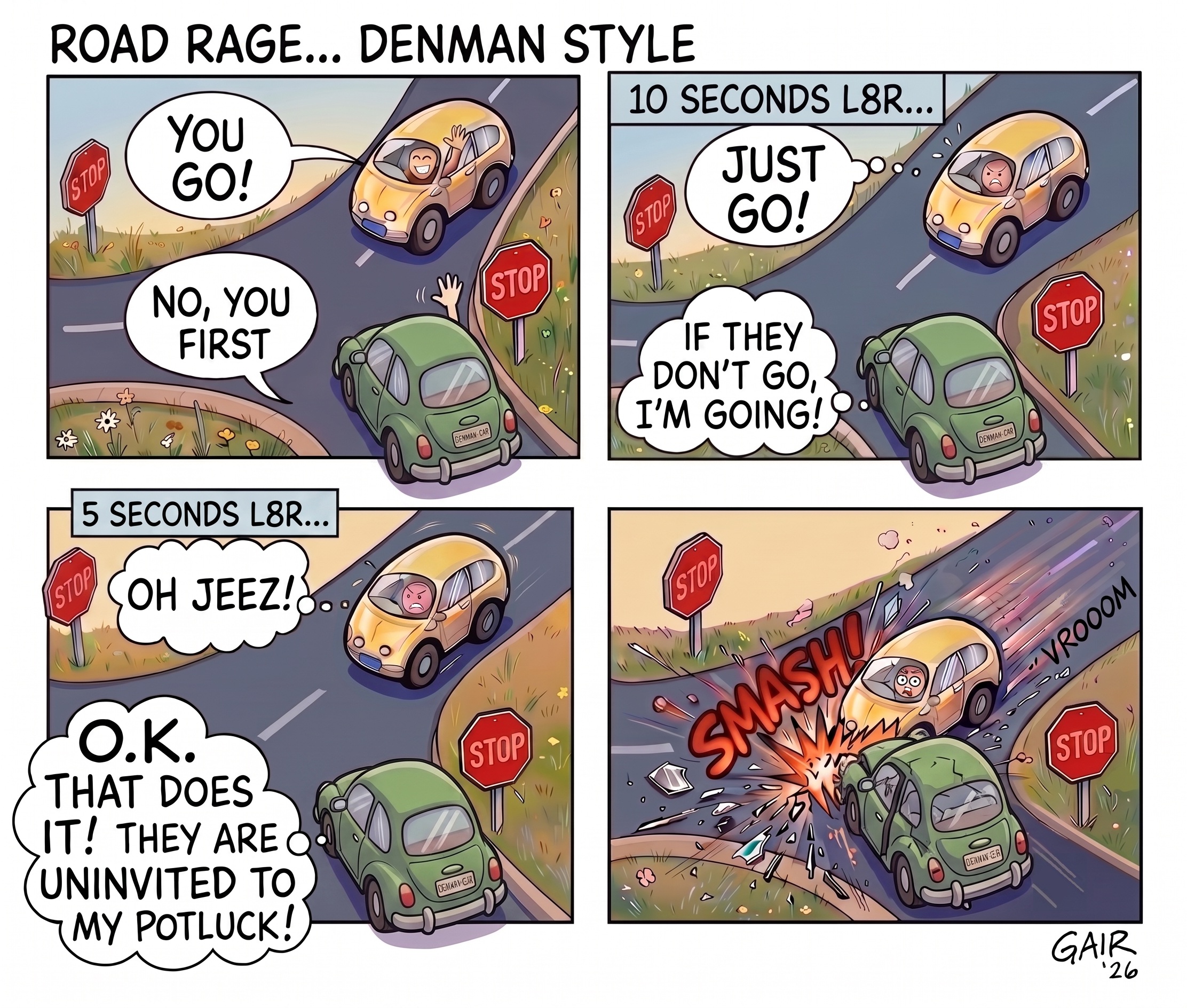
DIRA and DenmanWorks?

DIRA and DenmanWorks?
By Cylon 2036 We/Us
There was a time when “public consultation” meant asking people what they thought before making a decision. That was adorable. Today’s local tax-funded institutions have refined the process into something far more sophisticated. The decision is made first, then the public is invited to participate in the exciting tradition of discovering why it was inevitable. This is known as engagement.
The modern consultation begins by cheerfully announcing that your opinion matters. The local institution proudly proclaims that “information has been made publicly available.” Indeed. Transparency and accountability have apparently become estranged cousins who no longer speak to one another.
Transparency used to mean making things easy to understand. Now it hides in plain sight while explaining even less. This counts as informed consent. Then comes the public consultations, following the announcement of Chair appointments and budget allocations, while the timeline has already been approved.
Questions from residents are warmly welcomed. Answers, however, are another matter. Questioners are thanked, comments are appreciated, concerns are acknowledged, responses are compiled, clarifications are under review, while additional information will be available at a later date. The vote is then taken.
One cannot help admiring the efficiency. Why spend time educating residents before asking them to vote, when you can simply educate them afterward about why the outcome was always the correct one? Nothing calms disappointment quite like retroactive explanations.
This approach has several advantages. First, it saves time. Second, it minimizes awkward public debate. Third, it eliminates the risk that informed citizens might suggest alternatives before tax dollars become invested in a single plan. Flexibility is now considered overrated.
Institutions often reassure residents that “we’re listening.” No one doubts this. Listening has never been the problem. The challenge has always been what happens immediately afterward. Listening, it turns out, is entirely compatible with continuing in exactly the same direction regardless of feedback.
Every proposal contains the comforting phrase, “Please share your thoughts.” It rarely contains the option to reject the premise of the entire project. Instead, participants are invited to rank their enthusiasm for predetermined outcomes.
“Perhaps everyone should slow down for a moment and explain what we’re actually doing” is not an option. That option was eliminated during private discussions about efficiency. The local institution later reports that “public engagement demonstrated community support.” And then the proposal proceeds exactly as planned. Coincidence is a beautiful thing.
Perhaps the greatest achievement is the invention of procedural transparency. Everything hides in plain sight. Every meeting time is made public, on short notice, and with little information available in advance. It is all perfectly visible, much like a submarine with glass windows. You can see everything, but just can’t get inside before it leaves the harbour.
When public trust declines, local institutions claim that they don’t understand why there’s not greater participation in local governance. The irony is exquisite. Perhaps this is all a misunderstanding, and the phrase “public consultation” has simply been redefined. It no longer means asking citizens what should happen, but instead informing them of what has already been decided.
The meeting minutes will read: “Thank you for your valuable input.”
Raven & Raccoon Proof your Garbage
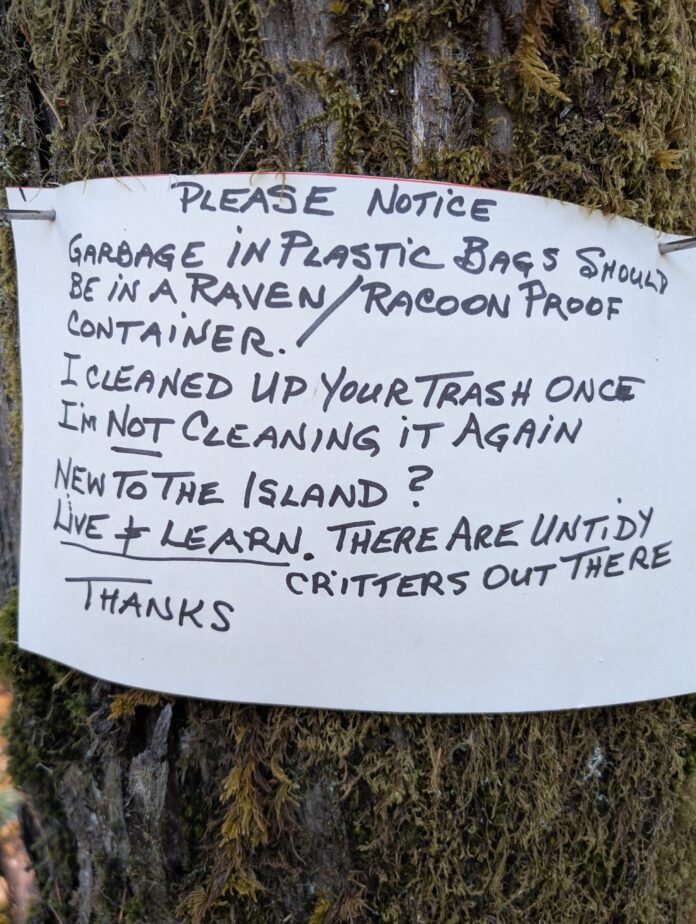
Thank you to the Denman Island residents who created this sign. We have included it in this publication as a reminder to everyone to put garbage in critter proof containers. Other conditions include a sticker ($2.50) which may be purchased at the general store or the recycling depot and a maximize weight of 40 pounds per bag.
The Waste Management Committee will be on the agenda for the next Denman Island Residents Association meeting on Monday, August 10 at 7:30 in the back hall. Change is afoot.
For more information: https://denmanresidents.com/waste-management-committee/
Informing Institutions

Informing Institutions
===================
I know I’m not alone in feeling relatively inconsequential against institutional behavior. After more than three years of simply trying to resolve a particular case of damage to public infrastructure caused by a government contractor, and confronting an insidious cascade of mendacious irresponsibility, some things became clear:
– don’t let it infect you; such stress is morbid
– quantity is more effective than quality
– activate elected representatives and hold them to it
– remain kind and civil but be persistent
Confronting institutional pathology can be discouraging and stressful, so best take measures to remain happy, healthy and strong, and work to raise awareness in the community rather than doing it alone.
Irrefutable evidence and clear documentation be damned when quality is subordinate to quantity. In other words, one person making a comprehensive and coherent case is more easily ignored than many people simply saying “stop that!” (i.e., especially from many distinct individuals, in contrast to petitions or other centralised approaches). It’s also enough to simply register opposition, without justifying position or explaining rationale. Details can be discussed once dialogue has opened.
Futile as it may seem, we still have people in office who are paid to listen to us and act on our behalf, and they are likely more fluent in the language of office. Best concentrate on those who wish to be reelected.
Persistence is essential, and empathy; to remember that real people exist inside the impersonal, and often offensive, Kafkaesque machinery.
For example, the BC Government betrayed due process and community trust in recklessly executing questionable “improvements” to Tribune Bay campground on Hornby. Denman is also affected as water is trucked bi-weekly from Vancouver Island to irrigate poor decisions on Hornby. One hopes that even the BC Government is upset by the results, but it should not be surprising that an industrial contractor from Alberta might be a poor choice to construct a campground in a rural community on a small island in a coastal environment.
In any case, considering the significant opposition, how did it happen and what about Phase 2? Instead of leaving it to others to confront the bureaucratic bully, and waiting until the damage is done, here’s to personal responsibility in proactive protection and prevention!
“Tribune Bay Park is a jewel in B.C. and people are drawn to this area to experience the natural beauty,”
Tamara Davidson, Minister of Environment and Parks
250 387 1187
Further reading (thank you, Petra!): tribunebayecosystem.wordpress.com
The proposed expansion at Gravely Bay was successfully halted thanks to the people who protested in number and in person.
The Book Report

Book report 13
By A. Bae Hel
 No Friend to this House
Natalie Haynes
Greek myths are currently enjoying a spotlight in current entertainment due to the recently released movie of Odysseus and the upset and outrage over the casting. Apparently, there is a right way to cast fictional mythical characters and a wrong way to cast them and the people who have never read Greek myths know the right way. I love the wounded outrage over mythical characters portrayal.
Enter Medea. This is the telling of her story, not Jason’s. Not the Argonauts. And it is not Euripides’s story. The telling is broken into parts told by the various women and goddesses involved. And animals. While the perspective is that of the women, it remains true to the canon, just fills in where the traditional male arc missed out. Medea’s tragedy is spun out with well researched detail. The author knows her Greek myths and uses that base to build an involving, richly detailed narrative about the characters. Medea is a character much more than the helper of heroes, or the woman betrayed. She is given complexity and a lot less rage than I would expect given the betrayal. But her vengeance is epic, and her decisions understandable.
The author has given us several books on Greek myths told from the perspectives of the female characters along with several non-fiction on the myths and ancient Greece. She is an excellent story teller and well worth your time. I can only imagine the outrage should someone decide to make a movie of her portrayal of the ‘heroes’ of the Trojan war.


The Women of Troy Book 1 and 2
The Silence of the Girls
The Women of Troy
Pat Barker
As I have said, I love finding reimagined fairy tales, myths and legends. The Greek myths books in the
school library were my favourites and I read them over and over, but as an old woman I want to hear
the story from the perspective of someone other than the toxic male.
These are those stories.
For 10 long years the Greeks waged war on Troy simply because a man got all pissy when his wife left
him. There is debate whether she left on her own accord, or whether she was kidnapped and raped by
Paris, but to Menalus it didn’t matter, his ego was bruised. So, for 10 years he and his king buddies laid
siege to Troy. Some say it was all plotted by Zeus to deal with over population. After 10 years of war,
you can be fairly certain it hampered future population booms.
After the Greeks destroyed Troy, they were stuck there on the land where they had set up camp
because apparently another god, Poseidon was pissed that his favourite didn’t win. These are the
stories of the women taken as slaves and conquest of war. Women whose men had all been killed.
Women handed around as honor gifts to other kings.
The stories not put in the Greek and Roman myths books in the school library. These stories are
narrated by Brisels a queen of one of Toy’s neighbouring kingdoms who becomes the prize of Achilles.
Just one of the thousands of women taken as bounty, she narrates the lives of the camp and the
conflicts post war. Women trying to navigate survival in a post war victors camp where pissing matches
continue even after the enemy is gone.
Well researched and filling in the gaps again. Worth your time
Shucking Oysters: Inhale This
Shucking Oysters: Inhale This
By Alex Allen
Remember every road trip, sitting in the back of our family cars (without seat belts on) breathing in our parent’s cigarette fumes? Remember when it was cool to smoke? Remember when they were less than $5 a pack? Different times. If coffin nails are so harmful, then why can people still buy them?
Once again follow the money. There’s nothing in this world that doesn’t have some monetary umbilical cord attached to it – even when it is inherently bad for you. The Canadian federal government obviously know that smoking tobacco is unhealthy, and yet they continue to sell darts and fags, because they make a lot of money.
Instead of just banning tobacco, come August 1st, the government has introduced more new graphic warnings that will adorn the generic drab brown (Pantone 448) packages. This is the fourth incarnation of graphic warnings since Canada became the first country to introduce them in 2001. The new images depict a range of health issues – from the dangers of second-hand smoke for children (and hello, dogs in cars, people), to diseases such as throat, lung, tongue and mouth cancers.
Did you know that cigarette smoke contains more than 7,000 chemicals? Formaldehyde and benzene, toxic chemicals used in industrial manufacturing and cyanide and arsenic, highly toxic agents that damage blood cells, to name a few.
It’s clear that the images are working on those who have never smoked and over 300,000 Canadians who smoked in 2023 quit in 2024. Data also shows smoking dropping to an “all-time low” of less than 2% for youth in 2024. Definitely not cool anymore.
David Hammond, a professor at the University of Waterloo’s School of Public Health Sciences, said the “scary and frightening” images and statistics on cigarette boxes are still having an impact. “But I will say that tweaking these warnings, changing the pictures, changing the wording, is likely going to have far less impact than other measures.”
Two of the images are being reused. One is of Barb Tarbox, a 42-year-old woman from Alberta who died of lung and brain cancer in 2003. The image shows her skeletal body near the end of her life with a cigarette still in hand, paired with the words “highly addictive.” The other is of bloody urine in a toilet bowl, “27 per cent of kidney cancer victims die within five years.” Six new messages are also being printed – in 8 point Lucida Sans Serif – on individual cigarettes, such as “Poison in every puff” and “Cigarettes cause impotence.”
In the UK, anyone born on or after January 1, 2009 will be banned from buying tobacco products as of 2027, a move aimed at preventing future generations from becoming addicted to nicotine. In Canada, the government is “monitoring measures taken by like-minded countries to reduce youth smoking,” however, they have “no plans to introduce a similar prohibition at this time.”
The Canadian cigarette and tobacco wholesaling industry made over $8 billion in revenue in 2026. The profit number would be even larger, if not for contraband tobacco, which accounted for over 38% of the 18 billion cigarettes smoked in Canada last year. In 2023-24, the average Canadian smoker paid $1,629 in tobacco taxes, with the government collecting over $5 billion in tax revenue – a split between $2 billion for the federal government and $3 billion collectively for provincial and territorial governments. By comparison, our federal and provincial governments make roughly $13 billion a year from alcohol sales. And now billions more from cannabis dispensaries.
Instead of graphic images, they should just print the amount of taxes each cigarette package is giving back to Ottawa. That might be an incentive. I quit smoking many moons ago, not because of my health but because of the price – $3 a pack. Today, a cheap pack of smokes at the store can set you back $25.
So, why can’t we just ban tobacco completely? Save a few lives and lower healthcare costs versus personal choice and lost tax revenue. Or like marijuana, people could grow three tobacco plants and roll their own. Follow the money. Canadian tobacco companies are formidable, constantly lobbying governments on issues like taxation and product regulations. Imperial Tobacco should have their own embassy in Ottawa given the amount of lobbying they participate in.
Now the tobacco industry are focusing on e-cigarette and vaping rules. Nicotine lobbying arms are heavily pressuring Health Canada, arguing that strict flavour restrictions (as in mint and menthol only, not candy flavours) push adult users back to cigarettes and encourage illegal markets. Both Rothmans and Benson and Hedges maintain that these products are a safer alternative for people looking to quit smoking cigarettes.
Research from The Johns Hopkins University published in October 2021 revealed 1,500 unique chemical ingredients in vape products, most of which are not even identified. Among those they could identify were several potentially harmful substances, including caffeine, three chemicals never previously found in e-cigarettes, a pesticide and two flavourings linked with possible toxic effects and respiratory irritation. Dr. Hassan Mir, a cardiologist and medical director of smoking cessation at the University of Ottawa Heart Institute, said some of his patients are vaping the nicotine equivalent of 100 cigarettes a day, without realizing. Safer?
Smokers often question why there are not warnings on alcohol. In fact, a bill currently before the senate is proposing adding warnings on alcoholic packaging in Canada. We will see how the alcohol industry swallows that. Why not just put the iconic BC ferry slippery surface graphic on everything? That’ll cover the basics, because isn’t everything a slippery slope these days?