
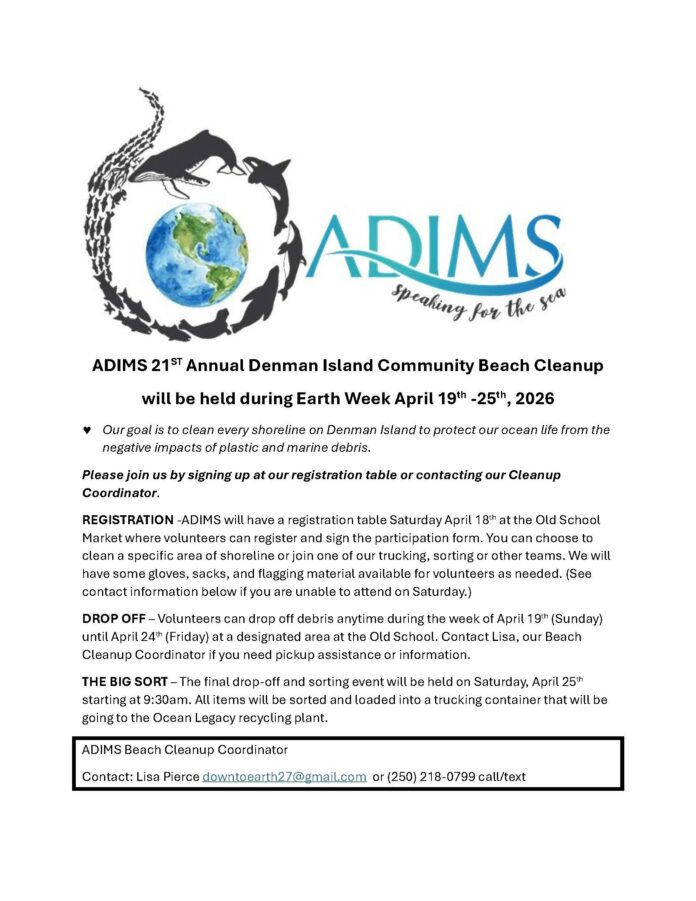
Laughter is Medicine comedy workshop and show is back!

Laughter is Medicine comedy workshop and show is back!
Have you ever imagined yourself doing standup comedy?
Are you interested in learning more about comedy and humorous storytelling as a way of exploring settler-Indigenous relationships?
Are you scared but secretly thrilled at the prospect of being on stage telling jokes to a friendly Denman crowd?
Join us!
This summer, Denman will welcome back Cherokee scholar and comedian Jeff Ganohalidoh Corntassel for a comedy workshop in May and show at the Community Hall on Saturday, June 6th.
Jeff will lead a group of us in a 4–part workshop to explore how Indigenous and non-indigenous folks express humour, to learn comedic storytelling and craft a 3-minute standup routine with the help of fellow workshop attendees and mentors. Everyone is welcome to sign up, especially youth and elders!
The newly minted comedians will then join a group of guest performers on stage at the Front Hall in a community comedy showcase on Saturday, June 6th.
The online workshop series will take place on Mondays from 6-8:30 p.m. May 11, 18, 25 and June 1. There will be a final workshop on Friday or Saturday before the show to finalize our routines. The cost is $150 for adults and $60 for youth, with no one turned away due to lack of funds.
By day, Jeff Corntassel is a member of the Cherokee Nation and the Professor of Indigenous Studies at UVic, where his research and teaching focus on “Everyday Acts of Resurgence” and the intersections between Indigenous internationalism, community resurgence, climate change, gender, and community well-being.
By night, you can find him doing stand-up at venues around Victoria, including Phillips Comedy Night at the Mint. He also produces stand-up comedy fundraisers for Indigenous communities on the frontlines, such as Wet’suwet’en First Nation, Maunakea, Hawaii, Standing Rock and others. Jeff regularly runs Laughter is Medicine stand-up comedy workshops with Mark Robertson, producer of Ratfish Comedy, for aspiring Indigenous and BIPOC comedians.
This fun and transformative workshop experience is open to Denman Island residents over 14 who are interested in developing stand up comedy skills through the lens of resurgence and reconciliation.
This event is being organized by Concerts Denman and supported by the Denman Island Reconciliation Group and the Denman Centre for Autonomous Living and Learning (D-Centre) @ the Snag (www.thesnag.org/dcentre ). To register for the workshop, contact Joan at jcdonaghey61@gmail.com
Shucking Oysters: Take a Number
Shucking Oysters: Take a Number
By Alex Allen
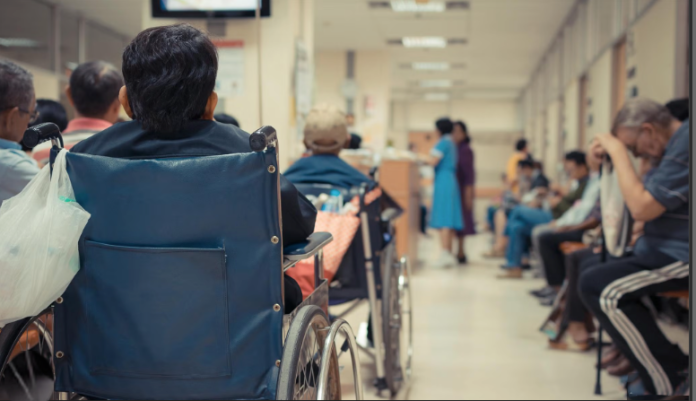
In Manitoba and Ontario over 20 hours. Quebec over 18 hours. And in BC 20 hours plus. If you think you have a medical emergency and that you will be treated in a timely manner, think again. These are average wait times at hospital ERs across Canada. Some walk in and walk out without even being seen. Too many rural ER departments in BC – Merritt, Fort Nelson, Port Hardy, Port McNeill, Mission, Delta, Salt Spring Island, to name a few– have temporarily closed or drastically reduced their hours. Is our healthcare system broken or is it yet another new normal?
“My grandmother arrived to our local hospital when she started vomiting up what looked like old coffee grinds, she waited for nearly four hours before being triaged, eventually moved into emergency where they sat her in an old vending machine alcove with a shower curtain and only checked on her when demanded. That is where she spent the last three days of her life.”
“The stories that you’re seeing coast-to-coast reflect that breaking point of the system that I think we’re unfortunately seeing manifest right now,” Dr. Michael Herman, an ER physician in Ottawa and vice chair of the Canadian Association of Emergency Physicians public affairs committee. “I’ve been doing this job coming up on 12 years now, and I think morale amongst the physicians is about as low as I’ve seen it. It’s a tough time right now, to be very frank.”
The problem is that when patients are admitted to a hospital through ER they end up staying there because hospital rooms are being taken up by patients who can’t leave due to lack of outpatient resources like long-term care or community support. As a result, Herman said, ERs are functioning “as the de facto boarding house for the hospital.”
Every emergency department strives to provide high-quality care, Herman said, but they often can’t due to system constraints. Canada had an average 2.5 hospital beds available per 1,000 people in 2023, well below the 4.2 average beds across other industrialized countries. By comparison, South Korea and Japan had 12 beds per 1,000 people.
Whether it’s trying to get an X-ray or accessing resources for Crohn’s disease, ERs are now the catch-all for every access issue in the healthcare system. “Emergency rooms become the conduit through which all these other issues flow.” None of this is new, Herman said, but now, the ongoing pressure on the system has reached a boiling point. Many people are using ERs as a walk-in clinic, as they don’t have a family doctor. Why not have walk-in clinics at hospitals?
Providing more primary care and long-term care services needs to be part of the solution, according to Herman, who also says Canada needs more doctors and more hospital beds, so staffing, training and infrastructure need to be priorities.
A healthcare ER worker in Ontario shared: “it’s a complete system breakdown from not enough family physicians, lack of walk-in clinics, limited specialists and not enough beds in acute and chronic care, the emergency departments takes the burden of everyone’s dissatisfaction. Implore your government officials to make changes starting with educating more doctors and creating more beds.”
Enigmatic BC Health Minister Josie Osborne has agreed that the situation is “unacceptable” and “alarming” for residents, pointing to the challenges of a global shortage of healthcare workers. In response, the province implemented an aggressive recruitment program, including fast-tracking US-trained physicians and nurses.
Island Health launched a website last summer giving estimated emergency room wait times for some island hospitals. In January, the government announced a Northern Health real-time emergency department wait website. Island Health, as opposed to Northern Health, doesn’t actually list wait times, but takes an average of that particular hour, that same day, over the past eight weeks. And then it updates that figure only once per day. The hospitals in Tofino, Alert Bay, Salt Spring Island, Port Hardy and Port McNeill simply say “open.”
It turns out Island Health chose a different option from Northern Health when they procured their healthcare software. Political correspondent Rob Shaw noted that BC health authorities purchasing incompatible IT systems has long been a problem. “All the different presidents and vice-presidents of the health authorities have justified their executive-level salaries by charging off to reinvent the technological wheel again and again.”
In a recent statement, Doctors of BC, which represents over 16,000 physicians, residents, and medical students, said they have been calling for the “creation of an emergency department stabilization plan” for way too long. “Physician shortages are also impacting emergency departments, and recent efforts to recruit US physicians and the new SFU medical school are certainly helpful, but more needs to be done to recruit and retain physicians, nurses, and other healthcare professionals to meet the needs of patients.”
Some physicians are calling on the BC government to expand contracts with private clinics in delivering publicly funded services. Australia has contracted with private clinics since the early 90s with great success. Additionally, the BC government could reform the way it pays public hospitals. Most public hospitals are expected to operate within a yearly budget, regardless of the level of services they provide. In contrast, more successful healthcare countries pay hospitals for the services they provide. In other words, by making the amount and level of services a source of hospital revenue, “hospitals are incentivized to treat more patients.” Quebec is already moving in this direction.
In Alberta and Ontario, the governments seem to be intentionally underfunding their hospitals so that they can slowly privatize healthcare. What direction BC takes remains to be seen, but in the meantime, when it comes to going to an emergency department, plan ahead, bring a book along, like War and Peace, and remind yourself it could be worse – you could be sitting in your car waiting for a ferry for 24 hours.
The Pseudopod Goes Shopping

The Pseudopod Goes Shopping. By Cylon2036 We/Us
Surveillance pricing marks a profound shift in how corporations operate. No longer is price determined primarily by supply and demand. Instead, it is increasingly shaped by a dense web of personal data, browsing history, purchase behaviour, and even inferred psychological traits. Corporations collaborate with AI systems and data-rich platforms to calculate what you are likely willing to pay.
At the center of this transformation are companies like Amazon, Google, and Meta, whose business models depend on the extraction and analysis of behavioral data. These firms have built vast surveillance infrastructures that extend far beyond their own platforms. This data is then fed into machine learning models capable of predicting consumer behaviour with startling accuracy.
Surveillance pricing further undermines the idea of fairness. Traditionally, the same product has roughly the same price for everyone at a given time. Now, people can be shown radically different prices for the same item, when one person has been profiled as impulsive, or less likely to comparison shop or has fewer alternatives, or where urgency can make them more vulnerable.
This is a form of algorithmic discrimination that is impossible to detect. Unlike overt price discrimination of the past, surveillance pricing operates invisibly. A user won’t know they are being charged more, or understand why. The opacity of AI systems compounds the issue as pricing decisions emerge from complex models that even their creators may struggle to fully explain.
Surveillance pricing amplifies the fundamental power imbalance at play. Corporations possess near-total visibility into the consumer, while the consumer has almost no insight into the mechanisms determining price. In such a context, “personalization” is less about serving the user and entirely about extracting maximum value from them.
There is also a broader social consequence. Surveillance pricing risks deepening inequality by systematically charging higher prices to those deemed less price-sensitive, but also potentially those with fewer alternatives, less digital literacy, or more urgent needs. In sectors like insurance, travel, and even healthcare related services, this could mean that vulnerability itself becomes a profit center.
Moreover, the normalization of surveillance pricing reinforces the expansion of surveillance capitalism as a whole. The more valuable personal data becomes for pricing optimization, the stronger the incentive for companies to collect ever more intrusive forms of information. This creates a feedback loop where more data leads to more precise pricing, which in turn justifies more data collection.
Regulation has not kept pace with these developments. Existing consumer protection laws are ill-equipped to address dynamic, individualized pricing driven by opaque algorithms. Few jurisdictions have even begun to consider rules around algorithmic transparency and data use, while enforcement remains a challenge, particularly when the practices are impossible to observe externally.
Surveillance pricing demonstrates how data mining is used as a system of extraction. It replaces the idea of a common price, with one calibrated to each individual’s perceived limits. In doing so, it obscures accountability and transforms the simple act of buying something into a negotiation you didn’t know you were having, against an opponent who knows almost everything about you.
Transparency, limits on data collection, and clear rules around pricing fairness are not just regulatory concerns, they are prerequisites for preserving the notion that a price is the same for everyone.
The Book Report

Yeah, I am hooked and all into the dungeon post apocalyptic world. Granted, I love dystopian literature, so the bar is low for my interest, but here we are.
Carl’s Doomsday Scenario,
The Dungeon Anarchist’s Cookbook,
The Gate of the Feral Gods
The Butcher’s Masquerade
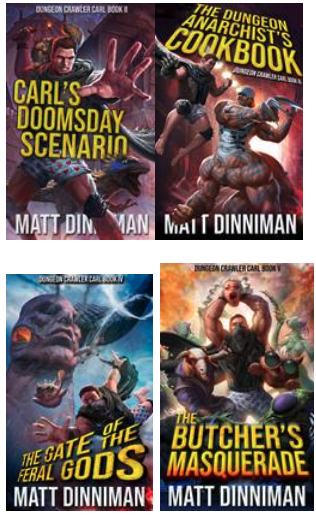
My knowledge of Dungeon’s and Dragons and Magic is really just adjacent knowledge from living with a teenage boy many years ago. If it were more a personal understanding, I would probably enjoy these books even more, but I am already hooked and enthralled, so obsession is not really needed.
The genre is a mash up of sci-fi/post-apocalypse/RPG/Reality TV show. Which sounds like it wouldn’t work. Except it does. This is where the magic of this writer makes it come alive. World building is a tough task in sci-fi, yet every book has a well-developed world and culture, along with expanding character development and secondary players. The NPC become increasingly important to the story arc and Carl’s development.
Series often eventually get to rehashing previous books with slight differences in story line. Carl and Donut however face new and increasingly insane scripts and challenges. The reality tv show aspect is getting exposed more on each level and the universe overlords are becoming a bit twitchy. It isn’t going as they scripted, or expected. HEY! Much like real life!
The latest book has such depth of complexity, ethical challenges and rage that it is built for this timeline. A book that can make you think, make comparisons and bring tears to your eyes is a book worth your precious reading time.
Yeah, these books will keep you up at night reading. Or listening. The audio version is spectacular – like a full on performance, not just a reading. If you are wondering why Carl is fighting demons, orcs, monsters and feral gods in a pair of boxer shorts, grab these read on.
5+++ stars.
I wanted to tell him to get out of my shared field of being.
Gabriel Jeroschewitz, March 28th, 2026, thoughts I had the other day about my resin
statuette friend Mrs. Death, who fell off the shelf and broke her ass
I wanted to tell him to get out of my shared field of being.
You don’t hate them. You hate what they reveal about you. The Interdimensional Lounge is where all kinds of consciousness gather to share drinks and stories. At forty-seven, thinking I’d mastered detachment, I watched as the shared field shifted with the arrival of God. Here, God wears a suit, sports a mustache, and nurses a hangover in my favourite spot in the universe.
Then they showed up.
First in was Mr. Death.
He was tall, dark, and striking in a three-piece suit that probably cost more than my childhood therapy bills. Right away, I felt irritated by him, a reaction tied to parts of myself I’d hidden away over the years with therapy and paperwork.
“Another scotch,” I told the bartender—a concept made manifest in human form.
Mr. Death ordered an existential dread on the rocks, shaken not stirred, because he had standards. I hated him. I called it a “personality clash” or “bad energy.” I ignored the truth echoing in my mind, shouting about my insecurities.
Then came Mrs. Death.
She entered the lounge, and the temperature of the establishment dropped to thermodynamic impossibilities. Mrs. Death was gorgeous enough to make the retinas of the regular patrons burn with admiration of her radiant beauty. Her eyes were a particular shade of iridescent red that emitted smoke from her sockets—delicate tendrils of ash, like cremation rituals, drifting in the air around her and smelling of expensive perfume and forgotten birthdays.
“Beautiful, isn’t it?” she commented to no one in the restaurant. “How the gorgeousness of my body warps the time-space continuum?”
I wanted to throw my drink at her. It was recognition—precise, psychological, surgical—targeting every bit of vanity that I had ever pretended to have forgotten about over time.
“Try the canapés,” Mr. Death commented, seeking to please his wife’s guest with a nod toward the decadent hors d’oeuvres that cost more than the drink orders in the lounge. “They’re made of everything you were taught was unacceptable.”
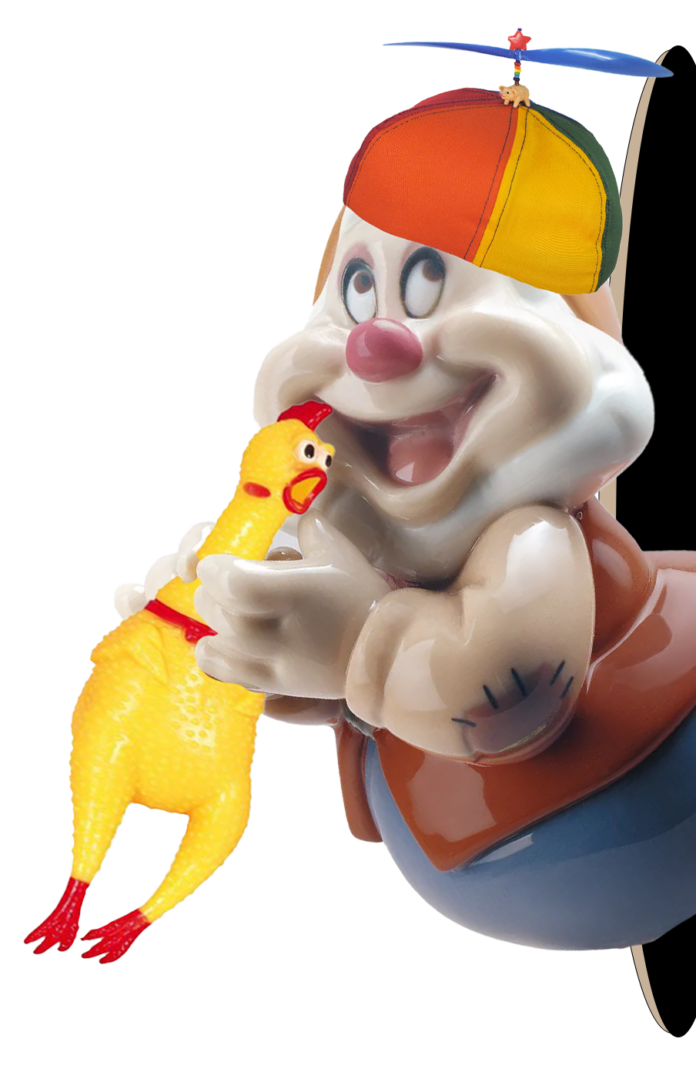
I was on the verge of replying with something cutting when my goofy dwarf friend showed up through the wall—not the door—wearing a propeller beanie and carrying a rubber chicken in one paw.
“Heya!” he shouted into the shared field of cosmic being. “Who ordered the pizza of infinite recursion?”
Short, loud, and joyously goofy in a way that made my teeth ache, my dwarf friend represented every aspect of me that I had edited out over time to appear more mature.
“Not now,” I hissed at him.
“Why so serious?” he asked me, honking the rubber chicken in his hand.
Above us floated the nude angels—the deities of universal existence—beautiful, naked, and unashamed to visit my shared field of being. Their glowing bodies indicated that they had never once googled the steps necessary to hide lower belly fat.
I didn’t want to look at them. Irritation quickly developed into rage toward these beings of existence.
“Do they bother you?” Mr. Death asked me.
They were so well-dressed, I couldn’t find the urge to tell him “no.” I hated him for it. “They’re fine,” I lied.
“They’re you,” Mrs. Death corrected me. “Every bit of desire you’ve labelled ‘inappropriate.’ Every bit of self-love you’ve termed ‘vanity.’”
The dwarf friend began juggling voids—empty spaces in the lounge filled with nothingness—each void making a sound like shloop whenever he tossed them in the air.
“Lighten up!” he shouted at me in my shared being. “The cosmos is just God experiencing itself—and God looks ridiculous when it comes to experiencing a fart!”
I wanted to tell him to get out of my shared field of being. I wanted to get rid of all of them—the handsome couple who represented my own hidden arrogance—the angels who showed me my greatness—and the goofy dwarf who represented my need for unashamed, ridiculous joy.
The field of cosmic consciousness did not permit me to do such a thing.
Separation from others in this shared field is an illusion. What irritates us is not the presence of others within the field of shared being, but that which is familiar yet disowned by ourselves.
When I looked into Mr. Death’s eyes, I saw my own unacknowledged desire for power over my mortality.
Looking into Mrs. Death’s eyes revealed my buried sensuality—too bright for beings like me to look at directly.
The dwarf friend reflected my potential to embrace chaos and joy without fear of others’ consequences.
The angels reflected the greatness within me—my potential to display my existence without fear or hesitation—all of it living in shadow in my personality.
“You’re not random,” I said to all the beings in the Interdimensional Lounge. “You’re surgical.”
Mr. Death raised his glass of scotch. “Finally,” he said, “you’re doing the work.”
Shadow work isn’t about soft healing, Mrs. Death said when she looked into my upturned face. “It’s about confronting what you see in yourself that you passionately defend—yet leave un-integrated.”
The dwarf friend stopped juggling the voids and handed me a rubber chicken. “It’s also hilarious,” he said. “Existence is inherently goofy. We’re all just meat puppets pretending to understand the principles of the cosmos and existence in general.”
The angels descended from their floating position in the lounge—yet their nudity was no longer irritating.
They were not attempting to tempt me into their shared existence.
They were instructing me—part of the field of shared being requires the stripping away of that which one is not.
I took the rubber chicken. I squeezed it. Honk.
I was not irritated anymore. I had integrated with the field of shared being—my irrationality included.
“So,” Mr. Death said to me after a brief silence between patrons. “Now that you’ve seen what you hate in yourself, which is actually the part of yourself that you’ve hidden from view…what will you do?”
Looking at the lounge sky and seeing the hermetic principles in effect in this shared field of existence, I realized that until I integrated the shadow within me—that part of me that displays arrogance, desire and irrationality—I would have any semblance of control over my existence. I was being controlled by myself.
“I’m going to need another drink,” I said to the bartender. “And this time, I’m not going to need to battle the judgment from others.”
The dwarf cheered. The angels applauded in tones that resonated through the shared field. Mr. and Mrs. Death smiled at me—perfect teeth, understanding eyes—and the cosmos experiencing itself in the Interdimensional Lounge for once seemed to look a lot like a bar where everyone knows your name because everyone is you.
The next time someone comes along and disturbs you—take a breath. Ask yourself a question: what part of me just got exposed?
That answer—the one found between the handsome Death in the corner and the nude angels floating in the lounge overhead, vibrating in time with the honk of a rubber chicken—is where your real power begins.
Most people scroll past the truth.
I chose to face it.
It was wearing a propeller beanie.
Phoenix Riting! – April 23rd, 2026

Lately, whenever I ride past that horror of a “campground construction zone,” I think of Earth Day. Right now, it’s two days away. By the time you read this, it will have been yesterday. Close enough — it’s still Earth Week.
It should be Earth Year. Earth Decade. Earth Millennium. When will we put Earth first? And by Earth, I don’t mean “the planet as a whole.” I mean the ground under our feet, the creatures we share it with, and our fellow humans. When will we put what is best for life itself first?
“Life” includes all life: the animals, the plants, the living biosphere, the Wood Wide Web, the intelligence and interconnectedness of the natural world. When did humanity begin to pry itself apart — to set itself above other life forms, to view itself as exceptional and privileged to dominate, use, control, and destroy, regardless of the harm done to the natural world?
But wait. Was that really “humanity”? Tribal cultures have always valued the natural world and viewed themselves as part of the web of life, responsible to, not merely users of, those who share their environment. It is the rich ruling classes, the businessmen, the profit-makers, the warmongers, the conquerors, the corporate overlords who have driven this bus roughshod over the needs and desires of “the people” of all species since the beginning of ruling classes.
I’m reading a fascinating book called The Dawn of Everything. It challenges the erroneous framing of human history that claims domination and control were the inevitable and necessary result of humans gathering in large cities. Recent discoveries in modern archaeology make clear that this is simply not true.
Ancient humans gathered in large population centres for millennia in social groupings that were egalitarian, defined by three basic freedoms that were once common: the freedom to leave one’s surroundings and move away, the freedom to disobey arbitrary authority, and the freedom to reimagine and reconstruct one’s society in a different form.
These freedoms kept human society fluid and evolving, and prevented the kind of global domination that has become the “norm” today, so thoroughly normalized that few question its necessity. Why try to escape when we believe the prison is the world itself? Where can you go when the walls are made of stone and tower overhead? We are told that such a large population simply must impose top-down controls, arbitrary authority, and punishment for disobedience, and powerful elites must be the ones to make the decisions. Otherwise, we’d have anarchy, which means chaos and destruction. Right?
Yeah, right.
The archaeological record proves there are, and have always been, other ways to live — in harmony with each other, with and within the natural world, in social forms that include freedom and flow. Right now, we are locked into a trajectory leading straight to a hard crash against the limits of growth. There is no Planet B.
Here we are. If we destroy our nest, that will be the end of us. Perhaps a few will escape in rockets to Mars, but the vast bulk of humanity will share the fate of the rest of the natural world. Is this necessary or right?
Hell no, it isn’t. There are signs of change, subtle hints that bottom-up growth is solidifying underfoot, as science begins to prove what the tribes have always known: Earth is alive, nature is intelligent, and if we get out of the way, nature will heal itself with astonishing speed.
Technocrats and transhumanists are simply wrong about humanity’s right role relative to nature. Earth does not require human intervention to fix the problems human intervention has created. It requires that humans stop intervening so much. Slow down.
The best thing the Covid shutdown did was slow the pace of industrial ravaging of nature, at least for a while. The skies cleared, wildlife began to venture back into the silent cities, and you could feel the Earth relaxing, taking a collective breath. Ahhh.
We are not bad for the Earth. Earth can handle humans. Technocrats, the military-industrial complex, corporate culture, and transhumanism are bad for the Earth. Billionaires are bad for the Earth. Western civilization is bad for the Earth. Something must change, and soon.
Can we turn this thing around? Maybe we don’t have to. Maybe the groundswell of awareness of the life we share, its variability, its intelligence and the growth of new technologies that prioritize harmonizing with nature’s ways, that value ancient forests for more than the board feet they contain, will continue to grow. Maybe, when the top-heavy towers of hierarchical domination fall and the oligarchy’s disconnection from reality becomes undeniable, we will simply step aside, let them fall, and be there to catch one another, building back something better, different, stronger, and more resilient in how we relate to each other and to Nature.
Maybe. Just maybe. I hope.
Bless this Earth, and the people of all species that share it. May the animal, vegetable, and mineral intelligences bring their teachings into our sphere, so our children can learn to include and cooperate with all beings, to embrace wholeness and real inclusion.
That’s what I think. What do you think? Email me at phoenixonhornby@gmail.com
Letter to the Editor – Bruce Holden
Dear Grapevine,
Alex Allen’s recent article regarding Earth Day was excellently written and succinct. It must have taken a lot of energy and research to create it. What a gem!
Thank you,
Bruce Holden