Caitlin Johnston has apparently been getting her news from Russian internet trolls. Or maybe the dreaded MainStream Media. How else to explain her letter to the editor assuming that U.S. President Joe Biden has dementia?
Experts are in full agreement on one thing about Biden: He is old. Consequently, he has an aging brain, so at times he’ll have trouble with word-finding or lose his train of thought. Combine that with jet lag from international travel and a head cold, and you’ll get a situation like the debate a few weeks back. It’s not pretty—but it’s not dementia.
The candidate who has the experts talking about dementia is the other old guy. If you don’t trust the experts, just listen to one of Trump’s recent speeches. He’s showing the classic signs: Making basic errors of fact (confusing World Wars II and III, Biden with Obama), spewing word salad. Or ask the American CEOs who left a recent meeting with him saying he was incoherent, comparing him to the classic “drunken uncle”.
Not that it matters. Regardless of his cognitive status, if Trump makes it back into the White House he’ll be busy enacting “retribution” against his perceived enemies (and, of course, playing golf). Meanwhile, his aides will be implementing Project 2025, the Heritage Foundation’s 887-page plan for the next Republican administration. The goals: Limit women’s rights (ban abortion nationally, without exceptions for rape or incest; ban contraceptives; end no-fault divorce), replace civil servants with party loyalists, build mass detention camps and deport immigrants, cut pension and medical programs for the elderly and disabled (Social Security and Medicare), deregulate big business, use the military to break up domestic protests, and on and on. In short: install a white patriarchal Christian autocracy. In shorter: fascism.
John Heinegg
Editor’s note: Apparently Caitlin Johnstone isn’t alone in her assessment. The New York Times, The Washington Post, and MSNBC have all opined that President Joseph Biden should resign his Presidency.
Two clocks are ticking on final comments regarding Rogers’ recently “staked claim” on a proposed cell tower site many residents feel would be much better used for community housing on an island that already enjoys myriad connection options.
In light of conflicting published deadlines for comments by July 13 and July 24, your comments are best submitted online here by July 12. (For those using small phone screens, the Submit Comment box is on the lefthand side of this webpage.)
Please proceed to the Crown Lands website linked above to Submit Your Comment regarding your preferred use of this land for community housing, instead of the proposed Rogers cell tower, which cannot be legally operated this close to new residences.
IMPORTANT!
You are no longer dealing with Rogers or the Trust. You are now addressing provincial officials at much higher levels in the Ministry of Water, Land and Resource Stewardship in charge of Crown Land — who are likely unaware of Hornby’s long history regarding community housing and cell towers. Instead of tediously recounting those campaigns, simply let these issues energize your respectful remarks. As HICEEC’s Katherine Ronan emphasizes,“It’s very important when making comments to be super polite and reasonable.”
And succinct.
Sure, many of us are weary of repeating our opposition to Roger’s proposed cell tower. But this time, we are addressing the province in favour of urgently needed “workforce housing” instead of a cell tower. While this terminology might seem too restrictive, in BC’s bureaucratic nomenclature, “workforce housing” is much more inclusive — with fewer boxes to check — than applying for “affordable housing”.
“We use different terms because BC Housing uses different terms,” Katherine explained. “Affordable Housing usually connotes subsidized housing by BC Housing, whereas Workforce Housing is a more flexible definition encompassing housing for all those who work, or who have worked.”
ROGERS AND THE TRUST
Commenting on Rogers’ competing application, she added, “Rogers wants this site because it’s the cheapest place to build as it is close to the road. Rogers is a large corporation and can afford to place the cell tower somewhere else on the Crown Land. This particular parcel is an excellent site for housing as it is centrally located and within walking distance of many community facilities.
The Islands Trust is onboard with allowing housing on this site and work on changing the bylaws has been initiated.
DELAYS EXPLAINED
So how is HICEEC’s housing application progressing?
“The process has been very time consuming and frustrating,” Katherine replied. “Our project does not fit neatly into any of the usual boxes. Crown Land is not usually released for Residential Use unless: 1. It is in a remote location and 2. The applicant is an industrial corporation such as a mine. Our other option would be to purchase the land at market rates which, as we know, would put it out of our community’s reach.
“A lengthy delay occurred when HICEEC started to apply under Residential tenure and discovered that, as a nonprofit housing provider, they were directed to apply under another tenure, Community Institutional. This form of tenure would mean that that land would simply be transferred out of one branch of government, Crown Lands, to another branch.
“This was exciting news as it would mean that we would not have to purchase the land. However, it required tedious further research in order to find the right ministry for sponsorship. It took much emailing and phoning to try to find the correct information as I was often directed to the wrong official or the wrong ministry.
“At last, thanks to our MLA Josie Osborne’s help, we are now in dialogue with the right people at the highest levels of government in the various ministries responsible: the Ministry of Housing, BC Housing and Ministry of Water, Lands and Resource Stewardship. And, more importantly, the different ministries are now in discussions with each other about our project and are working together to determine the solution.
“With time running short we are grateful that our housing project is at long last under consideration at the relevant levels of government. We are hopeful that we will have some definite answers soon.
Given Hornby’s time constraints regarding the Rogers application, these ongoing, high-level inter-department conversations could prove pivotal in securing this land for cost-effective workforce housing.
Post your comments to the ministry in charge of Crown Lands here:
By Chris Junck, Tayor’s Checkerspot Butterfly Recovery Project, with contributions from Pascale Archibald, Stephanie Govier and Neil Wilson
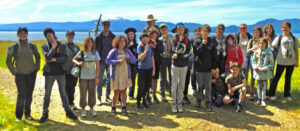
Take 19 excited students near the end of the school term; place them in a meadow of delicate wildflowers in Helliwell Provincial Park; add endangered Taylor’s checkerspot and propertius duskywing butterflies and other insects; mix well and let them simmer for two hours. Does this seem like a recipe for an ecological disaster or potential chaos? Apparently not when they are well-prepared Hornby Island Community School students on a field trip to Helliwell that was carefully planned and managed. The students were guided by their teacher, Garret Holt, BC Parks conservation specialist Stephanie Govier, and butterfly technician Pascale Archibald. Hornby Island Natural History Centre stewards Bill Hamilton and Neil Wilson, Community School staffer Jala Klone, and park ranger Sam Rae Harriss were on hand to provide additional information and field trip support.
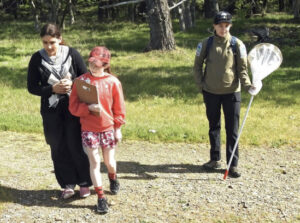
Stephanie Govier and Pascale Archibald outlined the coastal bluff meadow habitat restoration efforts in Helliwell Park over the last several years. Neil Wilson spoke about the contributions of students from the school during that time, which involved the planting of thousands of native butterfly host and food plants, which had been propagated by stewards of the Hornby Island Natural History Centre. Taylor’s checkerspot lifecycle stages were reviewed before students were handed laminated information sheets, surveys, pencils and clipboards and then sent to observe insects. Quite a few species were caught with nets by adults and placed in containers to study for a moment before being safely released.
“It impressed me how careful everyone was to not injure the bugs and by how much care was taken to stay on the trails to avoid trampling,” said Neil Wilson.
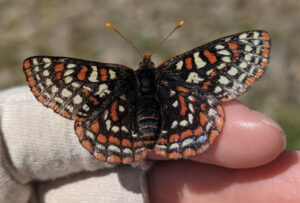
In the catch were several species of bees, flies, beetles and butterflies, including a propertius duskywing and a Taylor’s checkerspot butterfly – one of many spotted by the team of citizen scientists. The two-hour lesson also focused on meadow plants important for pollinators.
The field trip was part of ongoing efforts to increase awareness about the importance of pollinator insects. It also highlighted the collaborative work by BC Parks and the Taylor’s Checkerspot Butterfly Recovery Project Team to re-establish a viable population of the endangered species in Helliwell Park.
Taylor’s checkerspot butterflies vanished from Hornby Island in the mid-1990s. After several years of habitat restoration work and annual releases of Taylor’s checkerspot butterfly caterpillars in Helliwell Park, the project team finally received encouraging news this spring. In March, butterfly technicians Pascale Archibald and Kihan Yoon-Henderson found more than 230 Taylor’s checkerspot larvae that successfully overwintered in the park to continue their lifecycle.
At the end of March, the team released another 100 Taylor’s checkerspot butterfly caterpillars in Helliwell Park near St. John’s Point, and 340 larvae for the first time on Flora Islet. The caterpillars were raised at the Greater Vancouver Zoo by Wildlife Preservation Canada staff Andrea Gielens.
Pascale Archibald recently conducted follow-up surveys of adult Taylor’s checkerspot butterflies and their offspring in Helliwell Park. More than 130 individual butterflies were observed on 14 survey days between May 9th and 29th. She also found 88 clusters of larvae between June 8th and 13th. “There are definitely more out there though as I didn’t manage to search the entire meadow area,” said Archibald.
While these are very hopeful signs for Taylor’s checkerspot butterfly recovery in Helliwell Park, their future is not assured. The caterpillars are tiny, delicate and vulnerable. Trampling by park visitors, dogs and bicycles are a key threat to the larvae and the plants they need to survive.
Helliwell’s visitors can increase the caterpillars’ chance of survival by adhering to park rules. “Dogs must be on a leash according to provincial park regulations, and bikes aren’t allowed in this park,” said Stephanie Govier. Please walk carefully and watch out for caterpillars. Stay on the trails that are delineated by ropes and restoration area signs. If you visit Flora Islet, stay on the shore, and avoid the fragile meadows. This will reduce the possibility of stepping on a caterpillar or their host plants.
Don’t move or pick up Taylor’s checkerspots. Instead, report sightings to Taylors.Checkerspot@gov.bc.ca, or by using the free iNaturalist app (www.inaturalist.org). It is an easy-to-use species identification tool that enables citizen scientists to record and contribute important species data for projects around the globe.
BC Parks and the project team thank the Cowichan Tribes, Halalt, Homalco, K’ómoks, Lake Cowichan, Lyackson, Penelakut, Qualicum, Snaw’Naw’As, Stz’uminus, Tla’amin, We Wai Kai, and We Wai Kum First Nations for allowing us to restore ecosystems in their traditional territories. Several local volunteers from Conservancy Hornby Island, the Hornby Island Natural History Centre, the Hornby Island Provincial Parks Committee, and others also contributed to the success of this project.
The recovery project has benefited from funding and in-kind contributions from the BC Parks Licence Plate Program, the Habitat Conservation Trust Foundation, the Environment Canada Habitat Stewardship Fund, and the B.C. Ministry of Environment and Climate Change Strategy (Ecosystems Branch), and others.
The Taylor’s Checkerspot Butterfly Recovery Project Team includes biological consultants and representatives from the B.C. Ministry of Water, Land and Resource Stewardship, B.C. Ministry of Environment and Climate Change Strategy, BC Parks, Denman Conservancy Association, Garry Oak Ecosystems Recovery Team, Greater Vancouver Zoo, Mosaic Forest Management, Wildlife Preservation Canada, and others.
Learn more about the Taylor’s checkerspot butterfly:
Hornby Island Community School field trip to Helliwell Park, May 2024. Photo by Bill Hamilton.
Students with information sheets and field survey forms. Photo by Bill Hamilton.
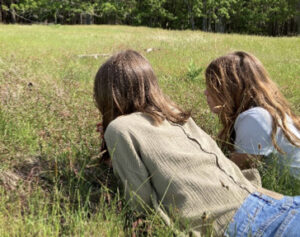
Photo by Stephanie Govier.
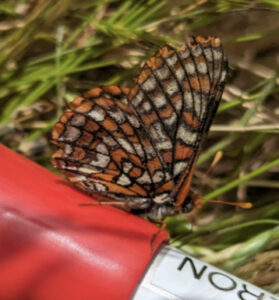
Several Taylor’s checkerspot butterflies and other insects were observed. Photo by Stephanie Govler
Photos by Pascale Archibald.
More than 130 Taylor’s checkerspot butterflies were found during surveys in May.
In June, Pascale also located 88 webs containing hundreds of Taylor’s checkerspot larvae. It’s proof that the butterflies are producing offspring, which is a hopeful sign that the reintroduction project is succeeding. Photo by Pascale Archibald.
Historical range was Hornby Island, southeastern Vancouver Island, Puget Trough and to the Willamette Valley in Oregon. In B.C., they were once abundant at 10 sites in the Greater Victoria Area, one site each near Mill Bay and Comox, and sites on Hornby Island (including Helliwell Provincial Park).
They were thought to have been extirpated (became locally extinct) from Canada by 2000 when no Taylor’s checkerspots could be found in their last known sites on Hornby Island despite intensive searches. However, new populations were discovered on Denman Island in 2005 and near Campbell River in 2018.
It is federally listed as Endangered (COSEWIC, SARA Schedule 1), and is on the BC Red list of at-risk species.
Taylor’s checkerspot butterflies need open sunny meadows where they can find suitable host plants (food for larvae and nectar producing flowers for adults), such as woolly sunflower, common camas, small-flowered blue-eyed Mary, wild strawberry, sea blush, and yarrow.
Habitat loss, degradation and fragmentation are major factors in the species’ decline. For example, the meadows along the coastal bluffs in Helliwell Provincial Park became less suitable for butterflies due to invasions of non-native plants and encroaching forests.
Habitat enhancement work (weeding, selective limbing +/or removal of conifers, re-planting and seeding with native species) has been ongoing in Helliwell Provincial Park for several years.
The Taylor’s Checkerspot Butterfly Recovery Project
The Taylor’s Checkerspot Butterfly Recovery Project is led by Jennifer Heron of the B.C. Ministry of Water, Land, and Resource Stewardship and is guided by the Garry Oak Ecosystems Recovery Team’s Invertebrates at Risk Recovery Implementation Group. It is a collaborative effort to restore Taylor’s checkerspot populations in British Columbia through habitat enhancement, captive butterfly rearing and release, monitoring, public outreach, and other activities.
Team Members
Jennifer Heron (Chair), B.C. Ministry of Water, Land, and Resource Stewardship, Vancouver, B.C.
Erika Bland and Andrew Fyson, Denman Island Conservancy Association, Denman Island, B.C.
Deborah Bishop, Denman Island, B.C.
Menita Prasad, Greater Vancouver Zoo, Aldergrove, B.C.
Eric Gross and Ross Vennesland, Canadian Wildlife Service, Environment and Climate Change Canada, Delta, B.C.
Crispin Guppy, Entomologist, Whitehorse, Y.T.
Molly Hudson and David Vey, Mosaic Forest Management, Nanaimo, B.C.
Chris Junck, Garry Oak Ecosystems Recovery Team and B.C. Conservation Foundation, Victoria, B.C.
Suzie Lavallee, University of British Columbia Faculty of Forestry, Vancouver, B.C.
Patrick Lilley, Private Consultant, North Vancouver, B.C.
Erica McClaren and Stephanie Govier, BC Parks, Black Creek, B.C.
Kristen Miskelly, Satinflower Nurseries, Victoria, B.C.
Derek Moore, Area Supervisor Von Donop Area, BC Parks, Black Creek, B.C.
Nick Page, Raincoast Applied Ecology, Vancouver, B.C.
Hazel Wheeler and Andrea Gielens, Wildlife Preservation Canada, Guelph, ON.
Bonnie Zand, B.C. Conservation Foundation, Fanny Bay, B.C.
Supporters
B.C. Conservation Foundation
B.C. Ministry of Environment and Climate Change Strategy
B.C. Ministry of Water, Land, and Resource Stewardship
BC Parks
BC Parks License Plate Fund
Conservancy Hornby Island
Denman Conservancy Association
Environment Canada Habitat Stewardship Fund
Garry Oak Ecosystems Recovery Team
Greater Vancouver Zoo
Habitat Conservation Trust Foundation
Hornby Island Community School
Hornby Island Co-op
Hornby Island Natural History Centre
Hornby Island Provincial Parks Committee
Mosaic Forest Management
Sea Breeze Lodge
University of British Columbia
Wildlife Preservation Canada
For more information about the Taylor’s Checkerspot Butterfly Recovery Project, visit: www.goert.ca/activities/taylors-checkerspot/
Or contact:
Project Lead/GOERT Invertebrates at Risk RIG Chair
Jennifer Heron
Provincial Invertebrate Conservation Specialist
B.C. Ministry of Water, Land and Resource Stewardship
Office: 778-572-2273
Jennifer.Heron@gov.bc.ca
Public Outreach Coordinator
Taylor’s Checkerspot Butterfly Recovery Project Team
“We are committed to moving forward and exploring alternative solutions that align with the needs and priorities of our staff and community as a whole.”“It’s a ‘win-win-win’ for local farmers, for local consumers, and for food security moving forward.” “Going forward, health officials need to give concrete examples of what is and isn’t acceptable social interaction.”“We’re working collaboratively with BC Ferries to find a way forward.”
Stop it. Going forward. Moving forward. Whatever happened to “in future” or “looking a head”? Every time I hear this “brainlessly upbeat” tag-along, I feel like I’ve been hit with a heated cattle prod (or for the visually impaired, tasered). As BBC writer, Lucy Kellaway wrote, “When someone says ‘going forward’ it assaults the ears just as, when a colleague starts slurping French onion soup at a neighbouring desk.” It is a frustratingly vague term which seemingly has profound meaning, but it doesn’t add meaning to a sentence. In fact, more often, the message would be the same if the positively, irritating, tag-on was deleted.
CEOs, politicians, bureaucrats, and even professional athletes love adding it to sentences. It has become the corporate equivalent of the full stop; the grown-up version of the word “like.” And if you have been around bureaucrats and politicians, you will note that “going forward” is as contagious as cognitive dissonance. It’s a kind of collective hypnosis. Politicians, especially, seem to find the pretentious term comforting. Ironically, doomed Hillary Clinton earnestly said “We are going forward” back in 2016 when in fact she was going nowhere.
Why do people speak like this? Craig Vann explained that: “The dreaded phrase is almost always used as a superfluous ‘filler’ when the speaker needs to sound knowledgeable and/or important, such as ‘our strategy going forward.’ What is a strategy if not forward-looking? Or, it is randomly tacked onto the end of a sentence, as in: ‘Let’s talk about that tomorrow, going forward.’” For some reason, it shows purpose, action, and direction –in a really smart way. Not.
Listen to the news, reporters, journalists, continue to drop this phrase with brainless abandon. And, “like some sort of linguistic prickly pear, this unstoppable slogan has spread unchecked, even into the nooks and crannies of our conversational lives.” As someone wrote on the Conversation, “It is loathed by all except those who are too busy moving goalposts and hitting the ground running to notice that this expression does something to the neck hairs of most other speakers.” Why is it so reviled? Maybe because it’s part of big business jargon – a meaningless mantra that if repeated enough will give you an express pass up the corporate/bureaucratic ladder. If it’s not in your lingo and you don’t talk the talk, well, sayonara, baby.
Prime Minister Justin Trudeau is perhaps, the worst offender of all, which gives an insight into his intellectual prowess. In 2021, Trudeau launched “Moving Forward Together – Canada’s 2030 Agenda National Strategy.” In his words, “Canadians have a clear choice: keep moving forward and build a better Canada for everyone.” It is like a disease with Trudeau.
Let me count the ways… “In October we’ve got a choice to make – keep moving forward and build on the progress we’ve made, or go back to the politics of the Harper years. I’m for moving forward, for everyone,” Trudeau said. “When I think about the biggest, most important economic policy this government, if re-elected, would move forward, you’ll forgive me if I don’t think about monetary policy.” Trudeau told a building trades union policy conference that the Liberals have “made the commitment that we are moving forward on a ban” on asbestos in Canada. Trudeau greeted reporters with the glad news that there had been “real substantive discussions” and that all concerned were “moving forward” in a “thoughtful, constructive way.”As Prime Minister Justin Trudeau insists that despite months of delay, his government is “moving forward” with a foreign interference inquiry, Conservative Leader Pierre Poilievre is accusing him of standing in the way.
The prime minister admitted progress has been slower than he would have liked but said he believes “things are moving forward.” “I think it’s fairly clear that the US administration has made its decision on that, and we’re much more interested in ensuring that we’re moving forward in ways that are good for both of our countries.” The Liberal Party of Canada concluded their 2023 National Convention in Ottawa, focusing on the work that Justin Trudeau is doing “to move forward on the priorities that matter most to Canadians.” Shall I go on? One more. Prime Minister Justin Trudeau was “focused on moving forward,” following the news that he and Sophie Gregoire Trudeau separated.
With Trudeau(like most politicians), “moving forward” puts a positive spin on the stuff that matters, like pipelines. Not that anyone has been fooled with his “sunny ways.” He’s a caricature of a Disney prince – youthful, charming, performative and superficial. Rita Panahi of SkyNews called him a “neomarxist Ken Doll.” Instead of constantly moving forward, Justin, maybe it’s time to move on.
It’s very revealing how everybody’s focusing on what Biden’s dementia-addled debate performance says about his ability to win re-election instead of on the fact that the current, sitting president of the United States has dementia.
But the conversation has almost entirely revolved around Joe Biden as a presidential candidate, with relatively little attention going to the fact that this person is the president right now. Everyone’s talking about whether Biden can assure American voters that he has what it takes to be president, and nobody seems all that concerned about the fact that he is already president and will remain so for half a year.
What this suggests is that people already kind of know on some level that the president of the United States doesn’t really run the United States, but are still mentally compartmentalized away from this reality enough to care who wins the presidential election.
If people really believed the president runs the country, they’d be freaking out that Biden in his demented haze might order an attack on the Soviet Union or nuke Libya to kill Muammar Gaddafi or something. They’re not worried that this will happen because they know their government is actually being run by unelected empire managers from behind the scenes, and that Biden is just the official face on the operation.
So in order to hold their mainstream worldview together, liberals are simultaneously straddling the two completely contradictory concepts that (A) it doesn’t matter who the president is because the country is actually run by unelected empire managers, and (B) that Biden’s debate performance was very concerning because it means Trump will become president.
If they let go of (A) then they’re no longer in the mainstream worldview where their country works how they were taught it works in school, and if they let go of (B) then they’re no longer in the mainstream worldview where presidential elections are super duper important and all their country’s problems are the result of Americans voting incorrectly. So they straddle them both and try not to think too hard about the obvious contradictions between them, in order to avoid the crushing cognitive dissonance they’d experience if they looked at them too closely.
In reality the US empire has marched along in all its usual depravity despite its official leader having Swiss cheese for a brain this entire time. They got their genocide in Gaza and their world-threatening proxy war against Russia, as well as China policy that is vastly more hawkish than that of Biden’s predecessors. The imperial murder machine hasn’t skipped a beat in its nonstop campaign of steadily increasing global tyranny.
This has happened because US presidential elections are fake and the results don’t matter. It wouldn’t matter if Americans elected a labrador retriever or a bottle of Tabasco sauce; the empire would roll forward without the slightest interruption. The wars would continue. The economic injustice would continue. The surging authoritarianism would continue. The oligarchy and corruption would continue. The ecocidal capitalism would continue. The imperialist extraction would continue.
US elections are just a diversion to keep Americans from pushing for real change in ways that pose a meaningful challenge to power, and Americans already kind of know this. The sooner they stop compartmentalizing away from this fact that they’re already dimly aware of and face reality, the sooner they can start bringing health to both their nation and the world.
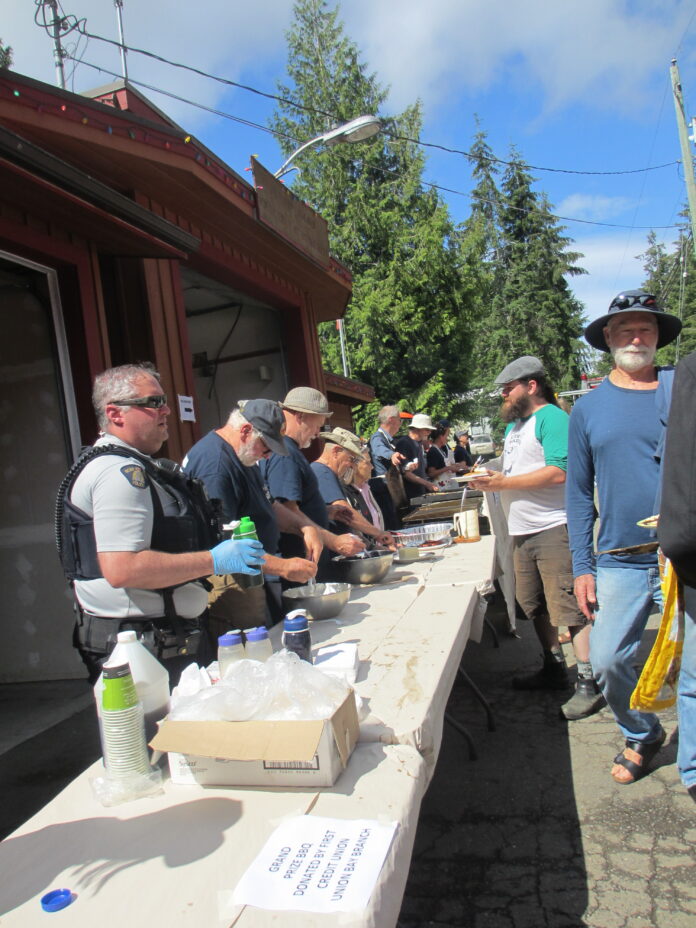
Eating together and working together are the two most potent ways I know to create community.The Denman Island Fire Department’s Annual Pancake Breakfast on 30 June was a great success as they had the whole Fire Department out there working together to provide a meal for hundreds or more.This was a great logistical exercise and the experience the Fire Department members acquire will help any of them if they ever need to set up a refugee camp.
I hear you say, “When are we ever going to need a refugee camp here?”Well, we have been terribly lucky for a great many years but it only takes some hot, dry weather, a bit of wind and a carelessly-dropped cigarette and a great deal of the island could go up in flames, including a lot of dwellings.Then, we will need some sort of a camp for the displaced people.I too hope this does not happen, but it could.
I went up to the event about half-past ten and was surprised to see no line-up worth mentioning.I think a lot of people try to get there early to avoid the crowds and huge line ups. The first people I met coming away from the breakfast were two ladies and a small boy.The younger lady grew up here as a little kid and has fond memories of the Pancake Breakfast.She was delighted to be able to bring her little child to experience it. She laughed and said, “They must have a test for everyone who joins the Fire Department to make sure they can all make pancakes before they are accepted.”I asked how she liked the pancakes and she pronounced them, “Delicious.”
Next, I caught Sam Croome, showing off the Fire Rescue vehicles. I asked him what he liked most about the Fire Department and he replied, “Bacon!”What really keeps him serving in the Fire Department is the continuing education they offer. Sam feels that learning different things keeps the brain from atrophy.
The next person I interviewed was Darius the carpenter.This is only his second pancake breakfast as he moved here, had one pancake breakfast and then Covid 19 hit and that was the end of social gatherings for a while. I asked him if he was interested in joining the Fire Department and he said he would love to join but his wife wouldn’t like it as they have small children.He feels serving in the department would mean too much time away from home.“When my kids are a bit bigger, then, I might join.”
I spoke with Kasian Russel, a valuable young man, what he most liked about his service in the Fire Department.“The experiences and the people.It is a lot of fun.I get to learn a lot and work in the community.”Kasian will soon be seventeen and has already finished the First Responder course except for the final exam.He plans to do all the training he can with the Fire Department as a means of self and community improvement.
I chatted with Helen Wilson and she finds the Fire Department to have a lovely community spirit.“When push comes to shove, they are excellent about what they do.The get the job done and work hard on professional development.”Helen also appreciated the line up for pancakes being in the shade this year.
Erika Bland said she likes all the smiling faces at the Pancake Breakfast and she shared with me her appreciation for the generosity of the Fire Department.If they raise more funds than they need, they share the surplus with other community groups.
Scot MacDonald was there, looking very dapper in his uniform tee-shirt and kilt.Scot is a retired soldier and what he likes best about the department is the sense of family and the really good training.
Everyone seems to rave about the training at the Fire Department which must be a great satisfaction to Jamie Prowse who is the Training Officer.
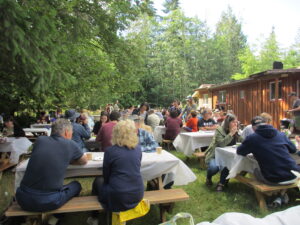
By this time, I was at the picnic tables which were full of happy people tucking into pancakes.I asked a couple of ladies what they thought of the breakfast and they said, “Very good!Fantastic.They love it that we have a Fire Department here on the Island and found the Fire Department members both friendly and efficient.
I talked to another local lady who said she thought this year’s event was even better than last year’s event.“They didn’t run out of bacon andthey seemed even more efficient than last year.”
In 2023, despite heroic efforts of the part of the Firefighters, they were not able to serve the promised gluten-free pancakes.This year, they got ahead of that issue by buying a new grill specifically for gluten-free pancakes.They also use it to cook the vegan meat which I hope is gluten-free too.
I would call this year’s Pancake Breakfast, an unqualified success.
Regardless of all that is presently unfolding in the wider world of politics, industry and money, underneath it all, when the chaff is cleared, if we wish to advance the collective cause, a reckoning must be made with the origins of the human state. In particular, it is imperative to investigate and come to an understanding that Love – in its phenomenal form, not the cliche variety – is in fact the generative form of Light. This is the very phenomena that many ancient esoteric disciplines say drives human consciousness, awareness and existence. Some of the most deep-thinking and profound spiritual belief systems have this notion at the core in some form or another: that love is the driving essence of creation and a compelling force that, at its truest, is called light. By virtue of this perspective, the force of love is thought to be generative because it, like all else, is a product or result of energy and intention in its purest form.
For lack of proper definition, consciousness is thought to be a product of quantum electromagnetic impulse or energy, the source of which humanity is still largely oblivious – the very reason we are still stuck between clinging desperately to money as the prime driver, rather than adopting an informed grander notion of our inclusiveness with the natural world.
According to the Law of Conservation of Energy, energy never dies, it only transforms – it undergoes a change in composition or structure, or changes its outward form or appearance, a fact with which the purveyors of ancient wisdom also agree: that energy does not dissolve or waste away, it only transmutes (changes in form, nature, or substance). This notion is said to inform the essence of consciousness as well – an “awareness” energy that is a product of the impelling force of creation – that is compelled to expand and evolve to its highest potential – just as all life on the planet has been shown to do via biological imperative and species evolution.
“Electromagnetic field theories (or “EM field theories”) of consciousness propose that consciousness results when a brain produces an electromagnetic field with specific characteristics. Johnjoe McFadden, an Anglo-Irish scientist, and Professor of Molecular Genetics at the University of Surrey, United Kingdom, suggests in his theories that “digital information from neurons is integrated to form a conscious electromagnetic information (cemi) field in the brain. As such, consciousness is suggested to be the component of this field that is transmitted back to neurons, and communicates its state externally.” Again, with respect to the field McFadden alludes to, it is, as yet, nebulous and beyond reach of empirical/traditional science. This all suggests to me that we are not a random result of chaotic principles as empirical science has proposed, but that we are the result of a compelling force of consciousness and creation that is not “other than” but is within and subject to its impelling force. Our present state is very much a result of cause and condition.
All else is, in terms of principles and beliefs, largely contrivance and conceptualization – an imposition of observation and meaning in order to make sense of the world. The struggle for the dominion of modern perspectives and ideologies is the very crux of what now faces humanity in almost every facet of human perspective. Whether it be the Sword of Damocles or the salve that heals, prevalent theories and ideas about how we conduct ourselves, is a product of ingenuity, imagination, perception, perspective and belief that is shaped by cultured learning and belief systems that emerge over time. Lack of careful, mindful scrutiny of what we adopt or what is imposed upon the human mind has driven human culture to walk a razors edge of which the cost may be too much to bear if a concerted effort is not made. Virtue is in action.
By the virtue of mind, we perceive, comprehend and conceive, then, by virtue of hands, feet, eyes, voice, and mind, we create. The prior mentioned spiritual and utilitarian ideologies hold that the essence of human existence is in fact our ability to imagine and create. The result of our combined efforts with respect to culture and socialization is the physical reality and the belief systems that we bring about by virtue of this ability.
Can we fix what’s broken? When the physical reality and the beliefs and things and the doings within it are created from the centre point, where love is the guiding principle and the prime driver, a reasonably fair and balanced system could evolve. However, for the most part what we have now is the product of systems within systems that are created and driven purely by undisciplined or misaligned human ego, and fuelled by covetousness, greed, desire, and a system that itself is designed to flourish when those principles are applied to varying degrees of result.
During the 1950s, a group of Japanese primatologists documented a troop of Japanese Macaque monkeys on the island of Kojima they say had demonstrated what appeared to be a unified consciousness effect. They had noted in their research that a female monkey in the group had figured out that if she washed the sweet potatoes they were consuming in water before eating, that younger monkeys in the troop were quick to mimic the behaviour. Eventually the majority of the troop had adopted the skill, except, apparently, the older monkeys in the group, who did not. Shortly thereafter, observations were made in monkey troops on nearby islands who, it was said, had mysteriously learned the behaviour despite no apparent direct connection. Thus the hundredth monkey phenomenon. From this study, it was suggested that once a certain, though unidentified number, had picked up the skill, it had the potential to enter the collective consciousness and become a common link in nearby troops. There are, as always, detractors of the theory, but efforts to disprove the idea seem to lack teeth to altogether dethrone the 100th monkey phenomena. Whether a tendency toward conscious transmission over distance, or whether, as was also proposed, a monkey had swam to the islands and spread the knowledge, is not likely provable. The point I’m making is that recent discoveries in quantum physics, molecular genetics, and on the fringes of medical science have begun to reveal that field theory is a reality – not a concept. The dynamics of consciousness may well link humans not only within their kind, but to the larger reality inclusive of all life on the planet. In this way new ideas and ways of doing take on a life of their own. Thus, they have the potential to transform the nature of human consciousness and the reality we choose to create.
I propose a deeper discussion about the state of things, and the erosion of democratic, fair-minded principle we are presently faced with. To help create what Freud might have called a bulwark of necessary origin, I believe as story tellers and chroniclers, it is imperative to connect and expand in some form or fashion – perhaps like the mycelium in the forest, which connects all trees across a given landmass, where it has not been broken by human ingenuity.
When we impose past belief systems that haven’t worked upon new situations, the result will always be the same. There comes a point where old belief systems must be changed, improved and evolved to better result. This is about how we might fix what’s broken.
Having just returned from five weeks in Quebec I am going through mail piled up during my absence in which there are half dozen copies of the Grapevine.In the issue of May 23rd I ran across a letter from Leif LeBaron questioning a technical matter in my article (May 16th) addressing Will Thomas’ earlier screed (May 2nd) in which Will advised everyone to have CityWest disable all household WiFi and rely only on direct cable connections for your devices.LeBaron took issue with this sentence I wrote: “This at the very time most of us are using portable devices which cannot be cabled.”
LeBaron quite rightly took me to task for suggesting that portable devices cannot be cabled.Of course they can and my definite ‘cannot be cabled’ is quite rightly interpreted as an untrue claim so I plead guilty to failing clarity on what I actually meant.The operative word in the sentence for me was ‘portable’ so I should have worded it something like this:
“Manufacturers are building and consumers are purchasing portable tablets and phones in droves and these portable devices are not meant to be continuously attached by a cable.They are designed and used to be portable; no one wishes to trail a cable behind them; they just want to pull the device out of their pocket wherever they are and begin to use it.Thus these devices, which currently far outsell desktop and laptop computers, depend on either WiFi or cellular radiation for portability along with whatever EMI such broadcasters emit.”
LeBaron mentions several methods of cabling devices “all in a compact case with a short cable”.Anyone with grandchildren knows that the last thing they want is a ‘short cable’ connecting their phone or tablet to a modem.Manufacturers know this as well which is why the most common way of cabling a device to a modem, an ethernet cable, has no ‘port’ built in to any of the millions of phones and tablet sold.These products are not meant to turn the consumer into a detail techie who knows all about ‘dongles’ and various ports; they are meant to be portable right out of the package and that is exactly what people want and how they use them.My point was not the very narrow technical one that LeBaron addressed; it was a cultural one of the widespread acceptance of portable devices that do not have to be cabled.Having just spent five months in a household of five—who all work from home—with four desktop computers, about five laptops, two wireless printers, five or six phones and a few tablets I can attest anecdotally that only thedesktops were cabled; the rest were used with WiFi and those using them would be outraged at the suggestion that they connect these devices with a cable to the single WiFi box in the basement or the secondary router.I am not a fan of portable computers and I cable nearly all my home devices but my partner does like her tablet and would not want me to start drilling holes through the floor to install a 40 foot cable connecting to the downstairs modem.But in my article I did fail clarity on this point, as so many writers do when they attempt to second guess the reader’s cultural knowledge.So, as we all should, I will strive to avoid ambiguity in any future articles.
As for his interpretation of my attitude as ‘conflating EMI with psychosomatic illness and ‘bogus diagnoses’’, I did not use the word psychosomatic anywhere in my article and I did not write of ‘bogus diagnoses’; that phrase was part of a web address to which I referred, it was not a contention of mine.To paraphrase LeBaron, ‘In contradiction to claims of massive health risks from EMI, a large body of evidence exists, there to be seen, by those who choose to look.