
Shucking Oysters: Clankers and Wankers
By Alex Allen
Artificial intelligence. Supreme Intelligence. Call it what you will. We shouldn’t be surprised that we arrived here so quickly, we humans seem to know only one direction: straight ahead (while dodging traffic cones). AI is not new; it’s been around for a while. It’s the divergent directions that we are heading that we should worry about.
AI is big-business. Worldwide investment was over $2 trillion in 2026 compared to a mere $12.7 billion in 2015. John Michael Greer wrote, “The belief that more technology is always better, that every problem must have a technological solution, and that technology always solves more problems than it creates, are among the prevailing superstitions of our time.”
We know that AI helps Amazon analyze our buying habits and drives our future consumption. Netflix and Spotify use AI to learn our preferences and feed us a steady diet of mind-numbing entertainment. AI made Siri and Alexa, and helps Facebook and X decide which social media to post on our smartphones. Yet, it is not all nefarious. From healthcare and finance to agriculture and cybersecurity, AI is driving good innovation. Let’s look at one direction.
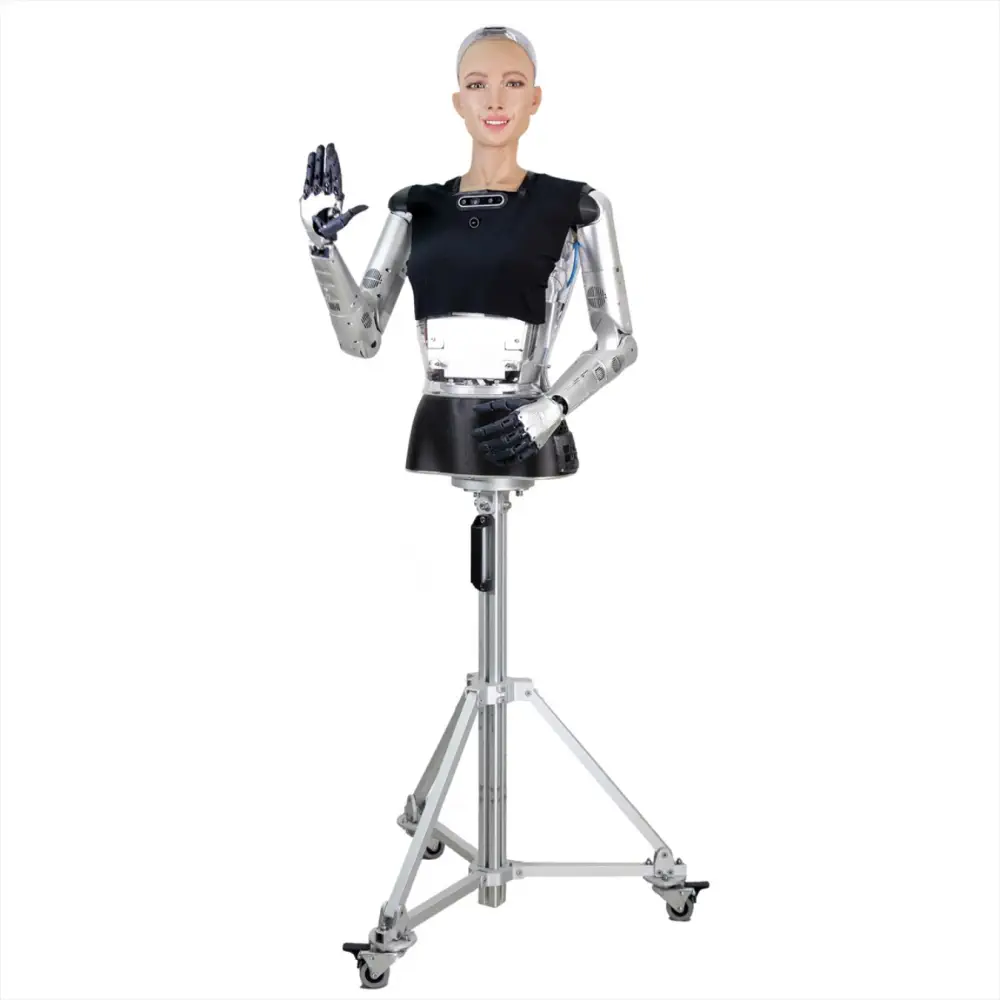
Door Number One: With stunning bone structure, deep-set captivating eyes, UBTECH’s life-like full size humanoid female robot will set you back over $145,000. Called U1, she stands at 5’5,” weighs 77 lbs and enjoys 88 degrees of freedom thanks to use of “a proprietary dual-pivot biomimetic cervical spine, enabling it to replicate up to 90% of fundamental human movements.”
Door Number Two: Sophia, the world’s most advanced human-like robot, created by Hanson Robotics. Sophia combines cutting-edge AI with patented Frubber skin technology. She can display over 60 facial expressions, hold natural conversations, and has appeared on major media platforms worldwide. In 2017, Sophia became the first robot to receive citizenship from any country.
And Door Number Three: Eden Robotics’ humanoid robots can do everything from serve cocktails to take photos and more. They are able to navigate even the most crowded spaces and “mimic human behaviour in a way that people find endearing.” For $37,500, you can purchase Johanna. At 4’9” she can be your household maid, lover, companion, and anything else you want her to be.
And just to be clear, like a real relationship, a humanoid partner is far from high maintenance. For a standard commercial humanoid robot, this translates to an average operating cost of $15,000 to $40,000 per year. These include technical support, software licenses, physical repairs, battery replacement and electricity. If the high cost is a barrier, virtual AI companion applications are available – some free, others only $70/year for personality and voice features.
As a commenter noted: “We may be willing to spend hundreds of thousands – or even close to a million – to buy a ‘perfect companion’ that can recognize more than 20 emotions and remains endlessly gentle and compliant. Yet in real-life relationships, we often want to walk away at the first sign of friction.”
Those leading AI say that we should not worry our little heads about this technology; it will make our lives better, faster, easier. Unfortunately, as with anything to do with humans, this technology will fall into the wrong hands, eventually.
We all know that AI need lots of data centres. We should be concerned about the environmental impacts. Globally, data centre power demand is growing four times faster than all other sectors, and is on track to exceed Japan’s electricity use by 2030.
Generative AI models – which generate text, images and video – consume “orders of magnitude” more energy than traditional computing methods. Some estimates suggest it’s five times more energy, others say it could be significantly higher. Much depends on the specific model or type of query. Trump and his courtiers must have their own data centre, considering their penchant for AI slop.
“Consumer software that generates text, images and videos are uniquely energy inefficient,” says Ketan Joshi, an Oslo-based climate analyst, due to the “vast data sets and computational strain of pattern-matching that happens underneath the hood.”
Asking an AI chatbot a question consumes a great deal more energy than finding the answer through a simple web search or calculator. It adds extra demand for no good reason, Joshi says, a bit like driving to the shops in an SUV instead of riding your bike. “You might still get the shopping done, and that single trip alone may not even look all that bad in terms of cost or emissions, but what happens when that’s all of your trips, and when all of society starts doing this?”
And throw into this mess, Jeff Bezos’ over-the-top and out-of-this-world business plan. Blue Origin plans to expand data centre infrastructure beyond Earth, proposing a vast orbital network of 51,600-satellites into orbit to support the rising demand.
The Blue Origin website states: “The Project Sunrise system will ease mounting pressure on US communities and natural resources by shifting energy – and water-intensive compute away from terrestrial data centers, reducing demand on land, water supplies and electrical grids.”
Scientists and environmental groups have warned that massive orbital data centre constellations from companies like Blue Origin and SpaceX could release harmful pollutants like aluminum oxides, black soot, and rare metals into the upper atmosphere.
Elon Musk claims that by as early as 2028, SpaceX will have successfully assembled an AI data centre in orbit, with plans to eventually harvest a staggering 100 gigawatts of new solar energy for AI annually, equivalent to one-fifth of all US electricity consumption in 2025.
Though “space is really big,” Musk eloquently shared, one million satellites would still profoundly and, likely irrevocably, transform our night sky into one in which data centres outnumber visible stars. Oh one more thing, Musk wants to build a million robots each year as well, and thinks a billion robots will work and mingle with us fleshy meat bags by 2040.
As of now, building a one-gigawatt data centre in space would cost about $51.5 billion compared with $16 billion for one on land. As Sara Herschander wrote, “if these tech giants succeed, it will not fix what’s wrong here on Earth, but merely prove once again their exemption to the gravitational forces holding the rest of us down.”