Shucking Oysters: Free-Floating Fiefdoms
By Alex Allen
What is with us humans that we can not just leave some things well enough alone? Why can’t we, as Nova Scotian’s say, just “leave ‘er be where Jesus flang ‘er”? We always have to DO something. Fix it. Hack it. Reboot it. Develop it. Scale it. Automate it. Conquer it. As if doing less, or even doing nothing, were not an option. Every inch of the Earth if it’s not abused it is eventually monetized. The rinse and repeat mantra of the capitalist world. As Douglas Rushkoff noted in his book, Survival of the Richest, “this is not creative destruction, but destructive destruction – all justified as the inevitable tide of forward progress.”
We have Jeff Bezos and Elon Musk flirting with space colonies, inhabiting Mars, and floating data centres, all in the name of what? Progress? Innovation? Transformation? Winning? As Rushkoff wrote these are merely euphemisms for conquest, colonization, domination and extraction. Like the colonialists of the day, the elite entrepreneurs of the world are competing for and hoarding every inch, with no oversight at all. “They can break the law of physics, economics, and morality to offer them something even better than a way of saving the world: a means of escape from the apocalypse of their own making.”
And it’s not just the usual’s. One company, Lonestar Data Holdings, wants to repurpose the moon “as a kind of off-world backup for Earth’s data.” Another company, Intuitive Machines, will be the mining the moon for iron and titanium. A third, D-Orbit, are looking at redacting old satellites and recycling parts for profit.
So now we have “seasteading,” a movement to establish permanent residences at sea, free from the pesky jurisdictions of any nation. Taking its name from “homesteading,” which describes the wild west approach to settlement in the US, seasteaders couch their economic interests in terms of innovation and freedom. As critic China Mieville explained, “Above all, they recast their most banal avarice – the disinclination to pay tax – as a principled blow for political freedom. Not content with existing offshore tax shelters, multimillionaires and property developers have aspired to build their own.”
In 2008, Patri Friedman (the poker-playing grandson of economist Milton Friedman) launched The Seasteading Institute (TSI), with funding from Peter Thiel, co-founder of PayPal and pay pal to Vance and Trump. Seasteading, like politics, is a technology of world building. As the journalist Oliver Wainwright argued, “Seasteading represents the ultimate Silicon Valley approach to governance.” The success of the libertarian seasteading “relies on state power being simultaneously eluded and exerted.” When it launched, TSI’s mission statement was, “to establish permanent, autonomous ocean communities to enable experimentation and innovation with diverse social, political, and legal systems.”
Not long after they received funding from Thiel in 2017, TSI approached French Polynesia with an idea: Could they build a few miles off the shores of their islands? French Polynesia’s government drew up a seven-year agreement and both hoped to get work underway. Unfortunately things began to get heated. The engineering side went well. The ideological side did not. Marc Collins Chen, CTO of Oceanix, realized that “what they seemed to be imagining was a kind of floating island for tech billionaires who wanted to live a low-rules and -regulations kind of life, while also using the resources – like tech resources and things – from French Polynesia.”
In Tahiti with no surprise, locals organized mass protests against “techno-colonialism” and blatantly using their fishing grounds as a food source for a floating island of billionaires. The agreement was eventually discontinued by the French Polynesian government. Do I hear echoes of Albania over the $1.4 billion Ivanka vanity project on Sazan Island?
UofT environmental scientist and professor of sustainability Peter Newman, one of the most outspoken critics of seasteading, once called it “apartheid of the worst kind.” In an interview he bluntly shared his views: “Whether it is privatized urbanism or techno-libertarian escape, the idea is pretty stupid. It’s a rich people’s diversion and has no obvious value.”
“The most positive way to look at seasteading is that it has a pioneering mentality which is seeking to go where no humans have dared to go,” Newman added, “like going to the Moon or Mars. Many aspects of human life have been improved by daring pioneers.”
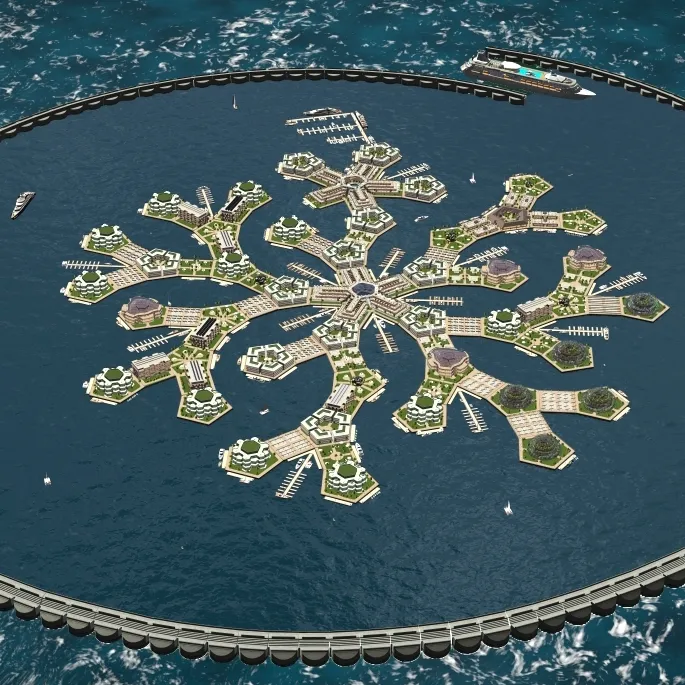
Collins Chen is working on a floating city off the shores of Busan in South Korea which will be starting construction in 2026. Oceanix, partially funded by the UN, focuses on climate change and less on creating a libertarian paradise, describes itself as “new land for coastal cities looking for sustainable ways to expand onto the ocean, while adapting to sea level rise.” The interconnected neighbourhoods will accommodate a community of 12,000 people, with each neighbourhood designed to serve a specific purpose: living, research, and lodging.
As interest in seasteading resurfaces, Collins Chen’s Oceanix experiment seems more encouraging as a sustainable blueprint. But as Holly Baxter warned in The Independent: “in the background, the fever dream of techno-libertarianism, where wealth replaces governance and fantasy stands in for infrastructure simmers on. Its promise of freedom is seductive, but its avoidance of accountability is perilous.” Baxter wrote that ultimately, it may say more about the psychology of a handful of very rich men than it does about the future of humanity.
Smart city infrastructures and space colonies are pitched not only as consumer-friendly, high-tech, and sustainable solutions for human survival, but also as “promises of a certain aesthetic futurism.” In all cases, a “glossy, sometimes spectacular design product or event is aimed to comfort and encourage us to hand the keys over what remains of our futures to the extinction designer, hoping that the world they promise actually has a place for us.”
In Silicon Valley, extinction is not a threat to living worlds, but a design opportunity – a bug to be fixed. For Thiel, Musk and Bezos, among others, extinction is their market. What matters is not what is left for the many, but what services and bling are anointed to the chosen few on their exclusive floating cities and space colonies. As Jonas Staal eloquently wrote, “like the American Dream, the Extinction Dream exists only for the elite’s elite.”