
Helliwell habitat work reduces fire risk and helps butterflies
By Chris Junck on behalf of the Taylor’s Checkerspot Butterfly Recovery Project Team
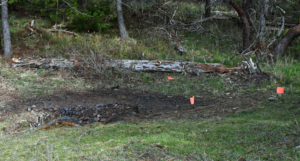
Did you hear chainsaws or see smoke in the Saint John’s Point area of Helliwell Park this spring? If so, don’t worry. It’s part of a multi-year BC Parks project to reduce forest fire fuels and improve habitat for butterflies and other pollinators. Selective removal of branches and a few trees was followed by native plant seeding of sites where piles of tree materials were burned.
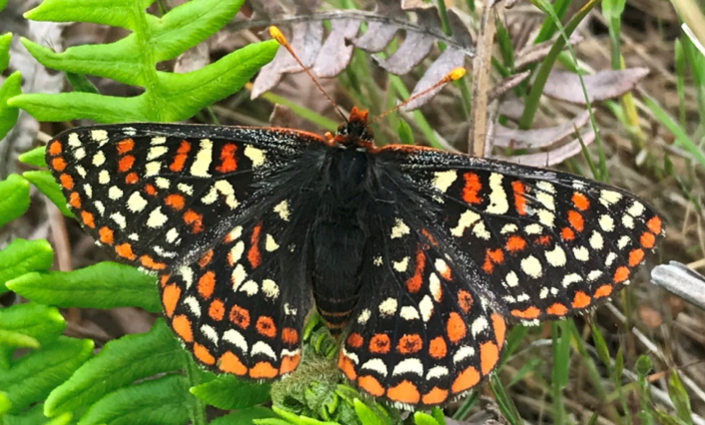
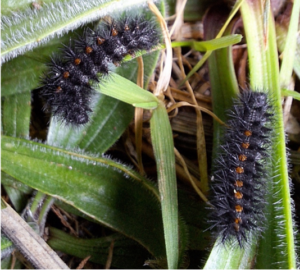
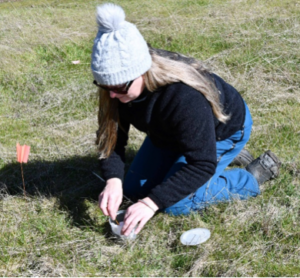
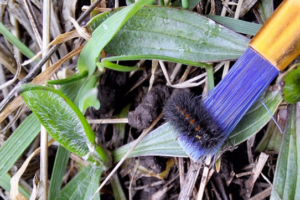
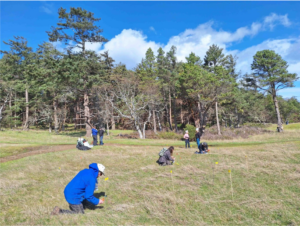
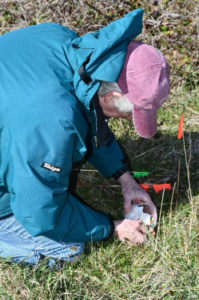
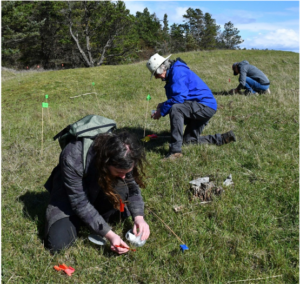
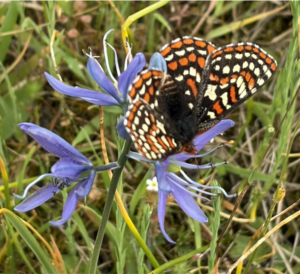
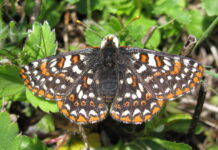
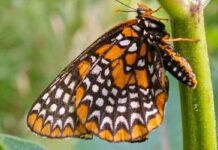
The initiative is succeeding. The Taylor’s Checkerspot Butterfly Recovery Project Team (TCBRPT) is excited to confirm that endangered Taylor’s checkerspots successfully overwintered in the park for the third consecutive year! Larvae were found in Helliwell’s coastal bluff meadows this March by Jennifer Heron, TCBRPT Chair and Provincial Invertebrate Conservation Specialist for the B.C. Ministry of Water, Land and Resource Stewardship. The caterpillars are the offspring of butterfly larvae raised by Wildlife Preservation Canada staff at the Greater Vancouver Zoo and released by the project team in Helliwell in previous years. “This is a good news story. It’s a positive sign that Taylor’s checkerspot butterflies are re-establishing a population in the park”, said Heron.
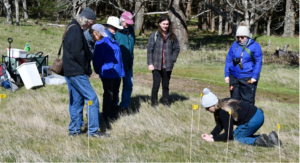
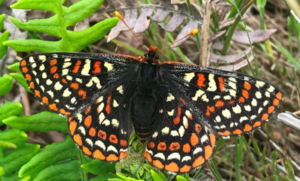
The Taylor’s checkerspot population in Helliwell received a boost with the release of approximately 1,350 zoo reared larvae in late March. During the adult flight period in April and May, more than 15 Taylor’s checkerspot butterflies were observed by local naturalists and TCBRPT biologist Nick Page. Hopefully at least some of them mated and produced eggs that will go through several larval stages before overwintering.
While these are very hopeful signs for Taylor’s checkerspot butterfly recovery in Helliwell Park, their future is not assured. The caterpillars are tiny, delicate and vulnerable. Trampling by park visitors, dogs and bicycles are a key threat to the larvae and the plants they need to survive. Helliwell Park visitors can help the caterpillars by following park rules: leave bikes in the parking lot, stay on marked trails and keep dogs leashed and on trails. If you visit Flora Islet, stay on the shore, and avoid the fragile meadows. This will reduce the possibility of stepping on a caterpillar or their host plants.
Don’t move or pick up Taylor’s checkerspots. Instead, report sightings to Taylors.Checkerspot@gov.bc.ca, or by using the free iNaturalist app (www.inaturalist.org). It is an easy-to-use species identification tool that enables citizen scientists to record and contribute important species data for projects around the globe.
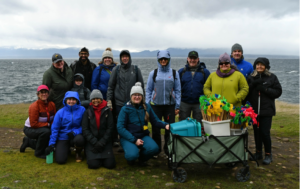
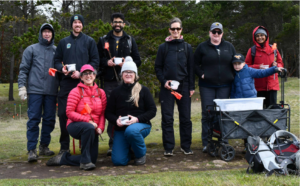
The project team would like to thank the Cowichan Tribes, Halalt, Homalco, K’ómoks, Lake Cowichan, Lyackson, Penelakut, Qualicum, Snaw’Naw’As, Stz’uminus, Tla’amin, We Wai Kai, and We Wai Kum First Nations for allowing us to restore ecosystems in their traditional territories. Several local volunteers from Conservancy Hornby Island, the Hornby Island Natural History Centre, the Hornby Island Parks Committee, and others also contributed to the success of this project.
The recovery project has benefited from funding and in-kind contributions from the BC Parks Licence Plate Program, the Habitat Conservation Trust Foundation, the Environment Canada Habitat Stewardship Fund, and the B.C. Ministry of Environment and Parks, B.C. Water, Land and Resource Stewardship (Wildilfe and Ecosystems Branch) Canada Pollinator Partnership and others.
The Taylor’s Checkerspot Butterfly Recovery Project Team includes biological consultants and representatives from the B.C. Ministry of Water, Land and Resource Stewardship, B.C. Ministry of Environment and Parks, Denman Conservancy Association, Garry Oak Ecosystems Recovery Team, Greater Vancouver Zoo, Mosaic Forest Management, Wildlife Preservation Canada, and others.
Learn more about the Taylor’s checkerspot butterfly:
https: //goert.ca/activities/taylors-checkerspot/
and
https://www2.gov.bc.ca/gov/content/environment/plants-animals-ecosystems/species-ecosystems-at-risk/implementation/conservation-projects-partnerships/taylors-checkerspot
~30~
All photos by Chris Junck, except the adult butterflies by Jennifer Heron and Nick Page.
Background Information
Taylor’s Checkerspot Butterfly (Euphydryas editha taylori)
- Also known as Edith’s checkerspot.
- Historical range was Hornby Island, southeastern Vancouver Island, Puget Trough and to the Willamette Valley in Oregon. In B.C., they were once abundant at 10 sites in the Greater Victoria Area, one site each near Mill Bay and Comox, and sites on Hornby Island (including Helliwell Provincial Park).
- They were thought to have been extirpated (became locally extinct) from Canada by 2000 when no Taylor’s checkerspots could be found in their last known sites on Hornby Island despite intensive searches. However, new populations were discovered on Denman Island in 2005 and near Campbell River in 2018.
- It is federally listed as Endangered (COSEWIC, SARA Schedule 1), and is on the BC Red list of at-risk species.
- Taylor’s checkerspot butterflies need open sunny meadows where they can find suitable host plants (food for larvae and nectar producing flowers for adults), such as native woolly sunflower, common camas, small-flowered blue-eyed Mary, wild strawberry, sea blush, and yarrow, as well as non-native species such as ribwort plantain and common plantain.
- Habitat loss, degradation and fragmentation are major factors in the species’ decline. For example, the meadows along the coastal bluffs in Helliwell Provincial Park became less suitable for butterflies due to invasions of non-native plants and encroaching forests.
- Habitat enhancement work (weeding, selective limbing +/or removal of conifers, re-planting and seeding with native species) has been ongoing in Helliwell Provincial Park for several years.
The Taylor’s Checkerspot Butterfly Recovery Project
The Taylor’s Checkerspot Butterfly Recovery Project is led by Jennifer Heron of the B.C. Ministry of Water, Land, and Resource Stewardship and is guided by the Garry Oak Ecosystems Recovery Team’s Invertebrates at Risk Recovery Implementation Group. It is a collaborative effort to restore Taylor’s checkerspot populations in British Columbia through habitat enhancement, captive butterfly rearing and release, monitoring, public outreach, and other activities.
Team Members
Jennifer Heron (Chair), B.C. Ministry of Water, Land, and Resource Stewardship, Vancouver, B.C.
Erika Bland and Andrew Fyson, Denman Island Conservancy Association, Denman Island, B.C.
Menita Prasad, Greater Vancouver Zoo, Aldergrove, B.C.
Eric Gross, Canadian Wildlife Service, Environment and Climate Change Canada, Delta, B.C.
Crispin Guppy, Entomologist, Vanderhoof, B.C.
David Vey and Rachel Shanner, Mosaic Forest Management, Nanaimo, B.C.
Chris Junck, Garry Oak Ecosystems Recovery Team and B.C. Conservation Foundation, Victoria, B.C.
Suzie Lavallee, University of British Columbia Faculty of Forestry, Vancouver, B.C.
Patrick Lilley, Private Consultant, North Vancouver, B.C.
Iain Reid, BC Parks, Black Creek, B.C.
Kristen Miskelly, Satinflower Nurseries, Victoria, B.C.
Derek Moore, Area Supervisor Von Donop Area, BC Parks, Black Creek, B.C.
Nick Page, Raincoast Applied Ecology, Vancouver, B.C.
Hazel Wheeler, Andrea Gielens and Jag Athwal, Wildlife Preservation Canada, Guelph, ON.
Bonnie Zand, Independent Consultant, Fanny Bay, B.C.
Supporters
B.C. Conservation Foundation
B.C. Ministry of Environment and Parks
B.C. Ministry of Water, Land, and Resource Stewardship
BC Parks License Plate Fund
Conservancy Hornby Island
Denman Conservancy Association
Environment Canada Habitat Stewardship Fund
Garry Oak Ecosystems Recovery Team
Greater Vancouver Zoo
Habitat Conservation Trust Foundation
Hornby Island Community School
Hornby Island Co-op
Hornby Island Natural History Centre
Hornby Island Provincial Parks Committee
Mosaic Forest Management
Sea Breeze Lodge
University of British Columbia
Wildlife Preservation Canada
For more information about the Taylor’s Checkerspot Butterfly Recovery Project, visit: www.goert.ca/activities/taylors-checkerspot/
Or contact:
Project Lead/GOERT Invertebrates at Risk RIG Chair
Jennifer Heron
Provincial Invertebrate Conservation Specialist
B.C. Ministry of Water, Land and Resource Stewardship
Office: 778-572-2273
Jennifer.Heron@gov.bc.ca
Public Outreach Coordinator
Taylor’s Checkerspot Butterfly Recovery Project Team
Chris Junck
chrisnjunck@gmail.com
* More photos available by request
BC Parks
Iain Reid
Conservation Specialist
BC Parks
Office: 250-218-6824
Iain.Reid@gov.bc.ca

 is excited to confirm that endangered Taylor’s checkerspots successfully overwintered in the park for the third consecutive year!)