Gabriel Jeroschewitz, January 10th, 2026,
WOONS and SWOON
It became necessary for me to visit a doctor.
His office lay behind a great wooden door in the district known only as the Swoon, where the streets seemed to curve away from themselves, and the air was thick with the smell of rotting fruit and candle smoke. The door was carved so heavily, so furiously, that it seemed less a door than a petrified wave. Entire scenes writhed in its surface — cherubs gnawing on human toes, saints with insect eyes, lovers whose mouths fused into a single, unbroken wound. It took me some time to find the handle, my head turning from side to side to peer beneath the pink planes of light that fell from cracks above. The light was not sunlight. It was a fleshy light, as if the sky itself were made of living meat.
“I have a cough,” I explained when the door grudgingly allowed me passage. “And these pink planes of light are following me everywhere.” I waved my hand through one beam and watched the flesh of my palm turn raw red. Through the gauzy rays I could see the doctor’s face — immemorial, sad, and hard as a beetle’s shell, a face that belonged to no living era. His cheeks bore the same carvings as the door.
Above us, the ceiling trembled. The monsters were in the sky again — angels swollen with longing, their eyes like gilt coins, their wings mottled with mildew. Some of them sang in voices pitched so high they could pierce enamel; others reached down with hands that were jointed like crustacean legs, seeking touch, seeking interchange, seeking the kind of intercourse that could never be real. I could feel their hunger pressing down through the beams, fraudulent and desperate. They wanted love the way a thief wants a key.
“Pity me,” I said.
He instructed me to lie down on a carpet that smelled of centuries-old sweat and violets. While he brewed his herbs in a copper bowl, I thought of compassion — not the clean, noble kind they paint in sermons, but the kind that comes warped and trembling, born from revulsion. The kind you feel when you see something so wrong you cannot look away.
Outside, I heard cries on the wind that had been circling for two hundred years. The voices were stitched together by time, whole centuries compressed into a single breath. Accursed creator! one of them wailed. Why did you form a monster so hideous that even you turned from me in disgust?
The grotesque confuses categories. Imagine a larval creature with fully developed eyes, staring at you knowingly from the soft folds of its unfinished body. Imagine youth crushed into age like a hand crushing a ripe fig. A giant baby whose gums are full of ancient teeth, or a little older man with the skin of a newborn.
I remembered the famine in another century — the starving children whose skulls glinted through their skin, whose fingers were long enough to pluck the strings of heaven. Their fragility was so pure it became unbearable. Usually, the grotesque makes you recoil or desire, but these small, aged children were meant to make you feel compassion. And yet what I felt was panic — they were too close to me, and I was still alive. That survivor’s guilt was a bridge between compassion and revulsion, and it hurt like a needle in my eye.
Above the Swoon, the angels shifted, their voices entangled. They sang counterfeit songs about love, about unity, about the world’s great heart beating as one, but each note was hollow, fraudulent. Their faces promised tenderness, but their hands promised theft.
We were joyful children once, my brother and I, laughing at the absurdity of it all — even the sacred songs. He could mimic voices, even the cracked drawl of those who claimed to heal the world through melody, and we laughed because the healing was never real. It was a performance. It was fraud.
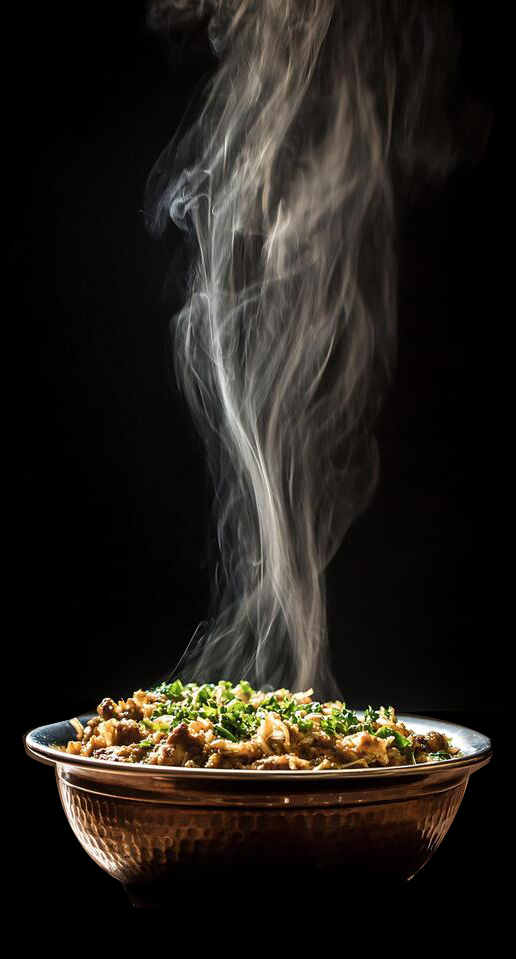
The doctor approached with his steaming bowl, the liquid inside glowing rosy under the meat-light from the ceiling. His fingers were long and lacquered, ending in nails that curved like hooks. The smell of the brew was thick and sweet at first, then turned metallic, like blood kept too long in a basin.
“Feed me,” I said.
A child is dying somewhere — in the next street, in another country, in the sky above. My friend once spoke against the deaths of children in far-off lands. Someone replied to her: “You wish the other children were dying instead.” And she said, “That is monstrous.”
I have spent years searching for a better word than “monstrous” — terrible, vicious, cruel — but none of them hold the same truth. “Monstrous” is where the speaker placed himself with those words: outside the wall of compassion, beyond the reach of even pity. To deny a child compassion is to become something else entirely. Something the angels above would embrace.
I began to drink from the bowl. The liquid was hot, almost alive, and as it passed my lips, a prickling started under my skin, as if tiny mouths were biting from within. I understood I was reacting. The doctor watched without moving. His eyes reflected the pink beams, making them look like wounds.
The monster evokes, in equal measure, both compassion and its opposite.
I understood I would have to drink it all.
The beams above shifted again, and the angels descended lower, their fraudulent romance dripping like syrup from their mouths. One approached — her wings were made of stitched-together lovers’ letters, stained and curling with age. She reached for me as if to kiss, but her lips were cold porcelain. Her breath smelled of iron. The kiss was not a kiss; it was an exchange of something nameless, something counterfeit, like a debt disguised as affection.
Around her ankles, other angels coiled like snakes, whispering promises in languages that no living heart could understand. Their bodies shimmered with beauty, but each movement was wrong — too slow, too sharp, too eager. The love they offered was an imitation, a forgery pressed against the skin until it bruised.
The doctor dipped his fingers into the bowl and brushed them along my temples. I could feel the liquid seeping into me, changing me. My bones began to hum. My teeth grew warm. In the beams, my shadow was no longer mine — it was taller, broader, with wings that twitched like insect limbs.
Above, the angels laughed. One peeled the skin from her own face to reveal another face beneath, more beautiful, more false. Another plucked out his eyes and rolled them across the floor toward me, the pupils spinning like coins. Wherever the eyes landed, the carpet sprouted flowers that smelled of rotting honey.
I drank again. The prickling deepened, becoming a crawling. I could feel something moving through my veins, mapping me. My compassion — my pity — began to flicker. It was as if the liquid was erasing the bridge between pity and revulsion, leaving me stranded on one side.
The doctor spoke at last. His voice was low and full of dust.
“You will leave here changed,” he said. “The cough will remain, but the light will no longer follow you. You will follow it.”
The angels pressed closer to the ceiling, their hands reaching down like roots. They were singing again — a song about love so convincing it almost hurt, but the pain was hollow. They wanted me to join them. To rise through the beams and dissolve into their fraudulent embrace.
I finished the bowl.
The prickling stopped, replaced by a heavy stillness. My skin was pale as wax. My breath came in shallow threads. The doctor turned away, as if my face now carried the carvings of his door.
I looked up into the beams and saw my own reflection in the angels’ eyes. It was not me. It was something monstrous — a creature shaped by both compassion and its opposite, pressed together until they were indistinguishable.
The angels smiled. They had been waiting.