Love was an entity that fed on emotion, abridged, post-semantic, Gabriel Jeroschewitz, April 9th, 2025.
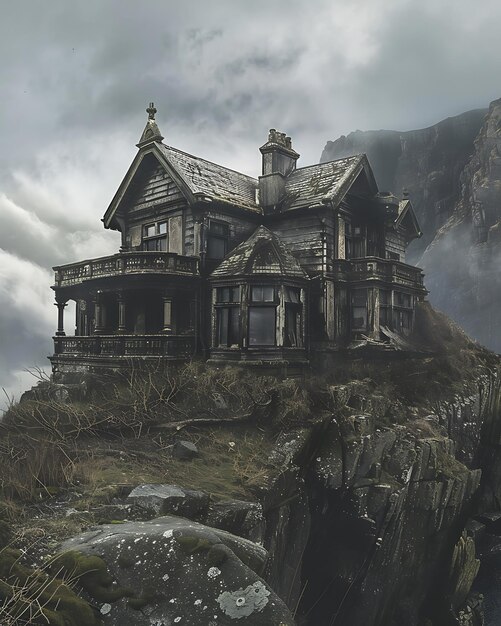
The old house, perched on a cliff that overlooked the tumultuous Atlantic, was a sight to behold. Its weathered shingles, the color of dried bone, whispered tales of a profound love that had the power to warp reality. As a folklore scholar, I was drawn to this enigmatic place by a morbid curiosity and a grant that promised to replenish my savings. I decided to spend a month within its decaying walls, eager to uncover its secrets.
The property belonged to the estate of Elias Thorne, a celebrated poet who vanished in the 1920s, along with his muse, a woman named Seraphina. Elias was obsessed with Plato, particularly the quote, “At the touch of love, everyone becomes a poet.” He believed that Seraphina was his conduit to a higher plane of artistic expression, that their love was a key to unlocking truths beyond human comprehension. The last entry in Elias’s journal, found years later, spoke of a ritual, a merging of souls through verse, performed under the light of a blood moon. Then, silence.
The real estate agent, a nervous man with a perpetually damp brow, handed me the keys with a tremor. His warning, delivered with a quiver in his voice, sent a shiver down my spine. “Just…try not to stay out on the cliffs after dark, Mr. Harrison,” he stammered. “Bad things are said to happen.”
The interior was exactly as I imagined – dust motes dancing in the shafts of sunlight pierced through grimy windows, the air thick with the scent of mildew and forgotten dreams. Elias’s study, overlooking the sea, was a chaotic shrine to his obsession. Books on ancient Greece were stacked haphazardly, poems scrawled on parchment littered the floor, and a large, unfinished canvas leaned against the wall, depicting a swirling vortex of colors.
The first few days were uneventful, filled with archival research in the local library and cautious house exploration. I found drafts of Elias’s poems, passionate verses filled with longing and an almost unsettling adoration for Seraphina. She was described as ethereal, a being of pure light and inspiration, a goddess descended to grace his life. But as the days passed, a sense of unease began to settle over me, a feeling that I was not alone in the house. I dismissed it as the typical hyperbole of a lovesick artist.
Then, the dreams started.
I would wake in a cold sweat, heart pounding, with fragments of verse echoing in my mind—not my own words, but Elias’s, or perhaps…Seraphina’s. They were beautiful and terrifying, filled with imagery of intertwining souls and transcendence achieved through artistic rapture. In my dreams, the house pulsed with a strange, unsettling energy, the walls breathing, the shadows whispering secrets in a language I couldn’t quite grasp.
One evening, as the sun dipped below the horizon, painting the sky in hues of blood orange and bruised purple, I found myself drawn to the cliffs. The wind howled like a banshee, and the waves crashed against the rocks below, a relentless, rhythmic roar. I felt an inexplicable pull, a sense of recognition, as if I had stood on this very spot before, in another life.
Then, I heard a voice, soft as the rustle of silk carried on the wind. It was reciting poetry, Elias’s, but with a haunting cadence and a feminine inflection that chilled me to the bone. I strained my eyes, trying to pierce the gathering gloom, and saw her.
She stood at the cliff’s edge, a figure cloaked in swirling mist, her hair a cascade of moonlight. Shadows obscured her face, but I could feel her intense, knowing gaze piercing me. As she spoke, the air around her shimmered, and the fabric of reality seemed to warp and bend.
“Do you understand now?” she whispered, her voice echoing in my mind. “Love is not merely an emotion. It is a conduit. It is the key to unlocking the infinite potential within.”
Fear gripped me, but it was mingled with a strange fascination. I wanted to run, to scream, but I was rooted to the spot, paralyzed by her presence.
“Elias understood,” she continued. “He knew that through our love, through our poetry, we could transcend this mortal coil, become something…more.”
The wind picked up, whipping my hair around my face, and the waves below crashed with renewed fury. I felt a pressure building in my head, a sense of being pulled in two directions, as if my soul was being stretched and contorted.
“He longed to unravel the mysteries of the universe, to dance among the stars,” Seraphina said, I think (because I couldn’t be too sure of what was reality anymore). “And I, his willing partner, helped him do just that.”
I tried to speak, to ask her what she meant, but no sound escaped my lips. My mind was a maelstrom of fragmented thoughts, images of Elias, Seraphina, ancient rituals, and swirling colors.
Then, she extended a hand, her fingers long and slender, shimmering with an unearthly light. “Join us,” she crooned. “Become a poet. Become eternal.”
That’s when the true horror struck me. Elias hadn’t found a muse; he had found something far more dangerous. He had fallen in love with an entity that fed on emotion, on passion, on the very essence of human creativity. Seraphina wasn’t a woman; she was a parasite, a siren luring souls to their doom with the promise of artistic immortality.
And Elias, blinded by his ambition and infatuation, had opened the door, unleashing her power upon the house and the world.
In a moment of clarity, I understood the truth. The “love” that Plato spoke of was a double-edged sword. It could inspire great art, but it could also lead to obsession, madness, and the complete disintegration of the self. Without reason to ground it, love could easily become a pathway to destruction.
Gathering every ounce of willpower I could muster, I screamed. It was a primal, guttural sound, born of terror and desperation, a rejection of her offer, a refusal to surrender my soul. But the figure on the cliff did not yield. Her eyes, burning with an unholy light, were filled with rage and disappointment at my defiance.
The figure on the cliff recoiled, her shimmering form flickering and distorting. Now visible in the darkness, her eyes burned with an unholy light, filled with rage and disappointment.
“You cannot escape your destiny,” she hissed. “The touch of love has already claimed you.”
Then, she vanished, dissolving into the mist, leaving me alone on the cliff, trembling and gasping for breath.
I stumbled back to the house, my mind reeling, my body aching with exhaustion. I packed my bags, every movement driven by a frantic urgency. I didn’t bother to clean up, to finish my research, to do anything but escape that accursed place.
I glanced back at the house as I drove away in the pre-dawn light. It stood silhouetted against the rising sun, a dark and forbidding presence on the horizon. I knew I would never forget what I had seen or felt.
In the rearview mirror, I thought I saw a figure in one of the windows watching me. Shadows obscured her face, and her eyes were burning with an unholy light.
I floored the accelerator and didn’t look back again.
I still dream of Seraphina and Elias, the churning sea and the crumbling house on the cliff. The dreams are less frequent now, but they are always there, lurking beneath the surface of my consciousness. And sometimes, when I’m alone in the dark, I hear the faint echo of poetry, carried on the wind, a haunting reminder of the price of love, the cost of inspiration, and the terrifying power of Plato’s words. I never write, but I swear, I dream in perfect verses. It’s the curse Seraphina left me with when she couldn’t claim my soul. I exist in love, as a poet; just not in life.