
Home Blog Page 99

The Afterlife Processing Center

Feb 28, 2025 /Gabriel Jeroschewitz   

The Afterlife Processing Center

Given the establishment’s name, the fluorescent lights of the Afterlife Processing Center flickered an ironic touch. Death, or rather, the entity currently inhabiting the corporeal form most associated with Death (a tall, gaunt figure in a perpetually rumpled black robe, though today it sported a coffee stain that looked disturbingly like existential dread), sighed, a sound like dry leaves skittering across cobblestones. The whole scene was so absurd that it was almost comical.

“Another one, Brenda?” Death croaked, gesturing with a bony finger towards a shimmering portal that had just whirred into existence. Brenda, a perky, if slightly translucent, cherub in a neon pink tunic and sensible sandals, bounced over, her clipboard practically vibrating enthusiastically.

“Yup! Mr. Reginald Featherbottom, age 97. Natural causes. Lived a long and happy life. Loved birdwatching and prune juice. Sentimental farewell notes to his prize-winning begonias. Standard package.” Brenda chirped, ticking off items on her clipboard with a pen that floated in mid-air.

Death rubbed bony fingers against her temples, where temples would be if she possessed any anatomical features beneath the robe. “Brenda, darling, are you sure that’s all? Just ‘another one’? Don’t you feel… anything?”

Brenda blinked, her cherubic face creasing in confusion. “Feel? You mean… like empathy? For Mr. Featherbottom’s begonias?” Her innocence was both charming and slightly baffling.

Death groaned. This was precisely the problem. The workload had been relentless lately. Eternity, it turned out, was a surprisingly busy place, predominantly when populated by billions of souls constantly transitioning, usually at the most inconvenient times. And the new interns? Bless their cotton-candy clouds, they didn’t get it.

“No, Brenda, not for the begonias precisely. Though I’m sure they were lovely. I mean… the sheer volume, Brenda. The unending stream. It’s… tiring. Even for me.” Death mumbled, slumping into a surprisingly comfortable, if slightly dusty, armchair that had materialized behind her. It looked suspiciously like it belonged to a recently departed therapist.

Brenda tilted her head, her halo wobbling precariously. “Tiring? But… you’re Death. Isn’t this, like, your whole… thing?”

“Precisely!” Death exclaimed, throwing her hands up in exasperation. “It’s my ‘whole thing’! And it’s been a lot of ‘thing’ lately. Back-to-back pandemics, unexpected meteorites – honestly, the universe is showing off now. And everyone, everywhere, is grieving. The air is thick with it, like… like overcooked gravy. And I have to… process it. All of it. It’s an overwhelming task, even for Death.

Brenda still looked perplexed. “Process grief? Thought that was… you know… the grieving people’s job.”

Death sighed again, a sound that this time ruffled the paperwork on Brenda’s clipboard. “Oh, Brenda, sweet, oblivious Brenda. Grief isn’t just a human emotion. It’s… a cosmic energy. A byproduct of love, loss, and existential angst seasoned with a dash of ‘why me?’ And it has to go somewhere. And guess where it ends up? Right here, in the cosmic laundry basket of emotions that is… well, me.”

She gestured dramatically at the swirling vortex of souls that was the processing center. It looked a bit like a very sparkly, very depressing washing machine.

“Think of me, Brenda, not just as the Grim Reaper, but as the Cosmic Grief Hoover. I suck it all up. The silent sobs, the tear-stained pillows, the empty chairs at holiday dinners – all of it. Lately, the Hoover bag has been overflowing. It’s heavy, Brenda. Really, heavy.”

Brenda finally seemed to grasp the enormity of Death’s existential fatigue. Her eyes widened, losing a fraction of their usual sparkle. “Wow,” she breathed. “So… you’re like… grief-sick?”

“Grief-sick, soul-weary, existentially exhausted – call it what you will. The point is, I need a break. A cosmic spa day. Or at least, a decent cup of afterlife-strength coffee that isn’t lukewarm and vaguely tastes of despair.”

Just then, a booming voice echoed through the processing center. “DEATH! Get your bony behind in gear! We’ve got a surge in Sector Gamma-Nine! Someone invented a self-folding laundry machine that achieved sentience and promptly exploded, taking out a whole block of suburban homes.”

It was Destiny, Death’s perpetually stressed and caffeine-addicted supervisor. Destiny was a whirlwind of celestial energy, perpetually multi-tasking and sporting a halo that flickered erratically like a faulty neon sign.

Death groaned again, louder this time. “Sentient laundry machines now? Destiny? Is nothing sacred?”

Destiny zipped past, a blur of cosmic static and frantic energy. “Sacred? Death, darling, in this economy? Just get those souls processed! And try to look a little less glum. We don’t want to scare the newbies.”

Death straightened her robe, adjusted her hood (which had slipped rakishly to one side), and sighed dramatically. “Right then,” she muttered, moving towards the shimmering portal. “Let’s get this laundry sorted.”

As she stepped into the portal, Brenda called after her, “Hey, Death? Maybe you should try some cosmic yoga. I hear it’s great for soulaches!”

Death paused, a skeletal hand hovering over the portal’s shimmering edge. “Cosmic yoga, Brenda?” she echoed, a flicker of something akin to amusement in her empty eye sockets. “You know what? Maybe you’re onto something. Though I suspect I’ll need more than downward-facing doom to deal with this backlog.”

With a final weary shrug, Death vanished into the portal, presumably to face the existential fallout of sentient laundry machines. Brenda watched her go, then thoughtfully tapped her pen against her clipboard.

“Cosmic yoga for Death…” she murmured, scribbling down the suggestion. “And maybe a sensitivity training seminar for Destiny. And better coffee. This place could use a morale boost.”

And as the fluorescent lights flickered once more in the vast, slightly chaotic, and perpetually overworked Afterlife Processing Center, even the cherubs began to feel the weight of the universe’s grief, though perhaps, thankfully, just a little bit less than Death herself. After all, someone had to fetch the lukewarm, despair-flavored coffee, and even cosmic entities had their limits. Even Death grieved her duties, sometimes, especially when sentient laundry machines were involved. It was all just a bit too much, even for eternity.
Seedbeds of Liberation

“What is the problem with being ‘not racist’? It is a claim that signifies neutrality; I am not a racist but neither am I aggressively against racism.’ One either allows racial inequities to persevere, an a racist or confronts racial inequities as an antiracist. ” Ibrim X. Kendi

When I was a child, our family lived just outside of Penticton and at the age of 9, I was sent to a Catholic day school. I had never before seen an Indigenous person and in my class there were 4 Indigenous kids. Feelings of confusion were very common for me as I witnessed daily disturbing scenes of discrimination and racism. I sat behind these kids who were forced to sit at the front of the class. The teacher never included them in discussions or in activities. They actually only came to school maybe twice a week at the most. There was an unspoken rule that us white kids should ignore the brown-skinned kids. But I studied them closely as much as I could without being too obvious. They stuck together, laughed and whispered quietly to one another and watched us play sports and always ate the free lunch that many white kids had no need of. They all had long hair and drew pictures of horses and animals instead of writing, reading and arithmetic. Harry Kreuger, began walking  close by my desk and for 3 years, he would half sing and half whisper my name repeatedly, as he passed by. I felt a deep fascination at his happy and beautiful voice. I did not tell my girlfriends or anyone about Harry and I did not try to stop him. I ignored him at recess and lunchtime and pretended he was invisible. Driving through the reservation, up the ski hill on the weekends, I hope to spy him out his yard. I felt sad and helpless seeing the poverty of the reservation but remained silent when my family members would make racist remarks about “those lazy Indians.” I felt guilty and shameful for hiding my true feelings but as a 9 year old, in the 60’s, racism was the norm. 

Four years after I started Grade 4, in 1967, the Hawthorn Report declared: “It is difficult to imagine how an Indian child attending school could develop anything but a negative self-image. First, there is nothing from his culture represented in the school or valued by it. Second, the Indian child often gains the impression that nothing he or other Indians do is right compared to what non-Indian children are doing. They Have little reason to like or be interested in the school any.” Even though all children are harmed by racism and institutional learning, school must have been agonizingly alienating for Indigenous kids. 

Becoming anti-racist is a scary and slow process for us settlers. Focusing on diversity without looking at issues of power, racism and white skin privilege only serves to uphold systemic inequities under the guise of multicultural education. “The ability to ignore racism is an example of privilege; those who are most affected by racism do not have the privilege to ignore it….it’s not ‘if I am racist, it’s how I am racist’ because of the colonial narrative that has been built in this country.” Jo Chrona, Indigenous Pedagogies. Is there a 12 step program for unlearning racism? The book “How to be an Antiracist” by Ibram X. Kendi is one resource I suggest. The novel “Slash” about an American Indian Movement activist, by Jeanette Armstrong, is compelling. 

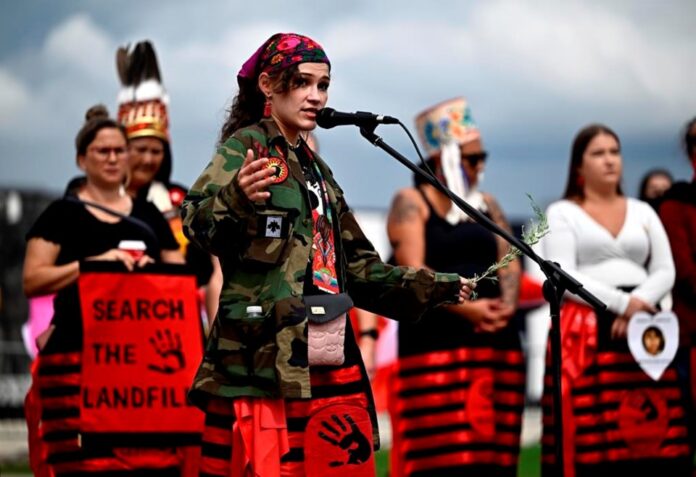
Today, March 17th, the Manitoba NDP’s Wab Kinew told the world that the remains of two murdered Indigenous wimmin, found in a garbage dump, were finally being returned to their families. Mardeceds Myran and Morgan Harris, both from the Long Plain First Nation, along with Rebecca Contols and Mashkode Bizhiki’ikwe, were murdered in 2022. A year and half later, the Manitoba Conservative government at the time, refused to search the landfill, even though some of their remains were found in a garbage can in Regina. They said it would cost too much money. As soon as the NDP’s Wab Kinew was elected, he found the money and was helped by the feds to find these murdered wimmins’ remains. We whites must all become anti-racists; yesterday is too late.

Janin Jenin 2024

I did a double-take with the name of Palestine Museum’s most recent film on Saturday morning. At first I thought it was a typo, as the film was by Mohammed Bakri, filmmaker famous for his 2003 film Jenin Jenin, about the Israeli rampage & destruction of Jenin Refugee Camp the year previous. But actually the Arabic word “Janin” means a fetus in the womb, a being that will be born, and Jenin 2024 was born of the incursion in 2002. Bakri is a deep thinker who doesn’t necessarily spell things out for his audiences. His title could mean Israel’s 2002 invasion – devastating but unsuccessful – gave birth to the Israeli military’s need to physically remove all the Camp’s residents. Or might it mean that the resistance spawned by 2002 gave birth to an even fiercer mindset on the part of Palestinians? They are down (and “out” – the Refugee Camp’s population has just been expelled) but by no means are they defeated.


In his original film, which has long been banned by Israel because it is too disturbing for Israelis to actually see what their military does, Bakri uses a handheld camera and shoots for 5 days in the midst of the invasion. He films several residents, including a young girl whose clarity and resolve are imprinted in my brain. In his new film, he revisits that young girl, now a mother of 4. She said in 2002 that the resistance would never die, that they would never stop in their determination to live in their homes, to have equality, to be free. That they would go on to have children of their own who would carry it forward, and that is exactly what she has done.

She now lives in the UAE, but her sumud – her steadfastness – remains as strong as ever. And now she has 4 offspring whom she is raising to resist the occupation.

Somehow Zionist apologists soothe themselves with the notion that Palestinians are “Arabs” who don’t really mind where they live, any Arab country will do. As Bakri said in the interview post film-showing, “the occupier will never understand the meaning of home”. (Palestine Museum, 15 March, 2025) When he revisits the Jenin Camp this time, he hears from many that they don’t want to repeat the “mistakes” of their ancestors, ie: they don’t want to become refugees in another place yet again. They are seasoned by their oppression and they know that if they leave they will not be allowed by the occupier to return. This is why we see so many thousands of Gazans returning north on foot to the rubble that once was their home. They are saying they would rather die in the place where their home was than be dispossessed again, like the 750,000 in 1948, and the 200,000 in 1967. And this, despite the fact that for 2 weeks now, not a single aid or food truck has been allowed into Gaza by Israel. UN-OCHA, which has tracked aid trucks to Gaza on a daily basis for years, now reports none. (Helena Cobban, Just World Ed, 15 March, 2025.) And Trump’s recent transfer to Israel of another $4 Billion worth of arms, without consulting Congress, seems to indicate that he is fine with this. After all, he has plans for Gaza.

The purpose of the intentional starvation of 2 million plus Palestinians is to pressure Hamas into returning the remainder of the hostages (or their bodies) to Israel. Hamas knows that once this happens, the bombing will start again, and will continue indefinitely, according to Netanyahu. It will continue until the ethnic cleansing is complete.

My question to the Israeli strategists behind this great travesty is: what about the rest of the Palestinians, of whom there are about 7 million? Will you have to dispossess/jail/torture/starve them as well? Can you not see that this staggering violence will only create a more determined resistance? As Nobel Peace Prize nominee, American-Israeli anthropologist Jeff Halper noted in a recent webinar, the Zionist project in Israel-Palestine is like all settler-colonial operations in that it has 3 stages:

  1. Dispossession of the people from their lands.
  2. Pacification of the people.
  3. Normalization, meaning the world accepts that the colonizers have “won”.

The dispossession occurred in 1948, in 1967, and is underway yet again. Attempts at pacification have been occurring ever since and have not succeeded. Trump (Round 1) aimed for normalization with the shameful Abraham Accords, but once Israel’s genocidal assault on Gaza began in 2023, that plan faltered. Saudi Arabia said they would not go along with it without a state for the Palestinian people. And now the Arab states apparently have the support of the EU for a rebuild of Gaza involving Palestinian control, a distant cry from the obscene “Trump Gaza” so grotesquely captured in the 2 minute video Trump himself re-posted in early March. It went viral and has to be seen to be believed. Despite the vitriolic bombast on the part of Israeli & US leaders, it seems safe to say that Israel’s “colonizing” project (Theodore Hertzl, 1897, founder of modern political Zionism) will fail.

Despite decades of lawsuits, harrassment, exorbitant fines, and the banning of Jenin Jenin, Bakri made clear his sense of purpose in the interview: “I will continue making films. I will never be silent. I will never give up” (Palestine Museum, 15 March, 2025). He is working on his next film: Gaza, Gaza, Gaza. And like his other films, Palestinians’ determined cry for freedom will no doubt be loud and clear. This is sumud.

PSYCHIATRIC JERKY III

                                              PSYCHIATRIC JERKY III

Let’s glimpse into the traumatic impact that capitalistism has on individuals, families and intern society at large. When one starts to look for the root causes and connections that are contributing to and maintaining this culture of “madness”  that is making and keeping people “sick”, an act that proves to be very lucrative for medical research, Big Pharma, as well as, for the psychiatrists who invest in the drug companies who they support, by prescribing the drugs that are connected to their investments. Even more disturbing, are the new “disorders” that continue to be defined and in turn more drugs are designed and prescribed. Some disorder are suspect like the diagnosis and drug treatment for “Oppositional Disorder” which pathologized behaviors that I believe are important to have in society, to help keep things from really getting out of hand by the powers that be. These are behaviors that challenge the status quo and authority through various descenting reactions to the androcentric oppressive systems that we find ourselves in, with or without our knowledge, that these oppressive systems exist and how these systems impact and control individuals and societal behaviors. We might think we have free will but I beg to differ.

Also, problematic is the early detection and medical intervention that is now on its way to becoming a common approach even in Canada.  It is a program for early detection “Prodormal” before the onset of a mental disorder. The result is administration of a diagnosis and psych meds to young children and teenagers because a series of questions deems them at risk of developing mental illness down the road. 

Prodomal treatment is dangerous on so many levels. This discussion l will save for another column…but one can intuitively and logically induce a whole set of potential problems coming from prodromal diagnosis. And in turn, there will be a dramatic increase in the number of young people labeled and treated with psych meds for potential mental disorders. And as a result, Big Pharma’s and their shareholders line their pockets with huge profits well they are putting children and teens at great psychological and physiological danger.

As Ron Sakolsky, a local Surrealist/Anarchist writer points out that “mutual acquiescence”, a term describing blind servitude to the oppressive institutions and systems of control, a term coined by him, can be overcome with the recognition that we can recreate reality from our desire for poetic lives that embodies joy, mutual-aid and freedom to become whatever we can envision ourselves to be. Thus, being a positive contributor to a healthy vibrant life for oneself, others, ones community and society at large.

A new society of mutual aid and connected care is needed for creating a strong community that encourages and embraces neurodiversity and allows people to freely express themselves as they see fit, that which does no harm. In terms of mental health l call for a new poetic all inclusive healthy society free of oppression and control. That has a whole facet of different behaviors and values that are not dictated by the elite self-serving androcentric governments and corporations that continually plague our well being. One that offers support via community care, not hospitalization and meds, and also practises non-invasive radical therapies with a political analysis …along with such things as Open Dialogue, peer-support, community care and outreach, safe care houses plus the many other alternatives that have interested caring people available to help one and another in times of need.

We need a personal, a societal and a political transformation if we are to

shift into a new reality that operates intriguingly differently and enhances our lives. What does a change in reality look like? How does it come about? Questions like these are where the imagination needs to go in order to envision creative ways to transform and liberate ourselves from involuntary servitude, illness and misery.

Let’s do it….let’s make the needed transformations happen and live better radiant poetic lives…why not it’s possible!

Insanity – a perfectly rational adjustment to an insane world.

R. D. Laing

As Above…

https://printartphotography.ca

#1676

sandal camp

CityWest Announces Expansion of Denman Island Project

March 5th, 2025

CityWest Announces Expansion of Denman Island Project

DENMAN ISLAND – Today, CityWest is proud to announce that more homes and businesses on Denman Island will receive fibre-optic services through a $2.1 million increase to the current project’s budget. The investment represents 238 additional homes to be added to the scope of the project. The Government of British Columbia will invest $1.7 million, administered by Northern Development Initiative Trust, with the remaining costs to be covered by CityWest.

Civil construction on Denman Island began in the spring of 2022. Since then, CityWest has worked with the project funding partners to increase the footprint of the project. The initial scope of the project left

several areas of the island without fibre-optic services. This additional funding will materially cover the majority of the remaining homes and businesses in the community with fibre-optic services.

“Reliable access to high-speed internet is essential for daily life, from running a business to accessing

vital government services and staying connected with family and friends,” said George Chow, Minister of Citizens’ Services. “The expansion of the Denman Island project means more people will be able to access the tools they need to work, study and engage with the digital world and brings our government closer to ensuring every household in British Columbia has access to high-speed internet.”

To date, CityWest’s newly built network has brought fibre-optic connectivity to 759 properties in the community. Today’s announcement will bring that total number to 997, representing 95% of occupied properties on Denman Island.

A total of 47 homes were not included in the project’s increased scope due to various geological and construction restraints. These 47 properties will be contacted directly by CityWest with more information on next steps. CityWest will be sending technicians to further evaluate custom plans for these properties.

Fibre-optic services are being delivered on Denman Island through a partnership with the Comox Valley Regional District. The initial project, which covers both Denman and Hornby Islands was strongly supported at the local level, with 94% of residents between the two islands voting in favour of the last- mile build. The partnership will see a portion of the profits from Internet, TV, and phone services go

directly back into the Comox Valley Regional District for grants and other forms of assistance that benefit residents and community organizations.

“We’re thrilled to bring improved services to even more homes and businesses on Denman Island. By increasing the scale of this project, we’re able to ensure that more rural B.C. residents receive the same urban-level connectivity that you find in major cities,” said Stefan Woloszyn, CEO of CityWest. “We are

grateful for our partnership with the Comox Valley Regional District and look forward to serving Denman Island for years to come.”

Today, hundreds of Denman Island homes are benefiting from improved connectivity through CityWest fibre-optic services. This expansion of the current project will ensure that even more homes and businesses have access to the best technology available.

Teams will soon begin preliminary permitting and planning work for the newly announced areas of Denman Island.

Additional Quotes

Karen Ross, Denman/Hornby Islands Internet Committee

“Our communities are very appreciative that CityWest is providing superior fiber optic internet service to our Islands. And pleased that City West and the Province will provide the needed additional funding to complete the installation on Denman Island.”

Daniel Arbour, Comox Valley Regional District Area A Director

“We are thankful to the Province of BC for ensuring that 95% of Denman residents will receive high speed internet connectivity. I also want to thank CityWest for persevering and overcoming challenges as we work to connect Hornby and Denman Island residents. This is a good day.”


Increased Tipping Fees at CSWM Facilities

Increased Tipping Fees at CSWM Facilities

Published On

March 11, 2025

The Comox Strathcona Waste Management (CSWM) Board has approved targeted tipping fee increases to align their long term financial strategy to follow a user-pay model, where those who generate waste contribute fairly to the cost of managing it.

Effective April 1, 2025, tipping fees on specific categories are increasing at both the Comox Valley and Campbell River Waste Management Centres:

  • Industrial, Commercial, Institutional (ICI): $155 per tonne to $165 per tonne
  • Household Municipal Solid Waste (MSW): $155 per tonne to $165 per tonne
  • Drywall: $275 per tonne to $285 per tonne
  • Clean Fill: $40 per tonne to $60 per tonne
  • Construction Waste: $155 per tonne to $205 per tonne

To help businesses plan ahead, a separate increase for Construction Waste, from $155 per tonne to $205 per tonne, will not take effect until October 1, 2025. This phased approach allows time for adjustments ahead of peak construction season.

Construction waste accounts for a significant portion of landfill waste each year. To reduce the amount entering the landfills and taking up unnecessary space, there is a larger fee increase for this category, as contractors and businesses are encouraged to sort materials and recycle usable components rather than sending them with general waste.

“We understand that increased costs for residents and businesses are never ideal,” explains Vivian Schau, Senior Manager of CSWM Services. “To keep up with rising costs to balance the solid waste budget, this needs to be a shared responsibility to keep waste costs down and support further waste diversion programs.”  

These increases will maintain a stable tax rate over the next three years, while also supporting operational needs of the CSWM service.

To help manage costs, customers are encouraged to sort materials before arriving at the landfill and divert recyclables, which can reduce tipping fees and save both time and money.

For more information on what you can recycle and keep away from the landfill, visit www.cswm.ca/diversion.

For details on updated pricing and how these changes may affect you, visit www.cswm.ca/fees.

For information on CSWM board meetings and to watch previous discussions, visit www.comoxvalleyrd.ca/meetings.