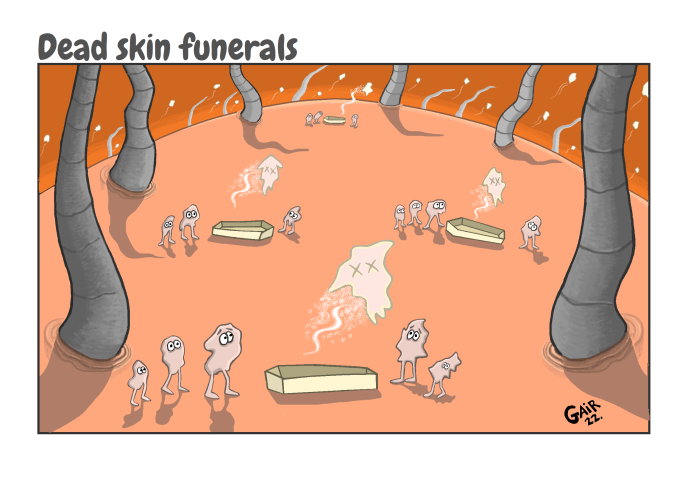


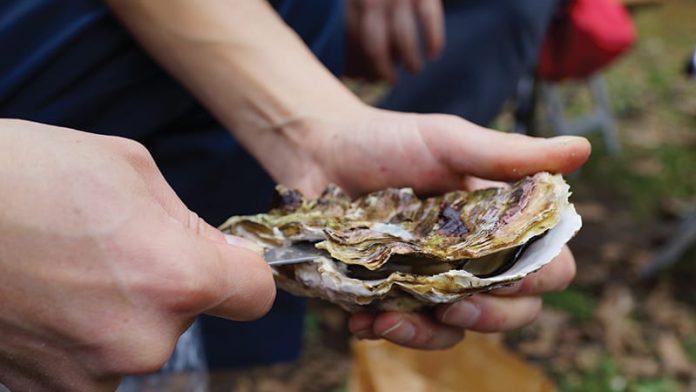
Shucking Oysters: Keeping It Weird
Keeping It Weird
Alex Allen
Full disclosure Denman, you borrowed this slogan, depending on your politics, from either the city of Portland or Austin. But that’s OK, mimicry is the sincerest form of flattery. As Marty Smith wrote, “if it’s any consolation, Portland isn’t the only non-Austin city to adopt the “Keep ____ Weird” mantra … You know what they say: When one person copies you, it’s plagiarism; when 50 people copy you, it’s a movement.”
According to CultureMap Austin and other sources, it was a telephone call from an Austin Community College librarian to a local radio station that launched the iconic slogan. In 2000, Red Wassenich called KOOP’s one Saturday morning because he was listening to ”The Lounge Show.” The show, a weekly radio program, played offbeat music (Bing Crosby crooning ”Hey, Jude”) and Wassenich liked it so much he made a donation. ‘Whoever answered the telephone asked, “Why did you support the show?’ ” Wassenich recalled, “I don’t know. It helps keep Austin weird.”
With that, the mantra was born, and Austin’s international reputation for being weird was established. Soon Wassenich and his wife began printing bumper stickers that year with the proceeds going to dogs shelters. And Wassenich is no stranger to weirdness himself. He fancies black velvet depictions of Elvis and has a collection of smashed cutlery and teapots hanging in his kitchen. His wife, when they met, had a collection of melted objects in her apartment. Weird.
Wassenich believes that Austin reached its weirdness heyday in the 1970s but admits that at that time he was in his 20s and “everyone thinks that in their early 20s.” Despite the city’s growth and the constant debate about whether Austin is truly “weird,” the slogan — and shop local campaign — has remained for over two decades. But some worry that the Austin has lost some of its weirdness due to commercialization and unaffordability. As for Wassenich, he’s not worried, “It ain’t as funky as it used to be, but neither am I.”
A sample of some weird Austin attractions … the Chicken Shit Bingo at Ginny’s Little Longhorn Saloon; the Cathedral of Junk; the Museum of the Weird; Spamara, featuring cooking and eating Spam contests; and Goga Yoga, goats climbing on you while doing the Downward Facing Dog and other positions. Part petting zoo, part yoga class. Weird.
And Portland? As Alexia Wulff wrote, “Portland has been affectionately referred to as ‘weird’ for decades – perhaps because it has the most strip clubs per capita in the nation or the highest prevalence of man buns and mustaches.” No matter what it is, the city’s weirdness has been apparent for decades.
Unfortunately, the city has also gotten more expensive than it used to be for artistic types to continue their thing, but there are a lot of people still working hard keeping it weird. One of those people, who dresses up as Darth Vader in a kilt and plays flaming bagpipes while riding a unicycle, is Brian Kidd, “The Unipiper.”
To help preserve the identity of the city, Kidd also runs a nonprofit, called Weird Portland United. Its vision: “a Portland devoid of barriers where citizens feel free to take risks, find success through living to their full creative potential, and take pride in their unique way of doing things.”
And Denman? Are you really still keeping it weird? Let’s have a look. You really like your stickers on your vehicles (including the one we are talking about). Though I’m not sure whether they exist to make a statement about yourself or are simply hiding random dents and scratches. But is this actually weird? According to psychologist William Szlemko at Colorado State University, the quantity of stickers on a car is a predictor of road rage. The more stuff plastered on the outside of your ride, the more likely you are to jump out brandishing a curling iron. (Don’t worry, Cortes Islanders really like their car sticker clusters, as well.)
So, let’s have a dawdle on Denman. You don’t have a marina, or a pub at a marina like most other islands. Weird. Even Lasquiti has a marina pub. You advertise only one place to go swimming (Fillongley Park), yet you have two lakes, and a couple of beach accesses. Weird, but I totally get it. And it’s been seven years now and you still don’t know how to merge. Weird.
Maybe it’s the locals who are weird, but from what I can observe as an outsider, you Denman Islanders seem rather normal, really. So perhaps, you may consider a couple of suggestions for a new island sticker: “Keep Denman Mildly Unusual” or maybe, “Denman: Trying to Keep It Weird.”
But hey, Denman, if you do manage to discover, promote and nurture those dreamers, creators, and risk-takers that Keep Denman Weird, then on Hornby, we will be sporting a new sticker on our vehicles: “Hornby Island: Between a Rock and a Weird Place.”
Caitlin Johnstone – Notes from the edge of the narrative matrix
We’re Taught About Liberal And Conservative Bias In Media, But Not US Empire Bias

One of the biggest problems with the urgent push for “media literacy” we’ve been seeing in the west these last few years is that everyone’s being taught about liberal bias and conservative bias in media, but they’re not being taught about US empire bias.
Your average western news media consumer will have some general awareness that Fox News has a conservative bias and MSNBC has a liberal bias, and if you try to use one of them to prove a political point to someone of the opposing ideology they’ll probably hasten to inform you of the biased nature of your source. A somewhat smaller but still very large percentage of the population will be aware that an outlet like RT is going to have a bias in favor of the Russian government, and if you try to cite RT to prove some point about Ukraine or whatever you’ll probably get called out on that right away.
That’s about as far as “media literacy” goes among the general public in the western world, which just so happens to work out very nicely in favor of the western empire. The radius of awareness extends just far enough to pose no threat to the empire’s information interests, and stops there.
https://twitter.com/Consortiumnews/status/1665723366810976256
What relatively few westerners are aware of is that the entirety of mainstream western media — both liberal and conservative — are so biased in favor of the US and its empire-like global sphere of influence that they are almost worthless for forming an accurate understanding of what’s happening in the world.
Every foreign policy agenda of the US and its allies is reliably facilitated by the western media, because the western media do not exist primarily to report the news, they exist primarily to administer propaganda. The New York Times has reliably supported every war the US has waged. Western mass media focus overwhelmingly on foreign protests against governments the United States dislikes while paying far less attention to widespread protests against US-aligned governments. The only time Trump was universally showered with praise by the mass media was when he bombed Syria, while the only time Biden has been universally slammed by the mass media was when he withdrew from Afghanistan. US media did such a good job deceitfully marrying Saddam Hussein to the September 11 attacks in the minds of the public in the lead-up to the invasion of Iraq that seven in ten Americans still believed he was connected to 9/11 months after the war began. To name just a few obvious glaring examples of far too many to list.
Kids aren’t being taught about this type of bias in school. Websites like AllSides and Media Bias/Fact Check set up to help improve “media literacy” and teach people about media biases focus only on biases of ideological partisanship, not international conflicts and foreign policy.
You’ve probably seen charts like this one from the Media Bias section of the AllSides website, where the biases of outlets are ranked from “Left” to “Center” to “Right”:
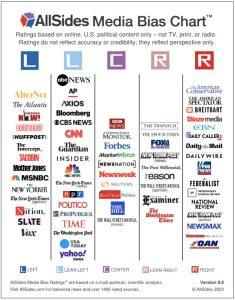
What you’ve never seen anywhere is a chart that ranks outlets in terms of how sympathetic they are to the US-centralized empire, with outlets like The New York Times, The Guardian and Fox News being listed on the extreme end of one side and more US-critical outlets like Consortium News, Mintpress News and Antiwar toward the other side. Notice how the above chart is so completely uninterested in foreign policy that it lists militarist smut rag The Atlantic in the same category as outlets that are often critical of US foreign policy like Jacobin and The Nation.
Here’s what the Media Bias/Fact Check profile on my (currently malfunctioning) website looks like as of this writing:
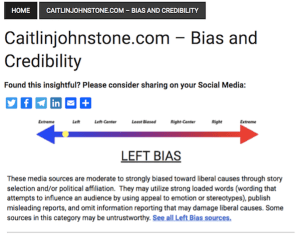
It places me on the far left ideologically, which is of course fair, but it doesn’t tell you anything about my attitude toward the US and its allies, which consumes a huge amount of my focus and commentary. Am I one of those “yay NATO” lefties or am I a “boo NATO” lefty? Am I one of those lefties who focuses on domestic issues and pretends foreign policy doesn’t exist? In international conflicts do I tend to side with the US, side with some other government, remain neutral, or some mixture of the above? It doesn’t say.
It doesn’t say for anyone else either. The New York Times is listed as having a “left-center bias” with a credibility rating of “high”. The New York Post is listed as having a “center-right” bias with a “mixed” credibility rating. It’s all about where they can be placed on the left-to-right ideology scale and some arbitrary determination about how “credible” they’re found to be, without any mention of the fact that they are both fiercely loyal to the US empire.
This is entirely by design. The whole push to promote “media literacy” and improve online information has never actually been about training people to see and understand the biases of media outlets, it’s been about training people not to see and understand them. At least not where it matters.
Foreign policy is the single most consequential aspect of government behaviour when it comes to the US and its allies, because it affects the most people to the greatest degree. Domestic policy has very real consequences for the kind of life people will have under the US power alliance, but you’re talking about questions like whether they’ll be able to afford healthcare or purchase legal cannabis, not whether they’ll be bombed, starved by crushing economic sanctions, or killed in a nuclear war. And yet our entire society is being trained not to look there when determining the biases of the sources we look to for information.
And this is exactly because foreign policy is so immensely consequential. Those who run the empire don’t care whether women can have an abortion or whether marginalized groups are abused by police, so they’re happy for the biases of their propaganda organs to be highlighted on such matters and for everyone to pour all their energy into debating them. What they absolutely do care about a very great deal is the operation of the globe-spanning empire, which is held together by nonstop violence and abuse and the threat there of.
So we are indoctrinated into supporting the US empire’s agendas of war, militarism, manipulation and resource extraction around the world, and we are trained not to look at the fact that we are being indoctrinated by sources of information who are all wildly biased in favour of that empire.
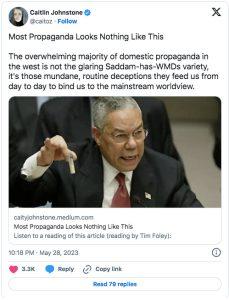
https://twitter.com/caitoz/status/1662795554869641219
By keeping the western media’s US empire bias out of the spotlight, imperial spinmeisters shrink the Overton window of acceptable opinion down to those foreign policy views which are promoted by mainstream information sources whose only criticisms of the empire come down to minor quibbles about the specifics of how the empire should be run, instead of whether a globe-spanning power structure should exist at all.
This is just one of the many sly little ways our perception of our world is tilted toward the interests of our rulers. It’s what Chomsky was talking about when he said, “The smart way to keep people passive and obedient is to strictly limit the spectrum of acceptable opinion, but allow very lively debate within that spectrum — even encourage the more critical and dissident views. That gives people the sense that there’s free thinking going on, while all the time the presuppositions of the system are being reinforced by the limits put on the range of the debate.”
A passive and obedient populace is exactly what the empire wants, so the imperial media keep the debate restricted to things like culture war issues and electoral politics, with the edges of the Overton window eclipsing out issues like capitalism, militarism, oligarchy and empire. In this way we are kept barking and snarling at each other, without ever turning our gaze upon our rulers, and without ever noticing how many more there are of us there are than them.
All my work is free to bootleg and use in any way, shape or form; republish it, translate it, use it on merchandise; whatever you want. My work is entirely reader-supported, so if you enjoyed this piece please consider sharing it around, throwing some money into my tip jar on Patreon, Paypal, or Substack, buying an issue of my monthly zine, and following me on Facebook, Twitter, Soundcloud or YouTube. If you want to read more you can buy my books. The best way to make sure you see the stuff I publish is to subscribe to the mailing list on Substack, which will get you an email notification for everything I publish. For more info on who I am, where I stand, and what I’m trying to do with this platform, click here. All works co-authored with my husband Tim Foley.

Bitcoin donations: 1Ac7PCQXoQoLA9Sh8fhAgiU3PHA2EX5Zm2
Jenin, Jenin (Part 2)

Jenin Jenin (part 2) by Sally Campbell
What is the power of art as resistance? How threatening is the artist to the fearful?
“The Freedom Theatre is a theatre and cultural centre in Jenin refugee camp, occupied Palestine. We stage professional theatre productions, hold theatre workshops in the refugee camp, Jenin town and villages, offer training in acting, pedagogy and photography, and publish books, exhibitions and short films. Since we opened our doors in 2006, we have made theatre and visual art available to every young person in Jenin refugee camp. Our work has made Jenin refugee camp known in Palestine and internationally for innovative, thought-provoking theatre and media productions. We have created a generation of artists and leaders, who one day will be at the forefront of the Palestinian liberation movement.” (The Freedom Theatre website.) This kind of sumud (steadfastness) is indeed very threatening to the State of Israel. You want the populace under your control to be weak and submissive, not empowered and inspired.
Israel’s Minister of Finance, Bezaliel Smotrich, now has basically a free hand in the West Bank, having been recently appointed head of its Civil Administration. He has indicated that the recent violent incursions (June & July) on Jenin refugee camp won’t be the last such type operation. Netanyahu’s ratings went up following the more severe July attack. All this suggests that a new policy is underway, rendering Jenin a target similar to Gaza. There, the military periodically bombs the most densely populated place on Earth, calling it “mowing the grass”. These events, wreaking havoc on Palestinian lives, are contained enough that they generally don’t make mainstream news. Tareq Hajjaj, Gaza Correspondent for Mondoweiss, said that he had trouble reporting after another such onslaught on Gaza 2 months ago, as his 5 month old baby was absolutely inconsolable. The incessant noise of the drones and the bombs falling on tiny Gaza (population over 2 million in a space the size of Texada Island) traumatized this baby. How many such traumatized babies and children live in places like Gaza and Jenin? And please! Someone tell me how does this kind of policy add to Israeli “security”? In the words of the little girl in Mohammed Bakri’s unforgettable 2005 documentary, Jenin, Jenin: “We will not give up. Yes, they destroyed everything, but we will rebuild it.”
As I wrote earlier on False Equivalencies, Western mainstream media tends to paint the crisis in Israel-Palestine as some kind of symmetrical “conflict”. Coverage by NYT writer Isabel Kershner, for instance, speaks of relentless Israeli attacks on the West Bank (this year, the most Palestinians killed in West Bank since the 2nd Intifada in 2002) as “reprisal” events, as if the Israeli military is simply responding to Palestinian terrorism. Canadian coverage is no better. CJPME (Canadians for Justice & Peace in the Middle East) recently filed a complaint with the CBC for its biased reporting of the July attack on Jenin. They cited 13 examples in a 28 hour period referring to Palestinian resistance fighters as “terrorists” or to Jenin itself as a “terror hub”, According to CJPME, “This language, directly adopted from the Israeli military, was presented to Canadian audiences without sufficient skepticism or counter-claims by journalists or others. This terminology was imprecise, misleading, defamatory and dehumanizing.” (www.cjpme.org) CJPME’s complaint goes on to clarify the definition of terrorism: “acts of violence carried out against civilians in order to advance political goals”. (italics mine) “With few exceptions, the militant groups in the Jenin refugee camp are involved in acts of armed resistance against military targets, including Israeli soldiers, military checkpoints and vehicles, and these cannot be considered acts of terrorism”. (CJPME)
On the other hand, most of those injured and killed in Jenin were civilians. Let’s see, who exactly is the real terrorist? (We would never hear the word “terrorism” used in reference to the Ukrainian resistance fighting against the Russian invasion.)
We know that in struggles against Apartheid and settler-colonialism, resistance will not cease until there is justice. The Freedom Theatre is a place of cultural resistance. It is now putting a 3 month recovery program in place for the children of the camp, none of whom is free from the trauma of the recent violence. TFT planned a big ceremony for July 15 in the middle of the camp, with clowns, singing, performance. Workshops, shows and cinema will follow, workshops for women/mothers to process what happened and for First Aid workers who were deliberately targeted by soldiers shooting at them.
The damage to the theatre is being assessed, but their courtyard was destroyed, doors blown off, huge cracks in ceiling. People taking refuge inside the theatre were kicked out so the Israeli military could set up operations there. Then after 2 days of mayhem (12 dead, 150 injured), the military left the camp, claiming its goals were accomplished. As one Freedom Theatre staff member stated: “We all need therapy and treatment…It is not just about structural damage, there is long-term psychological harm and trauma [to the community]”.
(TheFreedomTheatre webinar 9 July, 2023.) See their website for its training programs, productions and accomplishments: www.thefreedomtheatre.org.
(Next week: Part 3)
Phoenix Riting! – July 27th, 2023
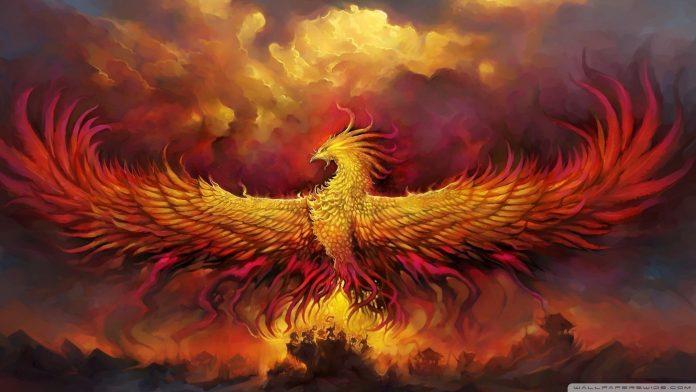
I’ve recently returned from a solo road trip that took me North. Just before Williams Lake, I drove into the heart of a province-wide pall of wildfire smoke. This is the height of wildfire season, and my home village of Fraser Lake was under an evacuation alert. I shall share the story here in brief, for it is worth telling.
My niece, a devout Christian, came to know and love a Muslim soldier in Afghanistan, who worked as an interpreter for the US military. It was harrowing, for he was frequently under fire. Once, the line went dead during their call and she spent days in terror for his life. Meanwhile, some of her friends, family and church community questioned her judgment, if not her sanity. Jennel didn’t care.
For seven years, she and Mahdi learned to love each other ever more deeply through this terribly long distance, meeting only once in India. They knew what they knew. When the US pulled out of Afghanistan, abandoning their Afghani support in the process, my niece was not about to let them get away with it! Jennel pulled strings, spent hours every day on the phone, exhorting action from people at higher and higher levels of the US military. It took a year, maybe two. She never let up for a second.
In the end, through intense bulldog persistence, my niece persuaded the Americans to go back and pull her beloved and many others, including hundreds of Afghani women, safely out and away from the Taliban.
Mahdi now lives with his new wife on the shore of Fraser Lake. The reception included Afghani expatriates, military personnel from South Carolina and Virginia (friends, admirers and supporters of Mahdi) as well as the local church community and Jennel’s family and friends. To see the way these staunch Northern rednecks (a label they use with pride) opened their arms and hearts to this amazing man, despite religious and cultural differences, was astonishing and heartwarming. Tales told at the mic brought floods of tears for both speakers and hearers.
As if divinely choreographed, the skies opened up just as the reception was beginning. The rains poured down for two days and washed the smoke right out of the sky. Yes, the dance space was drenched, but everyone rejoiced–rain in July, quenching fires, quelling smoke, glorious! Then the sunset came through, deep red, reflecting on the lake, so beautiful it hurt your heart.
It was pure, inspiring: a modern-day fairy tale. Their story would make a great movie, blending genres, romance, suspense and action-adventure.
I asked Mahdi how he liked it up North, thinking, oh the snow, the mosquitoes, it must be hard. His eyes shone enthusiastically. He declared, “I love it! It’s God’s country. And they have no idea!” I asked, who are ‘they’? He said, “The people who live here! They don’t know!” It struck me then what a Paradise Northern BC must be, after the life he has led in his poor, besieged and oppressed country, so far away. And it is true, Northerners love to complain. But deep down, we really do know. It is paradise, of a harsher sort than our sweet island. I still love it there. Every time I visit, I wistfully imagine moving back. But then I come home and… well, here I am. Why would I want to live anywhere else? My love for this little island, my adopted home, means it is highly unlikely I will ever return, save for visits.
Driving solo long distance for the first time made me realize, I loved it! I traveled like a turtle, with my home on my back, taking my time, stopping to camp when I felt like it. Exploring the beauty of BC. This province is incredibly beautiful, every inch and centimetre of it. Perhaps I shall do a road trip next summer to play music, once my album is out.
Speaking of music–the Festival is coming! This year I bought a pass. Why not? Every show is going to be amazing and I don’t want to miss a thing. My own turn opening for Alpha Yaya Diallo on August 12 is coming up so quickly–this is real! And I’ve been offered more shows at Lerena Vineyard. I played there a couple of weeks ago, and just loved it. Such a sweet venue, green and lush, and the people, food and wine are great. A couple young women painted me while I played and then gifted me their beautiful artworks at the end. I cried! It was the sweetest, loveliest tip. I’ll be playing there this Thursday at 5:30, and then again for several dates in August: the 1st, the 8th, the 22nd and the 29th. If my friends feel like coming out for any of those, it would mean so much to me!
The island is less crowded this summer, I noticed. When I returned from my trip on Friday afternoon, I showed up just as the ferry was loading, and they beckoned me aboard right away. It was quite surreal. I was expecting several hours’ wait, being a sunny Friday in mid-July. I missed the Hornby ferry by only two cars and was on the next one. Strange! I like it! Despite smaller crowds, business seems to be booming and now, it’s raining. Bless this wet! Happy summer, all. I will see you at the Festival.
That’s what I think. What do you think? email me at phoenixonhornby@gmail.com
A Tribute to a National Treasure – Oakley Rankin

A Tribute to a National Treasure
Kazuo Ishiguro, author of Remains of the Day, has called Eleanor Wachtel “one of the very finest interviewers of authors I’ve come across anywhere in the world.” She was one of the very few interviewers who truly enjoyed discovering her subjects and their writings and thrived on the necessary research—Pierre Berton had the same intense desire to prepare thoroughly before sitting down with a guest. Eleanor eschewed the banal; her questions and responses were intelligent and considered. That quiet enjoyment of all things literary and their importance to a well rounded life shone through in every interview she did. She swam against the current stream in believing that a high level of objectivity was attainable and did her best to keep her own biases out of her conversations. Her example is one we can all learn from; she conducted her interviews with compassion, wit, sensitivity, and humour—attributes sorely lacking in so much of our current cultural onslaught of opinion.
She is a Canadian ‘National Treasure’ and her Sunday afternoon hour for the past 33 years is a loss to our identity. On her final show June 25 she had tributes from Salman Rushdie, Zadie Smith, and Jonathon Franzen; she was joined on the program by Gary Shteyngart and Brandon Taylor. She will be sorely missed by many Canadians as well as listeners wherever she was broadcast around the world. We can only hope she will continue writing and broadcasting in her inimitable style.
Fortunately we can still access podcasts of many of her interviews and she has promised to make all 33 years worth available. For a second career as brilliant as her first,
Oakley Rankin
Green Wizardries with Maxine Rogers
Green Wizardries, Lughnasadh by Maxine Rogers
The Americans are losing the war in Ukraine and with it the last shreds of their national dignity and international relevance. The BRICS countries are announcing a new gold-backed currency in August. This is a direct challenge to the status of the US dollar as the world’s reserve currency. All these things are going to provide interesting challenges for the US and its allies, Canada among them.
Canada, under the Liberal/NDP federal government continues on its merry way of out of control government spending and assisted suicide for all. The country is rapidly burning down while becoming unaffordable to many of its inhabitants.
With all that in mind, I thought I would write something cheerful. Countries go up and go down and there is no point in getting overly emotional about things outside of our control. We are facing a time of great change but the world is always changing. The wheel of the year continues to turn and we are coming up to the splendid festival of Lughnasadh.
This is the ancient Celtic festival of the God Lugh who is a sun God. Some people consider Lugh to be the Celtic Apollo. The holiday falls on August first and consists of the usual round of prayers, reflection on the coming of autumn here in the Northern Hemisphere, the coming of the autumn years to people of my generation and the coming of the autumn years of Western Civilization. So, there is a lot to think about. Besides that, we get yet another occasion to feast with our friends and family and rejoice in the first harvest festival of this year.
The Irish used to enter into temporary marriages at this festival. If you didn’t like your new spouse at the end of a year and a day, you could just turn your back and walk away from them, ending the relationship. The reason for the marriages was that human fertility was considered a mirror of the fertility of the land. There may be something in this as humans are becoming less fertile, so are our lands.
Lughnasadh is quite a boisterous festival with athletic competitions such as foot races and horse racing. There is even a cycle race named after the festival. But Lughnasadh is chiefly famous for it’s dancing and feasting.
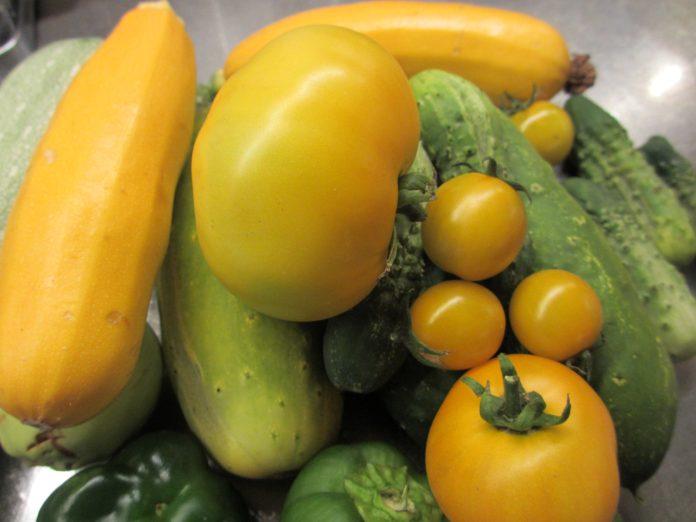
This is such an excellent time of the year to feast. We have heaps of fresh, lovely produce to choose from. The tomatoes will be ripe, figs should be ready, the first apples, sweet corn, greens fresh from the garden and of course the excellent freshly-harvested garlic. We make fresh cheese at this time too and it is so much better than store bought cheese.
A friend just taught me to make fresh pasta sauce with raw chopped tomatoes, finely chopped basil and thinly-sliced garlic. To this, you only need to add a little olive oil, salt and pepper and it goes, uncooked, over the hot pasta and is delicious.
Another dish you may want to try for this festival is gazpacho. Just blend some ripe tomatoes, celery, cucumbers and garlic in a blender. Add salt, olive oil,cumin, red-wine vinegar and chili to taste. Serve with some chopped red onions on top.
Cucumbers are doing well this season and every feast should start with a salad. My current favourites include Sichuan cucumber salad and basil cucumber salad. For the Sichuan salad, slice a bowl of cucumbers, add 1 teaspoon of salt, a dash of olive oil, 1 tablespoon of minced garlic, 2 teaspoons of apple cider vinegar, 1 teaspoon of soy sauce, 1 teaspoon of sesame oil, 1 teaspoon of sugar and 1 teaspoon of chili flakes. Stir and serve. This salad is delightful as it is both hot and cold at the same time.
The other salad starts with a bowl of sliced cucumbers to which you add sliced basil, mint, garlic and yogourt. Season to taste with salt and pepper.
Bread is the main course of the Lughnasadh feast as it is the beginning of the grain harvest that the feast is really celebrating. The first loaves made from the new grain used to be carried to church and blessed on the altar. So, bake some bread or cornbread and make that the focal point of the meal. You may even want to ask the Gods you worship to bless the bread, your family and the wider community.
A pleasant Druid custom involves cutting a slice of the first loaf and leaving it out for the birds to eat to share Nature’s bounty with Nature’s creatures.
Normally, we would be indulging in the blackberry harvest at this time but it has been so dry the blackberry vines are really struggling and what looked set to be a bumper harvest may be nothing of the kind. Never mind because the apple and fig harvests look to be pretty good.
Celebrating what we have here and eating locally will help prepare you and your family for the uncertain future many of us can feel coming.
Letter to the Editor – Graeme Isbister

Last weekend’s Readers and Writers Festival was a rich feast. Featured keynote speakers as well as local authors brought us sober, lucid reflections on the complexities of issues such as climate change, racism, and refugee displacement as well as the joys and challenges of the writing life and simply being human.
The ongoing theme for this attendee was hope – that education and engagement are the pathways forward and that here and now our choices matter.
Many, many thanks to all the organizers, committee members, volunteers and billeteers who made it all happen.
Graeme Isbister
Why Won’t Putin Go To South Africa? – Gwynne Dyer
23 July 2023
Why Won’t Putin Go To South Africa?
By Gwynne Dyer
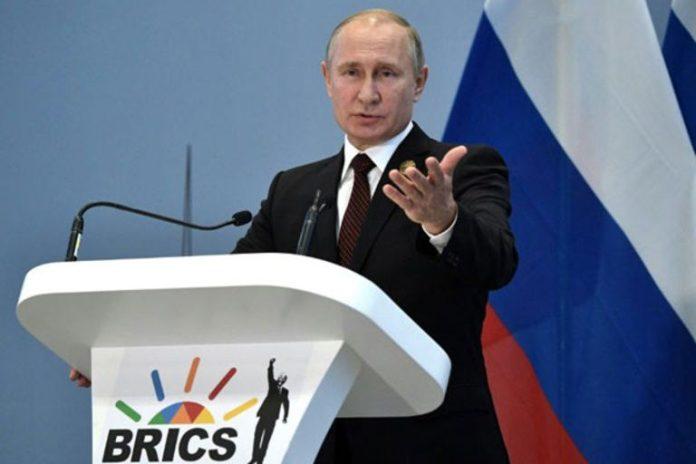
Last week, Russian President Vladimir Putin announced that he won’t be going to South Africa for next month’s summit of the BRICS countries (Brazil, Russia, India, China, South Africa), although all the other leaders will be there. In fact another couple of dozen national leaders who want to join the club will also be there. Why is Putin staying away?
One reason might be that it’s too dangerous, because a lot of Ukrainians want him dead. South Africa would doubtless let him bring his own security team, but he’s been quite cautious recently, visiting only dictator-run post-Soviet states (and a China trip coming up in October).
Another reason could be that Putin is afraid to leave Moscow at the moment. What looked like a coup attempt by Wagner Group mercenaries led by Yevgeny Prigozhin fizzled out late last month, but Putin is looking vulnerable and his absence in South Africa might tempt somebody else to have a go.
Or maybe he has just belatedly realised that the South African courts are independent. I’d vote for that one.
The International Criminal Court (ICC) issued an arrest warrant for Putin last March for alleged war crimes committed during the invasion of Ukraine. Putin may initially have assumed that the party that has ruled South Africa for the past three decades, the African National Congress, would protect him from arrest, but it’s not that simple.
The ANC depended on Soviet financial and military help back in the days of the anti-apartheid struggle, when most Western countries withheld their help, so there’s strong pro-Russian sentiment among the older comrades.
Moscow still subsidises the ANC today (in various clandestine ways), so Putin could reasonably expect Prime Minister Cyril Ramaphosa to protect him from arrest. However, South Africa is also a member of the 123-country ICC and legally obliged to execute its arrest warrants. Ramaphosa tried to stymie the courts, but by May it wasn’t looking good.
South Africa’s largest opposition party, the Democratic Alliance, went to the Gauteng High Court asking it to order the government to arrest Putin if he came to South Africa, and last Friday the court did just that. Forewarned of that decision, Ramaphosa announced on Wednesday that he and Putin had agreed that the Russian leader would attend only by video.
Ramaphosa’s explanation for the change of plan was the usual bumbling mess, claiming that arresting Putin would amount to a declaration of war on Russia, but the real winner in this was the rule of law, both in South Africa and in the wider world.
Having Putin available only on video will do no harm to the deliberations of the BRICS, an organisation that is set to grow its membership dramatically and could come to play a useful role in the world. It does South Africa no harm either: Putin may sulk a bit, but his flailing regime needs all the friends it can get.
And the rule of law in the world expands a little bit: for the first time, Russia’s ruler is is having to worry about being held responsible for his crimes.
You think I’m being naive? That there’s no chance Vladimir Putin will ever face an international court? Consider the fate of Slobodan Milošević, former president of Serbia and the prime mover of the genocidal Balkan wars of the 1990s.
In 2001, he lost an internal power struggle and was deposed as president, whereupon the winner, Prime Minister Zoran Dindić, handed him over to an international criminal tribunal in The Hague. He died behind bars in 2006 while the trial was still continuing.
That happened because the new Serbian regime desperately needed money and couldn’t borrow it unless it handed Milošević over. At that time, such a thing could not have happened to Vladimir Putin (who was already president of Russia), because great powers are, in practice, above the laws that apply to other countries.
Russia has fallen below that status now. Apart from nuclear weapons, it has none of the attributes of a great power, and it’s easy to imagine somebody who overthrows Putin handing him over to the ICC in return for international recognition and financial aid.
‘But that’s not fair’, I hear somebody cry. ‘Why aren’t George W. Bush and Tony Blair in prison as war criminals for their illegal (and exceedingly stupid) invasion of Iraq in 2003?’
They certainly should be, but they were the leaders of countries that are still great powers (though only by courtesy, in Britain’s case), so they were for all practical purposes exempt from international law. So are China, India, and the member countries of the European Union.
But not Russia any more, so Putin really needs to avoid countries that belong to the ICC and have domestic courts that enforce the rule of law.