Shucking Oysters: Battle Tanks to Toasters
By Alex Allen
With a bit of surprise Elon Musk announced that Tesla’s Cybertruck will cease production next year. Instead, the company is ramping up production of its driver-less Cybercab vehicles. When Musk rolled out the controversial wedge-shaped stainless-steel monstrosity in 2019, as someone said, it was “a combination of jaw-dropping technical audacity and arrogance.” No other vehicle in history has inspired such derision and odd devotion.
Matthew DeBord wrote on Slate, “with a road presence that strives for futuristic but comes off as obnoxious, it came to symbolize Musk’s transformation from a climate-conscious champion of the left – the Cybertruck was, at least, an electric vehicle – to a MAGA-addled, chain saw-wielding, Trump-boosting agent of the right.”
Musk explained to Automotive News: “I just wanted to make a futuristic battle tank – something that looks like it could come out of ‘Blade Runner’ or ‘Aliens’ or something like that but was also highly functional.” He confusingly called it “a better sports car than a Porsche 911” and “a better truck than an F-150.” It was hard to see who the Cybertruck was for. Contractors and farmers want a pickup that has towing capacity and durability, not the ability to go from 0 to 60 in under five seconds.
Kelley Blue Book estimated Tesla sold just 20,237 of the trucks last year, even though Musk said he’d make 250,000 Cybertrucks a year. Matt Sedensky wrote that if “the imposing, sharp-angled, dystopian appearance of the Cybertruck weren’t enough to turn many potential buyers away, Musk did so himself by allying with a panoply of right-wing figures, most notably US President Donald Trump. He alienated some customers as his image morphed from eccentric innovator to polarizing force trading his billions for political influence.” And we all remember the apologetic bumper stickers, “I bought this before Elon went crazy” and the Molotov cocktails hurled at Tesla vehicles.
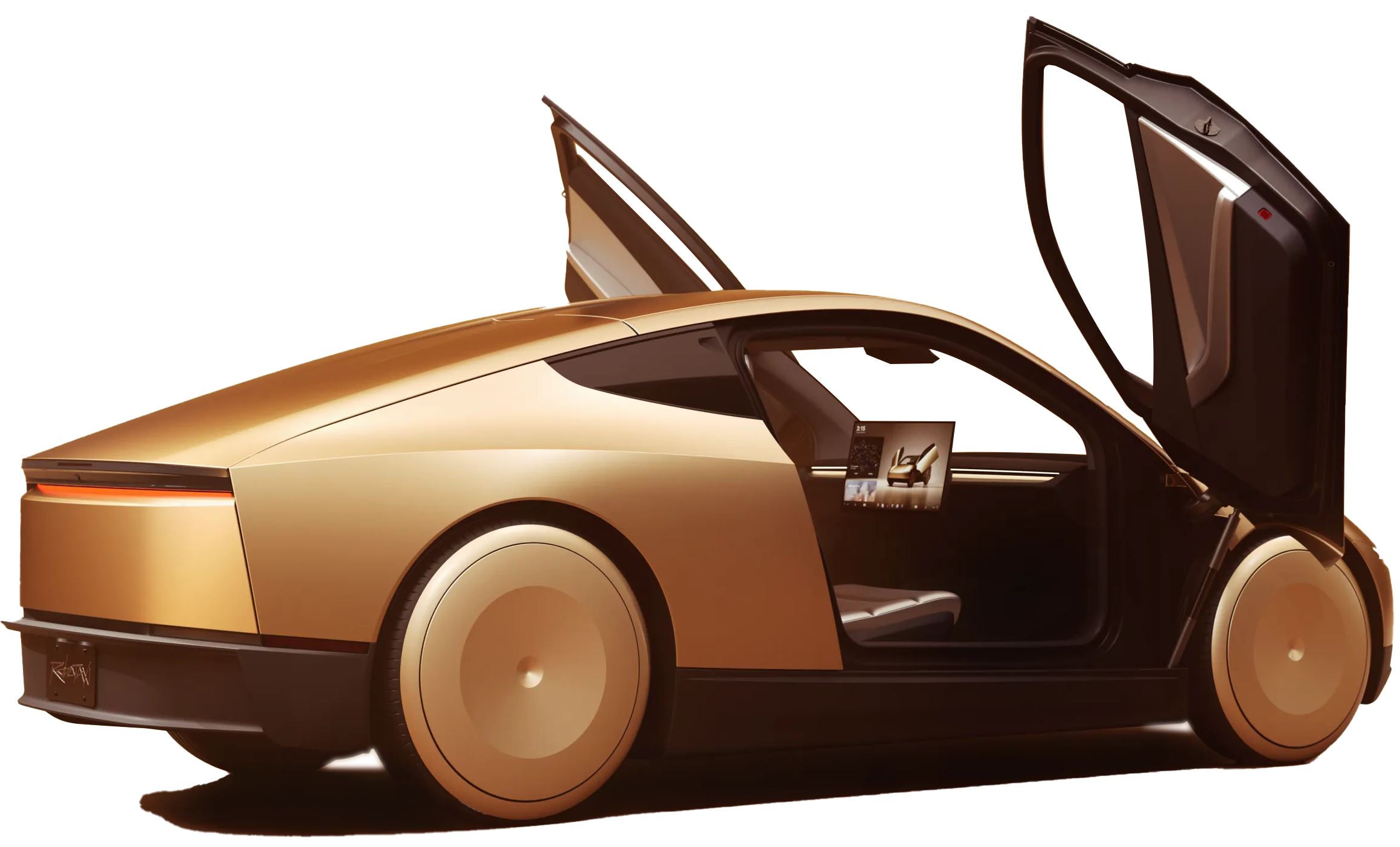
Last Friday, Musk “fresh off a shellacking of the candidates he bankrolled in the midterms,” posted that production would wind down to free up manufacturing capacity at Tesla’s factory in Texas, for a gold-coloured self-driving toaster that has no pedals or steering wheel.
With his robotaxi, Musk is aggressively taking on Uber and Lyft. At a cost of just $30,000 USD, with targeted operating costs of 20 to 40 cents a mile, Musk aims to undercut both Alphabet’s Waymo and Amazon’s Zoox by a wide margin. This month the Cybercabs are available to book in downtown Austin, where Musk sometimes resides.
Visually, the golden model looks sleeker than previous Teslas. Even the wheels are completely covered by a gold panel. Instead of gold, however, the interior is in matte beige and black. On the 21” screen passengers can log into Spotify, YouTube, or Netflix and watch movies and shows during the ride.
There are concerns. The Cybercab can only be controlled via app and screen, even in an emergency. So what happens if the screen shatters in a fire, or the entire electronics system fails, leaving the taxi movable only by crane? Jan Klauth went for ride, and noted that the “golden robot” is far from being user-friendly. When Klauth confirmed his ride, the app showed a wait time of 40 to 50 minutes. An hour and a half later, it showed 30 to 40 minutes. Then suddenly a message popped up: the taxi will be there in 12 minutes.
Another issue Klauth noted, that because the doors swing open like butterfly wings, they can’t park just anywhere, “it’s still a three-minute walk to my actual destination.” Anyone with heavy luggage or limited mobility can’t count on being picked up or dropped off exactly where they want, and will have to make do with somewhere in the general vicinity.
If Tesla’s robotaxis are to become competitive with Uber, Lyft and the rest of the gang, the biggest weakness is that the self-driving cars don’t go on highways. In the few cities where the robotaxis currently operate in Texas, the network is limited to the downtown core. A trip to an airport, for instance, which would require using highways, is not currently possible.
This is the early phase, however, so route coverage could expand significantly within a few years. Further, Klauth wrote, “the real trial by fire still lies ahead: at 30 mph, the Cybercab may navigate city traffic safely, backed by plenty of collected data. But how the car performs at highway speeds above 70 mph, on multi-lane roads, is something Tesla has yet to prove.”
According to market leader Waymo, roughly 4,000 fully driver-less robotaxis are operating in the US today. Uber and Lyft alone are estimated to have over a million drivers. Add to that almost 450,000 taxi, shuttle, and chauffeur drivers, that puts the market share at less than 2%. Autonomous driving is a definite bet on the future. In the meantime, what happens if a driver-less car gets into a minor fender bender? Scream at the non-driving backseat passenger? Yell at the screen?