Shucking Oysters: Pipe Dreams
By Alex Allen
“Beautiful British Columbia” our licence plates proudly display. “Super Natural British Columbia” our brand announces. One campaign years ago featured a print ad showing three orcas surfacing against a majestic mountain backdrop with the tagline: “So many of our visitors return in Spring.” And so it is with supreme irony, that Alberta premier Danielle Smith finally gets her southern pipe dream.
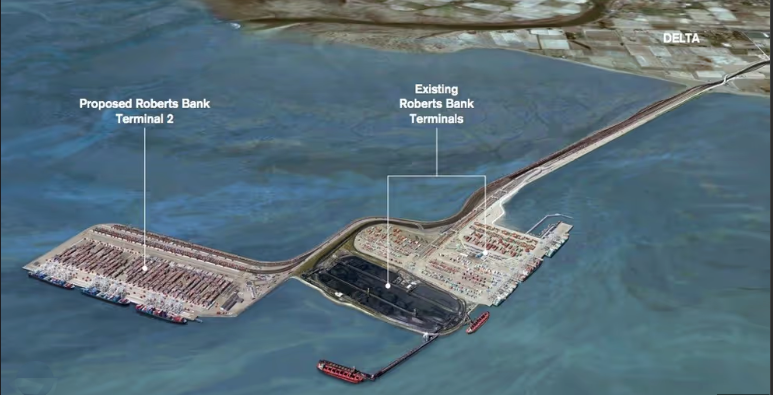
Under the proposed route, the pipeline will move one-million-barrels-per-day of crude oil to the soon to be built Robert Banks Terminal 2 in Tsawwassen. The entire Roberts Bank terminal facility will span almost 640 acres, including a brand-new causeway and jetty that could be five kilometres long and an artificial island about the size of 330 football fields. Put another way, it could handle an additional two million 20-foot shipping containers each year.
The product will then be loaded onto the aptly named “Very Large Crude Carriers” that are three football fields long, six highway lanes wide, and 20 storeys tall. Each of these vessels will have a capacity of up to two million barrels of crude oil, with traffic increasing to 408 tankers a year (up from 60). In contrast, the current Aframax-size tankers have a capacity of 750,000 barrels.
The oil tanker’s route will go through the home waters of the endangered southern resident killer whales and Western Canada Wilderness Committee’s Lucero Gonzales said that unless the route is changed, the species could be pushed to extinction.“It’s my worst nightmare. It’s an ecological nightmare. I don’t think a lot of us expected it,” Gonzales shared ominously.
Last year, a federal court judge dismissed a lawsuit by the David Suzuki Foundation, the Georgia Strait Alliance, the Raincoast Conservation Foundation and the Western Canada Wilderness Committee that said the expansion project would destroy vital chinook salmon habitat, threatening the very survival of southern resident killer whales. The pollution, light, noise, dredging and physical obstacles will “starve the estuary” and impact the entire ecosystem environmental groups warn.
The impact assessment found there would also be impacts on Dungeness crab, barn owls, western sandpipers and many other species. Yet after the assessment, while the-then Minister of Environment and Climate Change Steven Guilbeault concluded that the project would have significant adverse effects, cabinet approved the terminal expansion anyways arguing that the public interest “superseded the impacts,” and therefore the project was justified. The judge determined that as long as mitigation conditions are “rationally connected to the likely adverse effects on the whales,” all is well with the world. Say what?
As many know, Guilbeault made no secret of his opinion that the Carney government was headed in the wrong direction on climate and left cabinet last year in protest of the Memorandum of Understanding Carney signed with Alberta.
American Lovel Pratt, marine protection and policy director for Friends of the San Juans, warned: “This would significantly elevate the risk of catastrophic oil spills, vessel accidents, underwater noise pollution, and harm to endangered marine wildlife.” The increase in oil tanker traffic, Pratt added, “is especially alarming for the critically endangered southern resident killer whales, whose population currently numbers just 74.” Marine traffic noise and lights impact the whales’ abilities to hunt and communicate through echolocation. A large container ship can reduce a southern resident killer whale’s echolocation range from 400 metres in quiet conditions to just 60 metres.
Northern Washington first nations strongly opposed the previous Trans Mountain pipeline expansion and oppose this one as well. They argue that the large increase in vessel traffic endangers their treaty rights and threatens vital fisheries. If there’s a spill in the area, Pratt points out, “Oil knows no boundaries.”
The Union of BC Indian Chiefs also voiced concerns to the southern route. “If governments have accepted the longstanding opposition of Coastal First Nations on the north coast, they cannot simply move the proposal south and expect a different outcome,” said elected Chief Councillor Linda Innes.
“We have anxiety about the impact of any new pipeline project, period, on British Columbia’s coast,” Premier Eby told reporters. Eby acknowledged that permitting the new oil pipeline falls under federal jurisdiction and BC does not have the power to stop it. Carney said: “This is a representation of what we are all trying to accomplish to make Canada more independent, more resilient, more prosperous, more sustainable.”
“The decision to uphold the north coast tanker ban and not proceed with a northern pipeline is a huge victory for the many coastal First Nations, businesses and concerned residents who have spent years fighting to protect it,” said Flossie Baker of Sierra Club BC. “However, Alberta and Ottawa’s pivot to green light a pipeline to British Columbia’s southern coast is a repeat of a dangerous and economically misguided decision: the infamously over-priced TMX pipeline.”
Both Alberta and the federal government reaffirmed their commitments in the Memorandum of Understanding, including completing a trilateral MOU with the Oil Sands Alliance on the Pathways Project and the controversial oil pipeline expansion. If the project moves forward, construction could start as early as September 2027, at an estimated cost of $43 billion. How it all unfolds we shall see. As former US diplomat Alan Eyre said, “a memorandum of understanding is as comprehensive of an agreement as a Tinder date is to marriage.”