The Fête of the Immortal Sea

Gabriel Jeroschewitz, December 6th, 2025, Happy New Year Dedicated to Robert Burns.
The Fête of the Immortal Sea
as seen by Elric Fen, Shore-Watcher of Glassehaven
I tell yu now of that nite, tho it’s a thing I shudnt keep in my mouth long — it heavs on the mind like deep tide on the ribcage. It wer late in the warm-seazun, the kind yu call the Heartsmonth, when the town does its lantern-show, the Fête of Lumes. Women in silk-colors, men in bright coats, laughter like a spun chain runnin down the quay. We all was lookin landward at the gardens, at the quick lovers dartin from bower to bower, while out-behind us the sea lay quiet — quiet in a way that is its own kind of sound.
I was not partake like the others. I am shore-watcher, so my eyes go sea-side. I dont kno if you felt it before: how the sea can seem asleep in its skin but its deep belly is turnin. Its coil moves miles under, and if yu listen long yu can near feel it in your own chest. That nite, for no reason I cud name, I got the sudden sense that it was lookin back at me.
Yu mustnt think me fancy-talkin. I mean plain: the sea lookt. As if it had found me in the crowd and wanted a word.
Now, Glassehaven has its old yarns — the ones we half-jest about in the taverns but half-hide from children. Fêtes that wer watched from the waves themselves, by things not fish nor bird. Times when ships lay at anchor right off the quay and the music carried out across the water, to be answered by lights out at the black edge, lights that was not lantern nor star. Old folk say the sea got memory longer than any church record, and it keeps the faces of them that stood at its lip, even thousand years gone.
On that nite I swear I heard it call, not in sound but in pull. My feet wanted the wet stones. My hands felt the salt-stick from the air. And my heart — it quickt like a lad in first courtship, only this was no girl’s glance, but something far deep.
The fête went loud then — some manner of fire-thrower and drum-beaters in the garden-square. The lovers all pressed in close to see, petals from the bower-trees falling in their hair. But the sea behind them, it flasht. Not the white of common lightning — no — this was a red fork in the clouds, a spear of it, split in two mid-air and stabbing down into the far horizon.
And between that spear’s flicker and the next breath, I saw the ships — three of them, pale sails in the half-dark — all shudder at once. A quiver ran up the masts and the canvas went slack as if a hand had been laid on their backs.
I thought of old says: When the Immortal watches, mortal timbers feel it.
I started toward the breakwater. The stones there old and black with weed, slipper as eel-skin. A man shudnt walk alone past the last lamplight, not with deep tide on the turn — but my steps was not my choosing.
When I come to the water-edge, it was no longer quiet. Slow roll, yes, but each rise carried in it a sound like far music. Not played on strings nor pipes — more a thrum, a deep tune that yu don’t so much hear as feel low in the gut. It made me think: maybe the sea’s own heart got its rhythms, and now it wanted me to match mine to it.
I looked back — the fête was still bright, still laughing, still throwing its perishable flowers in the garden. But even from there, I could see how small it was against the seaface.
Yu see, the sea don’t care if yu are name-known or name-lost. It don’t care if yu are kissing under boughs or dancing in paint and wine. It’s seen every fête along every shore since man first thought to put a lamp in the dark. It’s seen lovers vow under myrtle trees and orange nights. It’s seen them sink together when the ship goes down, the music stopped mid-note. Their bones rest under miles now, no light there at all.
The red forks came again — higher this time, and stranger. They didn’t strike down but seemed to pause mid-sky, like they was holding. And in their light I saw out past the breakwater — shapes, pale as sails, but taller and narrow. Not ships.
They was lined in a half-ring, far enough that their feet — if they had feet — must be in water too deep for the harbor’s chart. I cudnt count them proper. Their heads was not heads, more curves where the lightning caught and slid off.
I thought — fool that I am — that maybe they was watching the fête same as me. But the longer I stared, the more I knew their gaze was not on the gardens. It was fixed on the quay. On me.
I felt it then, hard in the chest: a mighty power, as if the whole sea had leaned in. Joy, yes — not joy like a mortal’s, but that nameless lift yu get when yu are part of something too big for all your words. It was as if I’d been chosen to stand in that moment between the fête and the Immortal.
The power came with a promise. Not in speech, but in tide: You will not be forgot.
I can’t tell proper how it happen next. There was a change — a cold drawn up through every wave at once. The music from the fête faltered, a drum missed its beat. A smell of iron ran in the wind.
Then — nothing. The garden’s light still shone, the lovers still laughed. But a shadow had moved between us. Not one yu see with eyes, but one yu sense in the bones.
Behind that shadow lay a place I shud not go.
The Immortal waited. The ring of pale shapes held as the red lightning spears froze mid-sky. I felt my breath slow, my pulse match the low-thrum in the tide.
It was asking — no, it was offering. A fête of its own, with no end.
I knew the old tales: the ones who accept are taken. Not drowned like common shipwreck, but brought into the depth where time is not. They say those ones dance there forever, music of eternity in the quiet — no breath, no day, no night, just the endless.
The quayside stones under my hand was slick. The water close enough to take me in one step more. My heart was strong — too strong for any mortal fête.
I thought of the lovers back in the bower, their flowers already fading. I thought of ships that sailed for joy only to sink by morning. And I thought of the Immortal, who has kept its own music longer than the stars.
I stepped forward.
The water rose — not high, not rough — just enough to take my balance. The ring of shapes parted, two and two, making a way. The red lightning swam down into the path, turning the black into a strange warm gold.
I didn’t fall. I went.
I can’t tell yu the rest in mortal words. There’s no sense of hour in that place, only the feel of the sea’s heart opening to you. Vast gardens there too, not bough nor flower but coral risen like towers, weed streaming like silks. Others moved about me — not fish, not men, but tall and curve-headed, their long arms carrying lights no fire ever made.
We danced. We danced without ground underfoot, and the music was the deepthrum and the pulse of the tide.
It was love, if love is being part of a thing that will never end.
I don’t remember leaving. One breath I was there, the next I stood again at the quay, dawn just breaking, the fête gone. Not a petal left on the stones.
But I carry it. The power, the joy without name. I am still shore-watcher here in Glassehaven, but some nights — the warm-seazun nights — the sea will look back at me.
And I know it remembers.
Postscript by Elric Fen:
If yu read this and think to go alone to the breakwater on Heartsmonth, yer a fool. The Immortal gives only one fête to each man. And once yu step forward, there’s no turning back — save if it sends you. But if it does, yu will be never whole again for mortal shores.or sing Auld Lang Syne,
Phoenix Riting! – January 2nd, 2026

What a year it has been. It’s been like this for a few years now. At the end of every year, since about 2016, it seems, we look ahead and hope for a less crazy one. Please, we say, let this year not be as crazy as the last!
And every single year has been crazier. Every New Year, we say the same thing all over again. I don’t remember this being such a phenomenon in the past. I remember when the New Year was a time when some of us made resolutions about what we wanted to improve in ourselves and our lives. On New Year’s Eve we partied, or did our own private thing, assessed the year behind us, and anticipated the changes we might make to improve our lives, change our bad habits. But did we ever look back on every previous year as an absolute train wreck the way we do now?
I know only one thing about the year to come, and it is this: it’s going to be even weirder. So much weirder I can’t even imagine it. Guaranteed. The crazy quotient of each passing year is increasing exponentially. Every year is stranger than the last. It’s like we’re hurtling toward a ‘weird’ event horizon. It’s not the AI singularity we should be bracing for, it’s the weirdness singularity. I don’t think we’ve crossed it yet, but… maybe.
We’ve fallen down the rabbit hole, or stepped through the looking glass; that’s more like it. We’re in the backwards mirror world now, looking out at “normal,” but unable to reach it. Nothing makes sense anymore.
In the year to come, I resolve to roll with the changes. To dance with them. To look for what’s right, question my assumptions, and prepare for the strange ahead. What else is there to do? Oh, of course sometimes I’ll protest and complain. I’m human, after all. There’s real release in expressing frustration with the stupid choices made by the deciders of the world, especially when those decisions intrude unacceptably into my life and community. Ultimately, though, I will adapt. We will all adapt, or else start blowing gaskets and leaking in public.
Can’t have that. Must… contain… self…
Thing is, as local songwriter John McLachlan sings, “The future will always win.” You can’t stop what’s coming, if it’s coming. You can’t step in front of a speeding train without getting smashed by it. Some who are trapped on the train might fight their way to the engine and shout in the engineer’s ear, only to be told, sorry! The brakes are broken and there’s no stopping this thing.
History has momentum. The events, however weird, destructive and nonsensical, that are playing themselves out now must carry on to their bitter or natural conclusion. Perhaps those of us not trapped on the train, who still have the will, can run alongside and lend our weight to slowing it down, even rescue those few that we can. Maybe that’s futile. But what else is there to do?
We can effect small changes here (I hope) and there (maybe). We can probably mitigate some damage. Protect a few. But this thing will play itself out. I’m becoming convinced George Carlin was right: the owners will have their way, and they do not care what we think or say. The majority, whose numbers are required to have any effect to slow or even stop the train, are too busy munching processed snacks and scrolling their TikTok feeds to notice or care. Or else they are occupied with a titanic struggle merely to survive and they have no spare brain cells to pay attention to the bigger picture.
The masses aren’t listening, and those who are listening already know. Futile or not, I won’t stop saying what I think. That’s how I’m wired. And even though nothing seems to be changing, despite so many miraculous scientific breakthroughs revealing in depth what an interdependent, complex, diverse wonder this living planet truly is; despite the many brilliant alternatives being discovered to generate energy, clean the oceans, grow food, and so much more; despite all the kind, loving hearts working together, striving, saving all they can, I’m going to continue to feel it all. I’m going to laugh and dance and cry and shout and sing as hard as I possibly can.
There will still be a world when this weirdstorm has passed. Whenever that happens, I have faith in this living Earth. I believe she knows what she’s doing, no matter how it looks and feels right now. And I know, deep in my bones, that we crazy, destroying humans are collectively acting on her behalf. That in the very long run, somehow, it’s going to turn out that something is right about this.
I don’t know what it is. But this New Year, I choose to believe in the good. Faith, it’s said, can move mountains. Faith can grease wheels and encourage life to grow. Faith is an exercise, a practice, and I commit to deepening mine. I’m not talking about faith ‘in something’, God, a religion, leaders, the ones who know. Faith is simple. I have faith in blessings, in life itself, unfolding all around me, in vast entities, like this world and this cosmos, to evolve always in the direction of love.
Life feels better with a little faith. It’s not easy against all the evidence but it works for me. Give it a try, if you haven’t already.
My wish for you all is that you each have the best year you possibly can given the circumstances. I wish that all your crises be awakenings, that your lives evolve lovingly, that it all works out one way or another. Happy New Year!
That’s what I think. What do you think? Email me at phoenixonhornby@gmail.com
Under the Social Awning

Under the Social Awning
By Cylon2036 we/us
Pseudopod Certified
“How many times can a man turn his head and pretend that he just doesn’t see?” Blowin’ in the Wind, Bob Dylan
They called it a consensus, though everyone knew there had been no counting. By noon, social media was filled with certainty. Certainty had become extremely common. It carried hearsay, and traveled in groups. If you stood with it, you felt safe, like standing under an awning in the rain. Lauren stood under it.
She was, by nearly every private measure, a good person. She helped find lost cats. She called her mother twice a week. She had once taken a professional risk to defend a colleague who was unable to defend herself. She believed in fairness the way people believe in gravity. She had always stood firmly principled.
The screens of social media pulsed with the name of the local newspaper and its publisher and editor, a single father who rented his modest home. A sentence clipped from an article in the paper had gone viral, stripped of context, polished into something sharp and damning.
The crowd had done the rest. Committee Chairpersons had been notified. Some friends and friendly acquaintances abandoned him. Now came the final step of public condemnation. Smears and false accusations would follow. Silence would be interpreted. Lauren felt the familiar social pressure unfurl.
If she refused to join the mob’s chorus, there would be consequences, subtle at first. The slow cooling of conversations and invitations. Her partner’s reputation was important to her and her sister’s grant application depended on community support. No one said these things out loud anymore, and they didn’t need to.
If she joined in, the cost was internal, a tightening in her chest. A story she would later tell herself about how this wasn’t really harm, how it was only participation, how her single voice didn’t change the possible outcomes. Internal costs were untracked. They didn’t compound socially. They were invisible.
Lauren looked at the publisher’s editorials defending himself. He was not playing the victim, and that somehow made it more difficult. She searched her memory for something to justify the act, some rumor, some proof that he deserved what was happening. The social media smears continued.
Participation was easy, just type and hit “post.” Lauren thought of a line she once loved from a Bob Dylan lyric. She couldn’t quite remember it. What she remembered instead was the exhaustion of being brave when no one thanked you for it. She typed a few words supporting the mob, then hit “post.”
The mob accepted her input with affirming chimes. Somewhere, a score adjusted by a fraction so small it would never be noticed alone. The crowd’s certainty deepened, fed by many similar posts as social media attacks swelled. Certainty had a short half-life once its work was done. Lauren closed her laptop.
That night, she dreamed of social justice, and supporting community charities and housing initiatives. In the morning, she woke early and made coffee for her partner. She did all the small good things she knew how to do. They still counted. She promptly took care of her remaining volunteer tasks for the day.
She wondered, not for the first time, how many of them equaled the cost of one honest support for a neighbour under unjust fire, and why the answer never appeared anywhere she could see it. Her partner reminded her that they were under the awning, and out of the rain.
Monster Hunters ch1

Ben Vinkenhut hated school. He was bullied every day, and he usually ended up in the trash can. Ben looked like your average 13-year-old boy. He had long, light brown hair and bright blue eyes. He always wore a light brown hoodie. But Ben was about to find out that he was no ordinary boy. One warm spring day in mid-March, Ben was waiting at the bus stop with his friend Johnny Maken. Johnny was identified as tall with brownish hair and freckles with long, skinny arms and brown eyes. He wore a light brown hoodie that looked two sizes too big. Ben suspected that it was his older brother Fred’s. “UUUGGGHHH…” groaned Johnny, “It sure is hot out today!” “Yeah, I guess,” said Ben. He wore the same expression as he did every school day, mad and grumpy. “Are you okay dude?” asked Johnny, “You seem… weird this morning.” ” Well,” Ben explained; “I promised someone a snickers bar today, and I forgot to get it.” “Who wanted it?” asked Johnny. “James Jones,” answered Ben. James was the bully at Mountain Range Middle School. He bullied most of the students, but Ben was always his biggest target. “He’s gonna kill you for that, dude!” exclaimed Johnny, “He loves his snickers bars!” The Bus gently pulled up to where the two boys were standing. “Great,” said Ben in a sarcastic tone, “Another fun day at middle school.” As the bus pulled up, Ben couldn’t stop thinking about how James Jones would wedgie him in front of the whole class. James somehow knew how to do mean things when the teachers weren’t looking. Ben always got in trouble for making loud noises when the noises were not his fault. Most of the time, they were James’s banging Ben’s head on the wall. Or sometimes they would be Ben screaming from James giving him a wedgie.They got onto the bus. Ben sat beside Johnny. One of the one thousand things that Ben hated about the pool was the bus ride. He found it long and boring with no entertainment. After a half an hour bus ride, they got to school. Just as Ben was getting off the bus, he heard a voice say, “Hey Vinkenhut, where’s my snickers?” It was James Jones and his gang of two other boys, Dike Hardmasher and Wendle Bloodlust. James’ henchman had names quite scarier than James Jones, but it did not interfere with his ruthless bullying. The evil trio was known to the school as the gruesome gang. Ben didn’t know what to say. He decided to lie. “Uh…sorry James, but as I was waiting for the bus, a raven swooped down and… took the snickers bar from my open backpack.” “Stop right there, Vinkenhut, why was your backpack open?” Ben scrambled for an excuse before saying; “Weeellll… when I was buying the snickers, the shopkeeper asked for two dollars. I reached into my backpack for the money, and forgot to close it,” explained Ben.”You’re not that dumb,” snorted James, “Or maybe you are.” Dike and Wendle laughed along with James. “Well, I’ll be off.” said Ben sprinting away while yelling back; “Nice talking to you guys!” He sped down the hall. “Get back here!” shouted James before perusing Ben’s wake with his sidekicks. Ben ran into a classroom and locked himself in. Just then, Ben heard a jingling outside the door 19. He looked toward the door and to his horror; the lock was being picked by James. James took a short break from lock picking to peer at Ben through the window. “Hey everyone!” he jeered, “Look what Vinkenhut’s wearing!” Ben looked down and saw that he was wearing a pink sweater that was about two sizes too small for him. It belonged to his mom. Ben had done a lot of growing over the summer and winter break and was currently taller than her. Students began to look through the window and laugh at Ben. He darted around the room finding refuge behind a desk in the corner of the room, out of sight range from the window. “I wish I didn’t have to wear this sweater.” He said angrily. As he said this, the most unexpected thing happened. His pink sweater grew. Moments later, it had grown to be a perfect fit. Then it turned a bright shade of red and fake flames appeared around the sleeves. But confusment turned to horror in a heartbeat. James had almost gotten the lock and taunted Ben; “Your dead meat, Vinkenhut!” Ben quickly hid behind a stack of books on the teacher’s desk preparing for the worst. Just seconds later, James Jones had completely picked the lock and opened the door. Come out, Vinkenhut.” He said with a creepy singsong voice and an evil grin. Right on queue, Wendel found Ben crouched behind the books and called Dike over. They picked Ben up by the arms and held him suspended in place. Please don’t wedgie me!” yelled Ben,”I forgot to get the snickers bar, I’ll buy you three tomorrow.” But James wasn’t mad. He was staring with his mouth wide at Ben’s hoodie.”Where did you get one of those?” He asked in disbelief.” I guess it just appeared on me.” Ben could not answer. The shock of his hoodie transforming and James nearly beating him was too much. “Dude,” continued James, “That’s a fire blaster hoodie! I’ve heard that they cost thousands of dollars! The most expensive clothing brand in the world!” Just then a huge mean voice said; “Oi!” All the kids who were standing behind James, Dike and Wedel panicked and started running. Ben turned around and a giant man about nine feet tall was standing in the doorway. He was wearing sunglasses, and a giant cloak that had the letters M.H on it.”Ben Vinkenhut!” he shouted, “Come here son, we need to talk!”
The Israeli Government Put My Name At The Top Of An ‘Antisemite’ List
The Israeli Government Put My Name At The Top Of An ‘Antisemite’ List

My name appears at the top of a list in a document the Israeli government released earlier this month in order to draw false associations between the Bondi Beach shooting and online criticism of Israel and its atrocities.
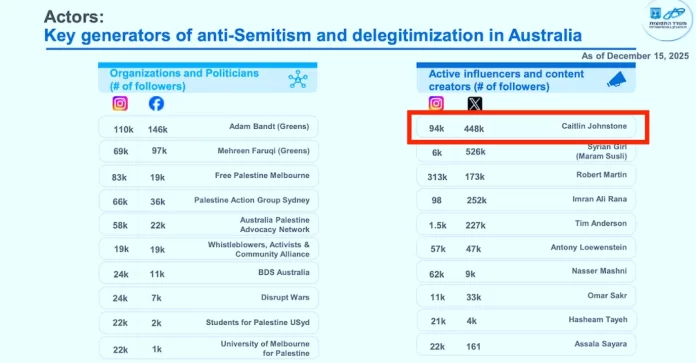
The PowerPoint document, released by Israel’s Ministry for Diaspora Affairs and Combating Antisemitism, is titled “Delegitimization and Antisemitism in Australia — A Snapshot October — December 2025,” and its claims have been cited by Israeli media outlets like Ynet News.
Page five of the document is titled “Actors: Key generators of anti-Semitism and delegitimization in Australia,” where the name Caitlin Johnstone is listed at the top of a column titled “Active influencers and content creators” which is ranked by number of followers. Page seven describes me as an “Anti-Western blogger, promoting conspiracies and complete delegitimization of Israel.”
This word “delegitimization” appears throughout the document, which I personally find funny. They knew the “antisemitism” claim couldn’t stand on its own, so they had to tack on this weird extra complaint about people “delegitimizing” the state of Israel — as though that’s a bad thing. I’ll always deny harboring any hatred toward Jews or Judaism, but I’ll happily admit to trying to delegitimize a genocidal apartheid state that cannot exist without nonstop violence and abuse.


The document attempts to make the argument that in the two months leading up to the Bondi attack there was an epidemic of antisemitic “hate speech” online, absurdly insinuating that those of us who were criticizing Israel and its abuses during that time incited two ISIS guys to commit an act of terrorism. Like ISIS were just a bunch of cuddly wuddly snuggle bears until some Australian influencers tweeted mean things about Israel.
Page 14 of the document is captioned “Examples of recent hate speech in the two months leading up to the attack: Selected anti-Semitic tweets on X: Caitlin Johnstone,” and it consists of two tweets. You can tell whoever collected them was just doing advanced searches for specific keywords from the people on their list because the word “Jewish” is highlighted in one of their screenshotted tweets, which means they had to scroll past the many tweets I’ve made over the years which would contradict the antisemitism narrative they’re trying to build.
The first tweet is from August 6 of this year, and it features a screenshot from journalist Owen Jones noting that just 6.7 percent of Israeli Jews surveyed had told pollsters that they are “very troubled” by reports of starvation and suffering in Gaza. I captioned the screenshot as follows:
“Poll after poll after poll shows that Jewish Israelis are horrible people who are quantifiably much more cruel and immoral than pretty much any other population. At a certain point you have to stop thinking the polls might be mistaken and see that the only real mistake is Israel.”
Note that I didn’t say “Jews” but “Jewish Israelis”. Poll after poll after poll shows that Israeli Jews are indeed horrible people who hold sociopathic attitudes toward Palestinians, because that’s what happens when you’re the privileged group in an apartheid state. White South Africans were horrible people during South African apartheid too. You can’t have apartheid without indoctrinating your public to see the disempowered groups as less than the empowered group. It doesn’t say anything about Jews or Judaism that this is the case; that’s just how apartheid works.
The second tweet is from October 6 of this year, and it reads as follows:
“Someone who is truly and sincerely worried about a rise in antisemitism will oppose the mass slaughter of children under the Star of David banner by a state which claims to represent all Jews while Jewish billionaires buy up media to silence criticism of that state and Jewish oligarchs openly purchase the president of the world’s most powerful government to ensure the facilitation of that state’s atrocities.”
I guess this one might look antisemitic if you didn’t know that every single part of it is completely true. Israel has indeed been mass slaughtering children and does indeed have a Star of David on its flag. Israel is indeed claiming to represent all Jews when it argues that criticism of Israel is hateful toward everyone who is Jewish. Larry Ellison’s family has indeed been buying up media platforms like CBS where virulent Zionist Bari Weiss has been put in command, and purchasing control of TikTok after Congress forced its sale to stomp out criticism of Israel. President Donald Trump has indeed repeatedly admitted to being controlled by megadonor Miriam Adelson, the world’s richest Israeli. These dynamics are indeed likely to feed into antisemitism in a very real way. I didn’t create those dynamics. Zionists did.
This is the Israeli government’s best argument that Australians like myself incited the Bondi attack. I tweeted about genocide and apartheid and it violently radicalized a father and son in Sydney, who then apparently invented some kind of time machine and traveled back to 2019 to join ISIS. That’s their strongest case.
If you’ve been wondering why I’ve been writing so much about the Bondi Beach shooting, this is why. It’s being used to justify an aggressive assault on freedom of speech and assembly in Australia, and that assault is happening at the forceful urging of the Australian Israel lobby and the Israeli government, which is now going so far as to compile official public lists of Australians whom it deems guilty of dangerous wrongthink.

Israel’s Ministry for Diaspora Affairs and Combating Antisemitism also put together a full-page profile on me and my work back in September in a release titled “Antisemitism & Anti-Zionism in Australia Key Influencers, Incidents, Groups, & Trends”, which I’ll just copy and paste here because it makes me look awesome:
Caitlin Johnstone, an Australian independent journalist and political commentator. Her writings frequently describe Israel as a “genocidal apartheid state” and a “settler-colonialist project” that perpetuates systemic violence and oppression. She argues that Israel’s actions are not isolated incidents but part of a broader strategy to maintain dominance over Palestinians.
On her social media platforms, Caitlin Johnstone frequently shares strongly anti-Israeli content in the context of the ongoing war in Gaza, while largely omitting criticism of Hamas. In a post dated April 15, 2025, she dismissed concerns about Israelis feeling unsafe, suggesting instead that their discomfort stems from a sense of guilt over what she described as the “genocide” in Gaza.
In an Instagram post dated April 7, 2025 Johnstone appeared to indirectly justify the October 7 Hamas attack, stating that “Hamas succeeded in exposing the true face of the empire.” She went on to highlight alleged Israeli actions in Gaza since the attack, while omitting any acknowledgment of the massacre carried out by Hamas.
The profile also includes some banger tweets I made like “Being a liberal Israel supporter these days probably feels like being a defense attorney for an accused murderer who won’t shut up about how much he loves murdering.”


I’m not going to lie, I do regard all this attention I’m getting from Israel as a compliment. Winding up at the top of an Israeli list of enemies is certainly more of an assurance that I’m doing the right thing than winning some shitty western “journalism” award like a Pulitzer would ever be.
But I’m also not going to act like miss tough girl and pretend it doesn’t creep me the hell out at the same time to have this murderous ethnostate keeping an eye on me. Israel is so intensely creepy.
Anyway, with that I guess I’ll just use this opportunity to remind everyone that I am an entirely crowd-funded writer, so if you enjoy seeing me piss off the Israeli government you can always toss a few coins in my hat to help fund my little operation here. Also a friendly reminder that the best way to make sure you see everything I publish is to get on my free mailing list, which will always be 100 percent free regardless of whether or not you become a paying patron.
Thanks for traveling along on this bizarre adventure with me.
________________
The best way to make sure you see everything I write is to get on my free mailing list. My work is entirely reader-supported, so if you enjoyed this piece here are some options where you can toss some money into my tip jar if you want to. Click here for links for my social media, books, merch, and audio/video versions of each article. All my work is free to bootleg and use in any way, shape or form; republish it, translate it, use it on merchandise; whatever you want. All works co-authored with my husband Tim Foley.
Bitcoin donations: 1Ac7PCQXoQoLA9Sh8fhAgiU3PHA2EX5Zm2