




Gabriel Jeroschewitz, December 20th, 2025, from the story I had read. When I was 10 years old, I had no idea who wrote it. Or if this is even the story
That night, I dreamed of her.
It began with spring.
Not the sweet, daffodil sort of spring, but the kind that arrives in thin, pale light and makes objects look unreal — a season that seems to have been forgotten by the calendar and yet insists on coming anyway.
I had decided, on one of those half-lit mornings, that I needed a new dresser. My bedroom was becoming a small textile storm — socks turning up in piles like driftwood, underwear nesting in corners, shirts slumped over chairs like drunken guests. I wanted order. I wanted compartments. I wanted something that would hold my chaos without complaint.
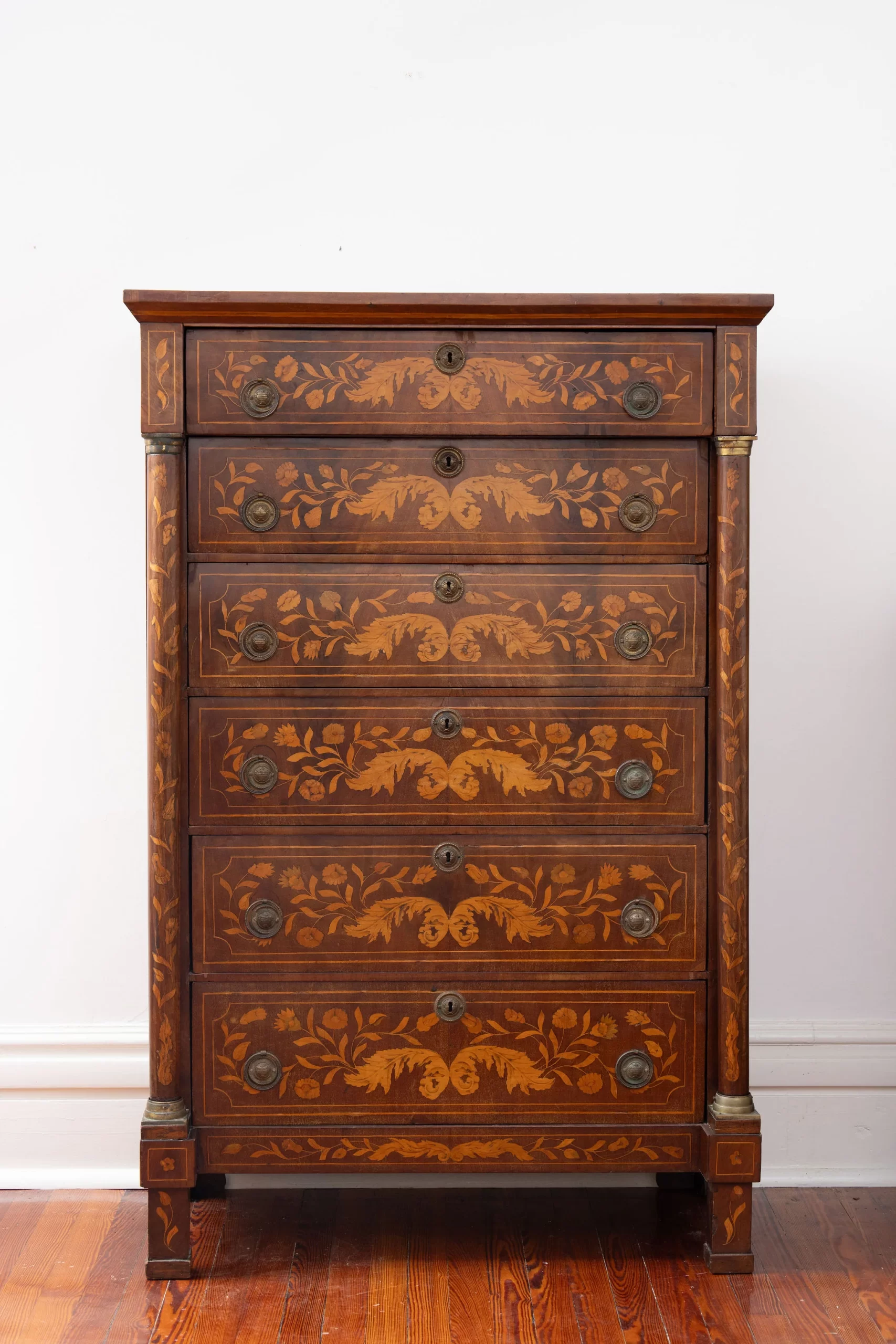
So I went to Vancouver, to the antique stores—nine of them in one long, footsore day. I passed through smells — varnish, old paper, pipe smoke that had soaked into wood decades ago. At the ninth shop, I found it: a chest of drawers, the kind they call a tallboy. Mahogany, late 17th century. Dutch in origin, but naturalized into English elegance during the William and Mary period. Two pieces stacked, the smaller atop the larger. Drawers like stages waiting for their props.
I bought it.
The delivery came on Saturday. The men carried it in without ceremony, though I felt a ceremony should have been performed — some low chanting, perhaps, or a libation poured at its feet. They set it against the wall, and when they left, the room felt different. The geometry of it pleased me. I sat on my bed and just stared. The wood had a deep, open grain, like a landscape seen from far away.
Hours passed. I opened and closed each drawer, listening to the small wooden sigh they made. It was in the top drawer that I found the compartment — hidden at the back, a square no bigger than six inches. I pulled it open.
Inside was a lock of hair. Long, blondish-grey, fine as smoke. It smelled faintly of oak and some perfume I could not name — a scent that felt both warm and cold in the nose, like the air in a cathedral. Around the hair was a broken gold frame, the glass missing.
I thought it odd. I fetched my antique catalogues and read about the hairwork of earlier centuries: mourning jewelry, memorial keepsakes. Hair as a relic. Hair as proof of love or death. From the Middle Ages to the early twentieth century, people kept locks of hair from the dead, sometimes weaving them into brooches or setting them under glass for private worship.
I placed the hair on my desk. Put the drawers back. Filled the tallboy with my clothing.
That night, I dreamed of her.
At first, she was only a shape in the dream — pale and seated somewhere just beyond a doorway. Then she began to sharpen: a woman in a long dress, her hands folded in her lap, staring at nothing with the deep concentration of someone listening to something only they can hear.
I saw her in what I call the hanging hours — that thin, trembling space between staying and leaving, when the body is reluctant, but the spirit has already begun its departure.
Her hair was the hair I had found. I knew this without question; the way you see the ground beneath your feet is solid, even if you never look down. The lock on my desk was a piece of her, and she was a piece of me now.
It is difficult to explain how quickly obsession can settle into the bones.
In the day, I thought of her. At night, I dreamed of her. I imagined her sitting by my window, looking out at the street as though the view were some private ocean. I imagined her voice — low, careful, as though she feared waking something that slept nearby. I gave her a name without meaning to: Elara.
I began to read about women of the late 1600s, about mourning customs, about illnesses that thinned the body but left the eyes startlingly bright. I imagined her ancestors. I imagined her death.
And then I imagined her not dead at all.
One night, I woke to a sound — drawers opening in the tallboy. Not abruptly, but in the slow, deliberate way of someone who knows exactly which drawer they want.
The room was dim, the spring moon hanging low. She was there.
Not a ghost in the white-sheet sense, but a presence made of stillness. She stood before the tallboy, her back to me, her hair falling long down her shoulders. She opened the top drawer, slid it out, and reached into the hidden compartment. She touched the air where the hair had been.
I wanted to speak, but found my throat closed. She turned her head slightly, enough for me to see the profile — a pale cheek, the line of her jaw — and then she was gone.
After that, the tallboy became a kind of shrine. I stopped using it for clothes. Each drawer was emptied, left bare. I placed the lock of hair back in its compartment, as though it belonged there and I had been wrong to move it.
Days blurred. I stopped going out. I kept the curtains open in case she came, so she would know I was waiting.
She did come.
Sometimes she sat by the window. Sometimes she lay on the bed, her body light enough to crease the quilt barely. Often she stood, looking at the tallboy as though it were a doorway.
I began to feel her ancestors.
They came in the edges of vision: a man with a face like carved wood, a woman with eyes that caught light and held it too long, children who moved on quick feet but never made a sound. They did not speak to me. They seemed to talk to her, though their mouths did not move.
The air in the room grew heavy with them. I would wake and feel as though I had been sleeping in a cellar.
Her hair — the lock in the compartment — began to change. It grew softer, warmer to the touch. Once, I thought I felt a pulse in it.
She was not dying politely.
She clung to the mortal coil as though it were the last rung of a ladder above a deep drop. There was a ferocity in her, a refusal to let go. I could see it in the way she held her hands, the way her shoulders set like stone.
I wanted to help her hold on. I wanted, absurdly, to give her my own life if it meant she could stay.
One evening, the moor-coloured sky pressed against the windows, and she sat by the tallboy and looked at me.
“You found me,” she said.
The voice was exactly as I had imagined — low, careful.
“I’ve been here a long time,” she said. “Too long. The hair keeps me. The hair remembers the body. The body remembers the room.”
I told her I wanted her to stay.
She smiled, but it was the kind of smile that comes when someone hears a song they once loved but now only half-remember.
The ghosts came more often after that. They filled the room like smoke. I began to lose track of which hours were mine and which were theirs.
She sat in the hanging hours, day after day, watching something I could not see.
One night, she reached for my hand. Hers was cool, but steady.
“You’ll keep it safe,” she said.
I nodded.
She let go, stood, opened the hidden compartment, and touched the lock of hair one last time.
Then she walked through the tallboy.
Not around it — through it, as though the drawers were air.
I have not seen her since.
The hair is still there. I keep it in the compartment. I open it sometimes in the thin light of spring and smell the oak and perfume.
I know she is somewhere.
I know, in the hanging hours, she will return.
Until then, I watch the tallboy and wait.


