


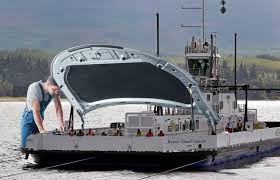


In the spirit of keeping our communities informed of my lobbying efforts for B.C. Ferries’ governance reform, I have been corresponding with the Federal Transportation Standing Committee reviewing the corporation’s $lB loan for Chinese-built vessels. This committee is timely, as it offers an opportunity to expose the B.C. government’s refusal to make B.C. Ferries accountable or introduce legislation that would strengthen governance to avoid the corporation’s failures. I asked that the loan for the Chinese-built vessels be conditioned with strong governance, as recommended in the l999 Fast Ferries audit, or taxpayers are likely to absorb the debt when the corporation defaults and the Chinese vessels are likely to suffer the same failure fate of their recent predecessors. I mentioned, of course, that the B.C. Ombudsperson has agreed to launch an investigation, but it could take years. The committee facilitator wrote a “Dear Sharon” response, saying he translated and sent my appeal to the Committee. Well, I have heard this before from the B.C. Minister of Transportation and the Commissioner’s office! However, it is also timely that the corporation’s 2024-25 performance report was recently posted that addresses the corporation’s current financial “vessel resilience” and financial crises. Therefore, I sent a followup letter to the committee, asking them to review the corporation’s proposal to form a “sustainable partnership” for funding from all levels of government to avoid a tax hike “well in excess of 35%–within the same governance vacuum. I also sent the following email exchange with MLA Josie Osborne, who appeared to interpret my appeal for an audit of government records of how the corporation spends tax dollars as an appeal to audit the corporation, as proof that the corporation continues to be accountable to no one, with NDP support:
December 5
Dear MLA Osborne:
This follows up your November 12 email claiming that because B.C. Ferries was created as a corporation following the 1999 Fast Ferries scandal, an audit of the government’s oversight failure cannot again be conducted. I am not alone in arguing that B.C. Ferries is not an “independent” corporation, but one totally dependent on ever-increasing, massive government subsidies to stay afloat. By operating in the red, deploying failing vessels needing millions in avoidable repairs, and projecting a 30% fare increase by 2028, B.C. Ferries will likely pass the $1B loan debt for Chinese-built vessels onto taxpayers and continue to drain the public purse with impunity.
The facts are grim: B.C. Ferries wasted $1B of taxpayer money in the 1990s. The 2001 Wright Review attributed this waste to a “baroque” oversight system in which no one was responsible, and accounted for the corporation’s incompetence. Regrettably, that same ineffective oversight system remains intact today.
Instead of correcting the failures of his predecessor—who was replaced due to incompetence—the current leadership is free to perpetuate them. The failed Baynes Sound cable ferry experiment, which has the highest breakdown rate in the fleet, remains in profoundly unreliable service due to “budget reasons.” (Due to an unresolvable design failure, it is currently replaced by the Quinsum.) The new island electric hybrids provide such unreliable service that they are being replaced or rerouted. This pattern of deploying unreliable vessels raises a critical question: Given the corporation’s history, what assurance is there that the Chinese vessels will not also fail? Premier Eby’s announcement that he will not intervene in the Chinese vessel purchase signals that the corporation will likely pass the $1B debt onto taxpayers and continue to drain the public purse–with impunity. This is an untenable impasse.
I am, therefore, appealing to you on behalf of Denman and Hornby islanders to call for reintroducing tabled Bill 7 that provides the government with oversight power by amending the Coastal Ferry Act, and to call for considering the creation of a fully independent and accountable board, as recommended in the Wright Review. The Canadian Federation of Taxpayers demands that B.C. Ferries get off the “gravy boat”; the Conservatives and Greens call for returning the corporation to the Crown. The NDP, however, remains oblivious to the cost of keeping the status quo—both to ferry-dependent communities and to taxpayers. The hundreds of millions, and perhaps billions saved could be allocated to mitigating current crises in health care, affordable housing, and education, or to purchasing new vessels.
Respectfully,
Sharon Small,
Denman Island.
Nov 12, 2025
Dear Sharon,
Thank you for following up on your email requesting an audit of the Baynes Sound Connector, as MLA Osborne’s constituency advisor I am pleased to respond.
My apologies for the delay in responding to your email, as we were awaiting information from both the Ministry of Transportation and Transit and the Attorney General’s office. We have now received information from both Ministries and I am happy to share this information with you.
The Province contracts BC Ferries to deliver coastal ferry services under the Coastal Ferry Act (2003). BC Ferries operates as an independent company overseen by the BC Ferry Authority and regulated by the BC Ferries Commissioner, who ensures both entities fulfill their obligations under the Act and the service contract. The Province does not oversee BC Ferries’ daily operations, these operations are managed by its Board of Directors.
What we have found out from our inquiry with the Attorney General’s office, is that as an independent company, BC Ferries is not subject to audit by the Office of the Auditor General (OAG) under the Auditor General Act. However, as a publicly traded company, BC Ferries must file and disclose financial information—including annual reports, financial statements, and executive compensation—through SEDAR+ (the System for Electronic Document Analysis and Retrieval), in accordance with Canadian securities regulations. Most reports can also be found on the BC Ferry Commission website here: Compliance Reports – Office of the BC Ferries
Commissione europea – Rappresentanza in Italia
The Ministry of Transportation and Transit receives regular audit requests from the Office of the Comptroller General (3CMB) under the Ministry of Finance as part of routine monthly desk audits of Ministry expenditures, including payments related to coastal ferry services. In addition, the OAG conducts an annual audit of the Ministry’s financial statements and contractual obligations, these audits include reviews of the annual payment schedule to BC Ferries and examine contractual rights, including obligations under the Coastal Ferry Act (2003) and the Coastal Ferry Service Contract.
The audit requests from 3CMB and annual audits by OAG do not include regular operational details of private contracted companies, such as BC Ferries. While the OAG previously reviewed BC Ferries’ operations before the Company was established as a private corporation (e.g., the 1999 Fast Ferry Project audit), routine operational oversight of the Company is conducted by the BC Ferry Commissioner under the Coastal Ferry Act.
The Ministry suggested that you may want to review BC Ferries’ publicly available financial information and to participate in public engagement opportunities with BC Ferries and provide feedback, either virtually or in person, when these opportunities arise.
I understand this is not the response you were hoping for, but I do hope this information is helpful.
Sincerely,
Andrea McDonald | Constituency Advisor
office of Josie Osborne, ML


